


BRUNSWICK COUNTY — A development agreement set to bring 12,499 homes near Winnabow has been withdrawn following a public hearing held Monday evening in Brunswick County. However, the developers assured they will not scrap the plans. Instead, Strategic Real Estate Partners will pursue the planned development process, which would go before the planning board. A development agreement skips the planning board, who has permitting authority in Brunswick County, and goes to the commissioners instead.
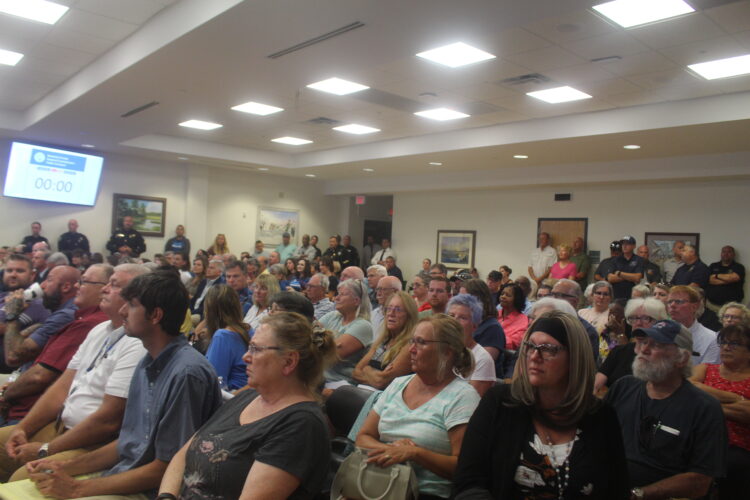
More than 50 people packed the commissioners chambers on Monday, June 15, as the Brunswick County board held a public hearing following the presentation of the Maco Road Development Agreement. The project takes up 4,362 acres and besides the thousands of residential homes, it contains two commercial districts on 90 acres, to consist of retail, a grocery store and possible urgent care. The development also accounts for several land donations to the county, totaling more than 200 acres, to build three schools on a single campus, two EMS stations, one fire station, a 50-acre county park, a satellite sheriff’s office and a water tower.
Eight people spoke in opposition to the development; no one approached the podium in favor. Most concerns regarded overdevelopment, traffic impacts, flooding, water and infrastructure capacity, including sewer and medical.
READ MORE: 13K-home development agreement sparks concerns from residents, commissioner
ALSO: Brunswick County hits sewer capacity snag under new state law, freezes permits
CATCH UP: 12,500-home community proposed for Brunswick County
“The Maco Road project is larger than all but two towns in Brunswick County,” resident Holly Long said. “I won’t be around when this monstrosity is completed, but my children will still be paying for the consequences if this agreement is approved.”
Commissioner Pat Sykes agreed: “I just can’t support something this large. I can’t.”
The developer initiated an agreement with the county in order to secure vested rights for up to 35 years and for a minimum of 20 years (developments normally are given three years of vested rights to complete the development) and to ensure they would be able to complete the project even if the unified development ordinance changes. Developers noted the large scope of the project and commented it would be built slowly over time. The development, planned to be completed in five phases, would be grandfathered in and not affected by any incoming UDO updates; the county is currently undergoing a UDO modernization project. A development agreement also does not require the developer to host a community meeting, complete a traffic impact analysis prior to a public hearing or be approved by the planning board.
The project is being brought forth from Atlanta-based Strategic Real Estate Partners but was represented by Richard Collier, regional manager of McKim & Creed and 2026 New Hanover County commissioner candidate, as well as the applicant’s lawyer, Amy Schaefer of Lee Kaess (Sen. Michael Lee’s firm). While Strategic Real Estate Partners has never developed residential or low-intensity commercial real estate, McKim & Creed is well-known, having done projects like Riverlights and Seahawk Village at the University of North Carolina at Wilmington.
During deputy planning director Marc Pages’ presentation, he listed at least 15 line-item issues the developers needed to address and noted county staff recommended denying the agreement.
The first reason, Pages explained, was the developer’s refusal of staff’s request to pave the remaining 3.3 miles between the development’s entrance on Town Creek Road to the Columbus County line. Staff wanted to ensure additional evacuation routes would be available to the large community, due to the population boom.
Brunswick County is the fastest growing county in North Carolina and has seen its population swell by 24% between 2020 and 2024. In correlation with the population boom, the area has seen large developments approved already, including the roughly 1,000-unit Cherrytree Tract in Winnabow, a little over 3 miles away from the proposed project.
Other reasons for denial, according to Pages, are:
- County park being in a flood zone which could present safety issues
- Inclusion of indoor garage parking to count toward minimum parking standards
- Lack of workforce housing
- No FEMA-approved flood study despite TRC recommendation
- No written proof or documentation of legal access to use private streets like Patrick Drive and Beasley Road for an ingress and egress; this can be gained through an easement with designated owners, typically homeowners associations
- No 20-foot buffer around jurisdictional or protected wetlands, which is not required by the UDO
- No delineation of a historic cemetery in the area next to Turkey Branch, which is required as it shows up on county GIS data and is meant to be preserved
- Commercial district being too far from the residential homes, making it incongruent with walkability, a county preference but not requirement
- Some tax parcel identification issues and required modifications to the agreement language itself
Commissioner Randy Thompson expressed confusion as to why a public hearing was scheduled if staff identified so many issues.
“I’m amazed,” he said. “I’m absolutely amazed.”
Though staff didn’t respond, Schaefer and Collier informed commissioners the developers wanted to pursue a public hearing to receive feedback from both the board and the public, which they would then use to make changes. Schaefer said they weren’t interested in a vote for or against the agreement on Monday, but rather a continuance.
The development agreement has been in discussion since December 2025; the project received comments from the county’s technical review committee twice before beginning the process. TRC lists issues and recommendations for the site plans:
- TRC identified several necessary permits the developer needs prior to buildout and approval, including stormwater, fire development, sedimentation and erosion control, among others.
- Buildout has been planned on jurisdictional wetlands; no delineation has been conducted by the U.S. Army Corps of Engineers to identify non-jurisdictional wetlands since the EPA v. Sackett decision that decreased wetland protection in 2023. The developers are still working with USACE to build on over 800 current wetland acreage.
- Paving Town Creek Road until the Columbus County line in order to address traffic impacts. Staff suggested it would improve interconnectivity and establish an additional evacuation route to prevent inundation.
At the public hearing, Schaefer explained the developers hoped to work more closely with the county and said a developer agreement allowed for collaboration more so than a planned development would, especially considering the project’s scope is allowed by-right. For example, despite a limit of 2.9 dwelling units per acre in the Residential Rural zoning, the developer has allotted 2.87 per acre, and open space, inclusive of wetlands, is about double the required amount.
Some of the acreage also falls in Commercial Low-Density zoning, allowing low intensity retail, office, and service uses, like medical facilities and the like and permits 13.6 dwellings per unit, which the developers are below. Neighborhood Commercial, another zoning district of the acreage, accepts low-intensity retail and personal services, like a salon, and allows a density of 5.8 dwelling units per acre, which they are under.
Schaefer also said some of the comments from staff were new, only delivered to their team about a week before the hearing.
Collier took the mic in hopes of combatting what he dubbed “misinformation” about their efforts to preserve the land and serve the community.
“I wanted to go over a little bit of history and go over things that happened because it’s being presented as we haven’t done jack and that is just not the case,” he said.
Collier explained the developers bought the land in August 2025 and executed several studies such as a threatened and endangered species survey, which identified no endangered species on the land. They also conducted a flood study, though it has yet to be approved or reviewed by the county. Collier also pointed to discussions with the U.S. Army Corps of Engineers over conducting wetland delineation on the property.
Collier said the team was working on a completed traffic impact analysis and provided preliminary numbers of the project eventually bringing 100,000 trips along Maco Road over the course of a day.
Public hearing
Mike Bowers, who lives about 10 miles from the development, called it a “behemoth” of a project and said he wouldn’t address the concerns he knew other people in the room were going to bring up. His main issue came in the placement of the schools in the north end of the site plan. Bowers explained hunting grounds abut the campus property, with a hunting club and gun range, and thought consistent gunshots could send the schools into lockdown.
A student support specialist in the county, Melissa Papp-Shelton, thought gunshots would lead to classroom disruption — potentially even be traumatic for students.
“We live in a very scary world,” she said.
Papp-Shelton also brought up the dangers on the two-lane Maco Road, already frequently traveled and known for trucks carrying large loads that often run smaller vehicles off the road. She added any turns made onto Maco Road are usually precarious at intersections because of the narrowness.
Later on in the meeting, Commissioner Marty Cooke said the road was originally built for “farm to market” deliveries and not to withstand thousands of vehicles.
“There are so many things wrong about this project, but my 3 minutes aren’t enough time to name them all,” resident Long said.
She listed issues in quick succession, mostly about the county’s infrastructure not keeping up, with roads “maxed out” and developments approved despite thousands of homes still available for sale.
Long also pointed out the county’s sewer system was at capacity; since February the county’s sewer system grew to 115% capacity, over the 110% limit, which means the county had to cease sewer extension permit approvals per Department of Environmental Quality statute. However, commissioners noted this was different from ceasing development or building permits, which would only be allowed in a moratorium. Thompson suggested a moratorium would come at the state level, noting state leaders would recognize that if any county needed a pause on developments, it was Brunswick County.
Last year, Thompson asked staff to research whether the county could enact a development moratorium. They responded, under general statute, the county can only impose a development freeze if faced with an imminent and substantial threat.
At the meeting, Thompson implied Brunswick County has already reached that level of considerable threat.
Commissioner Thompson cautioned Collier and Schaefer: “[A moratorium] is not gonna happen this meeting, and it doesn’t happen the next meeting. Guarantee you, six months from now, we’re going to be in a moratorium.”
Nancy Merrill-Dzidul and her husband, Edward, called the community meeting held by the developers in May “poorly planned” with her husband calling it “a farce.” The developer is not required to host the meeting but Schaefer said they did so anyway to get community feedback and introduce themselves locally.
However, she noted no emails came in after the fact, despite them encouraging residents to reach out at the May meeting. Schaefer added it was the reason they wanted the public hearing Monday.
“There was a kind of show-and-tell for us,” Merrill-Dzidul told commissioners. “With pictures set up on easels and people that couldn’t answer questions manning those stations.”
She noted community members had questions about the development and current happenings on the property, like alleged digging into the wetlands and soil prior to permitting, that couldn’t be answered.
Maureen Johndro, Jennifer Gates and Nicole Feldman spoke of similar concerns as their predecessors at the lectern, but also addressed properties being built over and close to wetlands and historical sites.
The site plans list more than 600 acres of the property consisting of wetlands, with parts in 100-year floodplains, though the county has identified more than 800 acres, which has been included in the development’s open space, and residents more than 1,000 based on alleged former site plans. While some wetlands are non-jurisdictional, or not federally protected, others require a survey by the U.S. Army Corps of Engineers to either clear the developers or delineate protected lands. The developers are currently coordinating with the USACE to schedule the survey.
Some of the land to be donated to the county, such as for a proposed park, is considered to be in a hazardous flood zone.
“When you redirect water, it blows onto other ramps, and across roads,” Johndro said. “Nature will take it back. Leland needs the wetlands for a reason.”
Gates thought the development agreement process lacked benefits for the residents and county and pointed out even if land was being donated to the county, taxpayers would still have to cover the costs of building schools, emergency services and the park. In her view, there wasn’t actually a benefit to the county or community that wouldn’t come with an even higher price tag.
“We are told they’ll be donating land,” Gates said. “The land does not respond to emergencies. The land does not drive those fire trucks, staff those ambulances, or patrol the neighborhoods. Land does not purchase equipment, pay salaries. Land does not recruit 500 EMS, paramedics, deputy staff, and dispatchers.”
Commissioner feedback
Overall, the board of commissioners vehemently opposed the developer agreement, with some citing a public hearing being requested despite unaddressed concerns from TRC and staff. Many considered the area too precarious due to the swampland and the narrow roads surrounding the property. All commented on the sheer size of the project giving them pause.
Commissioner Sykes asked county staff to take a look at how many approved developments, yet to be built, will have sewer extensions. She worried utilities have catch up with needs in the county. Sykes explained there are more than 59,000 units set to be developed based on prior approvals and only 18,000 have been built, meaning the county hasn’t even seen the impact of all the residential projects being brought in.
Further, she pointed out the homes were single-family and to be constructed close together. The homes have a buffer of a minimum of 10-feet between each other.
“We’re gonna have a major fire and these houses are gonna go,” Sykes said. “They’re just too close together and that’s gonna be devastating.”
Vice Chairman Cooke addressed the wetlands in question and called them swamplands, not feasible for this development. He acknowledged this was a new opinion for him to take, as he is typically in favor of more development.
“Quite honestly, you can table it, you can discuss everything else, but the door is closed, the store is shut down, the lights are off. And we’re not interested in doing this,” Cooke said, “unequivocally.”
Thompson said the developer prompted a “rare occurrence” by getting him to agree with Cooke.
Commissioner Frank Williams and Chair Mike Forte also were against the proposal. Williams called the traffic impacts an “insurmountable problem” and added the development would change the character of the area in a way he didn’t think they were ready for.
“It’s just too much, too big, too fast for me,” Williams said.
Forte did not think the construction design made sense, given the placement of the schools. He also did not think the sheer volume of the project matched the county’s needs and capacity.
Like everyone else, he added the resources needed to make the development possible just weren’t there. Winnabow has one fire station and is already prone to flooding. As previously noted, water and sewer are both at or reaching capacity.
Schaefer explained the team would be bringing the proposal back to the county eventually.
“It doesn’t mean there’s no development agreement. Doesn’t mean we can’t come back tomorrow with another development agreement. It doesn’t mean that the PD that was submitted last year is not still going through the process,” she said. “It just means that this version doesn’t work.”
Schaefer withdrew the agreement, issued after pausing the planned development submitted spring 2025. However, an alternative PD route would require certain studies and prerequisites that the development agreement doesn’t necessitate, namely a traffic impact analysis. The PD would bring the development in front of the planning board rather than the commissioners.
Collier explained to Port City Daily his team will need to “regroup” before finalizing next steps and making changes.
Tips or comments? Email Emily Sawaked at [email protected]
At Port City Daily, we aim to keep locals informed on top-of-mind news facing the tri-county region. To support our work and help us reach more people in 2026, please, consider helping one of two ways: Subscribe here or make a one-time contribution here.
We appreciate your ongoing support.
