


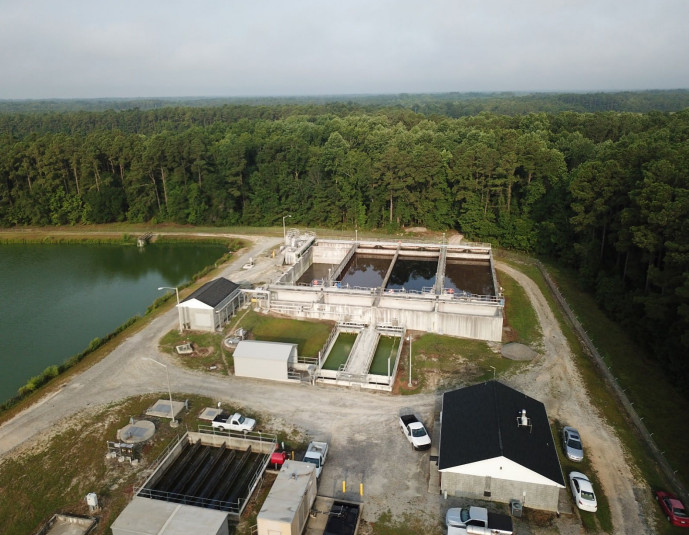
BRUNSWICK COUNTY — Residential and commercial projects requiring new sewer line extensions in Brunswick County are effectively stalled as state regulators apply a new wastewater capacity calculation, counting future development flow as already in the system.
Since November, Brunswick County has requested the state freeze several new sewer extension permits to avoid automatic rejections under a restrictive new law. Brunswick’s sewage treatment plants are currently operating with capacity to spare, though 2023’s Senate Bill 673 requires the North Carolina Department of Environmental Quality to count allocated flow — every gallon promised to a future home — as if it were already in the pipes.
The shift has pushed the county beyond its 110% legal threshold, stalling eight major projects in the northern end of the county and making Brunswick the first jurisdiction in North Carolina subject to the new enforcement standard.
READ MORE: Brunswick County ranks #1 in relocation, as developments surge
ALSO: Brunswick adopts 100-year storm standard to curb flooding from future developments
County Manager Steve Stone told commissioners last month that the county is being singled out because it has more growth than any other county in North Carolina. County staff learned of the issue roughly three months ago when the NCDEQ Wilmington Regional office told the county they would not approve any sewer line extension permits until receiving more data confirming active flow and potential flow of every home and business connected to the system.
“The yardstick that we’ve been working under, we really fare favorably,” Stone said at the January commissioners’ meeting. “It’s the fact that there’s a new yardstick that’s the issue.”
The new state rule requires the county to count future waste as if it were already in the system. Adding unbuilt homes in the calculation pushed the county’s capacity above legal limits.
Although passed in 2023, S.B. 673 is only being enforced now because the state had to complete a formal rulemaking process to translate the legislation into technical requirements. Those rules were finalized in late 2025. To protect applying developers, the county requested NCDEQ place several sewer applications on hold. This prevents a formal denial from the state, which would force developers to forfeit application fees reaching upward of $1,500 per project.
“There are a lot of people and businesses that have invested millions and millions of dollars in projects,” Chair Mike Forte said at last month’s commissioner meeting. He likened the change to “the 2-minute warning in the fourth quarter” of a football game where the entire rule book has been swapped out.
For decades, North Carolina wastewater systems have operated under the state’s standard 80/90 rule. The regulation was based on the actual flow of wastewater travelling into treatment plants and intended to force municipalities to expand treatment plant capacity before they ran out of space. When a plant reached 80% of its physical capacity, the county had to begin planning an expansion; at 90%, it had to have expansion permits in hand.
The county’s two primary wastewater systems remain within their physical limits and compliant to the 80/90 rule. The Northeast Brunswick Regional plant is operating at roughly 60% capacity, while the West Brunswick Regional plant tracks at 80%.
Under the previous 80/90 standard based on active flow, Brunswick’s current operating levels would have kept the plants in compliance, allowing officials to plan expansions while retaining sufficient capacity for additional hookups.
The county is managing five large-scale expansions designed to increase plant capacity. It includes:
- West Brunswick Regional Water Reclamation Facility increasing by 6 million gallons per day (MGD) for a total of 12 MGD at full build-out
- Northeast Brunswick Regional facility will increase capacity by 3.75 MGD to reach 8.725 MGD
- Shallotte/Mulberry Branch Wastewater Treatment plant will scale up by 1.5 MGD for 2.75 MGD total
- Mulberry Branch facility will accept 0.75 MGD of sewage flow from Southport into the West Brunswick Regional system
- Ocean Isle Beach Wastewater Treatment Plant will add 2 MGD for a total of 3.05 MGD
Even though treatment plants are slated to grow, county officials are worried the rule change could result in added costs for taxpayers. As Stone explained, the county may be forced to expand plant capacity beyond what is already underway for permitted homes that haven’t yet been built. As the fastest-growing county in the state, Brunswick has roughly 48,000 homes approved over the last decade in its development pipeline.
Referencing the West Brunswick Regional expansion, Stone said the additional 6 million GPD would only bring the county down to 100% capacity, though the goal is to remain below 80%.
“We would probably need to expand by 9 million gallons or 12 million gallons, or some other number,” he explained to commissioners. “And in my mind, that would cause us to spend hundreds of millions of dollars of capital way before it was needed and who’s going to pay for that? The ratepayers, our current customers.”
System development fees — one-time charges paid by developers to offset the cost of new infrastructure required by their projects — cover 75% of plant expansion costs. The remaining 25% fall to customers through monthly utility bills.
Stone clarified the freeze is not a moratorium on development or sewer permit applications, but rather a roadblock. While the county is not legally barring construction, the state’s refusal to issue new sewer line permits effectively halts any project not already connected to the system.
Commissioner Pat Sykes questioned whether the sheer volume of approved projects would eventually overwhelm the system, regardless of how the state counts them.
“But don’t you think if all those houses, those projects that have been approved were built, we would be in a mess anyway?” Sykes asked.
Stone countered the 48,000 new builds will be constructed over “a period of decades, not the next three years.” He argued the system should be expanded based on when people actually start using the service, rather than when a developer first draws a line on a map.
To break the logjam, the county has begun providing the state with flow data from the last three years to prove that modern, water-efficient homes use less than the state’s default estimates. Current state rules assume a standard home uses 120 GPD per bedroom, but according to Stone Brunswick’s newest homes are averaging closer to 60 or 70 GPD.
Stone reported to commissioners for an update on Feb. 16, stating the county has established a “path forward” for the eight stalled permits in the Northeast system. County staff and the developer’s engineers must complete a state form for each project to be processed for approval. It provides the connection information and accurate accumulated flow the state now requires to verify the system actually has enough room to handle new connections.
However, Stone said the West Brunswick system remains “much more complicated” because it serves multiple regional partners, including Oak Island, Holden Beach, Ocean Isle Beach, and Shallotte. He noted the West system involves “many, many, more permits” spread across various treatment plants. To clear the West Brunswick system, utility staff must gather the same detailed data for every single line extension permit issued across all the partner municipalities.
The timeline for a full resolution remains uncertain. Stone told commissioners he could not yet predict how long it will take for permits to move through the West Brunswick system and reach approval.
“We’re moving not at a pace I would like to move, honestly,” Stone said. “At 69, I still haven’t learned how to push a rope uphill.”
Have tips or suggestions for Charlie Fossen? Email [email protected]
At Port City Daily, we aim to keep locals informed on top-of-mind news facing the tri-county region. To support our work and help us reach more people in 2026, please, consider helping one of two ways: Subscribe here or make a one-time contribution here.
We appreciate your ongoing support.
