


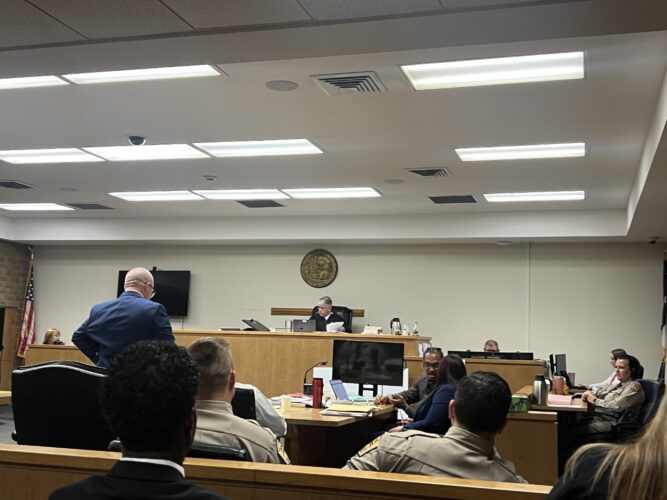
WILMINGTON — The Tru Colors double homicide trial will officially be handed over to the jury on Wednesday to decide whether Omonte Bell and Dyrell Green are guilty of first degree murder.
The Tru Colors trial has been ongoing for the last several weeks; Bell and Green each face two counts of first-degree murder for the deaths of Koredreese Tyson and Bri-yanna Williams and one count of attempted first-degree murder for M’Kaila Walker. They are also charged with one count of conspiracy to commit first-degree murder for Tyson’s death.
A third defendant, Raquel Adams, was found guilty in a separate trial last year. Bell, Adams and Green are all part of the United Blood Nation, who are rivals with the Gangster Disciples, which Tyson was the leading member of in the state.
Though Bell and Green are being tried together — despite several attempts from the defense to sever their cases — the jury must assess the charges in relation to each individual. Therefore, a different verdict could be rendered to Bell and Green.
A first-degree murder conviction carries a mandatory sentence of life imprisonment without possibility of parole, a fact Mathew Geoffrion, Green’s attorney, chose to focus on in the beginning of his nearly two-hour closing statement.
“That means if found guilty of first degree murder, Mr. Green will go to prison, and he will never leave there as a live man again,” Geoffrion said.
Based on closing arguments made Monday and Tuesday, the prosecution is hoping the jury will be able to parse together the heaps of phone data at the center of their case against the two defendants.
Attorney Doug Carriker urged the jury to use “common sense” — alluding to a phrase used jury deliberation instructions — in their interpretation of the presented evidence: text messages suggesting Bell and Green were working in tandem, phone data suggesting the defendants were together on the night of the murder, a lack of phone activity spanning the time of the murder, despite lots of activity before and after, as well as photos of the black Volvo believed to have been driven to the murder scene.
“Your own ingenuity will lead you to be in the back room, to be in the jury room, to be deliberating, and say, ‘Let me play the contrarian, let me be a devil’s advocate, let me float this kind of far-fetched scenario, or just say, ‘for the sake of argument’ — going that way lies no resolution,” Carriker said.
Geoffrion and Bell’s attorney, Meleaha Kimrey, are asking the jury to regard the state’s case as only a “theory” without physical evidence tying Bell and Green to the murder scene, 6708 Providence Road, or a murder weapon. They argued the state has not considered other explanations for Bell and Green’s physical and digital activity on the night of the murder, and are instead assuming an activity conducted that night was with murderous intent without real proof.
Geoffrion indicated the judicial system is not supposed to be about “vaguery [sic] that might mean something.”
The prosecution: ‘The heart of the trial’
Carriker began his two-an-a-half-hour closing statement Monday by showing pictures of Tyson and Williams’ bodies found at the murder scene, along with Walker in her hospital bed. The prosecution’s argument is Bell, Green and Adams targeted Tyson because of his prominent status in a rival gang.
“That is the white hot heart of the crime, but of course I need to make a distinction that is not the heart of the trial,” Carriker said, noting the center of the trial was the phone data the prosecution presented.
Carriker said the jury is instructed to use everyday reasoning skills in the case to reach a conclusion of if the state has proven Bell and Green are guilty beyond reasonable doubt. He provided the jury the definition of reasonable doubt as an “honest, substantial misgiving generated by the insufficiency of the proof” and noted it was not a “far-fetched scenario” that anyone can create.
The prosecutor then started piecing together the phone data in a linear narrative, claiming the murder plot began on July 20 when Green and Bell created contacts for each other; on July 21, Adams was released from prison, and Carriker noted he had been talking with Green and Bell before his release.
“He does not yet know the lay of the land,” Carriker said. “More prosaically, what’s something that he’s not going to have, having just gotten out of federal custody? He doesn’t have a set of wheels and doesn’t have transportation.”
Carriker pointed to Bell when he said transportation before pointing at Green and continuing: “And he doesn’t have up-to-date intel.”
Green’s relationship with Williams was a key point of information-gathering, Carriker noted, as Williams seemed to supply information to Green. He pointed to the text message Williams sent Green on July 18 with the 6708 Providence Road address.
Carriker said Williams, unwittingly, was a “willing participant in her own death”
“Had Bri-yanna Williams lived, she probably would have been charged as an accessory in this case,” Carriker said, noting that is hard to hear for her family and despite this, she didn’t deserve her fate.
Carriker also explained the investigators were confident in the projected path Bell, Green and Adams drove leading up to the murder. Their phone locations placed them on the road at almost the same time the black Volvo was caught on traffic cameras.
The prosecution theorized that Bell picked up Adams before the two of them drove to Fulton Avenue in Castle Hayne to pick up Green. They are then placed at a Circle K, Castle Hayne, before heading down Martin Luther King Jr. Boulevard and down Market Street. Law enforcement placed the Volvo at the Stevenson-Hendricks Honda Dealership before capturing an image of the vehicle by Gordon Road, a few miles away from the Providence Road home, which is the closest Bell and Green have been placed in relation to the scene of the crime.
Carriker said the reason Bell and Green were not tracked to 6708 Providence Road was because the phones were left at 1315 Castle Street, which also accounts for the lack of user-generated activity on the phones from 4:41 a.m. to 6:14 a.m. Carriker said the phones “came alive” at the same time, suggesting it was not a coincidence.
He also claimed there were suspicious text messages sent after the murder — one being Adams telling Bell to “tighten up” and Green to stop talking — along with the lack of calls to Williams, despite Green’s frequent communication with her beforehand. Bell also professed his apologies to Williams’ sister after the murder.
The prosecutor also wanted to dispel the notion that Bell and Green were “guilty by association” with Adams, who committed the murder on his own. For one, Carriker noted, bullet casings from the scene are from two different guns, suggesting there were two shooters, and camera footage from downtown Wilmington show Green and Adams together a few days after the murder.
“They are in lockstep,” Carriker said.
Geoffrion: Ignored circumstances
Geoffrion addressed the jury on Monday following Carriker’s presentation; from the outset, he stressed the case was not about the defendant’s likability, noting his client, Green, may not live a lifestyle the jurors would approve of. Nonetheless, he emphasized, Green’s membership in a gang doesn’t automatically make him guilty of murder.
“A conviction of the innocent doesn’t bring anyone back,” Geoffrion said. “In no way can an unjust verdict ever be justice, and that may sound like just word salad, but to say, ‘God, I really, really want to help these guys, I really feel bad, gosh, I really don’t know, seems like maybe’ — none of those things are enough.”
Geoffrion used his time to attack the state’s case, making note that as defense counsel he didn’t have to provide an alternative answer to who killed Tyson and Williams nor explain exactly what Green was doing that night because the burden of proof lies with the state. If the prosecution’s story doesn’t add up, Geoffrion said, it’s the jury’s job to see that.
Aside from failing to provide physical evidence connecting Bell and Green to the murder, Geoffrion said the prosecution did not rule out other explanations for the phone data aside from concluding Bell and Green were guilty of murder.
Geoffrion homed in on a 20-second video from Walker’s phone showing her arguing with Green outside a Taco Bell, where she and Williams were working the night of July 23, around four hours before the murder. Geoffrion said the state has blown the video “out of proportion” and claimed it doesn’t inherently show motive to kill anyone, the state only wants the jury to believe it does.
He also pointed to a text message from Adams in response to the address Williams sent to Green. Adams texted Green “that shit’s gated.”
“They are talking about a neighborhood that is in fact not gated,” Geoffrion said, referring to the Providence Road subdivision.
Geoffrion said the state could have shown the jury of the entrance to the neighborhood but chose not to because it didn’t support the prosecution’s narrative.
He then pointed to other areas the state chose not to explore, including Bell and Green’s phone habits outside of the few days surrounding the murder to demonstrate if their activity on July 24 was indeed odd. Geoffrion said the state did not show how often Green talked with Williams either.
Geoffrion also argued the prosecution wants jurors to ignore the possibility that Tyson and Williams were killed by one person with two guns, which would explain the two different casings found at the scene.
Additionally, Geoffrion argued the state didn’t explore the possibility that Adams was colluding to kill with other people aside from Bell and Green.
“When have they shown these variations to their theory are not possible?” Geoffrion said.
Geoffrion went on about the state not calling any of Bell, Green and Adams’ associates to the stand or attempting to interview them for information. And in one of the largest oversights, Geoffrion intimated, the state did not interview the one person whose fingerprints were matched from samples taken at the murder scene — Tyron Newkirk.
“The state didn’t have the time to interview a person whose fingerprints were found in the laundry area, which is right near where the body was found,” Geoffrion said.
The defense attorney then harped on Green’s two phones and deleted messages — one of which was factory reset. The prosecution has argued this is suggestive of Green having something to hide.
Geoffrion noted it would not be outrageous for a gang member to delete text messages in relation to any criminal activity, such as drug dealing or robbery. He also noted the phone that was factory reset was an iPhone 11 and suggested the phone could have been factory reset because it was sold. The previous owner or Green could have reset the phone for this purpose. Geoffrion pointed out Green’s other phone was an iPhone 8, an older model that Green’s text messages indicate was damaged.
Geoffrion also said the factory reset phone was not the one being used by Green on July 24.
“That’s the muddiness that the state wants you to buy,” Geoffrion said.
Geoffrion wrapped up his remarks speaking to reasonable doubt.
“A reasonable doubt can be reasonable and not all that probable, and that’s particularly important when we’re talking about things like life sentences,” Geoffrion said. “It can be about the risk of ignoring a reasonable doubt and the huge downside of ignoring a reasonable doubt.”
Kimrey: More likely suspects
During her closing statement, Bell’s attorney, Kimrey, claimed the prosecution’s evidence was incomplete and inconclusive. She concurred the prosecution dismissed other potential suspects, including Tyron Newkirk, Malachi Cooper, Eric Marshall and George Taylor III.
Kimrey leaned into reasonable doubt by bringing up Eric Marshall, a gang member who lived at the 6708 Providence Road house with Tyson when the murders happened; it’s unclear where Marshall was that night as he wasn’t home when the crimes occurred. She also brought up Tyron Newkirk, who lived at the Providence Road home before Tyson and more than six months before the murders. Newkirk’s fingerprints were found by the garage door and the bottom of the staircase, where Williams’ body was discovered.
“Who is Tyron Newkirk?” Kimrey asked. “Well, your guess is as good as mine and as good as law enforcement’s. Detective Boswell told you they really did nothing with that lead and there was just no time before trial.” In previous testimony, Boswell explained being unable to find him but dropped the search when they couldn’t find him, which Kimrey insinuated meant the investigation was rushed and neglectful.
However, Kimrey focused on the questioning, veracity and involvement of Taylor and Cooper. Taylor, she said, was written off almost immediately by law enforcement, including lead detective Jeremy Boswell, despite being present at the time of the murder.
Kimrey also reiterated to the jury Taylor did not call emergency services and, instead, reached out to both Marshall and Tyson. She suggested Taylor wasn’t as concerned or surprised as he explained being.
Tyson’s phone, Kimrey added, declined the incoming call, which she questioned how that was possible. Walker used the phone to call for emergency services, so it was likely not dead at the time of the murders. Kimrey suggested someone, like Walker, must’ve declined the call.
Kimrey suspected collusion in Tyson’s death and continued by implying Taylor’s involvement in the crime. She recounted a 9-millimeter unregistered gun was found under Taylor’s bathroom sink, which she said he “pled the Fifth” on. Immediately after, she commented on the peculiarity of the absence of guns in Tyson’s room, despite him having a “target on his back.” Kimrey suggested the gun belonged to Tyson but was hidden in Taylor’s bathroom.
Kimrey added it was another coincidence for Taylor’s doorbell camera subscription to change before Tyson was killed. While the subscription was active, footage consisted of live video, but a week before the crime, it was changed to capture a few images only. The prosecution used it to identify Bell’s Volvo, and Kimrey suggested the photo quality and sparsity of images meant the vehicle could have been anyone’s car.
Taylor was considered a suspect when law enforcement arrived that night and was handcuffed and put in the back of a police cruiser. Shortly thereafter, Taylor’s father, George Taylor, Jr., showed up and spoke to his son. Afterward, Kimrey deemed it suspicious that Taylor was never questioned outside of the presence of his father, indicating he was being given special treatment over Bell.
Kimrey claimed it wasn’t only Taylor who evoked suspicion. She noted Cooper, Walker’s half-brother, “coincidentally” called Walker just hours before the murder, which she told the jury was brushed off by law enforcement despite Cooper being in the same gang as Bell and Green. She also commented that Tyson was killed about three weeks after he and Walker started dating. Kimrey suggested the murder was instead planned by Cooper and Walker was an accessory to the crime.
“When asked on the stand about her brother, she became very dodgy,” Kimrey said of Walker. “She didn’t want to answer the questions, but she kind of had this little smirk.”
Kimrey poked holes into Walker’s testimony, questioning whether Walker was really woken up by a gunshot alone — on the stand, she claimed she only realized something was wrong when she felt pain in her arm from the bullet. Kimrey also suggested the jury question how she was unable to see either her phone or whether Tyson was in the room if she turned the lights on and called Walker’s recollection of the sequence of events “unlikely.”
Kimrey then noted Cooper took a Miami vacation a month after Tyson was killed though, which she suggested he earned for killing Tyson.
She also brought up the jail call between Arrion Williams-Dixon, Bri-yanna Williams’ older sister, and Bell from August 2022; Williams-Dixon said Bell admitted to being drunk the night before the murders. Kimrey questioned Bell’s sobriety and whether he was awake during the time of the crime, and encouraged the jury to question how Bell could have driven around Wilmington if he was “so drunk.”
She also pointed out to the jury the prosecution has been unable to place Green, Adams and Bell together that evening and morning and have no evidence suggesting a three-way call or a group chat to discuss the murder of Tyson. Contrary to the prosecution’s theory that Bell either left his phone at a different location or disconnected it from the internet prior to the murder, Kimrey said Bell was likely at home asleep.
“And they want you to believe that Omonte Bell and Dyrell Green were so crafty as to leave their phones behind while allowing Raquel Adams to take not one, but two, phones,” Kimrey said.
She closed her statement Tuesday morning by requesting the jury not give into the state’s “narrative,” which she suggested was targeted and inconsiderate of other possible suspects and evidence. Like Carriker, she also appealed to the jurors’ common sense.
“Do not replace your own common sense and good judgement with a narrative and theory and a story spun by the state,” Kimrey concluded.
At Port City Daily, we aim to keep locals informed on top-of-mind news facing the tri-county region. To support our work and help us reach more people in 2026, please, consider helping one of two ways: Subscribe here or make a one-time contribution here.
We appreciate your ongoing support.
