


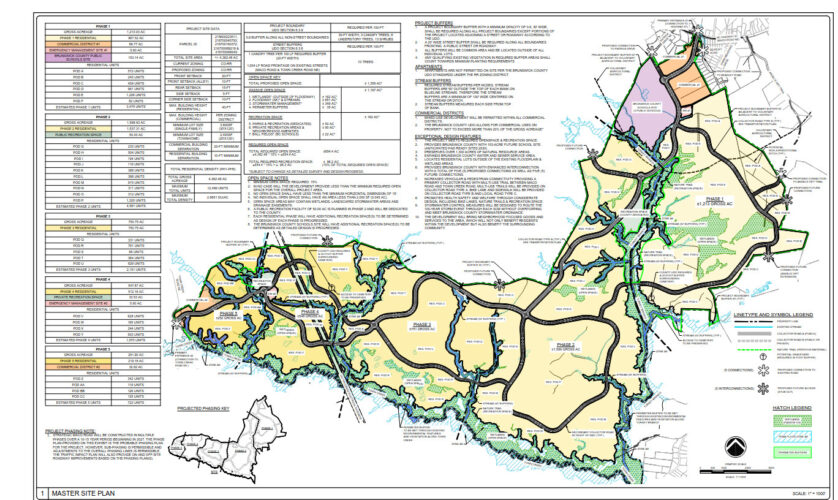
BRUNSWICK COUNTY — Residents will have an opportunity to provide feedback on almost 13,000 homes planned for Brunswick County at June 15’s commissioners meeting. The county and Strategic Real Estate Partners have drafted a development agreement and Monday will be the first time the commissioners have taken up the project since it was first proposed last fall.
The developer agreement is a contract between the developers and county, typically used for large-scale projects that are expected to take an extended period of time to complete. The Maco Road development is proposed by applicant SDP Brunswick LLC — from Strategic Real Estate Partners, based out of Atlanta — and is expected to be built out in five phases over the next three decades. Known for its industrial real estate as well as logistics and commerce centers, Strategic Real Estate Partners does not have mixed-use developments in the county.
The Brunswick County proposal consists of a 4,362-acre project, to include 12,499 residential homes on just under 4,000 acres, and two commercial districts that will take up 90 acres. Commercial will include retail, according to the developer agreement, but it doesn’t clarify what types of businesses are expected.
READ MORE: ‘Everybody does not have to move here’: Residents oppose 400 Shallotte homes, board approves
ALSO: Legislation to shift development authority in Brunswick County moves forward
CATCH UP: 12,500-home community proposed for Brunswick County
A developer’s agreement is beneficial for the county and developers for varied reasons. Developers receive master site plan design flexibility, consistency in development rules and regulations. The county benefits from diverse property use and housing types, insight into development plans, such as protection of natural resources and infrastructure improvements, an increase in the county’s tax base, and commitments to providing public services and amenities.
The Maco Road agreement stipulates the developers will donate 50 acres of land for the county to create a park. The county will need to consult the developers about the park’s design, name and build and cannot sell the land. The county park also will need to open within 20 years or the agreement becomes void and the acreage reverts back to the developer to count toward open space requirements.
The developers will also gift 11.5 acres for emergency services — to include two fire stations, two EMS bays, and a satellite sheriff’s office location. The county has to decide on the location of the public facilities within five years to keep the land.
Also, the developers are in talks with Brunswick County Schools to donate 153.14 acres for a K-12 school campus, to include an elementary, middle and high school.
Normally, the planning board signs off on projects that come for development approval in Brunswick County, but Maco Road is permitted to skip the step. The developer agreement stipulates planning board review is only required when land needs to be rezoned or if the project is a major subdivision or a planned development.
County spokesperson Meagan Kascsak explained the project does not fit in either: “Approval authority for Development Agreements rests solely with the Board of Commissioners.”
The agreement acts as a preliminary subdivision plat approval, which means the county staff and technical review committee reviewed and tentatively approved the developer’s plan for dividing the site. Normally, the developer would have to have a hearing and receive a vote from the planning board instead of from commissioners, though the document notes the planning board was involved in discussions.
The land mass consists of five parcels, currently zoned Residential Rural, Commercial Low-Density and Neighborhood Commercial. With any agreement in place, developers can build the project by-right, as the Residential Rural allows a maximum density of 2.9 dwelling units per acre; all the single-family homes built fall under, at 2.87 dwelling units per acre. Commercial Low-Density allows low intensity retail, office, and service uses, like medical facilities and the like and permits 13.6 dwellings per unit, which the developers are below. Neighborhood Commercial accepts low-intensity retail and personal services, like a salon, and allows a density of 5.8 dwelling units per acre, also above the proposed density.
According to the agreement documents, should the development be approved, the developers would have an initial 20 years of vested rights to complete the project — more than the three years allowed per the county’s unified development ordinance. The developers also have the ability to renew the agreement for an additional 15 years if construction is delayed at any point.
The contract would protect the development from future UDO or zoning changes made within the county; the developers would only be subject to new or amended state and federal statutes.
Notably, after approval, the developer will only need to return to the board if any major changes are made. These could include an increase in dwelling units or density, a change in land use, modifications to the boundary of the property or reduction in open space below the required minimum. Otherwise, county staff can sign off on minor alterations.
Pushback
The project has received criticism, particularly from nearby residents and at least one commissioner. Traffic impacts and safety, increased infrastructure expenses, higher property taxes and overdevelopment have been talking points.
Brunswick County commissioner Randy Thompson told Port City Daily he would not vote in favor of the development agreement.
“There needs to be considerable infrastructure put in place and guarantees that the infrastructure can support it prior to it having an opportunity even to be initially approved,” he said.
Thompson said he heard from local municipal leaders in his district about water being at capacity; most of the county is 80% in total use. Winnabow is not one of the municipalities under a water conservation alert put in place in Brunswick County June 9, but more than 15 localities and some unincorporated areas are.
Thompson noted the agreement was spearheaded by county staff, though officials informed Port City Daily the contract came as a request from the applicant.
Thompson said he wasn’t sure if the agreement was beneficial to the county.
“Up until this point, I have had to rely on the planning professionals to do the right thing,” Thompson said, “and now I’m beginning to question the planning professionals.”
He pointed to developments approved five years ago or more still not completed as population continues to grow — Brunswick County is the fastest-growing county in the state, increasing by 22% between 2020 and 2024. Thompson specifically mentioned Rice Creek development, located 8 miles from Maco Road, and approved in August 2021. It will consist of 3,400 units on 1,200 acres, but the commissioner said it was yet built out.
All the while resources have become strained. There is a freeze on sewer permits due to Senate Bill 673, which requires the North Carolina Department of Environmental Quality to count allocated flow — every gallon promised to a future home — as if it were already in the pipes. The shift has pushed the county beyond its 110% legal threshold, stalling projects and making Brunswick County the first jurisdiction in North Carolina subject to the new enforcement standard.
Port City Daily reached out to all commissioners about the Maco Road development agreement, and other than Thompson, only Pat Sykes responded. However, she had not look over June 15’s agenda or the development agreement to provide comment.
Winnabow resident Ray Combs worried about a property tax increase with more homes coming in.
“These people are not going to be able to afford where that developer’s going to drive their taxes to,” Combs said. “There’s single-wide trailers in there that look like they’re ready for the scrap heap that people are living in. That’s not gonna be good for those people.”
In order for the commercial development to be more beneficial to residents in the county, Combs said it needs medical facilities as well. There are two main hospitals in Brunswick County: Novant Health Brunswick Medical Center in Bolivia with 74 beds and Dosher Memorial Hospital in Southport with 89.
Novant Health Leland Medical Center was approved by town council in December 2025, and is set to bring 20 licensed care beds, a 24/7 emergency department with 10 observation beds and five procedure rooms.
The Novant Health Brunswick Medical Center is the closest hospital to Winnabow by 14 miles currently, but the Leland facility will be a little more than 10 miles away.
Schools also remain top-of-mind, due to many being at or near capacity. According to county data from the 2024-2025 school year, schools serving Winnabow include Town Creek Elementary, which is over capacity by 4%. South Brunswick High School is set to exceed 95% capacity by 2028 and Town Creek Middle School is currently over 80% capacity.
Brunswick County Schools is in talks with the developers to purchase land for new schools, though nothing has been finalized, including the price for buildout or the land purchase.
However, Combs worried schools planned for the site would be rapidly filled by the new residents and thus not benefit anyone living outside of the proposed neighborhoods. Both he and Christie Marek, who leads the Brunswick County Conservation Partnership, worried taxpayer dollars would be used for schools only serving the proposed development site.
Marek also was frustrated a traffic impact analysis was not completed ahead of time, noting there were “safety risk” roads and intersections, like Maco Road NE and Green Hill Road NE.
Brunswick County spokesperson Kascsak said the developer agreement allows for a TIA to be conducted after the public hearing.
Article 10 of Chapter 160D of the North Carolina General Statute does not specify when a traffic impact analysis study needs to be completed for developments. However, the developer is required to complete one before receiving building permits or the recordation of any lots of land is made, if daily trips exceed 1,000 vehicles or more than 100 trips are projected during peak hours.
According to previous Port City Daily reporting, the developers did a preliminary study to find out what traffic improvements were necessary for the neighborhoods; this includes a traffic circle and an 8-mile public road. However, Marek called this study a “natural disaster,” due to what she perceived as lack of thoroughness.
Wetlands concerns
Marek presented more environmental concerns, particularly regarding wetlands on the developable properties. She noted the first iteration of site plans, prior to the assessment from the technical review committee, listed wetland acreage at 1,524. The second site plan included in the development agreement notes the acreage is now 622.5.
The federal regulations protecting wetlands were recently reclassified, allowing development of jurisdictional wetlands, meaning areas without a “continuous surface connection” with other bodies of water — also known as “isolated wetlands.” Recently, the United States Army Corps of Engineers began changing the designation of wetlands to align with the law.
“These changes could reasonably account for differences in the reported wetland acreage. Brunswick County Planning staff have observed notable reductions in the number of jurisdictional wetlands identified in multiple projects following these federal regulatory changes, including this one,” Kascsak said.
Marek said she brought in a drone specialist, indicating developers used an excavator on the property near Turkey Branch in January.
The county could not confirm its use and the developers did not respond to Port City Daily, though Marek claims: “That’s where they have drained too. It used to be full of water.”
According to both Marek and Combs, when questioned about the site activity at a community meeting held on May 19 in Town Creek Elementary, the developers said, at first, they didn’t know what Combs and Marek were referring to. When pressed by Combs, he heard they were “digging test holes.”
As a part of TRC review in September 2025, former planning board member Jim Board, who resigned in March, commented on the project: “With over 25% of the available acreage already being wetlands, it appears to me that this is a major flooding emergency waiting to happen!”
Marek thought the development, which would add more impervious surfaces to an already at-risk property, could exacerbate water issues and present a “huge health and safety risk for that area and our entire county.”
The developers have proposed 1,359 acres of open space while 654.4 acres is the minimum; however, these numbers include the wetlands. They have noted they will build a second park by Town Creek Road NE for residents of the neighborhood as well.
Commissioner Thompson did not believe wetlands should count toward open space calculations.
“I’m opposed to that,” he said. “I think that the wetlands shouldn’t be considered for anything, they should just be sustained as wetlands, and the open space requirements should be met with the existing space that is available, not including the wetland area.”
Marek also suggested a public hearing was not enough resident involvement and that the community should have a larger say in the development agreement. However commissioners could push the vote to a later meeting; another public hearing is not required.
Upon being asked how much money Brunswick County is projected to earn — whether through permitting, property taxes or other streams of revenue — from the project, Kascsak said it could not be calculated at this time.
The public hearing on Monday, June 15, is scheduled for 6 p.m.
Tips or comments? Email Emily Sawaked at [email protected]
At Port City Daily, we aim to keep locals informed on top-of-mind news facing the tri-county region. To support our work and help us reach more people in 2026, please, consider helping one of two ways: Subscribe here or make a one-time contribution here.
We appreciate your ongoing support.
