


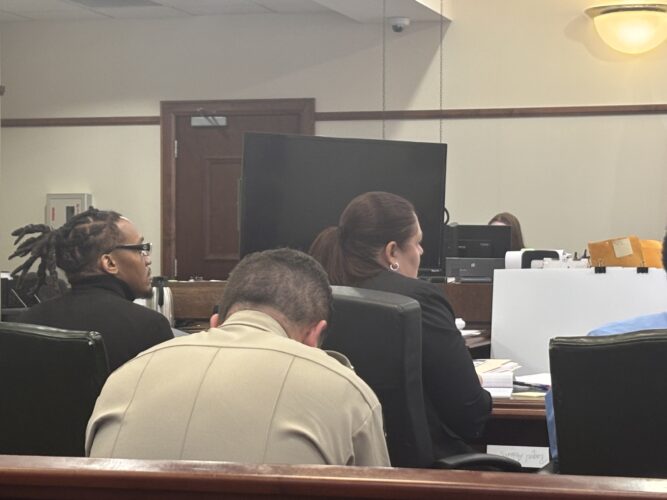
WILMINGTON — In the TRU Colors Brewing double homicide trial, the prosecution called a parade of expert witnesses to testify on the stand attempting to validate the evidence they’ve presented to a jury. However, one expert witness called to explain the history of gang activity in Wilmington and decode gang jargon raised several concerns from the defense attorneys.
Over the course of three days — May 28, May 29 and June 1 — the prosecution, represented by Assistant District Attorneys Doug Carriker and Sean Spiering, called more than a dozen expert witnesses to testify in the case of Omonte Bell and Dyrell Green. The two defendants are charged with two counts of first-degree murder, one count of attempted first-degree murder, and one count of conspiracy to commit first degree murder for the deaths of Koredreese Tyson and Bri-yanna Williams, though the conspiracy charge only applies to Tyson’s death.
Bell and Green are accused of killing Tyson and Williams after breaking into the home of TRU Colors Brewing COO George Taylor III. The for-profit company hired rival gang members — including Tyson, Bell, and a third convicted suspect, Raquel Adams — to curb gun violence. The defendants are also accused of shooting a third, surviving victim, M’Kaila Walker.
READ MORE: Survivor, former TRU Colors COO take stand in double-homicide trial
ALSO: Opening statements, first witnesses presented to jury in TRU Colors double-homicide trial
CATCH UP: Jury selection concludes after week of dismissals in TRU Colors double homicide
Bell and Green’s trial already featured the testimonies of both Taylor and Walker and a host of other civilian witnesses, including the parents of the deceased.
The prosecution took a technical approach when questioning expert witnesses, using them to explain, corroborate and validate physical evidence. For example, experts were asked to interpret X-ray photographs of Williams and substantiate reports put together by investigators, about records and findings.
The defense — which includes Green’s attorney, Matthew Geoffrion, and Bell’s attorney, Meleaha Kimrey, as the judge did not allow the trial to be handled separately — did not work in tandem. The defense claimed during the pre-trial motions that the arguments each defense attorney would have may affect one another’s client, as the basis for their defenses were different. They previously requested to separate the two cases, but this was denied by Judge Frank Jones, who said the differences between their arguments would not be overly burdensome on their defense.
Geoffrion continued with the aggressive approach he took with civilians when cross-examining law enforcement expert witnesses. He often suggested they were not testifying the whole truth or were not revealing every side of the story. In an attempt to strike testimony, Geoffrion also returned with a motion to separate his client’s case from Bell, meaning they would have separate trials. Kimrey did not make a similar motion but attempted to present her client as unrelated to the evidence, suggesting he had no direct relation to what was being presented.
FBI’s gang expert
On Monday, June 1,, the prosecution called Maj. TJ Waddell to the stand, though the jury was asked to step out so he could be independently questioned. Called “voir dire,” the process means a witness will be independently questioned outside of the jurors’ presence, to ensure what is said is both on topic for the case and will not be prejudicial to the defendants. In Waddell’s case, the defense was concerned about the scope of his testimony and its relevance to the case, since his testimony included shootings dating back to as early as 2010, and believed it may be prejudicial to their clients.
Waddell currently works at the Holly Ridge Police Department but worked for the FBI to specifically address gang activity in the greater Wilmington area for 13 years. He also received an award in 2019 from the North Carolina Gang Investigators Association for his investigative work on gang activity in the area.
However, Waddell was not an investigator on this case. Instead, he was brought in solely to act as an expert in Wilmington gang activity, due to his experience working in the field and his being a native to the city.
Waddell provided context about gang interactions, specifically between the Gangster Disciples and the United Blood Nation. The prosecutors wanted to use his information to support the narrative that Tyson was murdered due to gang rivalry. Waddell said he gleaned his information from informants, training and experience throughout the years.
He defined terms the jury would need to understand upon viewing evidence — such as “stain,” which typically meant either someone was killed or someone received the opportunity to move up in the gang’s ranks. “Lick,” he explained, had to do with a drug user or criminal activity like a robbery or shooting. “Mu” a Swahili term often used by the Bloods, referred to brotherhood.
All three terms were used in the text messages gathered for the case and are expected to be shown in upcoming testimonies; the information acted as preparation for the jury.
Waddell also explained Tyson was the “governor” of the Gangster Disciples in the state, and the specific name for the United Blood Nation in the city is the “Double I Bloodset.” Bell, Green, and a third suspect, Raquel Adams — the latter of whom was convicted for the same crimes in 2025 — are all a part of the rival Bloods.
Waddell said on Mother’s Day in 2020, a man named Daiquan Jacobs, who was a high-ranking member in the Double I Bloodset gang, was shot and killed in a rival dispute.
“He was one of the tops at narcotics trafficking for the Bloodset here in the City of Wilmington,” Waddell said and added Jacobs’ death was a blow to the gang’s finances. “He was very highly respected in the gang.”
He stated a string of shootings led to Tyson’s murder, but the only one Waddell described in detail was Jacobs’. Waddell suggested the murder of Jacobs, another high-ranking gang member, is what eventually led to Tyson’s retribution killing.
Upon cross-examination, Bell’s attorney, Kimrey, implied information Waddell received related to gang activity was biased because it came from informant gang members who wanted something in return.
“It’s not often that validated gang members just want to confess all their sins, correct?” Kimrey asked Waddell, to which he affirmed.
Waddell previously stated to the court gang members in prison would send him letters with information and offer to speak in exchange for a good word being put in with the DA. Waddell would inform the district attorney about their cooperation and if the information was sound and factual.
Kimrey suggested informants, on the streets, would give him more information because they expected to get paid more, which could make their information unreliable. Waddell confirmed it was true they would get paid more.
Rather than trying to make Waddell’s information seem biased, Geoffrion implied in his questioning that Waddell was not truly an expert, only knowledgeable. The defense attorney inquired about Waddell’s education in sociology, criminology, psychology and the like. Waddell does not have a degree but said he has college “credits” in sociology and criminology due to workforce training from the FBI on the subjects.
“I’ve got credits from math in college and I’m not a math expert by any stretch of the imagination,” Kimrey said, pointing out that credits did not equate to expertise. She then added that training lessons weren’t enough either; in a similar fashion, noting while she has to take technology training for her license every year, she is not an expert in technology either.
The attorney further argued Waddell had not made a direct connection between the deaths of Jacobs and Tyson. Waddell defended his testimony, saying he could walk the court through the string of murders starting from 2010 that led to the death of Tyson but said it would “take hours.” Waddell was not asked to recount the years of violence.
Geoffrion and Kimrey both attempted to prevent Waddell from testifying in front of the jury, however, due to lack of expertise in gang activity they noted other law enforcement officers brought in as experts on the case were related to the investigation in some way; Waddell is not. Geoffrion argued he was biased because of his profession.
Judge Frank Jones denied the defense’s request to prevent Waddell’s testimony but added if they had any objections about any questions that seemed too far removed from the case, he would rule in their favor.
While Waddell’s testimony in front of the jury remained largely the same, certain responses detailing criminal activity associated with gangs, like human trafficking and prostitution for example, were not admitted on the record.
Waddell explained to the jury his credentials, and then began explaining the recent history of the gangs in Wilmington. He told them what he knew of previous shootings, but referenced only Jacobs’ death. He added he had met Tyson before during his line of work and defined the language used by each gang to the jury. However, he was not allowed to explain findings about Tyson after he was released from prison after the defense objected and the judge ruled in their favor.
Investigators, arresting officers
Over three days, the prosecution called more than a dozen law enforcement officers who acted as experts in the investigation and could explain evidence they gathered. The evidence was also presented to shape the prosecution’s theory about the defendants’ whereabouts and at what times, as well as to establish them as having been together the morning of the murders.
New Hanover County Sheriff’s Office Detective Will Campbell’s expertise was called upon to trace phone call locations. The investigators wanted to find out where the defendants were before, during and after the murders and establish a pattern of communication between alleged co-conspirators.
Though he never obtained the phones, he presented the phone records showing Green called Williams seven times between midnight and 4:11 a.m; Williams and Tyson were killed around 5:30 a.m. Adams called Williams as well around 4:43 a.m. that same morning. Phone records also show calls and messages being exchanged between Nixon, Adams and Bell.
Though the content of the calls and texts were not revealed, they were part of the prosecution’s framework for showing the conspiracy to kill Tyson. Geoffrion argued the calls meant Williams and Green were friends.
Detective Nicholas Lee, also with NHCSO, was called to the stand. He collected video surveillance footage from a Honda dealership and Circle K, including imagery of the black Volvo SUV allegedly used to drive to and from the Taylor home. Investigators determined it depicted Adams and Bell inside the Circle K in Castle Hayne on the morning of the murders, establishing the two were together and had been for a few hours.
While these locations were not close to the home where the murders took place, law enforcement combined their information while the investigation was ongoing to track the trajectory of both the vehicle and the defendants.
The evidence created a theorized path of travel of the defendants for the prosecution to refer to during the trial. Bell and Adams are alleged to have traveled from downtown Wilmington to the Circle K in Castle Hayne before leaving from there to pick Green up from where he was gambling on Fulton Avenue. The three men are then alleged to have traveled to the Taylor house together. Afterwards, the prosecution said they went to a Stevenson-Hendrick Honda dealership only a few minutes away from the Taylor home, which was seen on surveillance footage.
However, the path of travel was explained by Harrison Putman’s testimony later in the week. Putman described on Tuesday that Adams and Bell were together the night and morning Tyson and Williams were killed, and had traveled from downtown to Castle Hayne.
The arresting officers for both Bell and Green were called to the stand Monday. Bell and Green were determined to be suspects in August after the DA received a community tip, and warrants were issued for their arrests on Aug.17, 2021. Both were arrested the following day, Aug. 18.
Bell was apprehended by Detective Paul Weis with the Charlotte-Mecklenburg police department while he was pumping gas in Charlotte, which is where the owner of the vehicle lived. Prosecutors showed Weis’ body camera footage from the arrest, showing Bell rummaging through his backseat before being apprehended by officers.
NHCSO Detective Jonathan Davis was one of the arresting officers for Green, who was found leaving a hotel on Racine Drive and Market Street. However there was no body cam footage from this arrest presented to the jury.
Arresting officers were primarily questioned about the sequence of events prior to the murder and what was said during the arrests.
Medical professionals
Two medical professionals also took the stand Thursday and Friday. Dr. Timothy Novosel, an acute care surgeon at Novant Health, was the doctor who performed the emergency surgery on M’Kaila Walker when she was brought to the hospital after being shot. He extracted the bullet from her body and was primarily asked to recount her injuries and treatment for the jury, and speak about Walker’s state when she arrived.
Novosel said Walker came in with bullet fragments in her arm and clavicle and with bone fractures; after removing the bullet fragments, he turned Walker over to police. Walker was in the hospital for three days and also endured physical and occupational therapy, as the doctor said post surgery she had numbness in her left arm and shoulder.
During cross-examination, however, Geoffrion wanted to confirm she had been shot only once in the arm.
“I can’t make that opinion,” the doctor replied.
During previous questioning of Walker, Geoffrion implied she was associated with members and friends of the United Blood Nation, including Green. He suggested her injuries were not as severe as they could have been, especially when considering the state of Tyson and Williams, who were each shot several times.
On Friday, Dr. Karen Kelly, a forensic pathologist formerly employed with East Carolina University, was called to speak on the autopsy she performed on Williams, though the audience was not privy to the images due to sensitivity measures. Only the jury, witnesses and court personnel were able to view them.
She determined the cause of death was from a gunshot to the head, the bullet fragments fracturing bones in her face before one exited through the bridge of her nose. Williams was also shot a second time in her neck. Kelly explained the gunshot wound on Williams’ neck was partially burned, which meant Williams was shot at close range, as if the gun was pressed to her skin.
The defense did not have questions for Kelly.
The prosecution did not bring forth an expert witness on Tyson’s autopsy.
Lynn Bradham and the motion to sever
The last civilian witness brought to the stand on Friday, May 29, was Lynn Bradham, though the defense attempted to stop her from testifying — primarily Geoffrion. Bradham’s testimony implicated Geoffrion’s client, Green.
Bradham is the mother to Ryan Barber, who died from an overdose in December 2021. The prosecution claimed he bought drugs from Green, despite the two being in rival gangs. Geoffrion urged the judge to dismiss Bradham because he said the death of her son — Bradham’s home in Southgate where he died and where Green allegedly visited — was unrelated to the trial.
“They’re going to attempt to show that Mr. Green knew him, that Mr. Green got a tattoo from him, and to that, I shrug because so what if he knew him?” Geoffrion said, hands in the air. “There’s nothing that ultimately shows that that address is actually related to this case.”
Geoffrion said the evidence was an attempt to define Green’s character rather than act as evidence for the crimes with which the two defendants are charged.
Judge Jones denied excusing Bradham’s testimony because he did not think it was irrelevant to the case.
However, the testimony led to another motion — actually, a recall of a motion filed by both defense attorneys prior to the trial’s start. Geoffrion and Kimrey both asked Judge Jones to sever Bell and Green into two separate cases because they had different arguments to make that could negatively impact one another’s case. Jones denied it because he did not find the joined cases to be overly burdensome or prejudicial.
Geoffrion brought it up again on May 29. He told the judge one of Kimrey’s questions was hearsay; she asked if Bradham’s son was afraid of being implicated in a murder during the summer of 2021, referring to Tyson’s death. Geoffrion made a motion to strike that question, but before it could be ruled on, he made another motion to sever the cases.
Geoffrion suggested Kimrey inviting in information involving Ryan Barber put the two attorneys at odds with one another because while Kimrey invited responses from Bradham, Geoffrion wanted to strike the information on Barber from the record altogether. He described Kimrey and himself as put in a “precarious position.”
The judge denied both motions by Geoffrion, who did not view the two defenders as antagonistic. The motion to strike was requested too late to be granted.
The court will next dig into the scope of text message evidence collected by the investigators, which is the centerpiece of the prosecution’s argument.
Have tips or suggestions for Emily Sawaked? Email [email protected]
At Port City Daily, we aim to keep locals informed on top-of-mind news facing the tri-county region. To support our work and help us reach more people in 2026, please, consider helping one of two ways: Subscribe hereor make a one-time contribution here.
We appreciate your ongoing support.
