


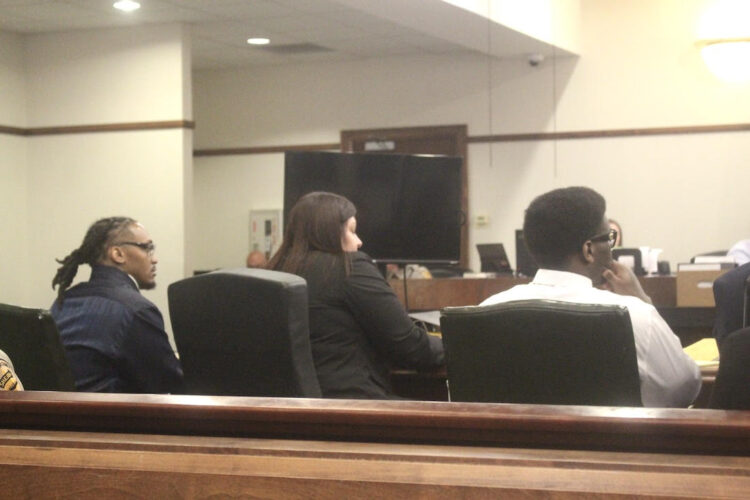
WILMINGTON — After two weeks of pre-trial motions and jury selection, the defense and prosecution in the Omonte Bell and Dyrell Green trial presented opening statements to the jury on Tuesday. Already four witnesses have been called to the stand and the jury heard the phone call that injured victim M’Kaila Walker made to 911.
Bell and Green are both charged with two counts of first degree murder, one count of attempted first degree murder and one count of conspiracy to commit first degree murder for an incident that took place on July 24, 2021. They are accused of breaking into the home of George Taylor III, where Koredreese Tyson and Bri-yanna Williams were both killed, and Walker was left injured. The conspiracy charge is only related to the murder of Tyson, though.
Tyson was the leader of the Gangster Disciples in the state of North Carolina, but he worked for TRU Colors Brewing, a for-profit company that hired rival gang members to curb gang violence started by Taylor’s father, George Taylor Jr. A third suspect, Raquel Adams, worked at the company as well; Adams was convicted of the murder in 2025. All three victims were staying at Taylor’s Providence Road home when the killings occurred.
READ MORE: Jury selection concludes after week of dismissals in TRU Colors double homicide
ALSO: Double murder trial involving former TRU Colors gang members begins
Bell, Green and Adams are all part of the United Blood Nation, a rival gang to the Gangster Disciples, which Assistant District Attorney Doug Carriker pointed out to the jury was the motive for the murder, especially considering Tyson’s status as a top gang leader in the state at the time he was killed. Tyson’s mother, Carol, would later confirm his position and further added Tyson had been a part of the Gangster Disciples since he was 15 or 16.
Though a pre-trial motion was approved to prohibit the two defendants’ prior gang activity from being used as evidence, the prosecution can still bring up the defendants’ current relation to the gang.
On May 26, the jury first heard from the prosecution, represented by Carriker, and then from defense counsel. Bell is represented by public defender Meleaha Kimrey and Green by Matthew Geoffrion. Carriker addressed the 12-member jury and three alternates for nearly 40 minutes.
“Woken by a bullet,” he started. “Woken by a bullet entering her body, fired from a gun. This is 21-year-old M’Kaila Walker and this is how she has woken during the early morning hours of July 24, 2021.”
Carriker explained the majority of the evidence was digital, since most of the ballistics were not viable due to a lack of match to any weapons allegedly owned by or confiscated from the suspects. There was also a lack of DNA or fingerprint evidence from the crime scene implicating either Green or Bell. Though injured in the incident, Walker also could not recognize the assailants since she was asleep when it occurred and it was dark when she woke up.
Carriker spoke of the text exchanges among alleged parties, like Bell, Adams and Nixon, and said the prosecution plans on decoding them, due to street or gang jargon with which the jury may be unfamiliar. The prosecution also is bringing in digital forensic analysts. He referenced text messages previously noted during pre-trial motions which say “We on Thug ass on low,” and “Is he dead yet?” both referring to Tyson.
“At the end of this trial, I am gonna come back to you and I am going to pull together the digital evidence in this case,” Carriker said in closing. “I don’t know which way of describing this you wish to use — connecting the dots, that sounds kind of juvenile. Putting together stars to make a constellation — that’s a bit too flowery.”
Carriker concluded by suggesting the case was clearly pre-meditated: “If this is not first-degree murder, then what is?”
The defense, however, did not rely on a presentation of evidence but a lack thereof instead.
Geoffrion, representing Green, stated the evidence from the prosecution does not directly implicate his client and the lack of material evidence — such as fingerprints in the home — in general was enough to prove there was no case against Green. The defense previously attempted to separate the defendants to host two trials, but it was denied by Judge Frank Jones. Geoffrion further emphasized, while his client may run with some people who others may deem the “wrong crowd,” that does not mean he was present to commit the crime nor participate in it.
A black Volvo SUV was implicated by law enforcement during the investigation as the car likely to have been present at the scene of the crime, though it wasn’t when first responders arrived; it was seen through door camera footage. Geoffrion said Green was never found to be in a black Volvo SUV. The SUV is being used as evidence of the getaway car in the crime, as presented by the prosecution.
Additionally, Green was not privy to text conversations which discussed killing Tyson and concluded, ultimately, the prosecution only had an alleged argument between Green and one of the victims to implicate his client in the crime.
The defense explained the altercation between Green and Walker — cited in court documents and by the prosecution as having occurred at a Taco Bell on 17th Street where Walker and Williams both worked — was not as intense or heated as the prosecution made it seem. The argument took place the night before Tyson and Williams were killed, at the end of Walker’s shift; the prosecution would use the argument between Walker and Green as an additional motive for the killings. Geoffrion claimed Green did not raise his voice, and certainly not to a degree where it would have been heard by someone outside.
Geoffrion also noted the prosecution left out certain key parties in the case, like Walker’s half-brother Malachi Cooper. The defender hinted at close connections between Walker and individuals like Cooper, leading to possible conspiracy on Walker’s part, though he did not say as much directly.
Geoffrion encouraged the jury to question everything and consider what every piece of evidence and every testimony “really means.”
Kimrey lastly addressed the jury, noting her client was innocent because the prosecution could not confidently connect Bell to the crime. Like Geoffrion, she, too, pointed to a lack of evidence implicating Bell and noted the Volvo he was driving actually belonged to Bell’s old girlfriend, whose car he borrowed regularly.
Ultimately, Kimrey noted, like Geoffrion, the lack of DNA and ballistic evidence.
“In what they failed to present,” Kimrey said of the prosecution’s evidence, “lies reasonable doubt.” The prosecution needs to prove beyond a reasonable doubt the defendants are guilty.
The family
The prosecution called two family members to the stand Tuesday to set the scene from their perspectives and to also provide context into the lives and activities of the deceased victims. The two were able to provide background in addition to a timeline of when they found out about the crime, and in Tyson’s case, when he got involved with the Gangster Disciples.
Elton Williams was the first person called to the stand and testified about the kind of person his daughter was.
“I had a grocery list before I even get home,” he said, remembering living with Bri-yanna. “I’d have to turn around to go to Wendy’s and go get her a chocolate chip cookie. A lot of little knickknacks and everything.”
He also said she enjoyed playing video games at home.
Elton provided two primary details: the timeline of events through his perspective and information about his daughter. Bri-yanna was the youngest of three and lived with her father, worked in local fast food joints like Cook Out and Taco Bell, and her shifts typically aligned with her father’s, who worked at Novant Health Regional Medical Center, meaning he was home when she left to go to Providence Road.
The night before her murder, Elton recalled seeing his daughter at home, packing an overnight bag to hang with a friend he had never met before. He recounted their brief conversation and insisted he bring her to work the next day. She told him, instead, to get some rest.
Around midnight, Walker took Williams to Providence Road. The next time Elton heard about his daughter was when he received a call she was involved in an incident and he needed to report to the hospital. The time was roughly noon, though police responded to the Providence Road home at roughly 6 a.m. Walker was taken to the hospital after.
“They took us to this private room in the hospital and that’s where they broke the news to me and her mother,” Elton explained on the stand per learning of his daughter’s death.
Carol Tyson, Koredreese’s mother, was also called to the stand Tuesday. She validated facts regarding her son’s gang involvement and relationship with TRU Colors and the Taylors. She also provided insight into Tyson’s gang activity and background.
Carol explained she found out about her son’s gang involvement when he was 15 or 16 years old; Koredreese was 29 when he was killed. She also learned about his nickname, “Thug,” which was the name used in text messages between alleged conspirators.
Mostly, Carol explained having been worried for his safety when she found out about the extent of her son’s involvement.
Eventually, he began to lead the Gangster Disciples, becoming the head statewide. Carol told the court he also went to prison but was released in 2017, the same year TRU Colors was founded and he began working there.
“He seemed pretty tight with them,” Carol said of her son’s relationship with the brewery’s founders, the Taylors.
The 911 call
The court played the 18-minute phone call from the morning Tyson and Williams died, previously reported on from Port City Daily. Only Walker made a phone call to the police, using Tyson’s phone since she couldn’t find hers in the heat of the moment; the attorneys directly asked both law enforcement and 911 telecommunicators if they received a call from a male, or Taylor III, and all replied in the negative. The audio was played to illustrate the witness testimony and to detail what happened right after Walker and Tyson were shot.
In it, Walker is clearly distraught and in pain, describing having woken up to being shot in her arm and seeing an excess amount of blood. She locked herself in the bedroom and was awaiting the arrival of first responders.
“Where are they?” she is heard asking several times.
The telecommunicator walks her through triage, directing Walker to put a towel on her wound to stop the bleeding.
Debra Cottle, the former manager of NHC’s 911 call center where she spent 36 years, had taken the stand earlier to describe the standard procedures for responding to an emergency call, deciding which emergency response agency to send to an incident and how triage is explained to a victim. She was also able to verify the validity of the 911 call recording.
Eventually, law enforcement arrived and told Walker to exit the room with her hands up. She exclaimed: “I can’t move!”
Walker left the room after unlocking the door and can be heard explaining she was in bed with Tyson, who appeared unresponsive. Officers helped sit her down before she was brought to EMS.
State highway patrol officer Sergeant Bryan Phillips was the first on the scene. The prosecution also questioned him about his duties, why he responded to the call as a highway patrolman and where he was prior to responding. His testimony was cut short due to previous arrangements that ended Tuesday’s court session at 4 p.m. Phillips had to be called back to the stand Wednesday morning.
With Phillips having been first on the scene, both the prosecution and the defense wanted to understand his duties, standard procedure, and then what Phillips did and saw the morning he arrived at the Providence Road home, with the defense looking to point out irregularities.
The prosecution asked about the layout of the home, what he saw, where Phillips typically worked, where he was when he heard the call and how he responded.
The defense wanted to know whether Williams’ body was moved before or after a photo was taken — it was before — and why he did not turn his sirens or lights on when arriving at the scene. Phillips described that not turning on either was a safety measure, to ensure any remaining suspects were not aware police were incoming. If alerted, they could leave quickly without being seen.
While not the unit meant to respond, Phillips said he knew the sheriff deputies were on a shift change. Further, he was the closest to the home on Providence Road. He waited for the sheriff’s deputies to arrive, scouting the outside before heading into the back of the house near the porch at the direction of the deputies.
The sheriff deputies entered through the garage, which was ajar and perceived as a point of entry by the assailants.
All officers began surveying the area; Taylor III was the first to exit. He was put in cuffs, since officers did not know who the perpetrator was, though he was eventually released after being verified as unsuspecting.
Phillips described he saw Walker, covered in blood, slide to the floor after hugging the wall. He took her outside to the emergency medical service providers, as police cleared the area of danger.
After Walker and Taylor III were secured — and treated as needed by EMS — the officers entered the bedroom to see Tyson’s dead body. Photos were taken of the deceased to preserve the integrity of the crime scene; these were then presented to the jury.
More law enforcement officers are expected to take the stand in the coming days, including now-Detective James Riley, the first New Hanover County sheriff’s deputy on the scene in 2021. Wednesday’s court session included testimony of Walker, though Port City Daily will cover it later this week.
Have tips or suggestions for Emily Sawaked? Email [email protected]
At Port City Daily, we aim to keep locals informed on top-of-mind news facing the tri-county region. To support our work and help us reach more people in 2026, please, consider helping one of two ways: Subscribe here or make a one-time contribution here.
We appreciate your ongoing support.
