


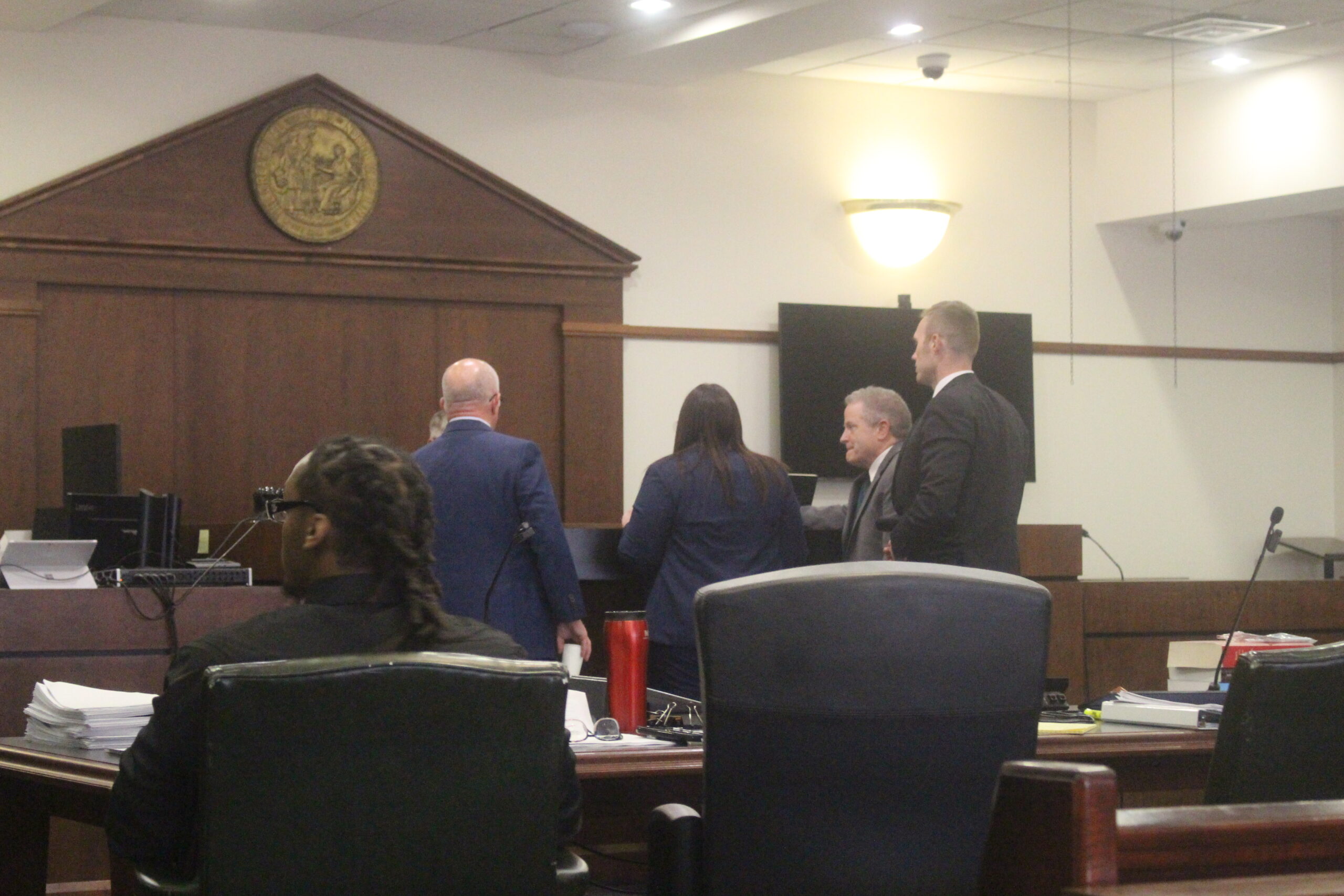
WILMINGTON — One week, at least a hundred potential jurors and a plethora of dismissals later, a 12-member jury and two alternates for the TRU Colors Brewing double homicide has been decided.
Jury selection began Friday, May 15, and wrapped Friday, May 22, for the trial of Omonte Bell and Dyrell Green, charged with first-degree murder first-degree attempted murder of Koredreese Tyson and Bri-yanna Williams. The defendants also face conspiracy to commit first-degree murder of Tyson.
In July 2021, the murders took place in the home of George Taylor III, the CFO of the brewery started by his father George Taylor Jr. in 2017. Bell, Adams and the victim, Tyson, all worked for TRU Colors, which closed in 2022.
READ MORE: Double murder trial involving former TRU Colors gang members begins
Bell and Green are accused of having broken into Taylor III’s home, alongside Raquel Adams, to kill Tyson and Williams. There was also a third victim, M’Kaila Walker, injured during the crime. In May 2025, Adams was convicted and received two consecutive life sentences.
The trial for Bell and Green started May 11, with the first two days revolving around dismissed motions — such as a request from the defense to exclude media, like photographers, broadcast and microphones, from the courtroom. In particular, Bell’s defense shared concerns of witness and juror safety, and noted ongoing media coverage could be seen by sitting jurors. The judge denied the motion but said no witnesses or jurors could be photographed. He also added recordings could be taken during proceedings for reporting preparation but not used for broadcast or radio.
Prosecutor Doug Carriker and public defenders Meleaha Kimrey and Matthew Geoffrion immediately were concerned of previous knowledge jurors may have about the case. Because the crime happened in a wealthy neighborhood on Providence Road and by employees of a brewery specifically founded to hire active, rival gang members in an attempt to curb gang violence, the case received plenty of media attention.
Many jurors — whose names are not allowed to be divulged in the media by law, according to Rule 15 of the general rules of practice for the Superior and District courts — were excused throughout the week for simply knowing too much about the crime prior to arriving to court for the selection process.
Port City Daily reached out to the attorneys to inquire as to why there wasn’t a request for venue change — which would call for the case to be tried in a court outside New Hanover County — but did not hear back by press. A change in venue is typically allowed if the defense can prove staying in the county the crime happened in would result in an unfair trial by overwhelming prejudice or if both the prosecution and the defense agree to the change.
“The court has a preview of what’s going to happen,” Geoffrion said in reference to the publicized Adams’ trial last year, which has been discussed in reference to the current trial.
He also acknowledged the Adam’s trial is legally considered separate from the case of Bell and Green. A motion to try Bell and Green individually was denied, but the judge granted removing the gang enhancement, which means the court cannot use the two defendant’s prior gang involvement as evidence in the trial.
One by one, jury candidates were dismissed; so many were turned away, in fact, the court needed to bring in another group of 40 people to question to determine the three alternates. One alternate was chosen but had to be promoted to the main panel, due to a chosen juror exiting the courthouse without permission. Per the rules of jury selection and the court, jurors are not permitted to leave the courthouse until officially dismissed for the day or for a lunch recess.
Questions asked by attorneys included prior knowledge and conflicts of interest in the case — one woman was dismissed, for instance, due to her son attending school with two of the victims. Counsel also inquired whether the jurors would hold gang activity against the defendants and their understanding on the burden of proof being on the state.
Carriker spoke amicably to the jurors, particularly when describing the legal proceedings and the role of a juror. As such, he frequently described Bell and Green as “draped in a cloak of innocence” when questioning whether a jury candidate understood the defendants have a right to a fair trial and were innocent until proven guilty.
Public defenders Kimrey and Geoffrion asked independently — as Kimrey represents Bell and Geoffrion represents Green — whether a juror believes someone has the ability to change despite being a gang member or if they are willing to convict one defendant but not the other.
Attorneys also asked candidates if they would follow the law as the judge explained it, believe law enforcement or expert witness over other testimony, and had formed pre-ordained opinions.
“Is there anything about a woman being shot in the back and a man being shot in his sleep that would give you pause?” Geoffrion asked one dismissed candidate.
The candidate answered she would not be perturbed by the facts of the case but affirmed her belief that gang members were more likely to commit a crime.
Nearly every juror, a mix of men and women, on the panel is white in a case with two Black defendants. Port City Daily asked the court for the exact demographic makeup but was told the information cannot be disclosed.
The dozen or so potential Black jurors were turned away by counsel, some for personal connections to witnesses or related parties. One juror described her relation to people working in the judicial system outside of New Hanover County, and further explained her previous position as a victim in a medical malpractice case and a domestic violence case.
One of the other Black jurors was removed from the panel after he revealed a 27-years-long friendship and working relationship with Elton Williams, the father of Bri-yanna Williams. The juror was clear it made him sympathetic toward the prosecution and enter the process with preconceived beliefs.
Another juror was dismissed after Googling gang activity statistics during court recess. Jurors, potential or chosen, are not allowed to do independent research related to a case while undergoing the selection process or while the trial is ongoing. The potential juror also explained how he read that people in a gang were more likely to commit a crime and partake in criminal activity.
Some jurors were excused for having strong opinions about TRU Colors Brewing. One woman explained she was suspicious about the business model, which she said was created by a white man without personal experience with the target communities.
Others had strong opinions about criminal justice in general. One woman was dismissed after she revealed an unwillingness to convict someone of murder if they were a getaway driver — which Green is argued to have been.
With jury selection complete, the trial will begin on Tuesday morning at the New Hanover County Courthouse with the attorneys’ opening statements.
Have tips or suggestions for Emily Sawaked? Email [email protected]
At Port City Daily, we aim to keep locals informed on top-of-mind news facing the tri-county region. To support our work and help us reach more people in 2026, please, consider helping one of two ways: Subscribe hereor make a one-time contribution here.
We appreciate your ongoing support.
