


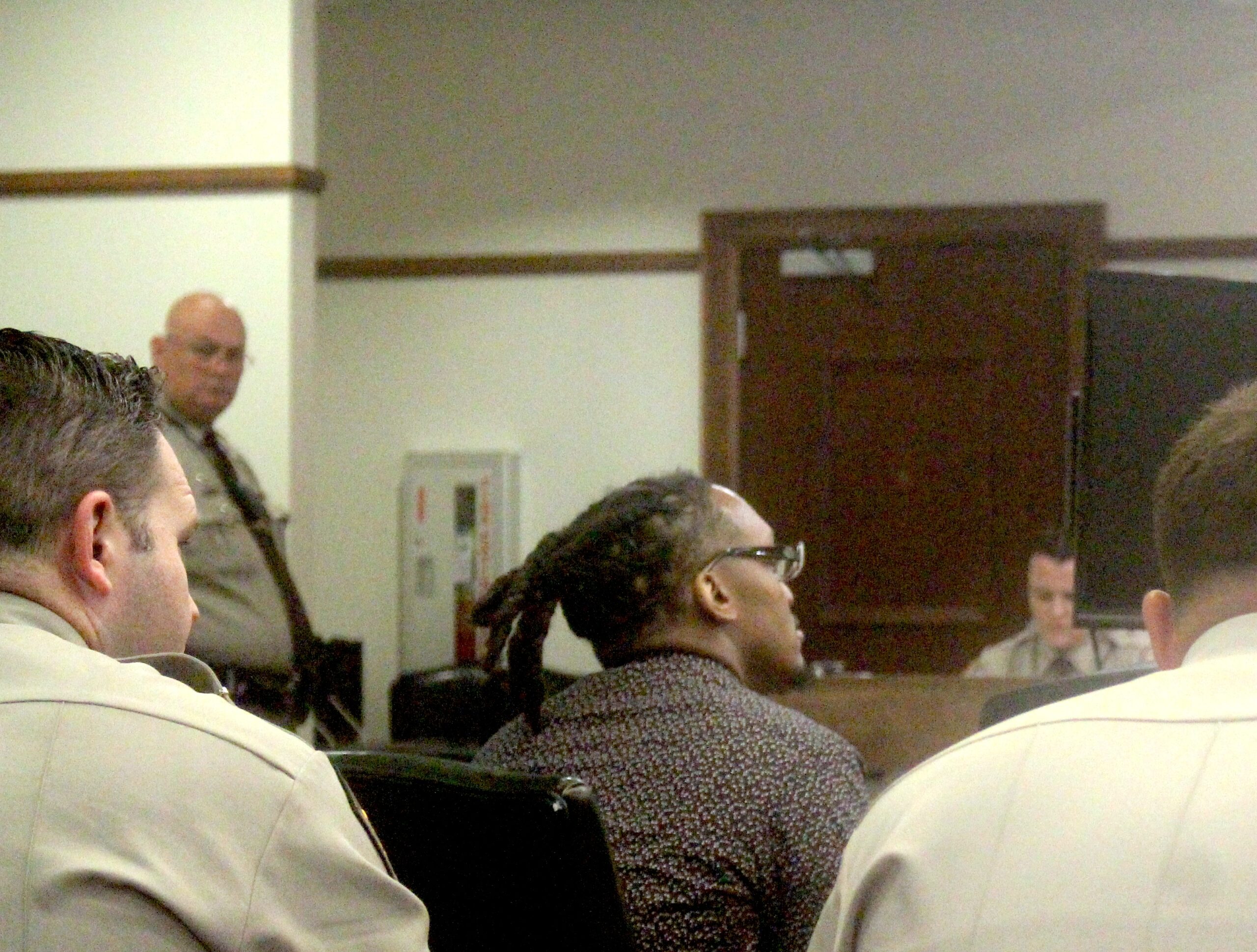
WILMINGTON — The only two witnesses present the night of Koredreese Tyson and Bri-yanna Williams’ murders were called to the stand in what’s been dubbed the “Tru Colors double homicide” case. M’Kaila Walker took the stand on Wednesday and a day later George Taylor III was called by the prosecution for questioning on Thursday.
The defense’s main goal for the two witnesses was to question their credibility, while the prosecution’s questions framed them as sympathetic characters, victims in a tragedy.
On the morning of July 24, 2021, Tyson and Williams were killed in the home of Taylor III; Walker, Tyson’s girlfriend, was also living there and was shot.
READ MORE: Opening statements, first witnesses presented to jury in TRU Colors double-homicide trial
ALSO: Jury selection concludes after week of dismissals in TRU Colors double homicide
CATCH UP: Double murder trial involving former TRU Colors gang members begins
One person, Raquel Adams, has already been convicted of the murders in May 2025; now, Omonte Bell and Dyrell Green each face two counts of first-degree murder and one count of attempted first-degree murder. They are also charged with one count of conspiracy to commit first-degree murder for Tyson’s death.
Bell and Adams worked at TRU Colors alongside Tyson. Bell, Adams and Green are all part of the United Blood Nation, who are rivals with the Gangster Disciples, which Tyson was the leading member of in the state.
Walker’s testimony was marked by an inability to remember many of the details from the incident, including the identities of the killers. The prosecution portrayed her responses as shock from the event and finer details lost to time. The defense used this to draw suspicion toward Walker and also called into question her acquaintance with Green prior to the murder.
The questioning of Taylor focused on his relationships with the victims and defendants, since he worked at Tru Colors and invited many gang members to live with him. Ultimately, Taylor denied any tension between the victims and suspects. He was also unable to identify the killers, having been holed up in his bathroom during the shooting.
George Taylor III
Taylor was called to the stand on Thursday afternoon — an event he attempted to avoid earlier this year in a motion to quash his subpoena. Judge Kent Harrell denied it in March saying the subpoena did not present an undue burden or expense towards Taylor.
After calling Taylor to the stand, the prosecution first began asking him about the brewery he and his father started back in 2017.
TRU Colors Brewing was a for-profit company that hired active gang members to curb gun and gang violence, and there were different departments they could work in before it shuttered in 2022. Tyson, for example, worked in community outreach. Taylor spoke about his family’s desire to help local communities; he said he was first introduced to Tyson after learning of his influence locally. Tyson then urged Taylor to meet Adams.
The prosecution’s argument: The double homicides were a result of pre-existing hostilities between rival gang members, which became more intense due to the close proximity created by the brewery’s employment. The defense also pointed out that people working at the brewery — including rival gang members — knew Tyson was staying at Taylor’s home.
The prosecution asked if hiring rival gang members ever caused issues at the company and whether employees brought issues between the gangs into the workplace.
“I think every workplace has tensions and conflicts, which certainly we had some,” Taylor said, though he denied any arose to the level of violence.
Assistant District Attorney Doug Carriker asked about Taylor’s role at the brewery, how he knew Tyson, and why Tyson lived at the Providence Road home.
Tyson lived with him for six months after failing to find another residence due to Tyson’s criminal background, Taylor explained. He detailed it was a commonplace struggle for the brewery workers and noted there was another gang member named Eric Marshall living at the house at the same time, though Taylor said they were friendly with one another.
The defense followed with questions suggesting Taylor didn’t know everything going on in his home, and thus was unaware of who a trustworthy source is and was not a credible witness for the comings and goings of people in his home. Geoffrion pointed out a music video shot in Taylor’s living room that showed “convicted felons” with guns in his house. Taylor testified he thought it was going to be more tame than it was and admitted separately he wasn’t always aware of people coming to his house at odd hours of the night.
The prosecution moved on to the night of the murders. First, one set of gunshots went off according to Taylor
Taylor described to the jury he didn’t know the source of the noise at first. He said Walker and Williams sounded drunk when they arrived at the house between 3 a.m. and 3:30 a.m. and assumed the loud noises about two hours later were the two “spilling something over the balcony.” Taylor later learned they were gunshots.
He also didn’t deem it necessary to call the police that night, he told the court, because he was both unsure if there was actually a problem and because if someone was in his home, calling 911 wouldn’t be an immediate help to him.
Carriker showed text messages Taylor sent to Tyson roughly 10 minutes after the gunshots: “What the hell is happening?”
However, he received no response because Tyson already had been shot.
When a second set of shots rang out, that’s when he grabbed his guns, Taylor said.
“At that point, you didn’t call 911?” Bell’s attorney, Meleaha Kimrey, asked, trying to clarify why he decided it was best to reach out to Tyson and grab a weapon instead of calling 911.
“If I think someone’s in my house, 911’s not going to solve my problem,” Taylor said.
Taylor hid in his bedroom’s bathroom with a shotgun and a pistol until law enforcement arrived; he emerged and immediately was ushered to the ground.
M’Kaila Walker
Walker on the other hand, was asked by the prosecution to give a rundown of her relationship with Tyson. She explained they had only dated for a few weeks. Walker also explained being friends with one of the accused parties, Green, prior to the murder.
She described the events leading up to the murders: She and Williams were working a shift at Taco Bell, where Green waited outside to reportedly get free food. Walker and Green allegedly argued before Williams and Walker drove to Taylor’s house; on the stand, Walker said she didn’t remember what was said.
The prosecution entered into evidence a video that a coworker took of a phone conversation between Walker and Green that happened during their shift on the night of July 23. Though the court was unable to make out words, Green appeared to be yelling and talking quickly.
The prosecution drew a connection between the argument Walker had with Green, and then her being shot hours later, as further evidence of the likelihood of Green’s involvement in the crime.
Walker then described being in bed with Tyson at 5:40 a.m. when three people allegedly broke into the home and opened fire. She testified she was awakened by a bullet in her arm and Tyson lying dead beside her.
She walked the court through the rest of the evening: the shell casings on the floor, the 911 call, her injury, law enforcement arriving and going to the hospital. However, a frequent issue examiners came across was Walker not remembering granular details, like who opened the door to Tyson’s bedroom the morning of the shooting before she locked the door, phone calls made before Tyson’s death, or texts she may have sent.
The prosecution framed their questions to make Walker a more sympathetic victim, asking about any lasting pain, which she explained feeling despite months of physical therapy.
The cross examination of Walker was dominated by Green’s attorney, Matthew Geoffrion, who proceeded to ask about her half-brother, Malachi Cooper, who goes by “Cut.” Cooper is friends with Adams, and allegedly spoke with Walker right after she clocked out from her Taco Bell shift, around 2 a.m. She said she did not recall what they said, though Geoffrion implied Walker’s relationship to her brother meant she was acquainted with the defendants, including his client.
Geoffrion ultimately wanted to home in on Walker’s relationships to the defendants, victims and people close to the defendants, calling into question her credibility. The defense implied she was not a trustworthy source, nor an uninvolved party, because of relationships she had with her brother, Green, and through mutual friends, Adams. Geoffrion suggested Walker reportedly had issues with Bri-yanna, too, commenting Walker spoke with her friend about it hours before the incident.
Geoffrion suggested Walker’s brother, Malachi Cooper, and three other friends and acquaintances were all affiliated with the gang that killed Tyson; confirmed by their connection to Adams. By extension, the defense further implied Walker had some association to United Blood Nation because of her brother, hinting at suspicions about her loyalties because of this.
“And your brother was also friends with a guy named Raquel Adams, right?” Geoffrion asked, to which Walker confirmed. “Now, do you remember writing to your friend Alana, telling her that Bri was the ops on the night of the 23rd?”
He was suggesting Walker and Williams were at odds. However, Walker denied being upset with Williams, saying she did not recall feeling that way.
Geoffrion then asked if Walker had a chance to view her text messages from the night of July 23 and the early morning of July 24; Walker said she had not. Many of the questions Geoffrion asked Wednesday garnered a similar response: Walker didn’t remember.
Regarding when Walker woke up with a gunshot wound and called emergency services, Kimrey asked if she requested help for Tyson; Walker confirmed she did not. An 18-minute 911 phone call already was presented before Walker testified, indicating she did not bring up helping Tyson; she only named him to the operator when asked directly if anyone was with her. Walker didn’t mention Tyson was shot until officers showed up, according to the audio of the 911 call presented to court.
Carriker upon re-direct examination, which occurs after the defense has cross-examined a witness, asked Walker why she didn’t mention Tyson in need of medical aid. He explained this was her “opportunity” to reason how she approached the 911 call.
Walker replied: “He was already deceased. I could tell. He was not moving. He wasn’t making any sounds. He was just laying there.”
Walker may still be called back to the stand for questioning.
DeMarcus Gaines
DeMarcus Gaines, the cousin of Koredreese Tyson, also was called to the stand Thursday. He drove Green to Taco Bell the night of July 23, 2021. Gaines and Walker dated for a week in high school but hadn’t connected after graduation, Gaines said.
He was the last person to have seen Green before allegedly being involved with Tyson’s murder.
Gaines explained he, Green, Gaines’ older brother, and Malachi Cooper went gambling together at a house on Fulton Avenue in Castle Hayne the night of July 23. He testified not knowing Green prior to that evening, but said they all drove to the Taco Bell to get food. After Green and Walker’s exchange outside, the group of guys left the restaurant and Gaines proceeded to take everybody home; lastly, he dropped off Green at Fulton Avenue.
Carriker asked if Green ever contacted Gaines afterward, which Gaines confirmed.
“Did Dyrell Green threaten you?” Carriker followed up.
Gaines responded yes. As Carriker inquired further, Gaines said Green threatened to kill him.
“It was kind of weird,” he said, explaining he was getting multiple calls over the course of a few days after the murder from unknown numbers or blocked callers. “The blocked phone calls, I recognized his voice, but then prior to that, it was him calling from his number.”
He had not received calls from Green before Tyson’s death; Gaines said they did not know each other before then.
Geoffrion then suggested Green never threatened Gaines, but instead his client asked Gaines to not spread “vicious rumors” after July 24 about Green’s connection to Tyson’s death. Geoffrion referred to suspicions Gaines voiced that Green had something to do with Tyson’s death, though Geoffrion did not explain the rumors further.
Geoffrion added Gaines never told anyone about Green’s threats until Gaines was pulled over by the police on or about July 28, 2021 and charged with possessing a stolen firearm. The defense attorney suggested Gaines only reported a threat because he was on probation at the time and didn’t want to return to jail.
Upon asking if Gaines had any kids — he has two — Geoffrion suggested he’d want to stay home to take care of his family.
Gaines admitted when he was later questioned for two hours by the police, he only spent 45 minutes talking about his charges; the remaining time he conversed about Tyson, due to the nature of the ongoing investigation. Knowing his relationship to Tyson, police got information about Green from Gaines.
“And you were upset because your cousin, the leader of the GDs, was dead, right?” Geoffrion pressed.
Gaines agreed to being upset.
“And you wanted to avenge that, correct?” Geoffrion asked.
“No,” Gaines replied.
He was asked to step down shortly after.
Expert witnesses are planned to be called to the stand Friday, May 29.
Have tips or suggestions for Emily Sawaked? Email [email protected]
At Port City Daily, we aim to keep locals informed on top-of-mind news facing the tri-county region. To support our work and help us reach more people in 2026, please, consider helping one of two ways: Subscribe here or make a one-time contribution here.
We appreciate your ongoing support.
