


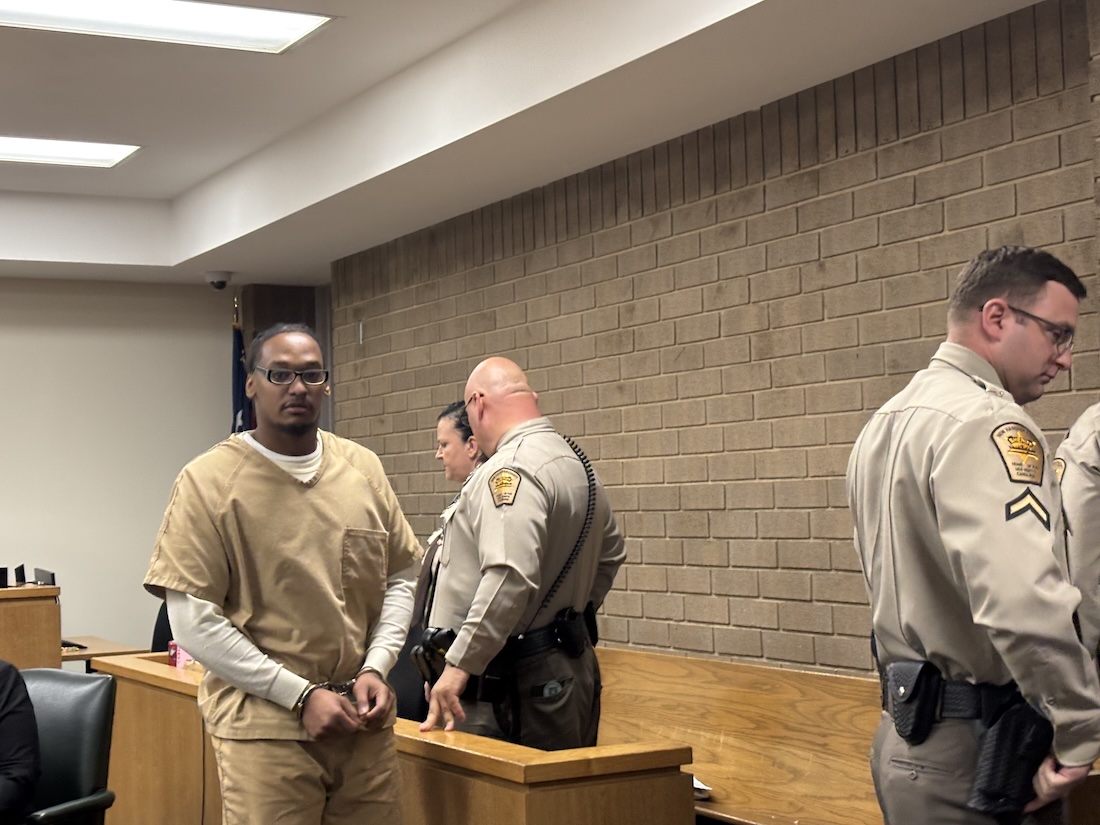
WILMINGTON — Nearly five years after a deadly home invasion on Providence Road left two people dead, the murder trial of alleged United Blood Nation members Dyrell Green and Omonte Bell is underway in Wilmington.
With jury selection coming Wednesday, the main issue of the trial so far has been the defense’s attempt to sever the two men’s cases. Prosecutors argued the pair conspired to kill a high-ranking Gangster Disciples member, while the defense argued trying the two together would violate the Sixth Amendment if the two had conflicting testimony or information that would jeopardize the other.
Ultimately, Judge Frank Jones denied severing the cases, disagreeing with the defense’s argument that the consolidation would result in an unfair trial.
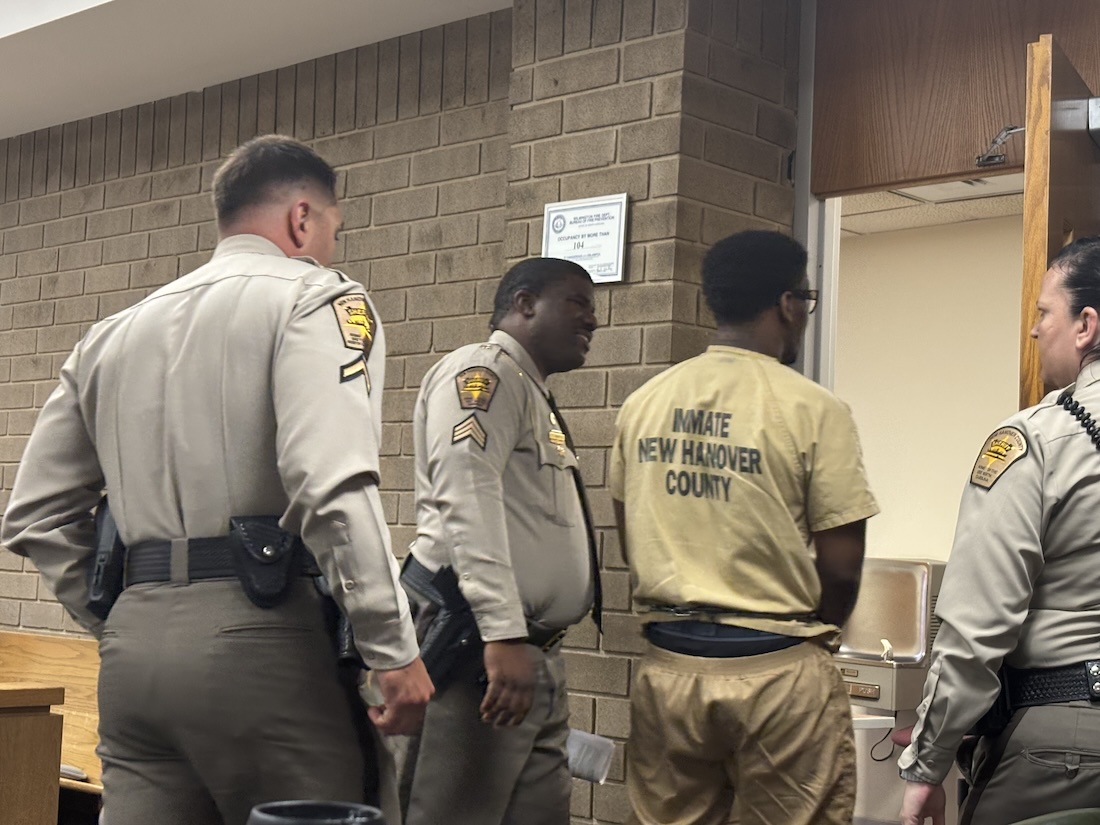
Dyrell Green and Omonte Bell first appeared in court on May 11, the former represented by Matthew Geoffrion and the latter represented by Meleaha Machelle Kimrey.
Both Green and Bell are charged with one count of conspiracy to commit first-degree murder, two counts of first degree murder and one count of attempted first degree murder. The second count of conspiracy to commit first degree murder of Bri-yanna Williams was dropped from both defendants on Monday, with the state reasoning her death was not pre-planned. However, the conspiracy to murder charge for Koredresse Tyson’s death remained.
Green, Bell, and Raquel Adams (who was tried in 2025) were arrested for the murders of Tyson and Williams in August 2021. Tyson was considered the tri-county area’s highest ranking member of the Gangster Disciples at the time; Bell, Green and Adams are all members of rival gang United Blood Nation.
In July 2021, Tyson, Williams and her friend, M’Kaila Walker, were staying at the Providence Road home of George Taylor III, the chief operating officer of Tru Colors Brewing. Tyson, Bell and Adams all worked at TRU Colors, a for-profit business that opened with the intention of hiring active, rival gang members with the goal to offer financial stability and, by proxy, de-escalate violence on the streets.
Adams, Bell, and Green allegedly broke into Taylor III’s home, where Williams and Tyson were killed and Walker was injured. Taylor III was found hiding in a bathroom with a shotgun and a pistol; he called 911. Earlier this year, Taylor III attempted to evade speaking as a witness at Bell and Green’s trial, saying he was both traumatized and did not witness anything. Judge Kent Harrell denied a motion to quash the subpoena.
Taylor III was originally subpoenaed to speak on May 11; Port City Daily asked the state when he is expected to take the stand, but Carriker could not provide a response.
His father, George Taylor Jr., former CEO and founder of TRU Colors, ended up shuttering the brewery in 2022 and was later sentenced in 2024 for tax evasion related to another company, National Speed.
Though Raquel Adams was found guilty last May, Bell and Green’s trials were repeatedly postponed due to issues with counsel, particularly as both their attorneys removed themselves from the case, though no reason was provided publicly.
Expected to speak during the trial are family members Carol Tyson and Alton Williams, investigators and sheriff’s office employees Jeremy Boswell, Eric Kelley, Will Campbell, as well as experts like FBI Agent Harrison Putman and Carla Cuomo, the former manager of Castle Hayne Stowaway, whose surveillance footage was used during the investigation, among others. Altogether, the state is expecting to call 10 expert witnesses to the stand; Port City Daily asked the defense how many they intend to call but was told it is unclear.
To sever or not to sever
One of the most debated topics in court Monday was a motion to sever the cases.
Due to the two men being in the same gang, the state consolidated both cases into one. The same evidence from Adams’ trial — notably, the witnesses and text and call exchanges — will be present in Bell and Green’s trial.
However, both public defenders filed the motion and argued consolidating the two cases infringes upon the defendants’ right to a fair trial. They stated having two defenders speaking on the same turn for different defendants — not exactly in harmony with one another — would muddle statements and examinations and could affect a jury’s decision.
The defense also argued their clients, while members of the same gang, did not act in lockstep and, therefore, had different arguments to make. Discrepancies include who was involved in the conspiracy to commit first-degree murder, level of involvement in the incident, and the whereabouts of each defendant.
One of the pieces of evidence Geoffrion referred to was a series of text messages sent on July 22, 2021. Revealed in the Adams trial as being between Adams and the incarcerated Tyzheem Nixon, the texts read “we on Thug ass on low” — Thug was a common name used for Tyson — and “Is he dead yet?”
“One of our positions is that some of the most important evidence to the state was created on July 22,” Geoffrion said of the text exchanges, “and it doesn’t have anything to do with Mr. Green.”
He argued further that Green had nothing to do with what happened July 22.
Representing Bell’s interest, Kimrey presented her argument and said there are other text exchanges she would like to use in Bell’s defense but cannot due to the cases’ consolidation. Using the messages would infringe Green’s right to a fair trial, Kimrey said.
Kimrey explained there are text messages between Green and Williams and evidence of Green and Walker arguing at Taco Bell; Bell was not present for either conversation, Kimrey said.
The defense argued requiring the defendants to be tried together — and potentially point fingers at each other — would violate the Sixth Amendment, which grants citizens the right to a fair, speedy, and public trial. Cited in court Monday was Bruton v. United States, the Supreme Court case which decided a co-defendant implicating the other outside of court without being cross-examined during trial was a Sixth Amendment violation. Also broached was Nelson v. O’Neil, which decided there were no constitutional violations if the co-defendant who implicated the other recanted.
However, because neither defendant confessed nor provided information about the other to law enforcement or on a witness stand, concerns of the consolidation leading to an unfair trial did not carry legal weight in the judge’s opinion. Carriker said the defense could not argue Sixth Amendment violations based on legal precedent because neither man admitted anything to law enforcement or a jury.
The lawyers also argued the jury would be confused if the two cases were combined because they may mix up on whose behalf each defense attorney was speaking, either with the witness questions or closing arguments.
Kimrey argued there would be a lack of physical space — in Monday’s courtroom, the tables needed to be pushed together to fit the defense — which could act in the defense’s detriment if they cannot see witnesses or address them as needed. However, both the state attorneys and the judge noted the practical concerns of timing and placement were not substantial enough to warrant a severance.
Prior history
Similar to the Adams’ trial, the judge did agree on Tuesday to separate the gang activity enhancement from the other offenses. Bifurcating the enhancement from the offenses would eliminate any discussion of prior gang activity committed by the defendants.
The defense argued that not separating the enhancement from the actual case would be damaging to the defendants. The jury may immediately presume the two are guilty based on a pattern of behavior rather than the facts of the case.
The prosecution argued the previous gang activity was motive for the killings.
“It assaults the conscience of people when you hear that people have become so imbued with these almost sectarian ideologies of gang rivalries,” Carriker explained to the judge. “It offends the conscience, but it’s not unfair. These are folks who are actually motivated on this basis.”
However, the judge validated the defense’s motion, so their prior activity will not be included in the trial.
Evidence
Also on Monday, three witnesses took the stand for pre-trial housekeeping: one of the detectives in the case, Sergeant Campbell, digital forensic examiner with the New Hanover County Sheriff’s Office, Detective Kelley, and a surveillance footage expert witness who may have scheduling conflicts for the actual trial dates, Cuomo.
Pre-trial evidence signed off on and gathered by Campbell and Kelley alike needed to be filed formally into the court record by verifying each item — a disk containing text message exchanges, call records and the like between the alleged involved parties.
Geoffrian, however, was quick to object to each one for similar reasons. He argued while the information was received in August 2021, the credibility of the exchanges were only certified and notarized in October 2023, leading him to have some “trustworthiness issues.” Without directly accusing the witness and law enforcement of wrongdoing, he noted the time disparity was “suspicious” and thus invalid for evidence.
“We’ve got a stale certificate and I’d ask these not be authenticated under 803(6),” Geoffrian said.
Presenting evidence of what someone else has said without verifying the correspondence with the original creator — like if someone heard a rumor, the origin point would be the person who started the rumor — and further questioning would typically be considered hearsay. However, Federal Rule of Evidence 803(6) allows documents, including texts, emails and other digital exchanges, from reputable companies — major telecommunications companies — to be submitted as evidence without the creator of the messages testifying.
The defense had further concerns with one of the disks holding phone records. The information submitted by the provider could not confirm whether a third phone number listed in the call and message logs was in fact associated with the same device. The certification also did not match the phone numbers or case number accurately, and the evidence needed to be revisited by Campbell to find the correct document with the correct number on the disk.
Other motions addressed Monday before court recessed at 5 p.m. included an approved request to record all court proceedings, including bench conferences, closing arguments, and jury selection, and a motion to sequester the prosecution’s witnesses. Excluded from the sequester are the families of the deceased, along with Agent Putman and Detective Boswell.
The state also filed a motion at the behest of the federal government regarding the scope of testimony of Adams’ federal probation officer, Cierra Wallace.
The Supreme Court ruled a federal agency head has the authority to limit the scope of questioning a subordinate in a court of law. Counsel must adhere explicitly to the subject matter and not extend beyond what is agreed upon for discussion. In this case, Wallace is permitted to speak about her usual duties and her relation to Adams. The judge granted the motion.
On the subject of Cuomo’s scheduling conflicts, the defense argued if a question came up during trial where Cuomo’s knowledge was needed, she would not be there to answer, which could hurt their case. Cuomo had scheduling conflicts related to her health which could make her unavailable. The judge granted the motion to preserve her testimony.
On Monday, Cuomo described her experience with the video surveillance system used to aid the investigation in 2021, and gave credibility to the accuracy and working conditions of the system and footage, confirming the technology was sound.
On both Monday and Tuesday, the defense also made motions to strike evidence from the trial before it is presented to a jury.
The defense attempted to get rid of messages allegedly between someone named “Shannon” and Bell. The messages suggest Bell and Green had a role in the murders. Bell is said in the text exchanges to have been in a Volvo used to drive away from the scene.
Kimrey argued the text exchanges may not even involve her client, due to allegedly unverified identities.
The defense also wanted to strike information about the history of gang violence in Wilmington, photographs from Tyson’s funeral and alleged testimony Green had been shot; they indicated the information presented would appear inflammatory and harm the defense’s case.
The state agreed to striking the information about Green being shot, while the other two motions about the funeral photos and the history were denied. The judge said prejudicial concerns did not outweigh the evidentiary value.
Also on Tuesday, the defense requested to strike that the death penalty is no longer considered and should not be mentioned at all to the jury. The comment was first brought up by Carriker during the Adams’ trial in 2025. Geoffrion suggested the jury would view the state as merciful for not seeking capital punishment, which could play in the prosecutors’ favor. The judge denied the motion and most of the defense’s motions as well.
Jury selection, which will include a questionnaire made by the defense and asking potential jurors about relation to law enforcement and demographics, will take place beginning Wednesday morning.
At Port City Daily, we aim to keep locals informed on top-of-mind news facing the tri-county region. To support our work and help us reach more people in 2026, please, consider helping one of two ways: Subscribe here or make a one-time contribution here.
We appreciate your ongoing support.
