


WILMINGTON — North Carolina ranks near the bottom nationwide in teacher pay and per-pupil spending, according to new data from the National Education Association. The report comes as teachers prepare to rally in Raleigh on May 1, for their voices to be heard about years of stagnant wages, policy changes, and expanding private school vouchers, which many think are straining the profession and public schools.
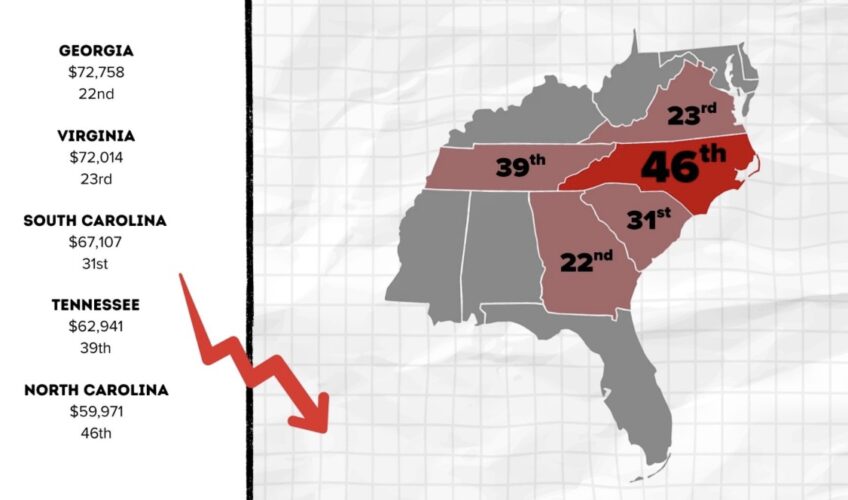
The National Education Association released its 2026 Educator Pay in America report this week indicating the Tar Heel State has fallen to 46th in per-pupil spending and teacher pay — the latter of which declined by three spots since last year. The NEA collects data annually from state departments of education, state affiliates, and public federal sources to determine outcomes.
READ MORE: NHC commissioner prods school leaders over $915K, questions if it’s for pre-K
ALSO: NHC school board decides against calendar change to accommodate teachers’ strike
According to the report, a teacher in North Carolina makes $16,500 less than the national average of $76,552.
“Every year, the story for North Carolina continues to get worse,” North Carolina Association of Educators President Tamika Walker Kelly said at a Monday press conference. “The downward trend reflects choices of a General Assembly funneling public money away from public schools through corporate tax cuts that have drained state revenue and a dramatic expansion of private school vouchers that divert public dollars to private hands.”
North Carolina Association of Educators — an affiliate of the NEA — is hosting the Kids Over Corporations Rally at the N.C. State Legislative Building in Halifax Square on Friday. The organization is expecting thousands of educators and advocates in the state capital.
New Hanover County Schools District informed that roughly 325 substitute positions were requested for May 1, with 194 filled and 131 still needing coverage. Personal leave requests were accepted until 5 p.m. on Friday, April 24, and according to NHCS, central office staff will be utilized to support schools in filling remaining vacancies as needed.
New Hanover County Schools confirmed the NEA’s numbers also trend consistently with what the district is seeing in other national analyses, such as the Education Law Center report “Making the Grade.”
“These reports highlight ongoing concerns regarding per-pupil funding levels and the challenges districts face in meeting the growing and increasingly complex needs of students,” Superintendent Christopher Barnes told Port City Daily. “Student needs have evolved significantly over the past decade, particularly in areas such as mental health, academic intervention, and workforce readiness. However, the state’s funding model has not been substantially updated during that same period. This misalignment continues to place pressure on school systems, especially those serving high-poverty communities.”
New Hanover County kindergarten teacher Alison Bellamy, also a member of NCAE, called the report’s near-bottom teacher-pay ranking “simply unacceptable.”
“The students of North Carolina deserve the best, and that requires valuing and investing in experienced, highly educated teachers,” she said.
Lindsay Parsons Noble, a high school civics and economics teacher for 25 years, agrees. Noble started her career in Tennessee but moved to the tri-county area in 2006, at first working in Pender County schools before moving to New Hanover County. She recalled making around two grand more at the time than in Tennessee.
“And I was so excited, thinking: ‘They’re actually paying me what I’m worth here,’” Noble said.
However, throughout the years, it shifted. A recession hit in 2008 and educators were put on a pay freeze. Then legislators voted to take away master’s pay from teachers in 2013, followed by docking longevity pay in 2015, instead moving toward a performance-based pay system.
“But it continues to be provided to other state employees,” Bellamy said, “and that funding was effectively rolled back into the salary schedule to support raises for beginning teachers. As a result, experienced educators did not see equivalent increases, and the salary scale became increasingly compressed.”
Bellamy will graduate in July with her doctorate in educational leadership and a focus on educational policy, yet struggles with the fact it will have no effect on her pay.
Noble, who has a master’s and is grandfathered in for the pay bump, said a decade ago she didn’t have a family or own a home, and could make ends meet by coaching on the side. Since, she has had children and thus financial responsibilities grew; it’s become tough receiving “a couple of little tiny increases” in pay throughout the years.
“So from year 15 to year 25, it’s almost like I’ve been stuck,” Noble said. “I’m dipping into my savings now.”
Today, Noble continues to clock basketball games, monitor ACTs on weekends and cover planning periods to help supplement. Money isn’t coming in for the extra hours she puts in nightly to grade papers or lesson-plan, as a typical workday also includes multiple mandatory trainings, book studies, IEP or 504 meetings.
“Too many educators work second and third jobs to make ends meet,” Kelly said. “One job should be enough for people educating our children — it should not be a radical statement.”
In Gov. Josh Stein’s 2026-2027 budget, he is recommending an 11% pay increase for teachers. Yet, the North Carolina General Assembly hasn’t passed its 2025 budget yet — the only state in the nation without one — and is working from 2023 numbers. This also means frozen salary increases and funding not accounting for expanding student populations.
“I’m teaching these teenage kids how to do budgets,” Noble said. “How has the General Assembly not actually passed one? It’s beyond me, but they act like it’s not that big of a deal. They say: ‘We are still funding things.’ But you’re funding things on money from years ago and inflation has skyrocketed just the last couple of years. And there’s been no change.”
Port City Daily reached out to all legislators in the tri-county region about where they stand on the budgets, asked for feedback on the NEA report numbers, as well as teacher pay increases. No one responded by press, though Rep. Deb Butler put forth a bill last week called “No Budget No Pay” to withhold representatives’ paychecks for everyday they don’t vote for the budget; a similar bill is rolling through the Senate as well.
According to Kelly, NCAE wants teachers to receive a 25% pay increase to account for inflation, rising healthcare costs and dormant educator pay. She reminded North Carolina is the only state in the country in 2026 to have average teacher salaries decrease.
“This is why we keep seeing educators leave NC to better paying jobs across the border,” Kelly said. “It is why teacher turnover has hit 10% for three consecutive years. You cannot build a stable, high-quality educator workforce when the state next door is offering thousands more per year. North Carolina cannot remain competitive for teachers, for students or for the businesses that depend on an educated workforce if the trend continues.”
Compared to North Carolina’s bordering states, NEA ranked Georgia 22nd in teacher pay at $72,758, with Virginia coming behind at 23rd ($72,014), followed by South Carolina in 31st ($67,107), and Tennessee in 39th ($62,941).
Gov. Stein has stated a goal of making North Carolina one of the highest for teacher starting pay. However, Kelly said to do so would mean a 21% pay increase at least is needed to match Georgia — that’s 10% more than the governor’s proposal.
“Every single neighboring state pays teachers more than we do,” she clarified of North Carolina’s $59,971 average.
When it comes to per-pupil spending, North Carolina dropped by 10 spots, NEA reported. North Carolina increased per-pupil spending by $40 from last year and tracks around $13,680. That is $5,567 below Louisiana, which holds the marker in the southeast; the national average is $18,870.
According to kindergarten educator Bellamy, she forks out upward of $1,500 of her own money annually to pay for school supplies and classroom needs.
“Books, instructional materials, snacks, and basic necessities for students who may not have them,” Bellamy listed. “These are not extras — they are essential to creating a supportive learning environment.”
She believes legislators need to make substantial changes that move beyond short-term corrective measures. Instead, Bellamy would like to see thoughtful commitments that show the state is invested in educators’ prolonged viability to help youth succeed into adulthood.
“This includes raising base salaries, restoring compensation for advanced degrees, and ensuring veteran teachers are not left behind,” Bellamy said. “In addition, schools need adequate funding so teachers are not covering basic classroom and student needs out of pocket. Policymakers must begin including teachers in the decision-making process.”
The New Hanover County Schools have been in contact with legislators, Barnes informed, consistently advocating for teacher compensation, the passing of a budget, funding flexibility and resource allocation. The district has been advocating for increased salaries for educators in the 15-to-24-year experience mark.
Bellamy has been teaching for 26 years in the state and said her last “meaningful raise” came in 2014, due to longevity pay being still active. It accounted for a bonus of anywhere from 1.5% to 4.5% of her salary. Even with Stein’s recent proposal, Bellamy doesn’t think the increase is enough, as she clocks weekly an estimated 15 hours without compensation.
“Coupled with rising living costs, this has made it increasingly difficult to maintain long-term financial stability, despite decades of experience and dedication to the profession,” she said.
Noble said keeping veteran teachers is a must in the workforce; however, she also believes they’re the ones being exploited. To her, lawmakers know the experienced educators are aware they will get a full pension starting at 30 years, no matter the age (or 25 years if aged 60 and 20 years if 50 or above). So regardless of pay increases, she believes most of the workforce sector will likely stick around.
“Don’t get me wrong: We’re grateful to even have a pension, it’s a benefit that a lot of other jobs don’t offer,” Noble said, noting if she moved out of the state right now she would not be eligible for full benefits. “It’s extremely frustrating because we’ve devoted our entire lives to this job.”
Had Noble stayed in Tennessee 25 years ago, she said she would be making around $80,000 today in one of its larger school districts — roughly $10,000 more than her current salary. If she still resided in her small, rural hometown in Bedford County, it would be around $5,000 more annually than she currently brings in.
Also, Tennessee pays more for educators who have a master’s degree and still recognizes longevity pay. Plus, the state provides pay bumps when teachers take additional classes throughout their veteran education career.
Turning new hires into veteran teachers is becoming problematic statewide as well. The North Carolina Department of Public Instruction has reported an attrition rate of 10.11% as of the 2024-25 school year, and teachers with 1 to 5 years of experience are leaving the profession most — between 14% and 18%.
Noble has worked with UNCW interns over the last five or so years, many of whom have decided to move to other states in order to take advantage of better salaries and retirement benefits. A few years ago, North Carolina eliminated state-funded retiree health coverage for teachers hired on or after Jan. 1, 2021.
Other educators-in-training, Noble said, have abandoned the classroom altogether after seeing the hurdles versus value firsthand. Classrooms are growing in size, putting a larger strain on teachers to get to know student needs one-on-one. Noble currently has 38 students on average, which has risen since she first started teaching in New Hanover County, then around 30.
The state passed a new attendance policy last year mandating a student cannot fail due to lack of appearing in school, which also adds more pressure. Noble said they work longer hours to ensure students don’t fall behind in schoolwork and can pass.
“It almost seems like there is a movement to dismantle the public school system,” she said.
She points to the Opportunity Scholarship Program as an example. In 2023, legislators dropped income caps and prior public school enrollment requirements to allow anyone to apply for the $3,000 to $7,000 scholarships. Lawmakers have allocated the program around $625 million for the 2025-26 school year, with funding anticipated to increase to $655 million in 2026-27, reaching over $700 million annually by 2027.
NCAE contends the voucher program has eaten into funding for public schools. Roughly 106,789 students are enrolled, according to data from the North Carolina State Education Assistance Authority. Stein has proposed capping the program at $90,000 for a family of four. If Stein’s budget passes, it would knock off roughly 60,000 students from the voucher program and the governor suggested putting a moratorium on new enrollment. Stein has indicated taking no action would divert $7.5 million away from public schools funding in the next 10 years.
Noble has friends — doctors and lawyers, making six figures a year — who have access to the vouchers for their own children to attend private schools, schools they already were enrolled in, she explained. She also takes issue with public taxpayer dollars helping fund private schools that are religious institutions, noting it goes against the separation of church and state.
The teacher plans to be at Friday’s rally in Raleigh. Bellamy cannot attend due to other commitments; however, she has marched during previous years and continues to advocate for value in the education profession, which she said she receives from students, colleagues and families.
“However, at the state and district levels, that sense of value is much less consistent,” Bellamy said. “Teachers are often not included in meaningful educational decisions that directly affect our classrooms. Our autonomy and professional expertise are not consistently recognized or valued, and that is unfortunate.”
Bellamy’s doctorate dissertation centers on educational decision-making, particularly teachers — the real “experts” in the field — deserving a seat at the table.
“If we want strong schools, we must trust and invest in the professionals who are working with students every day,” she said, adding it’s hard not to be discouraged by the limited progress, despite constant chatter between legislators and districts.
NCAE President Kelly said a more robust budget for public schools means more student-facing positions, a reduction in class sizes, and more one-on-one instruction, as well as all-around increased resources. This could amount to more tech programs or Chromebooks or even money to put toward school infrastructure.
In addition to teacher pay, Barnes said the district continues to advocate legislators on multitudes of issues — Exceptional Children (EC) weighted funding model to support diverse learning needs; significantly increased allotments for instructional support personnel — counselors, social workers — to enhance student safety and mental health; dedicated funding allotment for Multi-Tiered System of Supports Coordinators to ensure timely, targeted academic and behavioral interventions that improve outcomes and close achievement gaps; and expansion of the Community Eligibility Provision meal program to ensure all students have consistent access to nutritious meals, reducing barriers to learning.
“While districts continue to manage resources thoughtfully and strategically, local efforts alone are not sufficient to address these systemic funding gaps,” Barnes said. “Aligning the state funding model with current needs remains critical to supporting both student success and a sustainable educator workforce.”
Bellamy calls being a teacher a dichotomy of truths. It’s the best, yet one of the most “disheartening” jobs.
“It’s the best because of the children — their curiosity, their joy, and the incredible growth you get to witness each day,” she said. “There is nothing more powerful than being part of that foundation. At the same time, it can be deeply disheartening due to the lack of care and investment in public schools and children’s education. Despite those challenges, it’s the kids who keep me in it.”
At Port City Daily, we aim to keep locals informed on top-of-mind news facing the tri-county region. To support our work and help us reach more people in 2026, please, consider helping one of two ways: Subscribe here or make a one-time contribution here.
We appreciate your ongoing support.
