


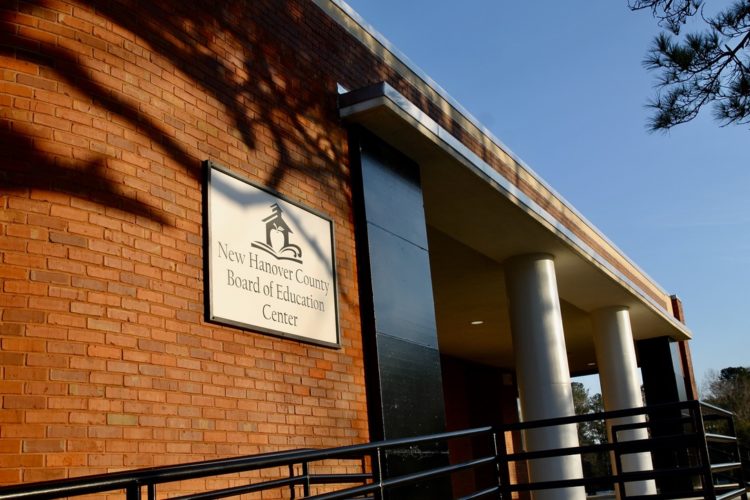
NEW HANOVER COUNTY — A recent New Hanover County Schools finance committee meeting revolved around the status of pre-K funding and whether $900,000 in additional county money was needed for the program.
At the committee’s April 21 meeting, Superintendent Chris Barnes explained the school district has balanced its budget based on several factors, including a 3% increase in the county’s operational allotment and implementation of a $25 student technology fee (exceptions to be made for students qualifying for free or reduced lunch).
READ MORE: NHCS narrows budget deficit to less than $500K with more projected county help
ALSO: NHC backing away from Revenue Stabilization Fund, tax increase to be reviewed
Barnes also said its pre-K capacity will remain the same. As part of the county’s budget cuts last year, commissioners voted to trim nearly a million dollars for six pre-K classrooms, half of the school district’s offerings.
School staff were able to make up the funding and keep the classrooms by using leftover Title I funds, federal dollars to assist children from low-income families. The district could use these funds on pre-K because the program’s eligibility is primarily based on a family’s income being at or below 75% of the state median.
The move wasn’t intended as a long-term solution to pre-K funding, but because the district has other financial scarcities in next fiscal year’s spending plan, Barnes told the committee the extra Title I funding — or “carryover” from unspent money in this year’s budget — would continue to be used for the classrooms.
Commissioner Rob Zapple, also a finance committee member, questioned if restoration of the county’s pre-K funding was necessary.
At a budget session on April 16, staff itemized budget lines the commissioners had indicated wanting to restore, including its annual workforce housing commitment. Also listed was “Increase Pre-K Contribution” at $916,500.
The commissioners questioned why the pot of money existed outside the school district’s planned 3% increase and asked if it was an additional request.
County Manager Chris Coudriet clarified — multiple times — that the county staff took the initiative to suggest it based on commissioners’ indication they would like to restore pre-K funding to former levels. Still, commissioners who have had one-on-one meetings with the superintendent reported Barnes said he could cover pre-K without additional money.
“I feel like I’m getting drug into a disagreement about what the schools have said they need; what I feel like you all have said is we want to maybe talk about pre-K,” Coudriet said.
Fast forward to the committee meeting and Zapple’s question: “Is that money necessary to make pre-K work?”
Barnes didn’t give a yes or no answer.
“I’m cutting things to make sure pre-K stays where it is,” the superintendent replied. “So in that regard, would that money be available for use in any number of other ways? Yes.”
The superintendent said the current proposed budget puts school funding so low that he doesn’t deem it “educationally responsible.”
However, Zapple’s qualm wasn’t with the district’s need for the money — he agreed the district should be funded more, particularly from the state — but rather how it was communicated to the commissioners.
He indicated tagging the $916,500 as “pre-K funding” wasn’t entirely accurate and questioned why it was presented that way.
“They just want an extra [$915,600] and they put the name pre-K on it so guys like me will go: ‘Yes! We’re going to get the pre-K,’” Zapple said.
Barnes told the committee the district did not request the $916, but if the county wanted to “lean back in” by restoring funding, it would be put to good use.
“That money is a rising tide that’s going to float all boats,” Barnes said.
It could be used to pay for the school board’s $534,000 in identified priorities that they are currently unable to afford, Barnes pointed out.
They include the addition of three assistant principals, reclassifying pay scales for exceptional children teacher assistants and including occupational therapy and physical therapy supplements.
Zapple indicated he didn’t doubt the schools would put the money to good use, but he questioned why the $916,500 was not part of the school’s general operating request.
“Well, jeez, I need $6 [million],” Barnes replied in frustration, noting the state’s biggest school districts were asking their commissioners for upward of $30 million.
Barnes said he wanted to be reasonable and financially responsible in its request to the county, though he said the ask could “easily” have been for a 4% or 5% increase to cover “critical” needs.
The superintendent said he was trying to find as much savings as possible within the district before coming to commissioners with an additional ask; for example, the district is exploring ways to reduce its physical building footprint to accompany declining enrollment. Despite the decreasing student population, the county has continued to increase funding, a narrative Zapple said he hoped would be the “headline” going forth.
Barnes recognized the county’s contributions in several budget sessions this year, but said his job was to advocate “relentlessly” for the benefit of the school district.
Additionally, New Hanover County Schools is putting forth a referendum on November’s ballot for a $320-million bond for large capital projects across the district.
Finance committee chair and board member Pat Bradford said the district’s budget request was also cognizant of the likely tax increase needed to support the bond next year; the county’s current estimate is 1.75 cents.
Bradford said the school board and district didn’t want to jeopardize the bond, claiming a tax increase this year coupled with the bond’s anticipated tax increase may sour voter’s favor at the ballot box.
Zapple indicated the committee’s explanation on the $916,500 was important for his ability to accurately advocate for the school’s request.
“I now am armed with a lot more information,” Zapple said.
Making pre-K work
Aside from using Title I money, the district’s plan to balance pre-K funding includes moving two classrooms from Murrayville and Blair elementaries to one of the district’s pre-K centers. Doing so would save $178,000.
“You could say to yourself this is only $178,000; however, we are at this place — we’re at the place where I’m scraping together smaller amounts of money to get the job done,” Barnes said.
Murrayville and Blair elementaries each have two pre-K classrooms, but they’re not “certified.” North Carolina Pre- offers some reimbursement for local pre-K classrooms but will not fund the uncertified rooms.
The essentials of a certified room include an internal bathroom and sink, plus an exterior door. The additions minimize interactions with school-aged children and particularly for the sink and bathroom, allow teachers to maintain the required class ratio of one teacher for every nine students. If there is a teacher and teacher’s assistant in a classroom, there can be 18 kids and neither instructor can leave without jeopardizing the ratio. Without an internal bathroom, they would need to escort all students to the bathroom at once, disrupting learning time.
Because certifying the Blair and Murrayville classrooms would take time and money the district doesn’t have, moving two classrooms (one from each school) to a certified room at the pre-K centers would allow the district to get reimbursed for the classrooms.
However, Barnes noted the move wouldn’t be “terribly popular” among parents; it would also require the school board’s sign-off.
To minimize disruption, the 4-year-olds currently enrolled in a pre-K spot at the two elementary schools will stay put, thus is the reasoning behind keeping one classroom at both Blair and Murrayville. It would be 3-year-olds impacted by the move.
Barnes said in his discussions with parents, the priority remained the number of slots — keeping the same amount of pre-K openings, no matter where they are placed.
Finance committee chair Bradford told Port City Daily the relocation of pre-K space is a “complicated and emotional issue wrapped around funding, or lack thereof.”
“The district is trying to live within means,” Bradford said.
At Port City Daily, we aim to keep locals informed on top-of-mind news facing the tri-county region. To support our work and help us reach more people in 2026, please, consider helping one of two ways: Subscribe here or make a one-time contribution here.
We appreciate your ongoing support.
