


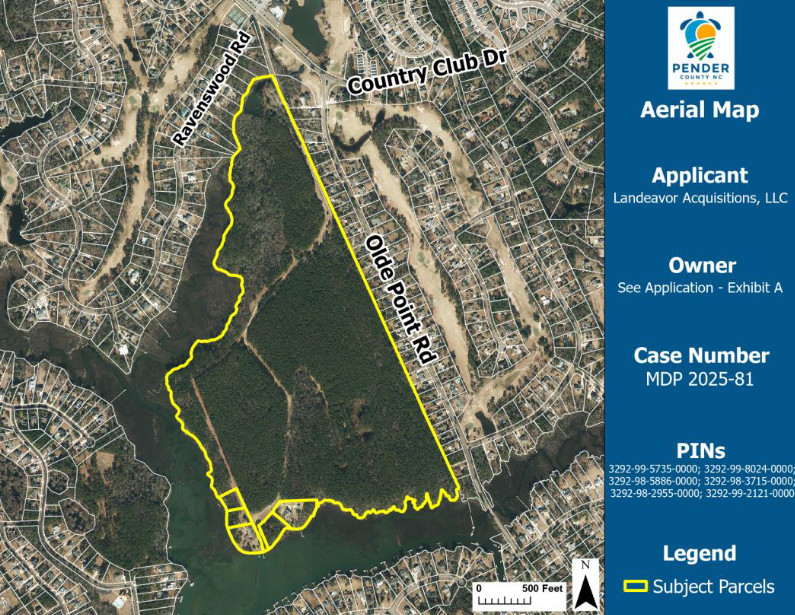
PENDER COUNTY — A proposed 355-home single-family subdivision in Hampstead won approval from the Pender County Planning Board in a 5–2 vote on Jan. 6. Board members said they were legally bound to approve the project because it meets county zoning rules, despite public opposition centered on traffic congestion, emergency access, and environmental impacts.
The project, submitted by Landeavor Acquisitions, LLC, was signed off on after three hours of discussion and public comment. Dozens of residents warned the development would worsen already strained infrastructure along Country Club Drive.
READ MORE: Surf City set for new 417-site recreational vehicle park
ALSO: Development moratorium discussed among Pender County commissioners
Landeavor Acquisitions has developed several residential projects across North Carolina and the Southeast, including Anchors Bend, a community of 218 homes on 129 acres in Wilmington. The Hampstead subdivision is planned on 147 acres off Olde Point Road and bordered by Nixon Mill Creek and Old Topsail Creek. Plans include 355 detached homes at a density of 3 units per acre, the maximum allowed under the county’s planned development zoning. There will be a clubhouse and pool, multiple waterfront park areas, a community dock and kayak/boat access, and a trail system with sidewalks, multi-use paths, and elevated boardwalk-style segments through wetland areas.
The development team highlighted the project’s amenities and compliance with county standards, while residents focused on whether existing infrastructure could support its scale. Board members echoed resident concerns, but said state law left them little discretion to deny a project in compliance with the county.
During its deliberations, Chair Damien Buchanan said the project placed the board in a difficult position because it met — and in some cases exceeded — Pender County’s unified development ordinance requirements. His comments came during an emotionally charged meeting, during which residents repeatedly interrupted proceedings with applause and frustration, prompting Buchanan to strike the gavel multiple times.
He explained under North Carolina law, the board’s review of planned developments is largely administrative. This means projects that comply with zoning, density and design standards cannot be denied based on traffic conditions, school capacity or other infrastructure concerns controlled at the state level, not by the county.
“What we’re looking at is whether they have followed the ordinance — have they met the objectives of the ordinances we have in this county, or not,” Buchanan said. “If they’ve done that, it’s our requirement to pass this master plan unless we find something else.”
About 20 residents at the meeting argued existing traffic conditions on Country Club Drive already exceed the road’s capacity, particularly during morning and afternoon school hours. North Carolina Department of Transportation traffic maps indicate traffic on Country Club Drive has climbed steadily over the past two decades, rising from about 5,600 vehicles per day in 2002 to about 9,700 vehicles per day in 2024 near the U.S. 17 intersection. Speakers also questioned whether the project’s traffic impact analysis accurately reflects real-world conditions.
Exult Engineering completed the TIA, approved by the Wilmington Urban Area Metropolitan Planning Organization and NCDOT in September 2025. The study evaluated projected traffic from the subdivision in combination with background growth and nearby developments, including Hawksbill Cove. It also analyzed conditions at intersections along Country Club Drive, U.S. 17 and Transfer Station Road.
The analysis estimates the development will bring approximately 3,200 vehicle trips per day at full build-out, with the subdivision expected to be built in phases. To mitigate its impacts, the developer will be required to construct a right-turn lane into the subdivision from U.S. 17 after 95 homes are built and install a traffic signal at Spring Garden Road after construction of the next 228 homes.
However, many residents contended the traffic study fails to capture routine congestion along Country Club Drive, citing narrow lanes and a lack of viable alternate routes.
“This morning alone, I couldn’t make a left off Ravenswood — traffic was backed up all the way to Sawgrass,” Dana Clark told the board during public comment. “I can’t imagine trying to make a left when a traffic light is installed on Spring Garden Road because all the eastbound traffic is going to block the end of Ravenswood, and I won’t be able to make a left.”
Others framed traffic as a public safety issue rather than an inconvenience, with concerns about emergency vehicles navigating congestion during peak hours and evacuations during severe weather events.
“Simply put, our community is not built to safely support this level of density,” resident Ivan Hudson-Bloom said. “Continuing forward as proposed would be irresponsible.”
Public safety concerns extended into questions about emergency access for the subdivision. Access into the neighborhood would be primarily from Country Club Drive, with a gated, emergency-only secondary outlet using an existing 25-foot-wide easement to Old Point Road, which then feeds back onto Country Club Drive.
Several residents argued the design effectively functions as a single access point, noting both routes ultimately funnel traffic onto the same congested roadway and are located roughly 1,800 feet apart along Country Club Drive via Olde Point Road.
“I was a firefighter and EMT for 25 years,” resident Mitchell Clark stated. “A single-road-in, single-road-out is a disaster. If I had to drive a ladder truck across that secondary access, I don’t know if any of you have ever seen a fire truck roll over, but I can guarantee you it’s six months to 18 months to get a new one. So safety wise, I think this is a big, big issue.”
Project representatives said they explored an additional access point at the opposite end of the property that would have provided a more direct secondary outlet. However, doing so would have required permission from the Olde Point Property Owners Association, which governs the adjacent subdivision.
Stratton Lobdell, secretary of the Olde Point Property Owners Association, told the board the HOA’s rules do not allow a roadway to be built across a residential lot. Lobdell said the HOA cannot authorize a road connection without changing its governing rules.
Despite resident concern, Pender County Fire Marshal Amy Burton said the project complies with county fire code requirements by providing two points of access: a primary entrance from Country Club Drive and a gated, emergency-only secondary outlet using an existing easement to Olde Point Road. County commissioners, at Burton’s request, approved adoption of Appendix D of the North Carolina Fire Code in December, which requires developments of more than 200 homes to provide at least two points of ingress and egress for emergency access.
Acknowledging the layout was not ideal, the fire marshal said the emergency-only access would be required to meet minimum width, clearance and load standards and would be accessible to emergency responders through a controlled gate system.
Beyond traffic and emergency access, residents also raised concerns about the project’s proximity to sensitive waterways, including Nixon Mill Creek and Old Topsail Creek that border the site. Project opponents said added pavement from subdivision roads would accelerate stormwater runoff into adjacent creeks, particularly during heavy rain events and hurricanes. Thus, they worried it would carry sediment and pollutants into waterways.
“These waters support salt marsh, shellfish, seagrass — they are a state-designated primary nursery area that shouldn’t be taken lightly,” resident Anne Deaton told the board. “They’re some of the best creeks we have left in Pender County. A development of this density will significantly increase stormwater runoff, degrade habitat, water quality and fish populations.”
Lee Kaess attorney David Ray, speaking on behalf of the applicant, explained the project is designed to meet all state and county stormwater requirements and emphasized wetlands on the property would remain undisturbed. Environmental consultants SEGI identified approximately 13 acres of wetlands on the site, all of which are proposed to be preserved and incorporated into open space areas.
He added the subdivision would be required to comply with North Carolina Department of Environmental Quality standards for coastal waters and final stormwater plans would undergo additional review and permitting from NCDEQ and county staff before construction begins.
As discussion wrapped, board members acknowledged lingering traffic, emergency access and infrastructure concerns, but said none rose to the level of a legal basis for denial.
County attorney Trey Thurman told the board when a proposed development complies with the UDO, it is entitled to approval even if board members or the public disagree with the outcome. He said broader concerns about traffic congestion or managing growth would need to be addressed through county ordinance changes rather than through administrative review of a single project.
As a result, the board ultimately voted to approve the development, clearing the way for the 355-home subdivision to advance to state permitting and county technical review. Because the project met county UDO requirements, no further action from county commissioners is required.
Have tips or suggestions for Charlie Fossen? Email [email protected]
At Port City Daily, we aim to keep locals informed on top-of-mind news facing the tri-county region. To support our work and help us reach more people in 2026, please, consider helping one of two ways: Subscribe here or make a one-time contribution here.
We appreciate your ongoing support.
