


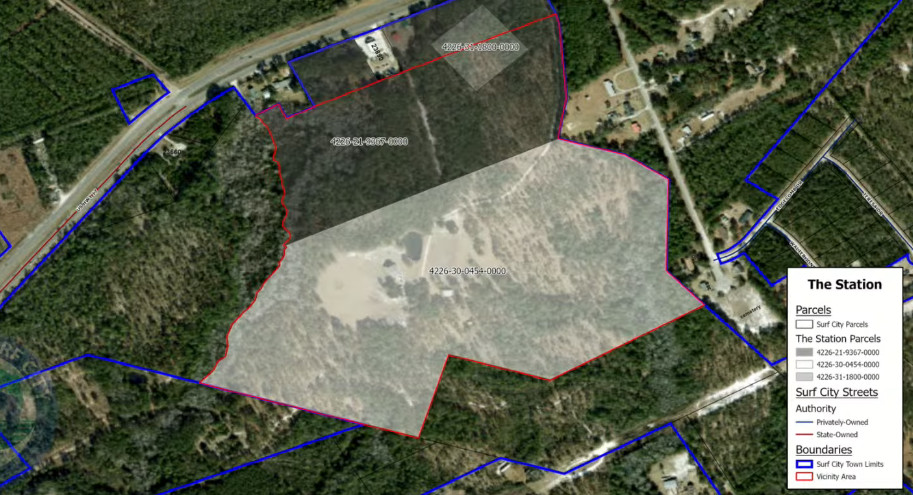
SURF CITY — Surf City council has opened the door for a new RV park and campground near Sloop Point, a move expected to invite more visitors to the area.
READ MORE: Amid tax impact concerns, Pender commissioners certify revaluation standards
ALSO: Development moratorium discussed among Pender County commissioners
A conditional rezoning for a 417-site recreational vehicle and campground park off U.S. Highway 17 near Sloop Point was approved by Surf City Town Council during its Dec. 2 meeting, with Mayor Teresa Batts casting the deciding vote in a 3-2 split. Mayor Pro Tem Hugh Cannady and councilmember John Koloski voted in favor, while Alicia Hawley and Trudy Solomon opposed the rezoning, citing concerns over traffic, sewer, and other infrastructure impacts.
The rezoning request, submitted by Jeff and Noni Morris of JL and Morris Enterprises of Hampstead, seeks to reclassify 82.5 acres from the residential R-10 to residential multi-family RM-5 conditional zoning, allowing for the development of a short-term stay RV park known as The Station.
The site plan, in its conceptual stage, outlines two phases: the first includes 240 RV sites, with the second including 177. Amenities would include two bathhouses and a 20-foot natural buffer with a walking trail surrounding the property.
The rezoning was required because the property is currently zoned R-10, which only allows low-density residential development, such as single-family homes on 10,000-square-foot lots. An RV park, even for short-term use, is not permitted under R-10 zoning. By rezoning to RM-5 conditional, the developers are able to pursue their plan for the RV park.
Hawley noted while the RV park would generate real estate and sales tax, it would not contribute to the accommodations tax, which applies to traditional lodging — such as hotels or vacation rentals — but not to RV sites. By contrast, if the property remained zoned R-10, roughly 320 single-family homes could be built, each generating property taxes.
“That’s 320 houses that we get revenue off of as a town,” Hawley said. “I’m just playing devil’s advocate, which is my job to do up here — we’re not getting accommodations tax out of it, and that’s a hard pill to swallow for me.”
Surveyor for the project Charles Riggs said while the town would not receive either accommodations taxes and individual real estate taxes, it would receive real estate tax for the entire parcel.
“I’m not a real estate appraiser, but I do know that if you get 400 sites on here, the value of this tract of land with 400 sites is more than just a tract of land when it comes to real estate tax,” Riggs said. “So you will be gaining money from real estate tax.”
Council discussion quickly turned to infrastructure, with members raising questions about how the RV park would handle sewer, septic systems, and stormwater. Under the concept plan, phase 1 would rely on a private septic system, while phase 2 is proposed to connect to the town’s sewer system. However, town staff clarified a sewer connection for phase 2 is not guaranteed. The applicant would have to apply for commercial sewer allocation, and approval would depend on available capacity when a site plan is formally submitted.
Resident Hunter Young, whose property borders the site, raised concerns about how close the septic drain field would be to his lot — specifically potential odors and increased stormwater runoff from impervious surfaces affecting his property.
In response, town staff said septic and stormwater designs would be evaluated during the site-plan review process, noting the concept does not yet include detailed engineering. They emphasized any septic system would have to meet state and local environmental standards, and stormwater controls would be required to prevent runoff from impacting neighboring properties.
As for impervious surfaces, planning staff said the site would only be required to have a paved access road, but the developer would not be required to pave the entire RV park. Gravel roads and RV pads could be used throughout the rest of the site, reducing the amount of impervious surface and helping manage runoff.
Resident Mickey Tucker asked whether the RV park would strain Surf City’s water system, questioning whether the town had enough supply to support hundreds of additional short-term sites.
Utilities director David Price said he was not concerned about water availability for the project. The town’s water system produces 2.6 million gallons per day, exceeding the year-round average of 800,000 gallons and the all-time high of 2 million gallons. The town is also planning to replace an existing 10-inch main supplying water to the island with a larger 16-inch line to improve transmission and support future growth. Based on current demand projections, he said the RV park would not exceed capacity.
Council members also questioned whether RV owners would be allowed to keep their campers parked on the property for extended periods, effectively turning the sites into long-term storage or semi-permanent residences. Surf City’s Unified Development Ordinance restricts RV stays to 90 days or less, and the ordinance prohibits using RV sites for year-round occupancy or permanent storage. Any RV left on a site beyond the 90-day limit would be considered a violation and could result in fines.
With 417 RV sites planned, council members discussed the potential effects of additional traffic during peak periods. Planning staff noted under R-5 zoning, the parcel could theoretically accommodate up to 1,650 sites, highlighting the potential for congestion. A traffic impact analysis is required for the project, but will be completed during the formal site plan review process.
Still, some council members thought the benefits outweighed the risks. Speaking in support of the rezoning, Cannady said he liked the fact the project was located off of U.S. 17, explaining much of the traffic from the site would be confined to the highway and not the town’s residential streets.
He added the park would make visiting the town and its amenities accessible to more people.
“Not everybody can afford a beach house, not everybody can afford to rent a hotel,” Cannady stated. “I have family that has campers, this is what they do. It gives them affordability to come visit what we have and take part in what we do and enjoy the beach and be able to have that experience. I don’t want to exclude anybody from that.”
The project now moves forward to the site plan phase, where engineering details, traffic studies, and utility connections will be formally reviewed by planning staff and council.
Have tips or suggestions for Charlie Fossen? Email [email protected]
At Port City Daily, we aim to keep locals informed on top-of-mind news facing the tri-county region. To support our work and help us reach more people in 2026, please, consider helping one of two ways: Subscribe here or make a one-time contribution here.
We appreciate your ongoing support.
