


PENDER COUNTY — As growth continues in Pender County, outpacing schools and roads capacity, this week Pender commissioners discussed the ins and outs of legalities regarding a development freeze.
READ MORE: Pender County asks courts to dismiss Pender Post lawsuit
State statute allows local governments to develop a temporary moratorium ordinance, but it requires the entity to prove its need, else the moratorium could be shot down by the courts. County attorney Trey Thurman presented to commissioners how it would work, on the heels of an outspoken public consistently showing up to planning board and commissioner meetings citing overdevelopment.
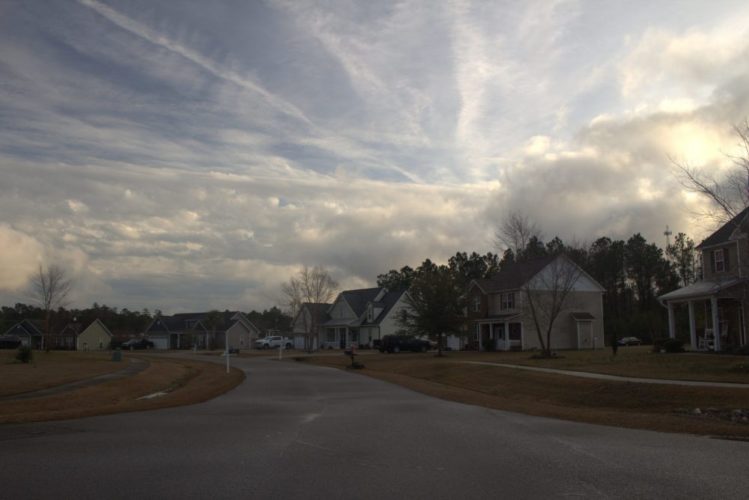
From 2020 through 2024, at least 5,000 single-family residential units have been approved in Pender County, the second-fastest growing in North Carolina. Its population has expanded by more than 25% since 2010.
Constituents have asked for commissioners to take action and slow down the build-outs in order to keep pace with infrastructure needs. For instance, a petition for a moratorium was started this year and has garnered more than 1,000 signatures to date. And just last month multiple people spoke during public comment at the last commissioners’ meeting against the 350-home Piver’s Tract — allowed by-right, meaning commissioners won’t have oversight. A moratorium was broached numerous times from the public, who spoke about the need for more schools, stormwater management, sewer and water capacity, pedestrian access, and safer traffic patterns, roadways and emergency access.
Chair Randy Burton said at the Oct. 20 meeting: “I wouldn’t mind a moratorium tomorrow. But we have to follow the law.”
He asked Thurman to look into the moratorium process to present commissioners at its Nov. 4 meeting. Though no action was taken Tuesday, Thurman was clear stopping development temporarily usually is enacted when the county shows there is an emergency need. He pointed to the Town of Belmont as an example of having a failing sewer system.
Located next to Charlotte, Belmont council voted favorably on a moratorium in 2024 to slow down residential output in the South Point area. This was due to a pump station potentially overflowing for even a two-year or 10-year storm event if building kept its current pace without addressing the issue.
The moratorium went into effect last October and will last through April 2027, to give the town time to upsize its 8-inch force main.
Thurman told commissioners the moratorium ordinance has to thoroughly state the time limit required to address correcting a need. It also would mandate the government entity lay out procedures to correct the problem that prompted any moratoria to begin with — such as, in Belmont, purchasing right-of-ways and easements, hiring an engineer, or entering a contract for construction.
However, even with a moratorium in place, it doesn’t affect developments approved beforehand or those with a:
- Special-use permit
- Site-specific vesting plan with expenditures already paid on it
- A plan or plat that has been preliminarily under review
A public hearing has to be held before commissioners vote on a moratorium ordinance and any development plans submitted before that hearing date will move forward. Plans that come in after would be put on hold.
A landowner against the moratorium can seek an injunction; the law states the case will be given priority and move up the court calendar to be heard by a judge expeditiously.
“It doesn’t matter if there are 10 cases in front of it, it will go to the top of the list,” Thurman said, noting the reasoning and ordinance has to be air tight or a judge would easily overrule it.
The attorney also was concerned with the downzoning provision tacked onto the Hurricane Helene relief bill, Senate Bill 382, last year. It prevents local governments from decreasing density or reducing usage of current zoning, noting an infringement on property rights. The attorney was clear the downzoning provision hasn’t been challenged yet in court, but the risk was there, he feared, for a moratorium as well.
“As a lawyer, you never want to tell a client you can’t do that, but there is an awful lot you can’t do when it comes to a moratorium,” Thurman said.
Some commissioners asked if school capacity would be reason enough to present a moratorium. Thurman thought it may be an “uphill battle.”
Around seven of 18 schools in Pender County are over capacity currently, including N. Topsail Elementary, South Topsail Elementary, Surf City Elementary, Surf City Middle School, Topsail Annandale Elementary, Topsail High School, and Topsail Middle School. All others are nearing capacity.
A new campus with J.H. Lea Elementary and Middle Schools is under construction and scheduled to open by fall 2027, eventually housing 2,300 students.
“While the schools will not open at full capacity, they will help relieve overcrowding in several parts of the district,” schools district spokesperson Bob Fankboner told Port City Daily. “Topsail High School will not directly feed into the new schools, so its enrollment levels will remain largely unchanged for now. However, we anticipate some relief at Topsail High once renovations at Topsail Middle are completed, as that facility is planned to transition into a freshman academy.”
Commissioner Jimmy Tate queried Thurman on how schools being over capacity wouldn’t constitute an emergency. He explained visiting Surf City Elementary and seeing students sitting outside of the classroom.
“If we don’t do something, could it not be ruled it would affect the quality of education, if teachers have 40 students in a classroom?” Tate asked.
His colleague, Vice Chair Brent Springer, suggested reaching out to the fire marshal, who would also confirm capacity issues leading to safety concerns. Thurman responded, even if that were the case, it would not address how a moratorium fixes the capacity issue.
“Rather, it’s about the school having to change or be closed,” he said, if it remained unsafe.
“I hear your presentation, counsel, but can we not address this issue with the General Assembly?” Tate asked. “If they made this rule, it seems we need to hold our state legislators responsible.”
Chair Burton said Rep. Carson Smith had an open invitation to the county commissioner meetings at all times and welcomed hearing his vision, mission and ideas for the 70,000 people who live in Pender County.
Thurman agreed it would be a good move as the legislature could change the law immediately, “if they wish — the issue with the schools is we need to build more schools.”
Tate conceded that would be his argument to have the temporary moratorium ordinance: “To build new schools, it takes two to three years. Until we build the schools and catch up to the growth, we have no where to put our students.”
Another frequent complaint from residents who speak out against development has come with bottlenecked traffic, particularly as the Hampstead Bypass continues to be finished by the North Carolina Department of Transportation. Like school capacity, Thurman didn’t think traffic matters met the threshold laid out by the statute.
“We don’t own the roads,” he said, noting any changes to help alleviate congestion has to be decided upon by the DOT and therefore wouldn’t be in line with the moratorium’s regulation for the county to show how it would fix the problem that prompted halting developments. “We can’t take steps or outline them to move the Bypass ahead faster or make other changes, like drop the speed limit.”
Springer asked for clarification on exactly what accounted for an emergency, to which Thurman said something posing “imminent” danger and risk. Springer broached emergency staff and response times, saying safety is paramount to the constituency. He thought public safety for health or medical emergencies would be vulnerable if crews couldn’t reach residents in a timely manner due to congested roads. He also questioned whether having understaffed fire, police and EMS personnel would not elevate the county’s cause for considering the ordinance.
The vice chair asked Thurman if he would be willing to draft a moratorium for the commissioners to see, but the attorney was unclear what should be in it, including reasoning, timeline, and if it would affect the whole county or only certain areas.
Burton stepped in and sided with Tate on going to the state first. He asked Thurman to put together a resolution for the commissioners to take up, asking the General Assembly to consider issues affecting the county leading to the moratorium discussion.
The chair also indicated one person’s comment against the Piver Tract at the commissioners’ Oct. 20 meeting gave him pause. A dozen people appealed to the elected leaders, one pressing them to buck developers, another welcoming a temporary high-density moratorium at any cost, even if taxpayers have to pay for a lawsuit filed against the county in its aftermath.
“Have the courage to stand up and do what you were elected to do: Protect us,” Susan Christie told commissioners Oct. 20, to much applause.
From her view, she explained the taxpayers have to pay for more schools and other infrastructure as new developments come in, thus justifying putting the money toward litigation that potentially may come from a moratorium.
Burton didn’t think everyone would agree with Christie’s approach.
“Some are on fixed incomes,” Burton said Tuesday, particularly speaking of elderly residents. “We on this board are not all power on heaven and earth. A lot of us agree with smart growth and development. And I wish we could partner more with developers and residents to make the developments more in line with our community. I push for that, but at the end of the day they will do what they can do by-right.”
Want to read more from PCD? Subscribe now and then sign up for our morning newsletter, Wilmington Wire, and get the headlines delivered to your inbox every morning.
