


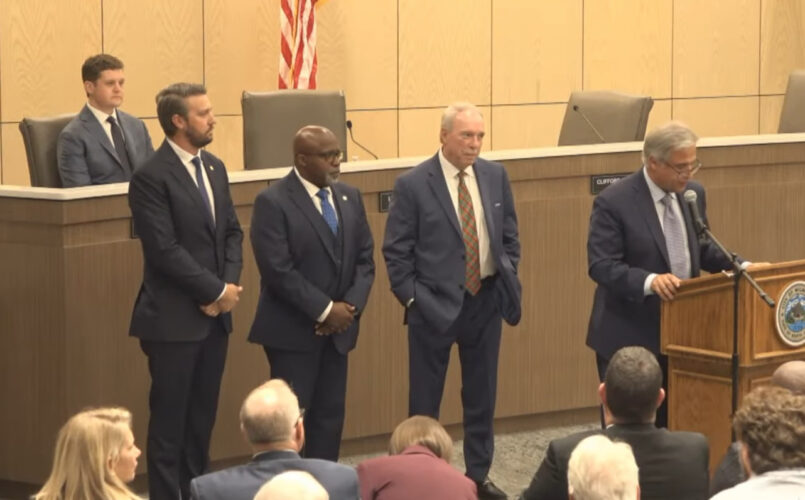
WILMINGTON — With the swearing in of three newly elected council members Tuesday night, the City of Wilmington said goodbye to three outgoing members, including the longest serving council member.
“I told somebody earlier tonight, I said, ‘I feel like I’m attending my own wake,’” Republican Charlie Rivenbark said in his farewell speech in council chambers. “It’s with mixed emotions that I leave here. I’ve done this for a third of my life, and I’m very proud to leave the city in the shape it’s in.”
READ MORE: Newly elected council members talk housing goals, other candidates discuss political futures
Rivenbark decided not to run in this year’s election, telling Port City Daily his 77 years of age meant it was time to go.
“There’s too many good young people out there that need to step up,” Rivenbark said, lauding the new crop of council members as “wonderful” additions to council.
JC Lyle, Cassidy Santaguida and Chakema Clinton Quintana were all sworn in Tuesday as well after winning out over incumbents Clifford Barnett and Luke Waddell, leaving the council controlled by women, Salette Andrews making up the fourth spot. Council races are technically nonpartisan, but this new council will be all Democratic now.
Waddell, a Republican, urged the new council to ensure a diversity of ideas continue to be discussed.
“The city is made up of a lot of people who see the world differently — Republicans, Democrats, independents, Libertarians, a lot of people who don’t think in partisan terms whatsoever, people of faith, young families, retirees, small business owners,” Waddell said in his speech at Tuesday’s meeting. “You know the makeup of this city. They are worried about taxes, growth, safety, neighborhood, character, affordability, whether kids are going to be able to live here when they grow up. All of them deserve representation.”
Waddell also thanked Rivenbark for sharing his wisdom and demonstrating what it is to be a “true servant.”
Rivenbark served the city for six terms beginning in 1992 before taking a break in the early 2000s until his comeback in 2009. He has overseen the city’s growth from 55,000 to 122,000 people, along with several city achievements he highlighted, including developing the downtown Riverwalk, several annexations that extended the city’s footprint and tax base, the creation of the Cape Fear Public Utility Authority and the purchase of the Skyline Center.
Rivenbark told Port City Daily his desire to run for council, back in the early ‘90s, was driven by the desire for the city to prepare for and court growth.
“I didn’t go on council with any kind of an agenda at all except that I felt that the city was just, we were just kind of muddling along,” he said. “There was nothing new being done, there was no vision.”
After he was elected, conversations started on developing the northern end of downtown, building the convention center and annexing land to expand the tax base. With the direction of city staff, the debt stayed within reason and tax rate stayed “middling,” Rivenbark said, leading to the “excellent” financial shape the city is in now, such as its AAA bond rating.
Rivenbark said he asked folks after the election why they ousted two incumbents in spite of the city’s success. The response, according to him: “I don’t know. I just wanted a change.”
As much as Rivenbark’s draw to local politics was to kickstart expansion and economic development three decades ago, he agreed this political moment is more about reacting to the consequences of that growth. Ranking as top priority for the incoming council members is affordability, specifically in housing.
Port City Daily asked Rivenbark if he thought the city could have taken different measures to combat the rising unaffordability in the region.
“It’s not like we were sitting over there in the dark not knowing that the growth was happening, but I don’t know, that’s a good one,” Rivenbark said, also pointing to 2018’s Hurricane Florence and 2020’s Covid-19 pandemic as exacerbating the issue.
He pointed out building affordable housing often isn’t profitable for developers without government support, which the city has provided, most notably in the 278-unit Starway Village redevelopment. He also pointed to the city’s density bonuses — allowing developers to have more dense housing than allowed in the land code in exchange for affordable housing components — as another way council has tried to boost affordability. He said he looked forward to how the new council members would handle the issue.
Port City Daily also asked Waddell and Barnett to weigh in on the council’s response to the affordability issue.
“I don’t think we’re going to tax our way into affordability,” Waddell said. “We think that we’ve made some good strides by utilizing some tax money toward gap financing, but the other issue is that we just are 52 square miles in the City of Wilmington, and there’s not that much real estate left … You’re not going to make it the most affordable place to live because [we] just don’t have the space.”
Barnett said: “I think we did the best we could asking individuals when they came before us, I would always ask, ‘How is this going to help with affordability?’”
Barnett added he’d also like the city to do more to keep people in their homes, such as through rental assistance or preventing code violations.
These programs can also prevent homelessness, which has risen from less than 300 people to more than 500 since 2018. Barnett supported the plan the city put together with the county in September 2024, which has now largely fallen to the wayside after the county decided to pull out earlier this year.
Waddell was not in favor of the plan, citing the lack of “accountability measures” for governments and nonprofits involved. The council member was vocal about his opposition to Housing First principles — trying to house homeless individuals without a prerequisite of sobriety or mental health assistance — and this year he also championed the city’s anti-camping ordinance.
The ordinance expanded what the city already had on the books prohibiting camping, sleeping and loitering on public property, though Waddell pushed for the ordinance after fielding complaints about homeless people occupying the sidewalks outside businesses and harassing downtown visitors. The new city chambers were packed with residents, most against the ordinance, on the nights the item was discussed; several public commenters criticized Waddell for the move, which he said became “really uncomfortable” sometimes.
However, Waddell said he had no regrets.
“I think it was absolutely the right thing to do,” he said. “I think there are hundreds of cities who have ordinances that are far more strict than the one that we ended up passing.”
Aside from the policy issues they faced, both Waddell and Barnett said they will miss the relationships they built and helping city residents solve problems. Waddell said he was still receiving requests for assistance even after his election loss.
“My strength was always being able to listen to both sides, and I felt as though my position was always to be that calm voice, the voice of reason,” Barnett said, noting his advice for future council would be to continue strengthening relationships with community partners.
Waddell said he will also miss being able to advocate for the Wilmington Police Department, particularly retaining the current workforce — around 80 less than the desired amount — and recruiting new officers with better compensation. He thinks it should remain council’s top priority.
“We cannot allow that to get worse,” he said. “I think some of it was cultural, and hopefully we’ve fixed that with Chief [Ryan] Zuidema, who’s really hit the ground running … we’ve just got to support him.”
While Rivenbark is retiring from politics — and looking forward to spending more of his energy on real estate — Waddell and Barnett haven’t yet made up their minds on another run.
“[God] hasn’t said to me what door or doors he plans to open, and he doesn’t actually tell me until it’s a need-to-know basis, so I’m going to enjoy doing some of the things that I was assigned to do,” Barnett said, referring to his role as a pastor.
Waddell, who said several residents have asked him to run for another office as filing for the 2026 election is now open, isn’t in a hurry to decide. He said he felt more relieved after this year’s election than anticipated, as now he’ll have more time to spend with his family.
“It is heavy work, even at the local level, it is heavy work, if you take it seriously,” he said. “And I tried to take it very seriously. It was very important to me, and so I’m enjoying my newfound time.”
Tips or comments? Reach out to journalist Brenna Flanagan here.
At Port City Daily, we aim to keep locals informed on top-of-mind news facing the tri-county region. To support our work and help us reach more people in 2026, please, consider helping one of two ways: Subscribe here or make a one-time contribution here.
We appreciate your ongoing support.
