PENDER COUNTY — Though the traditionally red Pender County is maintaining the status quo with GOP leadership securing numerous seats as part of the midterm elections, its county boards will have new members enter the fold before the end of the year.
Around 45.80% of the 55,165 registered Pender County voters turned out for the 2026 midterms. While state races will keep the same representation — Republican Carson Smith for House District 16 and Republican Brent Jackson for Senate District 9 — the board of commissioners will have three new Republicans sworn in by December after the votes are canvassed later this month.
Shayne Frey takes over for District 1, Ryan Collins for District 2 and Andy DeVane for District 3; Commissioner Jimmy Tate also ran uncontested to maintain District 4.
Only two Democrats opposed seats on the commissioner board, including Tim Zizack with 11,219 votes against Frey’s 14,112; Brookey Hardee had 10,220 votes against Collins’ 15,141.
On the board of education, Republicans Jennifer Hansen and Jason Spivey were re-elected, with Republican Jason Jordan joining District 2. All three ran without Democratic challengers in 2026.
Republican Alan Cutler also was uncontested for sheriff, securing his fourth term since first taking the position in 2018.
A new Pender County Clerk of Court is also elected in Republican Camille Costin Harrell, who resigned from the Pender County Clerk of Superior Court’s Office in 2024 after a judge dismissed a petition to remove then-elected clerk Elizabeth Craver from office at the time. Craver, found not guilty onthree felony counts of obtaining property by false pretenses, lost the primary this year; however her mother, Brenda Tucker, entered the race as a write-in candidate against Harrell. Tucker received 4,218 votes to Harrell’s 14,423.
All constitutional amendments also passed county-wide.
Below are the results from the N.C. State Board of Elections, which will be canvassed on Friday, Nov. 13.
U.S. Senate
NAME ON BALLOT
PARTY
BALLOT COUNT
PERCENT
Michael Whatley
REP
14,051
54.82%
Roy Cooper
DEM
10,898
42.52%
Shannon W. Bray
LIB
470
1.83%
Michael Dublin
GRE
213
0.83%
U.S. House of Representatives District 7
NAME ON BALLOT
PARTY
BALLOT COUNT
PERCENT
David Rouzer
REP
15,274
59.55%
Kimberly Hardy
DEM
10,133
39.51%
Maad Abu-Ghazalah
LIB
241
0.94%
N.C. Supreme Court Associate JusticeSeat 1
NAME ON BALLOT
PARTY
BALLOT COUNT
PERCENT
Sarah Stevens
REP
14,554
57.31%
Anita Earls
DEM
10,841
42.69%
N.C. Court of Appeals JudgeSeat 1
NAME ON BALLOT
PARTY
BALLOT COUNT
PERCENT
Michael C. Byrne
REP
15,063
59.42%
John S. Arrowood
DEM
10,289
40.58%
N.C. Court of Appeals JudgeSeat 2
NAME ON BALLOT
PARTY
BALLOT COUNT
PERCENT
George Cooper Bell
REP
15,021
59.37%
Tobias (Toby) Hampson
DEM
10,280
40.63%
N.C. Court of Appeals JudgeSeat 3
NAME ON BALLOT
PARTY
BALLOT COUNT
PERCENT
Craig Collins
REP
14,925
59.00%
Christine Marie Walczyk
DEM
10,373
41.00%
N.C. Senate District 9
NAME ON BALLOT
PARTY
BALLOT COUNT
PERCENT
Brent Jackson
REP
17,011
100.00%
N.C. House of Representatives District 16
NAME ON BALLOT
PARTY
BALLOT COUNT
PERCENT
Carson Smith
REP
15,375
60.34%
Jim Harris
DEM
10,106
39.66%
N.C. District Court Judge District 6 Seat 1
NAME ON BALLOT
PARTY
BALLOT COUNT
PERCENT
Lindsey L. McKee
REP
16,991
100.00%
N.C. District Court Judge District 6 Seat 2
NAME ON BALLOT
PARTY
BALLOT COUNT
PERCENT
James H. Faison III
DEM
13,262
52.20%
Kurt B. Fryar
REP
12,145
47.80%
N.C. District Court Judge District 6 Seat 3
NAME ON BALLOT
PARTY
BALLOT COUNT
PERCENT
Janelle L. Cline
REP
14,705
58.29%
Melinda H. Crouch
DEM
10,523
41.71%
N.C. District Court Judge District 6 Seat 4
NAME ON BALLOT
PARTY
BALLOT COUNT
PERCENT
Chad Hogston
REP
15,055
59.56%
Katherine Corpening
DEM
10,220
40.44%
District Attorney District 6
NAME ON BALLOT
PARTY
BALLOT COUNT
PERCENT
Jason W. Smith
REP
17,191
100.00%
Pender County Commissioners District 1
NAME ON BALLOT
PARTY
BALLOT COUNT
PERCENT
Shayne Frey
REP
14,112
55.71%
Tim Zizack
DEM
11,219
44.29%
Pender County Commissioners District 2
NAME ON BALLOT
PARTY
BALLOT COUNT
PERCENT
Ryan Collins
REP
15,141
59.70%
Brookey Hardee
DEM
10,220
40.30%
Pender County Commissioners District 3
NAME ON BALLOT
PARTY
BALLOT COUNT
PERCENT
Andy Jessie DeVane
REP
17,050
100.00%
Pender County Commissioners District 4
NAME ON BALLOT
PARTY
BALLOT COUNT
PERCENT
Jimmy T. Tate
REP
18,033
100.00%
Pender County Board of Education District 1
NAME ON BALLOT
PARTY
BALLOT COUNT
PERCENT
Jennifer R. Hansen
REP
17,093
100.00%
Pender County Board of Education District 2
NAME ON BALLOT
PARTY
BALLOT COUNT
PERCENT
Jason K. Jordan
REP
16,958
100.00%
Pender County Board of Education District 4
NAME ON BALLOT
PARTY
BALLOT COUNT
PERCENT
Jason Spivey
REP
16,949
100.00%
Pender County Clerk of Superior Court
NAME ON BALLOT
PARTY
BALLOT COUNT
PERCENT
Camille Costin Harrell
REP
14,803
77.55%
Write-In (Miscellaneous)
4,286
22.45%
Pender County Sheriff
NAME ON BALLOT
PARTY
BALLOT COUNT
PERCENT
Alan W. Cutler
REP
17,309
100.00%
Pender County Soil and Water Conservation District Supervisor
NAME ON BALLOT
PARTY
BALLOT COUNT
PERCENT
Jennifer Hornacek
8,713
29.78%
Michael Shaun Wells
7,055
24.12%
Gene Buron Lanier
6,773
23.15%
W.W. (Bill) Murrell, Jr.
4,027
13.77%
Ivan Christopher Blume
2,280
7.79%
Write-In (Miscellaneous)
407
1.39%
Constitutional Amendment: Require ID for Voting
NAME ON BALLOT
PARTY
BALLOT COUNT
PERCENT
For
18,505
73.62%
Against
6,632
26.38%
Constitutional Amendment: Max income tax rate of 3.5%
NAME ON BALLOT
PARTY
BALLOT COUNT
PERCENT
For
18,995
75.59%
Against
6,134
24.41%
Constitutional Amendment: Property tax levy limit
NAME ON BALLOT
PARTY
BALLOT COUNT
PERCENT
For
18,389
73.50%
Against
6,631
26.50%
At Port City Daily, we aim to keep locals informed on top-of-mind news facing the tri-county region. To support our work and help us reach more people in 2026, please, consider helping one of two ways: Subscribe here or make a one-time contribution here.
As the precincts opened at 6:30 a.m. across the tri-county region, varied precincts prepared to welcome voters for the final push of the 2026 midterm elections. (Port City Daily/Emily Sawaked)
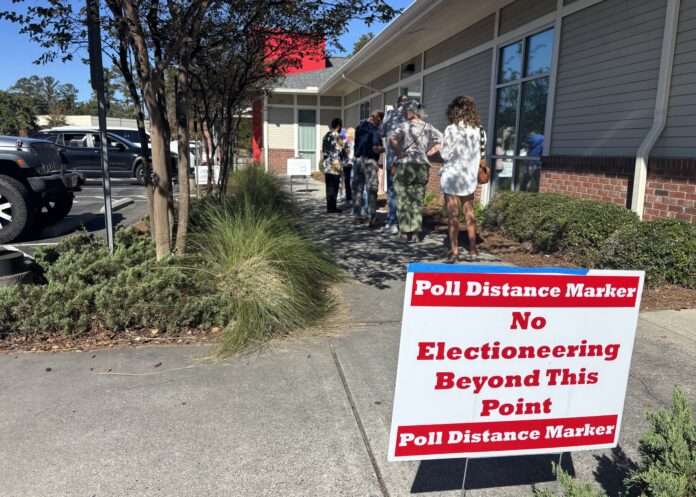
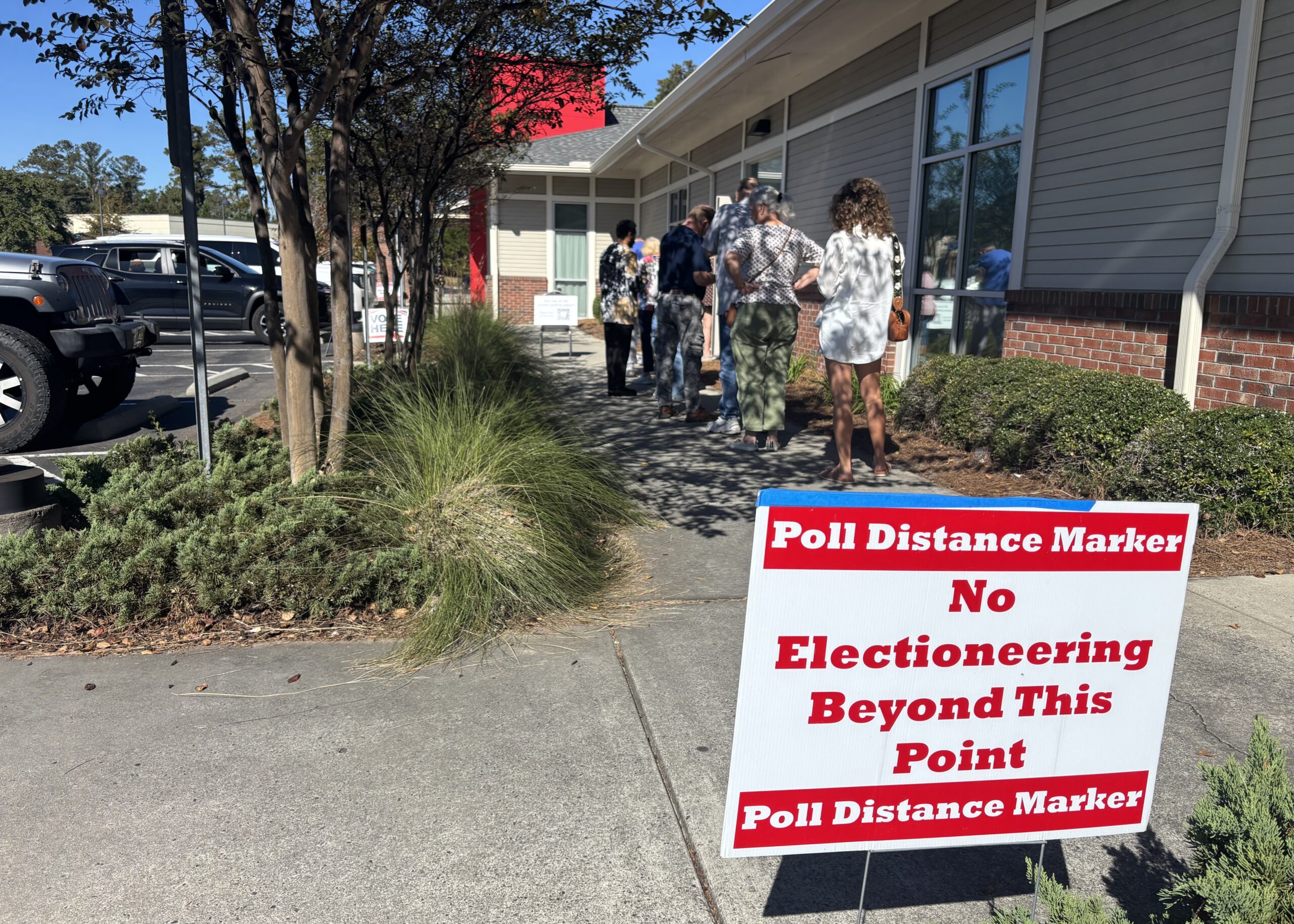
SOUTHEASTERN N.C. — As the polls opened at 6:30 a.m. across the tri-county region, varied precincts prepared to welcome voters for the final push of the 2026 midterm elections.
New Hanover, Brunswick and Pender counties have commissioners, board of education members, and legislators on the ballot this year, among judges, sheriffs, clerks of court and the constitutional amendments. Voters cited a multitude of issues, from the high cost of goods to area growth to teacher pay, as concerns that helped guide them at the polls.
At the Homer E. Wright Event Center in St. James Tuesday, newly minted Southport residents Sonny and Connie Wooten were concerned by overdevelopment in the area.
“I think infrastructure should precede the development,” Sonny Wooten said, pointing to county services, such as water use, and roadways being strained.
The North Carolina House District 19 race between Democratic candidate Scott Nasiff and incumbent Charlie Miller, who has served since 2021, was a race the Wootens were watching closely, though they declined to say how they were voting.
Miller has not responded to Port City Daily’s previous requests about development concerns, but Nasiff said a few weeks ago he would consider allowing the local government to institute impact fees on developers to pay for infrastructure. This is disallowed in North Carolina and needs approval from the state’s General Assembly. Nasiff has also said he would sponsor a bill allowing a local government to approve or deny a development, based on whether infrastructure is in place — roads, schools, water systems, fire and police.
Meanwhile, Brunswick County voters Terry and Bob Wynne had their eye on the U.S. Senate race, featuring Democratic candidate and former governor Roy Cooper facing off against Republican, and President Donald Trump favorite, Michael Whatley. Cooper has a 9-point lead, according to a new ECU poll.
The Cooper race also struck a cord with Republicans Jim and Jennifer Ashford, who moved to Brunswick County from Charlotte in the last few years.
“He handled Covid horribly,” Jennifer Ashford said, calling the former’s governor’s actions “Draconian.” “Cooper was very, very controlling.”
Cooper shut down the businesses on March 17, 2020, and staggered opening essential businesses that May in a three-phased approach statewide, requiring heavy social-distancing measures. Retail stores, commercial travel, restaurants, child care and personal care businesses, among others, were allowed to open in the spring, while bars, gyms, amusement parks and movie theaters remained closed until that fall. A group of bar owners ended up suing Cooper over the measures.
“He should have considered we’re a purple state and you don’t need to just close down,” Jim Ashford added. “He overreached and it was odd what he chose to be essential and it looked like it was driven from his party.”
While the Ashfords noted they weren’t super fans of Whatley, they conceded they would rather see him in office.
The Wynnes were concerned about government overreach too. Terry Wynne said her parents lived in Cuba under Fidel Castro’s reign and lost everything they worked for.
“I’ve seen what communism does to countries, and I think the ignorance of people believing the very subtle lies is devastatingly horrific,” Terry Wynne said. “And we can lose everything out of ignorance.”
Though conservative-leaning, the Wynnes are independents, much like the unaffiliated voters leading registration statewide with 3.1 million — or 40% of the voter makeup.
“It’s a declaration of being open-minded,” Terry Wynne said.
Republican Shawn Canniff at the Leland Cultural Arts Center cited similar fears about country’s direction “going socialist.”
“I like border security. I like an ID to vote,” Canniff said. “I don’t think illegals should vote.”
The Wynnes and Caniff were partial to casting a ballot on Election Day proper, both believing it should be a national holiday and day off for voters. They also take issue with mail-in absentee ballots.
Terry Wynne said she understands if someone needs an absentee ballot for extreme circumstances, but calls their current prolificity troublesome, “with so many controversies going on.”
“I personally know two people that received ballots from different states and they live here now,” she said. “And they’ve been taken off the rolls there, but they still receive ballots. I mean, it’s just ridiculous.”
Brunswick County has received 2,561 absentee ballots according to the State Board of Elections data; overall during early voting, 62,606 mail-in and in-person ballots were cast. Absentee ballots are accepted until the polls close at 7:30 p.m. on Election Day and can be dropped off in person.
If mailed, the ballots have to arrive before the polls close and can be tracked here; though a voter can alson let a precinct worker know to cancel their absentee ballot and cast one in-person instead.
Also at the St. James polls Tuesday morning, candidates were making rounds. U.S. Congressman David Rouzer, running for re-election for the House of Representatives District 7, was on site meeting with voters. One person approached to pray with him, as constituents and GOP volunteers circled around him, heads bowed.
Rouzer has held office since 2015 and faces off against Democratic candidate Kim Hardy and Libertarian Maad Abu-Ghazalah.
“What I’ve seen so far is a lot of enthusiasm,” Rouzer told Port City Daily.
Rouzer didn’t attend any candidate town halls or forums in the tri-county region this year, though did appear at a Brunswick County transportation summit on Oct. 20. As exclusively reported by Port City Daily, he announced at the event he will try to secure a one-year extension of the federal grant deadline or additional funding for the Cape Fear Memorial Bridge replacement, but also conceded it wouldn’t be easy.
On Tuesday the congressman said he was heading to Pender County, Sampson County and Cumberland County during his Election Day polling tour. District 7 serves a population of more than 820,000 people and eight counties, including New Hanover, Pender and Brunswick.
“There’s only so much you can do the day before or the day of the election, as far as affecting the outcome,” Rouzer said, “but this is a good way to spend the time, hit various precincts and say hello to people, and thank the volunteers and pollworkers.”
At the Leland Cultural Arts Center precinct, one poll worker, Johnnie Simpson, said she had volunteered during elections for “many years” and was the chief judge at the arts center since it opened a decade ago.
“It’s fun and you learn a lot,” she said. “This was a popular early voting site for the last two-and-a-half weeks.”
Marie Burton, a registered Democrat, clarified she usually votes early at the arts center but was too busy this year and instead had to go to her precinct in Navassa.
On a local level, the retired teacher was focused on the Brunswick County Board of Education, which has four candidates running for districts 3 and 4 — only one, Steve Gainey, is an incumbent.
“My big thing is, when you have board members, if they’ve never been in the classroom, to me, I think it’s hard because you’re not in it, you don’t see it. So you can make your opinions from outside,” Burton said and pointed to overcrowded schools and the need for more teachers paramount among her considerations. “But I don’t know how they’re going to get more teachers when you have so many leaving the profession and you have new hires coming in who don’t last a year.”
Brunswick and New Hanover counties both have school bond referendums on the ballot this year to help cover capital needs in the districts.
Burton also specified broader issues of concern, such as inflation and the cost of living, from fuel to housing to grocery prices. Brunswick resident Webster Burrier echoed the sentiment and supported the constitutional amendments on the ballot, including the levy on property taxes capping how much can be paid to local governments and the state income tax cap at 3.5%.
“Anything that we can do to keep a little extra money, even if it’s a couple $100 a year staying in the people’s pockets,” Burrier said. “I know in the grand scheme it was obviously going to be a trade-off for other funding.”
As previously reported by Port City Daily, many believe if a sales or property tax is capped, less money will be available to pay for needed services in a growing state, which means fees could appear elsewhere for constituents to pay. Others say it’s a way to ensure the government spends within its means.
Burrier thought North Carolina had a leg up in some of its state-funded projects already, citing roads being better here as compared to Pennsylvania, where he once lived. Growing up in a family of Republicans, Burrier said in 2016 he switched to independent.
“A lot of people in my generation, they’re 20s into early 30s, and starting to kind of get fed up with the duopoly,” he said of the two-party system.
Burrier was among the400 voters that came through the Leland Cultural Arts Center Tuesday afternoon, while across the bridge in New Hanover County, the Martin Luther King Jr. Community Center had a slower day with around 160 people casting a ballot by 1:30 p.m.
Emma Hanes said she was voting for candidates who will ensure current SNAP benefits remain in place and free lunches are available at schools. The latter is something Democratic New Hanover County Board of Education candidate Wendy Dale was platforming for this season. The school board also was a race Hanes had her eye on.
“I’m trying to be more involved in the local community,” she said, though didn’t clarify who she was voting for.
However, she thought female representation and diverse perspectives remained important, no matter if at the local, state or federal level.
According to poll worker Steve Dano, early voting was busier at the MLK Jr. Community Center site. Numbers show around 7,429 voters cast a ballot there ahead of Election Day.
“We had lines wrapped around the building,” Dano said.
Military Cutoff Road Northeast Library was the busiest location during early voting, with 18,948 voters. On Election Day, 420 had come through by 3 p.m.
RepublicansAnthony and Linda Giovannucci were there after creating their own practice ballot over the Halloween weekend — what they dubbed a “Frankenstein model” in support of a mixed-bag of candidates. The Giovannuccis were focused on state and federal issues, particularly calling for an end to the “senseless wars.”
“Republicans had a couple years to get it right. I didn’t think they did a great job, so it’s time to mix things up a little bit,” Anthony Giovannucci said, adding the U.S. Senate and House aren’t doing their jobs either, “letting the executive branch run away and do what it wants.”
He pointed to needless spending on the creation of a ballroom and arch, which President Trump has championed in D.C., but also said he agreed with the current administration’s immigration policy, though admitted it went too far.
Over in Pender County, Brooke Loven said she was focused on more local issues: “We’re building up the community way too fast.”
Loven was at the Hampstead Annex along with 700 other voters who had moved through there by 4:30 p.m. Overall, the county had 17,255 early voters from its more-than 55,000 registrants this year.
Pender County has grown roughly 25% in the last decade and is consistently listed among the top five fastest-growing counties in North Carolina. Matthew Edwards said this has led to overcrowding, something he wants to see addressed in schools, on the roads, and with infrastructure.
“In everything,” he said. “I’m kind of skeptical on what’s gonna change … it’s just steadily in decline here, in my opinion, but hopefully we’ll get some change and maybe we can slow that down a little bit.”
The Pender County Board of Commissioners will have three new members coming onto the board after this year’s election, as former Republican commissioner Brad George stepped down this year and either Democratic Tim Zizack or Republican Shayne Frey will be elected in his stead. Jerry Groves isn’t seeking re-election and Republican Andy DeVane does not have an opponent, meaning he is the presumptive winner for district 3. Chair Randy Burton lost the primary for district 2 and either Democratic candidate Brookey Hardee or Republican Ryan Collins will take his place.
In their election questionnaires, almost all candidates told Port City Daily development — while inevitable and part of a growing tax base — needs to come with adequate preparation and resources to avoid systems from being stilted.
Pender County voter Wendy Kittlaus also is keeping a close eye on the commissioner races and said the most important attribute for any of the winners is to utilize is common sense.
“The perception of them is they don’t know how to work together … arguing all the time,” she said of the current board.
Case in point: At the commissioners’ Monday night meeting, Chair Burton called out his colleague Jimmy Tate — the presumptive winner for district 4 uncontested election — due to a social media post Tate made. Tate indicated the county was “almost in a state of emergency from horrible commissioners running the county.” Burton brought it up at the meeting and asked the county manager if he had any knowledge of an “impending state of emergency,” to which Colby Sawyer denied under the state statute definition, made by the governor, county or other entity when it comes to natural or manmade emergencies.
Tate retorted: “I’m not going to dignify myself to the belittleness of using public citizen comment to attack a fellow commissioner. I’ll leave that to you all. … I can post what I want on social media, to say if I feel like we are in a fiscal state of emergency. And anyone with a level of intelligence can understand that.”
Polls close at 7:30 p.m. statewide and anyone in line at that time will be able to cast a ballot. Port City Daily will post preliminary voting results from the State Board of Elections; all results are not finalized until the canvass is complete on Friday, Nov. 13.
At Port City Daily, we aim to keep locals informed on top-of-mind news facing the tri-county region. To support our work and help us reach more people in 2026, please, consider helping one of two ways: Subscribe here or make a one-time contribution here.
Recreational sports dominated the conversation during a special meeting about Loblolly Park held jointly between the Leland Town Council and the parks and recreation committee. (Courtesy Town of Leland)
LELAND — Recreational sports dominated the conversation during a special meeting about Loblolly Park, held jointly between the Leland Town Council and the parks and recreation committee recently.
Leland began designing its new park in June 2026, slated to span 32 acres with a majority making up a disc golf course. Also planned — though subject to change — is a playground, a 1.5-mile walking trail, fitness facility and cornhole area.
More than a dozen people spoke at an Oct. 29 special meeting about Loblolly Park plans. Three residents were against the disc golf course because they said it did not accommodate the needs of everyone in the community. About 10 countered the argument that the sport welcomed people of all ages, including kids.
If agreed upon by council, Loblolly Park would bring the first 18-hole disc golf course to Brunswick County, which local players suggested would entice more people to visit and help build community.
“Leland has the opportunity to be the first in all of Brunswick County, and I think that’s something that your town could always have to be proud of,” said Ocean Isle Beach resident Sean Whitfield, who also is a Professional Disc Golf Association member. “A quality course can bring families and players into your town who might not otherwise visit.”
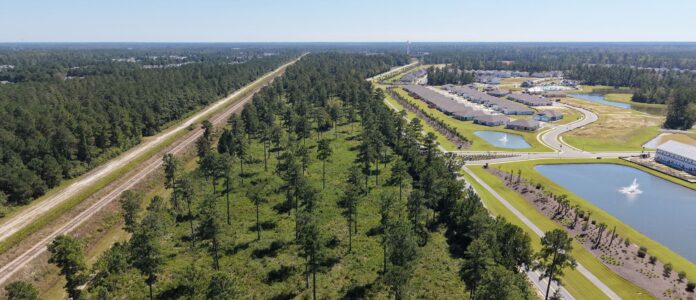
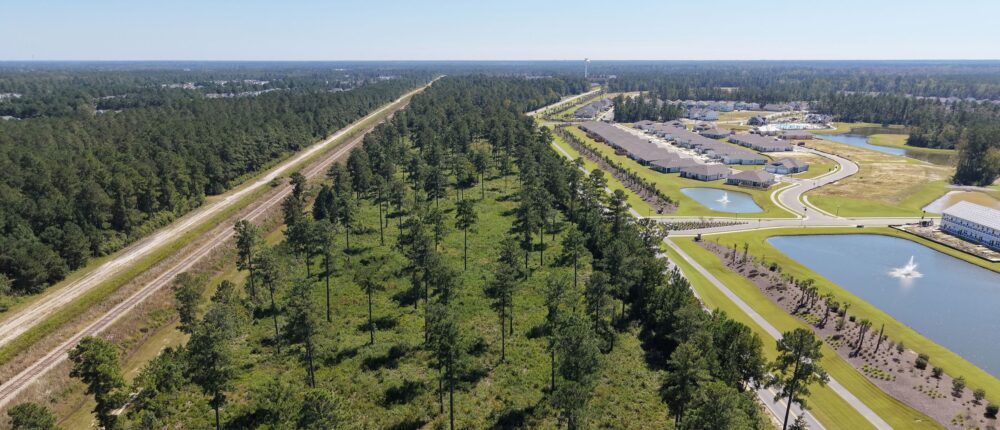
Loblolly Park will be located off of Long Pine Drive, directly adjacent to Brunswick Forest — a 4,500-acre development community primarily serving residents aged 55 and older.
Brunswick Forest resident Kathy Short suggested the disparity between the demographics of the sport and the town made disc golf an unwise choice for the new park.
“Disc golf is a fine sport, but the demographic data shows who actually plays it,” Short said. “93% of active Professional Disc Golf Association members were male and 61% were between 20 and 40. Case in point, only 7% of PDGA members were female. Given it is a young male-dominated sport, it leaves out the majority of Leland citizens.”
The Professional Disc Golf Association keeps an annual record of its membership demographics, with 2025 noting 92.3% of disc golfers were men and more than half of its roughly 115,000 players aged between 19 and 39.
Leland’s population has grown 46% between 2014 and 2024; women make up 51% of the town’s population, according to the U.S. Census Bureau. The median age is reported to be 47 years old, though more than half of Leland’s population is over 50.
Short argued families would be more inclined to go to a park with more dedicated playgrounds, walking trails and the like.
Magnolia Greens resident John Wozniak agreed something more “balanced” could accommodate more groups.
“I can come up with the following recommendations: extensive paved paths and nature trails for walking biking and enjoying nature without concern about disc golf play, a serenity pond offering a peaceful place for relaxing and connecting with nature,” Wozniak listed.
He suggested adding bocci ball or a dog park.
Council member Frank Pendleton had similar reservations about whether disc-golf was well-suited for the community.
“Is this the best use of this piece of land?” Pendleton questioned.
In June, Summit Design and Engineering was contracted for $56,500 — $8,500 has been paid thus far — for the park’s designs. The firm most recently completed another disc golf course in Forsyth County.
Council member Leland Hyer wanted to know the full price tag to develop the park. However, Leland staff could not give a ballpark figure.
According to town spokesperson Jessica Jewell, $10,000 in grants have been awarded to Leland so far for Loblolly Park and the town intends to apply for more in the future. She added Leland has envisioned an 18-hole disc golf course since 2023, when plans for a course at Founders Park fell through to make room for other amenities and renovations.
“Because the Town was not ready to proceed with a permanent course at that time, a temporary course was installed on Village Road, while a new permanent location was identified,” Jewell wrote in an email to Port City Daily and added disc golf is “extremely popular” in Leland.
The president of Leland Disc Golf Club — the local chapter of the Professional Disc Golf Association — Hastin McGill, explained the sport’s local popularity is not waning. McGill hosts events every Wednesday in Leland.
“We had an average this summer of 33 players,” McGill said. “We had weeks with 56, 54, and 52 players, with the age range being 14 years old to 71 years old.”
Many senior residents took the podium to share their perspectives, including 74-year-old Tommy Ashcraft. A Leland resident, Ashcraft plays disc golf with his wife as part of the New Hanover Disc Golf Club.
Ashcraft currently has to travel to New Hanover County to play 18 holes; two courses exist there, one in Castle Hayne and the other in Silver Lake. Ashcraft said in the last two years, he’s seen more children and couples attend the courses.
“They’ve actually got a youth league now for young people. So, there’s more opportunities for people,” he said. “And if you haven’t tried it, try it — a disc costs 10 bucks.”
Others boasted about the opportunity to also bring professional tournaments to Leland. According to the PGDA, the standard course size for professional matches is 18 holes; the Town of Leland Disc Golf Course, open for three years, only has 12 holes.
Both staff and town officials believe tournaments could bring economic benefit to the town. Economic and Community Development Director Barnes Sutton pointed out the town received a presentation in April explaining sports were an economic driver.
Sutton used numbers presented by a disc golf group called Throw Coast in Bladen County, which said 33% of visitors that came for a two-day disc golf tournament in April spent between $51 and $150; 31% spent $151 to $300 and 13% spent over $300.
“Then [players] spend those dollars within the local community on food, gas, souvenirs, and the like,” Sutton said.
However, some council members still had concerns about Loblolly’s disc golf course. Pendleton and council member Veronica Carter worried it could pose a safety issue because of its juxtaposition to busy roads and the Military Ocean Terminal Sunny Point Railroad.
“I’ve been around a lot of golf courses and not every golf ball gets hit straight down the fairway every time. Are the disc-golf players so proficient that they’re never going to throw the disc and it winds up either near or over the railroad tracks?” Pendleton asked. “Or are we going to put up some type of barrier that’s going to prevent these from going anywhere near the tracks?”
Mayor Pro Tem Bob Campbell echoed the sentiment.
“I have often, many times, had an errant golf ball go where I didn’t want it to go,” he said. “I’m sure that those discs sometimes have a mind of their own.”
Summit’s engineers originally suggested the trees on the property could act as a barrier around the park, and the placement of the holes on the course would force players to throw inward rather than in the direction of either the road or the train tracks. Summit principal landscape architect Tim Guadagno said the course is about 15 to 20 feet away from the edge of the property on each side.
Carter, a retired Army officer at Sunny Point, said the buffer between the two may need to be wider. She pointed to a joint land use study conducted by MOTSU in 2018, which enforced a three-quarter-mile safety screening zone around the railroad tracks.
Guadagno explained an additional buffer zone would be addressed in future technical review committee proceedings, but added he would take Carter and Pendleton’s concerns into account when updating the plans. Jewell explained town staff do not expect to see any major changes to the current designs.
No vote was taken at Thursday’s meeting before adjournment.
At Port City Daily, we aim to keep locals informed on top-of-mind news facing the tri-county region. To support our work and help us reach more people in 2026, please, consider helping one of two ways: Subscribe here or make a one-time contribution here.
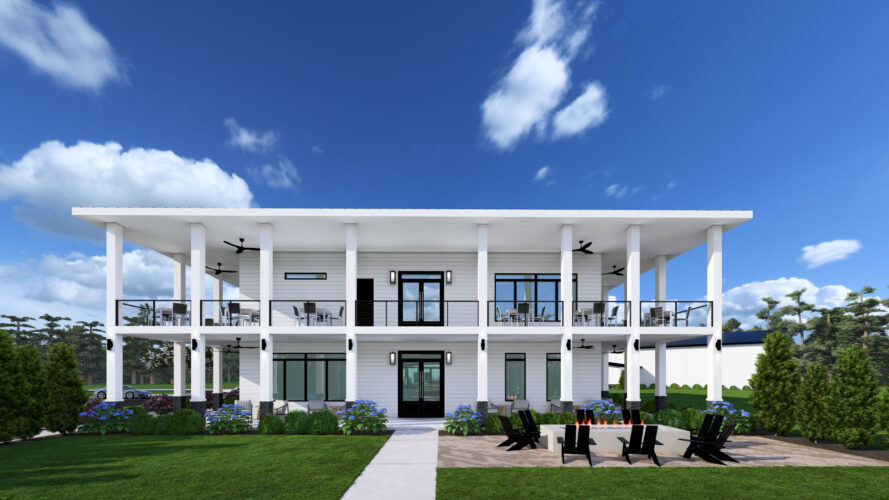
The Club at Midtown, a private recreational facility in a neighborhood off Holly Tree Road, has announced its grand opening on Nov. 6, 2026 from 3 p.m. to 6 p.m. (Courtesy photo)
WILMINGTON — The Club at Midtown, a private recreational facility in a neighborhood off Holly Tree Road, has announced its grand opening on Nov. 6, 2026 from 3 p.m. to 6 p.m.
Though the club will only be accessible to members, the opening event is open to the public — per RSVP. The even will feature a special ribbon-cutting ceremony, passed appetizers, complimentary beer and wine, and an opportunity to explore the club, meet our team, and connect with fellow guests and members of the community.
Built on the former Holly Tree Racquet Club site, The Club at Midtown features 11 indoor, air-conditioned cushioned pickleball courts, four outdoor covered and cushioned pickleball courts, two clay tennis courts, Full Swing golf and game simulators, a Junior Olympic-size resort-style pool with pool house and steam room, a fitness center, and an exclusive members’ restaurant, café, and bar. Designed as one of the largest racquet and social clubs in the region, the club is intended to host leagues, tournaments, social events and year-round programming.
“We created The Club at Midtown as a place where members can compete, unwind, and build lasting connections,” managing partner Mike Harms said in a press release. “It is designed for active lifestyles and genuine community right in the heart of Midtown.”
The expansion of the club was approved in 2025; at the time, several neighbors tried to speak against the expanded facility due to concerns over traffic from increased members and a suspected decrease in property values, mainly due to noise associated with outdoor pickleball courts.
However, many of the speakers were determined not to have standing, a measure required in quasi-judicial hearings before the Wilmington City Council. Because the facility opened in 1994 before the city’s zoning ordinance, the expansion required a special use permit.
Several conditions were part of the special use permit approval. Memberships are to be capped at 800, with the club reporting around 400 at the time of approval. Other conditions include that outdoor courts will include use of quiet paddles on outdoor courts, as well as other soundproofing measures. The were limited to 9 p.m. outdoors and 10 p.m. indoors and all tournament play will be prohibited on the outdoor courts.
The club does have plans for additional amenities and experiences in 2027, including bocce ball, badminton, and cornhole near the outdoor courts, along with a dedicated Mahjong room. The pool is scheduled to be replastered and heated in preparation for an enhanced 2027 pool season.
At Port City Daily, we aim to keep locals informed on top-of-mind news facing the tri-county region. To support our work and help us reach more people in 2026, please, consider helping one of two ways: Subscribe here or make a one-time contribution here.
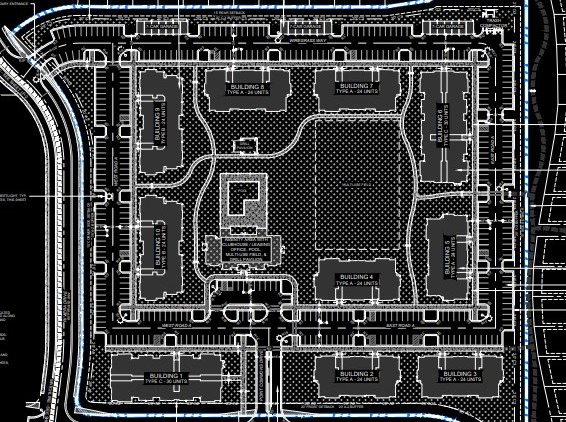
The first phase of a mixed-use complex that could bring 433 residences to the Scott’s Hill area is being heard this week in Pender County. (Courtesy photo)
PENDER COUNTY — The first phase of a mixed-use complex that could bring 433 residences to the Scotts Hill area is being heard this week in Pender County.
The technical review committee will hear about the 252 multi-family units coming up first in a two-phased Point South planned development. Eventually, 181 single-family detached units and commercial development will come to fruition as part of the plan. The Pender County Planning Board approved in May a revision to the master development plan, which added 15 residential units to the overall project.
While the overall development has been before the TRC, the apartments come back before the committee Thursday as a more detailed site development plan — separate from the master plan reviews already completed. The site development will be located in Topsail township, near the U.S. Highway 17 and North Carolina Highway 210 intersection.
After the TRC hears the plan, the applicant will address comments and requirements made by the committee. There is currently no schedule for when the Point South apartments could go before the planning board or Pender Board of Commissioners for final approval.
Name of Development: Point South Apartments
Property Owner: MCFT Point South, LLC
Developers: Grady Gordon with McAdams Homes is working with MCFT Point South on the project. McAdams Homes has also been involved with Forest Creek in Wilmington, Lea Landing in Wilmington and Harrison Cove in Hampstead.
Zoning: Currently zoned as Planned Development, it allows for flexible mixed-use development and design.
Acreage: 77.61 total acres, with 12.09 acres disturbed for the multi-family units phase of construction.
Buildings/units: There will be 10 apartment buildings for the 252 units: six buildings with 24 apartments each and a ground floor area of approximately 9,076 square feet; two buildings with 24 apartments each and a ground floor area of approximately 11,119 square feet; and two buildings with 30 apartments each and a ground floor area of approximately 13,663 square feet. All buildings have a maximum height of 45 feet.
Additionally, the property will have a leasing office and club house, three seven-car garages, a pool, a multi-use field, trash compactor, a grill pavilion and 359 parking spaces are proposed.
Density: Density is 10.10 units per acre for the overall development. Under planned development zoning density allowance is based on the Imagine Pender 2050 Future Land Use plan — classified as a regional center for higher-density residential development. It allows 12 to 15 units per acre, meaning the project falls under.
Traffic impact: A traffic impact analysis estimated 11,231 daily vehicle trips — with 567 during the morning peak hour and 950 during the afternoon peak hour — for the overall mixed-use development. Traffic analysis isn’t broken down per phase.
Notably, the TIA was approved in December 2024, prior to the additional 15 residential units being added to the project.
The project will have onemain entrance as well as a secondary entrance. There will be private interior roadways connecting the development.
Buffers and surrounding properties: A 1,393-linear-foot vegetative buffer will be between the apartments and the main road. The developer will plant 42 Southern Live Oaks and 28 Lavender Crape Myrtles in the 20 feet wide buffer zone.
Additionally, a buffer will separate the multi-family and single-family homes. The buffer will have 198 Wax Myrtles and 17 Nuttall Oaks. The 1,695-linear-foot vegetative buffer will be 20 feet wide.
Other trees to be planted are 44 Bosque Lacebark Elm and 404 Glossy Abelia shrubs in the complex’s parking areas. The vegetation will be in landscape islands with at least one canopy tree and two feet high screening shrubs.
Open space: 19.01 acres of open space will be provided as opposed to the 13.02 acres required. 17.19 acres will be active open space, while 1.82 acres will be passive open space.
Trees: As part of the tree mitigation plan, 51 Water Oaks, 22 American Hollies, three Red Maples and one Sweetbay Magnolia will be planted to make up for trees removed from the property. A tree removal plan was not included in the submitted site plan.
Wetlands/flood zone: Wetlands are not present onsite and the property is not in a Special Hazard Flood Zone.
Have tips or comments for Sophia DePhillips? Email [email protected]
At Port City Daily, we aim to keep locals informed on top-of-mind news facing the tri-county region. To support our work and help us reach more people in 2026, please, consider helping one of two ways: Subscribe here or make a one-time contribution here.
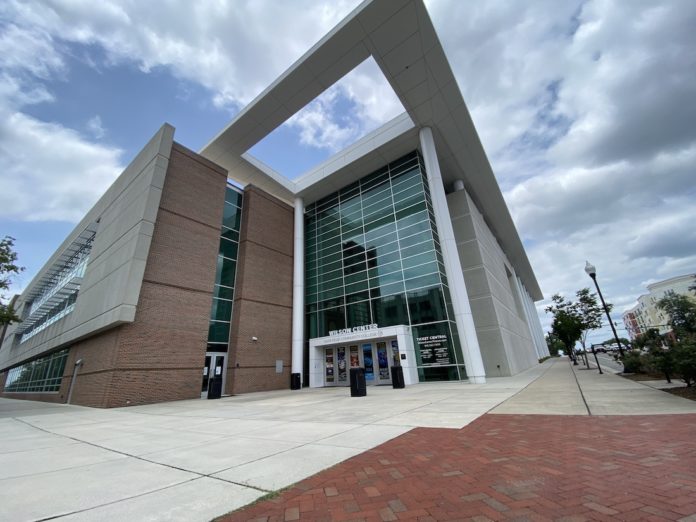
The students from Cape Fear Community College’s Commercial, Fine, and Performing Arts Department will host its fall production, “Machinal,”by Sophie Treadwell. (Port City Daily/File)
SOUTHEASTERN N.C. — The students from Cape Fear Community College’s Commercial, Fine, and Performing Arts Department will stage “Machinal”by Sophie Treadwell this month.
Students enrolled in the program oversee two shows a year, one in fall and another in spring, as part of their studies. Along with faculty, they will direct, design, and perform “Machinal” from Nov. 12-14 and 19-21 at 7 p.m. in the Studio Theatre, located at the rear of the Wilson Center on Hanover Street.
The play is set in the 1920s and follows a young woman trapped by society’s expectations and limited choices available while navigating a career, family life, marriage, and childbirth. Inspired by the true-crime trial of Ruth Snyder, the play examines how an industrial, capitalist society can provoke self-destruction.
Tickets can be purchased online at WilsonCenterTickets.com and are $15 for the general public, $12 for CFCC faculty and staff, and $6 for students and children.
At Port City Daily, we aim to keep locals informed on top-of-mind news facing the tri-county region. To support our work and help us reach more people in 2026, please, consider helping one of two ways: Subscribe here or make a one-time contribution here.
A little more than one-third of voters have turned out early for the 2026 midterm elections statewide, according to the North Carolina Board of Elections’ data. The amount of early voters also increased by 30% compared to 2022’s midterms; these trends mirror voter turnout in the tri-county region as well. (Courtesy photo)
SOUTHEASTERN N.C. — More than one-third of voters have turned out early for the 2026 midterm elections statewide, according to the North Carolina Board of Elections’ data. The amount of early voters also increased by 30% compared to 2022’s midterms; these trends mirror voter turnout in the tri-county region as well.
Early voting officially closed across North Carolina on Halloween – Saturday, Oct. 31 — at 3 p.m. Ballots cast so far total 2.8 million statewide, compared to the 2.1 million during the last midterms in 2022. This accounts for both mail-in and in-person balloteers.
Unaffiliated voters make up the top registration in the state, coming in at 3.1 million, followed by Democrats at 2.34 million and Republicans at 2.33 million. Libertarians fall behind at more than 46,600 voters and the Green Party with more than 5,000.
“Democratic and Unaffiliated turnout rates are up a lot, while the Republican turnout rate is up slightly,” according to Western Carolina University political science professor, Chris Cooper.
In Cooper’s blog, “Anatomy of a Purple State,” he notes how registrants are up this year by 59% Democratic, 38% unaffiliated and 11% Republican.
Democrats have long been early-voters, though during the presidential election both parties turned out heavily. Only 20% of Republicans and 18% of Democrats waited until Election Day to vote in 2024.
This year in North Carolina, Democrats make up 46.20% of early-voters, followed by unaffiliateds at 31.29% and Republicans at 31.64%.
Why does it matter? Well, it’s unclear how unaffiliated voters may sway an election’s outcome and North Carolina is one of many considered a battleground state this year, as Republican Thom Tillis’ U.S. Senate seat is up for grabs.
A Democrat hasn’t won the U.S. Senate in North Carolina since 2008. Currently, Republicans have the advantage in Congress, 53-47, over Democrats. Only four seats are needed by Democrats in 2026 to control the majority.
Vying to secure Tillis’ seat, former Gov. Roy Cooper holds a 9-point lead over Republican Michael Whatley, according to a recent East Carolina University poll. The poll was conducted from Oct. 26-29 and has Cooper at 54% to Whatley’s 45%, with a 3.5 percentage-point plus-or-minus scale.
Though early-voting numbers don’t show which candidates are voted for, North Carolina has been considered a purple state for years, meaning both Republicans and Democrats hold leadership positions across varied statewide seats. For instance, while the state’s General Assembly chambers have been controlled by Republicans for the last 16 years, North Carolina has had a Democratic governor for almost a decade in the same timeframe.
Currently, Republicans hold a 30-20 majority in the 50-member North Carolina Senate and have 71 of 120 state House seats, compared to 47 Democrats and two unaffiliated legislators. Republicans hold a supermajority in the Senate, but are one seat short of a three-fifths supermajority in the House of Representatives.
For Democrats to secure the North Carolina House majority, the party needs 61 seats, while Republicans need 72 to be veto-proof.
How do voting numbers compare locally?
Seemingly, when looking at voting numbers statewide compared to the tri-county region, many are in line with similar margins.
In New Hanover County, the State Board of Elections tracks 69,709 people have cast in-person or mail-in ballots of the 190,214 registered voters. That equals around 37% more early-voters than 2022’s midterms.
“We’re genuinely quite impressed and thrilled with the turnout that we’ve seen for early voting,” the New Hanover County Board of Elections Director Eric Navagh told Port City Daily on Friday, Oct. 30.
New Hanover County unaffiliated voters also lead early-voting numbers at 25,795. By comparison, Democrats have 22,468 and Republicans come in at 18,778.
Of Brunswick County’s more than 151,000 voters, 62,424 are early voters. The number is up from 45,780 in 2022 — or roughly a 31% increase. The county trends highest with Republican voters at 23,452, though unaffiliated early-voters are close behind at 22,461. Democrats make up 13,972 of the early votes.
So far, Pender County has welcomed 17,255 voters from its more than 55,000 registrants. In 2022, the county had 13,099 early voters, amounting to an almost 32% increase in the 2026 early-voting term. Pender’s unaffiliated voters are the second highest — 5,655 — behind Republicans at 6,916. Democrats make up 4,126 of early voters.
Mail-in absentee ballots are still being accepted at the boards of election in the tri-county region, with staff and the boards carefully vetting them; however, any that arrive with a signature not matching the name on the voter’s application or with an inner envelope not properly sealed will be tossed. Also, absentee ballots that arrive after the polls close on Election Day, even if they’re postmarked on or before Election Day, will not be counted; the grace period no longer applies, due to election law changes.
The absentee ballots can be delivered in person to the county board of elections before 7:30 p.m. on Election Day. Voters otherwise can monitor the progress of their absentee ballots through the state’s BallotTrax system. If their mail-in ballot hasn’t arrived by Tuesday, Nov. 3, they can choose to vote in person before the polls close. Just ask elections officials to cancel the mail-in ballot and vote at the registered precinct instead.
Also, absentee voters with ballots that have a curable deficiency — such as not signing a ballot or forgetting an ID exemption form — will be notified by elections board staff. There is a grace period to correct deficiencies, set for Nov. 10.
“Our office has been regularly reaching out to voters to make sure that they’re aware of those,” Navagh said, praising New Hanover County staff for its diligence and attention to the discrepancies. “As it gets closer and closer to Election Day, the timing is hard for that to be fixed for folks that cast their ballot — especially folks that might be outside of New Hanover County, but the law requires us to reach out to those folks to allow them that time. Curable deficiencies are due to our office the fifth business day after the election so that can be handled.”
All results on Election Day are not finalized until the canvass, scheduled statewide for Friday, Nov. 13.
At Port City Daily, we aim to keep locals informed on top-of-mind news facing the tri-county region. To support our work and help us reach more people in 2026, please, consider helping one of two ways: Subscribe here or make a one-time contribution here.
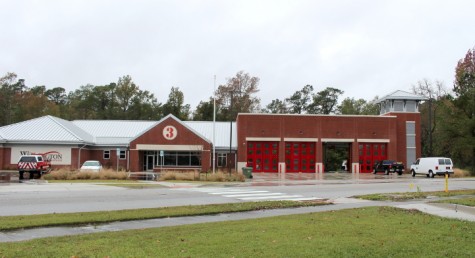
The Wilmington Fire Department's newly built Station 3 is open for tours this Saturday. Photos by Christina Haley.
The Wilmington Fire Department is collecting food donations for its annual holiday food drive to help provide nutritious food to children and families in the community. (Port City Daily/file photo)
WILMINGTON — The Wilmington Fire Department is collecting food donations for its annual holiday food drive to help provide nutritious food to children and families in the community.
Donations can be dropped off at any of the 10 Wilmington Fire Department stations or the Skyline Center.
The food drive will benefit Nourish NC, a local nonprofit working to provide nutritious food to children in need. Donations collected through the drive will be delivered to Nourish NC on Dec. 11 and used to support Nourish NC’s Market on Market and backpack programs. Last year, the department helped collect more than 3,600 pounds of food.
The most-needed items include:
Fruits and vegetables: pasta sauce, jelly, vegetable cups, canned vegetables, canned fruit, individual juice boxes, applesauce cups, and dried fruit
Grains: kid-friendly cereal, oatmeal, granola, rice, pasta, and granola or snack bars
Packaged side dishes: Knorr rice or pasta sides, noodle bowls and individual mac and cheese
Proteins: hearty soups, pasta with meat, peanut or almond butter, canned chicken or tuna, chili with beans, and black or pinto beans
Nourish NC recommends donating items that are nutritious, unexpired and easy for children to prepare or eat. Please do not donate glass containers, junk food or expired food.
At Port City Daily, we aim to keep locals informed on top-of-mind news facing the tri-county region. To support our work and help us reach more people in 2026, please, consider helping one of two ways: Subscribe here or make a one-time contribution here.
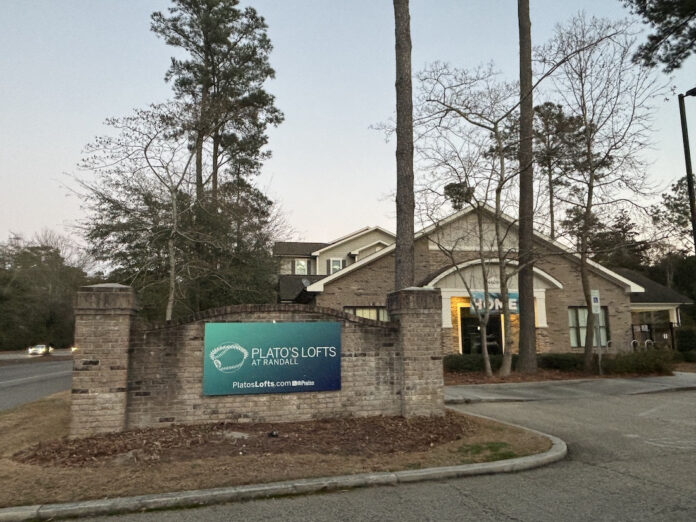
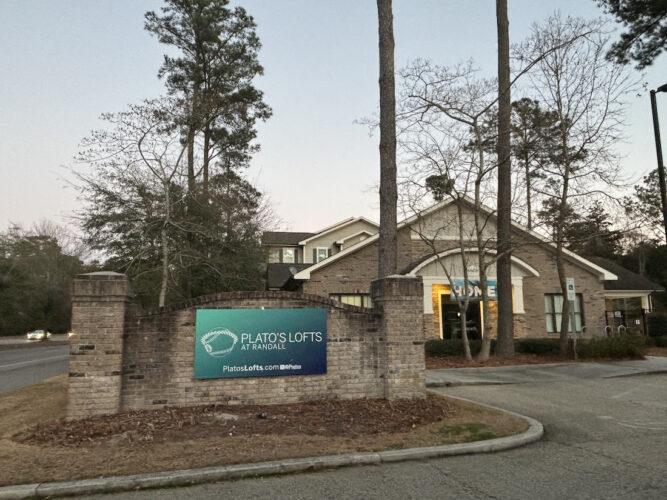
UNCW has acquired the 216-bed housing complex off Randall Parkway to add to its student housing arsenal. (Port City Daily/file photo)
WILMINGTON — UNCW has acquired the 216-bed housing complex off Randall Parkway to add to its student housing arsenal.
UNCW Corporation II Randall Parkway, LLC, the nonprofit subsidiary of UNCW Corporation II, completed the $16.25 million acquisition of Plato’s Lofts on Oct. 29, 2026. The property already serves UNCW students, and current residents can expect a seamless transition, according to the university. Plato’s Lofts will retain its existing name for the immediate future.
“This acquisition secures housing our students already rely on at a price that makes sound financial sense,” Miles Lackey, vice chancellor for business affairs and chief financial officer, said in a press release. “It gives us greater control over long-term housing costs and supports our efforts to keep this option affordable for the students who live there.”
Located less than a mile from campus at 4810 Randall Parkway, Plato’s Lofts includes 54 four-bedroom apartments in three residential buildings, along with a clubhouse and pool. The property provides apartment-style housing for sophomores, juniors and seniors.
“Students have enjoyed living at Plato’s Lofts, and this purchase allows us to make it a lasting part of our housing offerings,” Kevin Meaney, executive director of housing and residence life, said in a press release. “Securing these apartments expands our permanent housing inventory and gives upperclassmen an appealing option to stay close to campus and connected to the UNCW community.”
UNCW began leasing Plato’s Lofts in the summer 2024; its the most expensive housing option, costing students $11,640 yearly compared to $7,690 in UNCW’s oldest four traditional dorms.
In 2023, the university announced it had enrolled more students than it had room for, only two years after UNCW became only the third UNC System school to require both freshmen and sophomores to reside in on-campus housing. It has enrolled more students than it had traditional rooms for every year since, using overflow spaces in the schools’ dorms and off-campus leases. Aside from Plato’s Lofts, the university has also been leasing 80 units at the Cottages at College Arces, which abut campus near Randall Library.
When the UNC System Board of Governors approved UNCW’s leasing of Plato’s Lofts in early 2024, UNCW Chancellor Aswani Volety described the Plato’s Lofts lease as a short-term solution. The committee was charged with approving the lease before the board’s final vote.
“Our board of trustees really wanted to build a lot of residences on campus,” Volety said. “With the enrollment trends and the demographic shifts and all those things, I want to be a little careful about how many things I’ve built. But even if I were to build, it’s gonna take several years before I see these things.”
However, the university has only one dorm planned its it 10-year campus master plan, approved in 2024. It will replace Galloway Hall, which was UNCW’s oldest dorm, built in 1970, before it was torn down in 2024.
At Port City Daily, we aim to keep locals informed on top-of-mind news facing the tri-county region. To support our work and help us reach more people in 2026, please, consider helping one of two ways: Subscribe here or make a one-time contribution here.
The City of Wilmington has started examining its tree ordinance, though the takeaway from a recent discussion offered no quick fix to accommodate all the city’s values, particularly when it comes to saving trees and creating more housing. (Port City Daily/file photo)
WILMINGTON — The City of Wilmington has started examining its tree ordinance, though the takeaway from a recent discussion offered no quick fix to accommodate all the city’s values, particularly when it comes to saving trees and creating more housing.
Earlier this month, the city convened a group of developers, architects, environmental experts and affordable housing advocates to discuss the city’s tree ordinance.
The group — which included Paul Stavovy of Cape Fear Community Land Trust, arborist and advocate Joshua Shields, James Freeman of Freeman Landscapes, and Isabelle Shephard of the Alliance for Cape Fear Trees, among others — were tasked with giving the Wilmington Tree Commission feedback on the current ordinance and ideas on how to improve it.
Currently, the city requires developers to mitigate the removal of protected trees, either by replacing them at a rate of 200% or paying a fine, which can reach into the thousands of dollars. The city also has specifications for what size trees can be planted as mitigation and how far apart they should be spaced; though this can get complicated when determining what species are accepted and how they can fit into the site design. Additionally, some developers choose to pay mitigation fines rather than navigate the ordinance, prompting outcry from tree advocates and environmentalists.
Though the convened panel advanced specific changes, the overall message to the city included a redevelopment of its tree regulations, in tandem with its other priorities: the need for housing, natural area preservation, flood mitigation, parking needs, stormwater regulations. The group suggested any changes should allow staff and developers the flexibility to tailor tree mitigation to the site, rather than emphasizing a one-size-fits-all approach.
“When you’ve got different groups of people who care about different things that are all trying to come up with their ideal policy and shove it together into one, you get this weird creature that doesn’t make any sense, like a three-headed dog,” Business Alliance for a Sound Economy CEO Jared Patterson — who used to work in the city’s communications department — said.
Dave Spetrino, prominent developer and one of the panel’s most outspoken members, pushed for the tree ordinance to be easier to follow. He said, even though he takes extra measures to preserve trees, he is always weighing the cost of preserving a tree, incurred through changing site designs and layouts, against the cost of just removing the tree altogether.
Port City Daily asked the city for a rough estimate of how many developers choose to pay the fines for removing trees rather than save trees or replace them after removal. After publication, the city said it has released 80 development projects for construction over the last two years, of which 22, or approximately 27%, included a payment in lieu of tree mitigation.
“It’s important to note that payment in lieu is just one way developers can meet tree mitigation requirements and is intended as a last resort when mitigation cannot be achieved through other means,” a city spokesperson provided. “The City encourages developers to meet these requirements through tree planting and offers mitigation credits for activities such as relocating trees, planting trees larger than the minimum required size, and preserving non-regulated trees.”
Spetrino and Allison Engebretson, landscape architect at Paramount Engineering, both advocated for the city to update its suggested list of trees for planting and categorize them based on priority. For example, supplying developers a list of trees they can earn incentives for planting — such as species native to Wilmintgon — followed by a list of preferred trees and then a list of trees they should not plant, such as invasive species.
The group also recommended the city ensure trees on the lists are able to be procured, some noting the sizes can be unreasonable at times.
The panel also suggested the city evaluate lots and preservation efforts as a whole rather than mandating mitigation strictly on how many trees are removed and planted.
Additionally, Alliance for Cape Fear Trees representative Jim Gregory — the city has allocated $100,000 over the next two years for the alliance to maintain more than 300 trees, plant and care for 175 trees and distribute 1,000 trees— noted the city could also reconsider how it regulates critical root zones. The code mandates tree removal — triggering mitigation — if development activity disrupts 20% of a tree’s critical root zone, even if, Gregory said, the tree has a good chance of survival.
Roger Shew, geology and environmental science professor at UNCW, also suggested the city consider safeguarding natural areas rather than focus solely on tree preservation. He noted shrubs and grasses are just as valuable to the environment, plus they can be more resilient in hard-to-plant areas.
Others suggested the city focus on preserving tree canopy, or how much foliage shields the ground from sunlight, rather than how many tree types should be preserved. The city’s canopy has dropped from 48.1% in 2016 to 41.4% in 2020, according to the Alliance for Cape Fear Trees.
Several members of the discussion wanted to see the ordinance shift focus from “tree islands” — essentially requiring a tree to be placed sporadically in a parking lot, for example — and instead promote “pocket parks,” essentially small areas of trees or green space.
Spaced-out trees are intended to provide shade respites across large expanses, though several discussion members said they would prefer the preservation of tree groupings.
The developers also asked if the city could give credit saving tree groupings, even if the species are not protected trees. Right now, developers will be punished for removing one protected tree, but could remove as many unprotected trees as they want. just the same as saving one protected tree, such as a live oak.
Additionally, Spetrino thought the tree ordinance should have different applications based on the size and quality of properties.
“I think infill should be exempt from this whole thing,” he said, arguing any developer transforming a small property — mostly concrete or barren — into a better use for the community should not be held to the same tree planting or removal standards.
Spetrino said the city should come to terms with its more urban areas lacking trees, like downtown. He questioned the necessity of requiring a few trees to be planted on an infill lot, particularly in cases where properties are located near a municipal park.
While his push to avoid tree requirements on infill lots didn’t generate excitement from the other committee members, most supported different standards for different lots.
Even with suggestions on improving the ordinance, the conversation turned to the city’s competing values. Liz Carbone, a board member at Cape Fear Collective and the Wilmington Housing Authority, pointed to Hillcrest, located in downtown Wilmington’s south side and undergoing redevelopment, as a prime example of competing values.
The Wilmington Housing Authority is to double the size of Hillcrest, one of its oldest complexes constructed in the 1940s. The 550-unit redevelopment is set to be completed in five phases, the first of which has drawn scrutiny because of plans calling for the removal of six 100-year-old live oaks.
As reported by WHQR, the Wilmington Board of Adjustment granted WHA a variance to remove the trees. A variance is required for any removal or 20% critical root zone disruption of a specimen tree, which are specifies of exceptional size, form or rarity. However, City Manager Becky Hawke has said the city will not waive mitigation fees — which the manager can do for affordable housing or government-assistated projects — associated with removing the trees, estimated at $122,000.
Additionally, Shields, a long-time arborist, has pointed out some inaccuracies with WHA’s tree removal and mitigation plan, particularly whether one of the trees marked for removal is in a protected class or not. The city did not uphold this objection, but found that Shields was correct in other discrepancies he pointed out. The city noted WHA will need to rectify any mistakes before Hillcrest’s site plans are approved by the technical review committee.
“I lose sleep at night thinking about the fact that we might lose out on permanently, deeply affordable housing for people in our community who desperately need it over a tree, a singular tree, that is beautiful, don’t get me wrong,” Carbone said during the tree discussion.
She continued by claiming the tree may only have a lifespan of another 10 years due to the development occurring around it, while the housing being built would provide 100 years of affordability. Carbone also argued the tree ordinance should give grace to affordable housing projects.
Her comments prompted the panel to ponder how a continuously urbanizing city can accommodate its environmental and housing goals.
Many had one answer: build up.
The discussion members, including Carbone, advocated for the city to get comfortable with higher buildings, particularly residential developments with increased height in the more urban areas of the city.
“We need people to come to meetings and be advocates for height,” Carbone said.
Hence, as the discussion members pointed out, advancing tree preservation might need to go hand-in-hand with other adjustments in the land code.
After publication, the city told Port City Daily the Wilmington Tree Commission’s subcommittee on tree ordinance review will meet again on Nov. 4 to home in on initial amendments; proposed amendments are anticipated to be presented at a Wilmington Planning Commission public hearing in early 2027, along with a plan for additional amendments later in the year.
At Port City Daily, we aim to keep locals informed on top-of-mind news facing the tri-county region. To support our work and help us reach more people in 2026, please, consider helping one of two ways: Subscribe here or make a one-time contribution here.