
Saturday, November 7, 2026
Home Blog

Tackling growth, education in Brunswick County: Changes coming to commissioner, school boards 

0
While much of the nation turned blue from Tuesday’s midterm elections this week, one traditionally red county maintained the status quo. Still, Brunswick County will have a new commissioner and school board member to join its local boards come December. (Port City Daily/File)

BRUNSWICK COUNTY — While much of the nation turned blue from Tuesday’s midterm elections this week, one traditionally red county maintained the status quo. Still, Brunswick County will have a new commissioner and school board member to join its local boards come December.

Two seats were open on both the board of commissioners and board of education, with two Republicans securing the wins in Brunswick County. Sitting commissioner Randy Thompson was re-elected to his District 1 seat by 13.18% of the vote against Democrat Gary Woods. Republican Patti Hewett is expected to succeed current Vice Chair Marty Cooke for District 2, with 13.84% of the vote against Democratic challenger Sara Singer. 

Thompson said he will continue to tackle overdevelopment by pushing to improve local infrastructure before any new developments are approved and making developers pay for growth. Thompson would like for Brunswick County to charge the maximum amount to developers for sewer and water system fees, as permitted by the state. Counties can levy developers 75% of the estimated future cost to improve infrastructure to meet growth needs. Brunswick only makes developers pay 90% of the 75%.

READ MORE: Election 2026 Results: Brunswick County gains new commissioner, school board member

ALSO: Brunswick commissioner calls for planning board chair to step down again, motion fails

“To be quite honest with you, I’m to the point where new development needs to pay for all costs associated with new infrastructure,” Thompson said. “They need to be paying for 100% of the infrastructure costs instead of 75%.”

Growth in the county has brought public criticism over a lack of infrastructure improvements and county services matching the booming population and incoming large-scale residential developments. Brunswick County has had nearly 60,000 units incoming since 2016 and has grown 24% between 2020 and 2024, according to the Office of State Budget and Management. 

In addition to being the fastest growing in the state, Brunswick County is the sixth fastest growing in the country. The current population estimate from the 2025 U.S. Census is 174,702, compared to 136,695 in 2020. 

Many community members have expressed worries about flooding, sewer and water utilities and traffic congestion, and the preservation of wetlands and greenspace.

The commissioner wants to make further strides in increasing water utility capacity so the county can service all current and future county residents.

Brunswick County hit its sewer capacity at the start of 2026 and was issued a permitting freeze by the North Carolina Department of Environmental Quality. The freeze followed a 2023 state law that suggested municipalities may only allocate sewer hookups upt to 110% capacity, but if the county is fast growing, it can max out at 115%. However, the law also stated that municipalities had to factor in incomplete developments that were promised sewer connections. This made the county’s allocations skyrocket, leading to the freeze. 

Thompson wants to see the county’s ongoing and future expansions be prioritized in budget cycles and commissioner meetings, along with other infrastructure needs. 

Thompson has been a vocal member of the commissioner board about slowing development, calling for a moratorium, which has not gained traction with his colleagues, and trying to freeze applications and development proposals until the county’s sewer capacity could catch up. However, under G.S. 160D-107, this would constitute a moratorium, but a moratorium is only permitted if there is an imminent and substantial threat to public health or safety. 

Thompson has also asked for the ability to deny developments based on what county resources are available instead of an applicant’s adherence to the county unified development ordinance, last adopted in 2015. However, the county’s attempts to do so in the past have resulted in lawsuits filed by developers, who argued their project was allowable by-right and per the UDO. This occurred with the Green Hill Development, which was denied due to roadway, flooding and other concerns. Developers sued the county in May 2026 and the case will be heard by the Brunswick County Superior Court on Nov. 9. 

Thompson suggested the county’s approach to its growth has impacted this year’s election. He pointed to not winning in all of the county’s 27 precincts this election cycle, as he did last time; Thompson lost in six precincts in the northeastern part of the county in 2026. The precincts were primarily in Leland and its immediate neighbors Navassa and Belville, which are located outside Thompson’s district but have been affected by development. The county most recently approved South Cape, located near Leland’s town limits, though the area has been subject to several development approvals in recent years. According to the Office of State Budget and Management, Leland and Belville have been ranked among the fastest growing towns in the country and state.

Thompson has been on the board for more than 11 years; he told Port City Daily this will be his last term.

“To be quite honest with you, I had considered not running this time,” he said. “But there was not a good candidate that I trusted that would put Brunswick County first, so that’s why I chose to run. That’s why those within my own party encouraged a candidate to run against me in the primary.”

However, the commissioner expressed enthusiasm about working with a new board member. Hewett did not respond to Port City Daily’s numerous attempts to contact her about her goals and hopes for the new position.

“If I follow her campaign proposals and her desires she mentioned in her platform, I see a positive change and a positive working relationship,” he said.

Hewett has stated in her response to Port City Daily’s candidate questionnaire that she will support responsible and well-planned growth, ensuring safer roads, improving water and sewer services, emergency services and environmental protection. Like Thompson, she also expressed a desire for the county to be allowed to downzone; the state banned it in 2024 through the passage of S.B. 382.

“I see us moving from a — should I say — pro development, out-of-control development, board to a more centered board that is looking for smart growth,” Thompson said of Brunswick County.

With another law on the books this year, in the passage of H.B. 1222, commissioners will have more control; the planning board became a recommending board only with commissioners approving and denying all developments, starting with applications submitted after July 2, 2026. Thompson supported the state legislature giving over the authority because he believed elected officials should have a say over development and be held accountable for the direction of growth. 

The planning board still has a few more developments to approve, rather than recommend to commissioners to finish up all applications submitted before the July 2 deadline. Thompson has taken issue with the planning board’s approvals and his own district’s appointment this year.

Just this week, he made a motion to unseat the planning board Chair Clif Cheek, due to the board’s approval of the 829-unit South Cape development, despite the county planning staff recommending denial.  But the motion failed 3-2, with only commissioner Pat Sykes in support. It’s the second time this year he’s asked for Cheek’s removal. 

Thompson believes the county’s constituents are also more divided now across party lines, which has increased a desire for change. In Brunswick County as of Sept. 2026, there are 28,219 Democrats, 61,611 Republicans and 60,663 unaffiliated registered voters. In the same month in 2024, the county had 27,960 Democrats, 56,283 Republicans and 53,663 unaffiliated voters.

Despite being a Republican, Thompson vowed to represent everyone regardless of party affiliation. 

“My position wasn’t as clear as it should have been that I am bipartisan and I am willing to work for everybody,” he said about his campaign.

Thompson added his stance on development is what made him unpopular among some of his own party members and a minority on the board of commissioners. However, he said he’s eager for the shake-up in Raleigh. 

It won’t affect Brunswick County’s state legislators, as voters put back into office Rep. Frank Iler (R-Brunswick), Rep. Charlie Miller (R-Brunswick, New Hanover) and Sen. Bill Rabon (R-Brunswick, New Hanover). However, at the state level the House is a Democratic majority for the first time in 16 years, and the Republicans in the Senate have thus far lost their supermajority, though some races have yet to be decided.

“I think Raleigh received a wakeup call yesterday,” Thompson said on Wednesday. “So I think it’s time for our representatives to be working closely with county initiatives, and those initiatives are not uncontrolled overdevelopment.”

Thompson hopes to see more legislation passed to give the county the ability to charge impact fees for schools and parks — which is currently prohibited under state law but legislation can award the county special permission to instate them — and to have control over open burning. Only the state may issue a countywide burn ban, which commissioners have found troublesome in times of wildfires, droughts and water shortages.

Brunswick County Board of Education 

The school board race had two seats up for grabs this year. Republican Chair Steve Gainey beat out Democrat Brian Rupp by 13.82% in District 5 and Republican Paige Morgan will join Gainey, succeeding Robin Moffitt of District 3. Morgan won by 13.96% against Democrat Susanne Duncan.

Morgan, a former educator, said her first plan of action, once sworn onto the board in December, is to meet with local teachers, students, parents and other stakeholders to ask what their biggest concerns are.

She said she’s noticed a disconnect between the board and schools, both as a teacher and a parent, and believes that meeting with teachers shows someone is listening and not making decisions for them without their input.

She explained to Port City Daily this was her approach to improving teacher retention. 

“I know that teachers and school staff are our largest asset. We should be using this asset to help Brunswick County Schools grow and flourish,” Morgan said, adding she’d be asking for opinions from school staff related to board decisions. “When you work to create an environment where educational staff feel valued and respected, the return are teachers and staff members who want to work for Brunswick County Schools.” 

According to the North Carolina Department of Public Instruction, the attrition rate in the county is 14.32%, up from its previous number of 10% during the 2023-2024 school year. During the 2024-2025 school year, 125 teachers left the district. 

Gainey said hiring and retaining veteran teachers with a proven track record is important as he enters into his next term as a school board member. He has served on the board for four years and boasted Brunswick County Schools is a top North Carolina district for recruiting experienced teachers; however the state does not keep a record of teacher attrition by years of experience for each county. Instead, NCDPI measures the rate experienced teachers are retained across the state; teachers with eight to 27 years of experience had a lower attrition rate than beginning teachers and those with more than 35 years of experience.

Gainey added the district was also interested in retraining teachers to improve student growth, though this directive was already given.

“The board has charged Superintendent [Dale] Cole with developing a more focused emphasis on reducing the number of instructional staff who have failed to meet their student growth goals, two of the last three years,” Gainey explained to Port City Daily, noting this would help continue improving student scores.

He called the goal to reduce​ the number of teachers who are not meeting student improvement goals “aggressive” but added the district was “well-positioned” in its plan to replace staff not meeting county goals and standards. Only about 11% of county teachers were noted as needing improvement, based on NCDPI’s annual report using 2024-2025 data.

Both Morgan and Gainey said they wanted to continue the county’s upward trend in school performance. 

Using 2025-2026 data, only Supply Elementary and South Brunswick Middle were both listed as low-performing schools, an improvement from the previous year, which listed five low-performing schools. Of the county’s 20 schools, 14 met or exceeded the district’s expected growth, and seven schools improved by a letter grade this year. 

Morgan wrote in her Port City Daily questionnaire she wanted to examine needed resources in order to improve the scores on the remaining two low-performing schools. 

“Where are students struggling? Are there staffing or attendance issues? Do teachers have the resources and support they need? What strategies are working in similar Brunswick County schools that could be replicated?” she wrote.

When Port City Daily asked Morgan what policies she’d like to change first upon stepping into her role, she explained it wasn’t that simple.

“Though there are policies I would like to see changed, being a board member does not mean that I can go in with a list of changes and make them happen,” she said. “Having the opportunity to be a board member means that I am able to work with current members of the board, who all have different strengths, and use my experience as a classroom teacher and a parent to help create or change policies for the betterment of our students and staff.”

As for curriculum, in Port City Daily’s questionnaire, Morgan expressed wanting to examine policy 3120, which establishes lesson-planning requirements. The policy maintains that teachers’ daily lesson plans must be documented and reviewed by the school principal. There is no set schedule, so teachers must have lesson plans available and accessible daily. While important for accountability, Morgan suggested it can be restrictive.

“Having spent 10 years in the classroom, I know that effective teaching is flexible,” Morgan said in the questionnaire. “A lesson may need to change from one class period to the next based on student understanding. Detailed paperwork does not necessarily tell us whether meaningful learning is taking place.”

Morgan later told Port City Daily she’d like to further discuss the curriculum with teachers, especially following the state’s recent amendments to the high school math curriculum. The shift, passed this year, included making Math 3 and 4 no longer mandatory for graduation and integrating real-world applications to Math 1 and 2. The new curriculum also created several math elective courses that students can choose from: applied statistics and data science, mathematical and statistical modeling, applied logic and reasoning, AP classes, college-level math courses and math-based career and technical education options.

Gainey did not list policy changes or initiatives he’d like to pursue in his new term to Port City Daily

Also, Brunswick County Schools also will receive $350 million in bonds for eight  projects, including new schools, land acquisition for teacher housing, fields and field houses for schools and others. This passed with 54.95% of the vote in the midterms. It includes the construction of two new schools off U.S. 17 and in the northern part of the county, which are both slated to begin construction in 2029. This will address overcrowding from rapid growth in the county. 

According to BCS, it saves the district $2.5 million in the long run since alternative methods of payment, should the bond have failed, carry higher interest rates.

The new schools will require redistricting of students in the Jackey’s Creek and Leland area and the U.S. 17 corridor, which requires a draft map drawn by a consultant, public feedback and a vote. While Morgan deferred to her school board colleagues about redistricting efforts to accommodate the facilities, Gainey said the matter would most likely be taken up by the board in fall 2028.

“We will gather input from staff, the community and our demographic consultant and weigh the ideas and recommendations from those sources against the practical realities around transportation efficiency, and the goal of balancing the demographic profiles of our student populations in our respective schools.”


Have tips or suggestions for Emily Sawaked? Email [email protected]  

At Port City Daily, we aim to keep locals informed on top-of-mind news facing the tri-county region. To support our work and help us reach more people in 2026, please, consider helping one of two ways: Subscribe hereor make a one-time contribution here.

We appreciate your ongoing support.

Newly elected Pender commissioners cite growth, staff vacancies as top issues

0
A slate of three new Republican members are preparing to join the Pender County Board of Commissioners with goals of controlling development, keeping county infrastructure up to date and improving staff retention. (Port City Daily/Sophia DePhillips)

PENDER COUNTY — A slate of three new Republican members are preparing to join the Pender County Board of Commissioners with goals of controlling development, keeping county infrastructure up to date and improving staff retention. Aside from addressing starting priorities, District 1 candidate Shayne Frey also discussed his rocky road to the dais.

Though the county maintained its red status against a state of blue wave changes, two commissioner candidates ran unopposed: Andy DeVane in District 3 and incumbent Jimmy Tate in District 4. 

Frey ran against Democrat Tim Zizack and received 55.71% of the vote. Ryan Collins of District 2 received 59.7% of the vote against Democrat Brookey Hardee. Frey told Port City Daily he is prepared to represent all Pender County residents in all five districts.

READ MORE: Election 2026 Results: Republicans hold status quo in Pender County

ALSO: ‘Amazing amount of work’: New Pender County school to be completed early

He and fellow candidate Collins both cited managing growth within the county as their top priority once seated in December. Pender County is currently one of the fastest growing counties in the state and has seen a population increase of 19.8% between April 2020 and July 2025.

“One of the things that the builders developers like to do when we have RA zoning — residential or agricultural — we have a limit of one house per acre, right? They like to change that so they can get more money and put four houses on an acre,” Frey said. “I believe if the order or the UDO [Unified Development Ordinance] says one house per acre, we have to keep it that way.”

Collins did not respond to Port City Daily’s request for an interview upon winning his seat; however, in his candidate questionnaire early this fall, he had concurred with Frey’s stance on development and controlled growth.

“I do not believe we should routinely increase density through rezoning when the roads, schools, water and sewer, or emergency services cannot support that additional growth,” Collins wrote.

Commissioner Tate also did not respond to PCD’s request for an interview, but in his primary questionnaire said commissioners should enforce the Land Use Plan and development should occur where infrastructure already exists or is planned.

A representative for Pender County was not able to respond by press on how many residential developments that are not “by-right” — meaning the proposed development does not follow existing local zoning laws — are approved in the county.

Aside from controlling developments coming in, candidates also pointed to the importance of county infrastructure keeping up with the rate of development.

“We need to get our house in order,” DeVane told Port City Daily on Wednesday. 

When asked about policy changes he would like to see to ensure infrastructure meets the needs of new and current residents, DeVane said he would need to talk to constituents first.

“Before we start changing policies, I want us to hear from the people who live in

those communities and let them help guide those changes,” he said. “We need to make sure our roads, schools, water, sewer, and public safety services can support growth

while protecting the quality of life for the families already here.”

Frey seemed to concur, saying the county is “behind the eight ball” in its infrastructure needs: “I don’t think anyone’s going to argue that we have a traffic problem up and down [Highway] 17. I don’t think anyone’s going to argue with you to say Pender County Schools is splitting at the seams on the east side, you know, with students.”

Seven of Pender County’s 18 schools are at 100% capacity or over. Currently the district is working on building J.H. Lea, a new K-8 school set to hold 2,300 students and renovating Topsail Middle School, which will accommodate 600 high school students.

Within the next 10 to 12 years Pender County School District is expecting an increase of 3,000 to 5,000 students. Frey suggested looking into impact fees as a means to get funding for building schools as the population grows.

Impact fees are a one-time charge imposed by local governments and paid by developers. The fees are meant to cover a development’s needed services and infrastructure — water, sewer, roads, emergency services and schools. North Carolina law only allows sewer and water system fees — a type of impact fee — but does not permit others. Approval from the state General Assembly is needed to charge general impact fees for roads, libraries, schools and parks.

“There has been other counties in North Carolina that got approval to allow additional impact fees other than just the water and sewer and the safety type stuff,” Frey said, adding that he hopes to talk to local representatives Brent Jackson and Carson Smith. “Allow us to have impact fees because we don’t have enough tax revenue to build all these schools that are required for all of the kids that are already here, let alone the ones that are coming.”

While Collins, Frey and DeVane all pointed to development and infrastructure as a top concern, DeVane did depart from the group when it came to his number one issue he believed should be addressed within the county.

“The new board should focus on personnel within the county to ensure that we can properly serve the public,” DeVane said. “We need to ensure that all departments are properly staffed, properly trained, properly funded to to serve the people of the county.” He pointed to the county’s emergency services as an example.

In July the Pender EMS and Fire merger consolidated Pender EMS and Fire, a private non-profit fire and emergency services provider, to be under county control. Pender EMS and Fire Assistant Chief Mark Haraway told commissioners between March 2025 — when the merger was announced — and October 2025, 42 employees with Pender Fire and EMS left their jobs.  

Currently, 15 EMS and seven fire services vacancies remain. A county report from September noted understaffing had resulted in firehouses and EMS stations needing to close for a day.

Including emergency services a spokesperson for the county, Brandi Cobb told Port City Daily 92 county positions are currently vacant throughout 16 departments. The largest openings are 21 in the sheriff’s department, 18 in the jail and the 15 in Emergency Medical Services.

Cobb did note that 11 out of the 12 detention officer vacancies in the jail did not become active until Oct.1, meaning the county has had just over a month to fill those positions.

Other open positions include six in social services, one in the county manager’s office and one in the finance department.

When asked how he would address personnel issues, among his other priorities, DeVane said he’d need to get more information before presenting solutions. 

“It’s going to be one of those until we can see underneath the hood and truly get a grasp of what’s going on, it would be hard for me to give any credence or any decision making at this time,” DeVane said.

While not stated as their number one priority, both Frey and Collins did say in their candidate questionnaires they would push for stronger employee benefits and stronger pay as a means of addressing county staff retention rates.

Frey also addressed the recent challenges presented to his district seat, as it went vacant in August upon Commissioner Brad George’s resignation. Frey and Beth Burns applied to the Pender County GOP Executive Committee to fill the seat in the interim before the election. But what followed were several weeks of controversy and three challenges, two  by a sitting Pender County commissioner, Randy Burton. 

Burns won the appointment by one vote, which resulted in queries to the state over fairness and who was allowed to vote. In the end she was seated on the board in October — one month prior to the midterm election.

When asked if he supported the process in filling the vacancy, Frey told Port City Daily Wednesday the challenges submitted over Burns’ appointment were done in-line with regulations.

Frey also spoke to public pushback regarding the District 1 seat not having a sitting commissioner for two months while challenges against Burns took place. He emphasized that commissioners, regardless of their district, represent the whole county.

“This is an at-large county, which means my home of record has to be in District 1, however you serve all five districts,” Frey said, adding that while there was no sitting District 1 commissioner, the remaining four members were still working for and representing the people of that district.


Have tips or comments for Sophia DePhillips? Email [email protected]

At Port City Daily, we aim to keep locals informed on top-of-mind news facing the tri-county region. To support our work and help us reach more people in 2026, please, consider helping one of two ways: Subscribe here or make a one-time contribution here.

Copper Builders sues county for manager’s ‘usurp’ of authority in Hilton Bluffs approval 

0
The developer behind the proposed 1,800-home Hilton Bluffs is now suing New Hanover County after the county manager’s actions prevented the project from moving forward with only one access point in and out of the development. (Port City Daily/file photo)

NEW HANOVER COUNTY — The developer behind the proposed 1,800-home Hilton Bluffs is now suing New Hanover County after the county manager’s actions prevented the project from moving forward with only one access point in and out of the development.

Copper Builders, represented by Fox Rothschild LLP, filed a lawsuit on Nov. 3 alleging County Manager Chris Coudriet exceeded his authority on three separate attempts to stall Hilton Bluffs. 

“Hilton Bluffs was a by-right plan that met the county’s rules,” Copper Builders founder Wade Miller wrote to Port City Daily in a statement. “It was approved for 1,800 homes and would have permanently protected more than 3,200 acres of Sledge Forest along the Northeast Cape Fear River. We believe the county manager exceeded his authority in blocking it, and we’ll let our court filings speak to the specifics.” 

The lawsuit claims the county’s unified development ordinance does not grant the county manager decision-making power over the technical review committee or by-right development applications.

Hilton Bluffs is on 600 acres located off Castle Hayne Road and is allowed by-right but it still had to go through the county’s technical review committee to ensure it met permitting standards. The TRC approved in March its site plan with three access points; it was appealed and subsequently devolved into a single-access plan that drew significant controversy. 

The three incidents of interference cited by the lawsuit include Coudriet’s denial of the Hilton Bluffs site plan with one access point on Sept. 17. At the time, Port City Daily asked the county for its legal basis for the decision but did not receive a response. 

This was followed by directing the technical review committee to reconsider its preliminary approval of the original site plan with three access points after Copper Builders made a legal agreement with neighbors in the area not to use two of them. 

Additionally, Copper Builders claims Coudriet pressured the county fire marshal into rescinding his sign-off on a one-access site plan. The fire marshal at first said one access was permissible because fire code allows developers to forgo a second access when it is infeasible; he rescinded due to unresolved board of adjustment cases over access.

The lawsuit claims Coudriet’s interventions converted an administrative permit process into a “subjective decision-making process void of standards and based not on law but his vague, personal opinions.”

On Friday, a county spokesperson said the county does not comment on pending litigation. Port City Daily also asked if the county planned to hire outside counsel to handle the lawsuit; a spokesperson referred back to the no comment. 

No neighborhood, no conservation

Copper Builders has been trying to develop land in Castle Hayne’s Sledge Forest for several years; in March, it submitted plans to build 1,800 homes with three access points — one on Sledge Road and two through nearby neighborhoods, Marathon Colony and Wooden Shoe. 

The county’s technical review committee gave preliminary approval to the plan, which triggered a challenge from the Southern Environmental Law Center and another from the neighbors. 

While the SELC’s has yet to be heard due to delays, Copper Builders resolved the neighbors’ complaint by eliminating the two connections to the Wooden Shoe and Marathon Colony neighborhoods. Aside from opposing the connections, the neighbors filed a lawsuit claiming the roadways violated the subdivision’s HOA covenants.

Copper Builders’ lawsuit states it agreed to eliminate those connections and rely on a single point of access to Castle Hayne Road after talking with county planning staff and the fire marshal, along with the North Carolina Department of Transportation and Wilmington Urban Area Metropolitan Planning Organization. The lawsuit claims none of the representatives from these groups raised an objection to a single access point.

Copper Builders’ met with the county and NCDOT on June 4 and June 16 and confirmed the viability of a single-access plan, according to the lawsuit. The fire marshal, David Stone, then made his initial determination on June 24, allowing the single-access site to proceed. 

The state fire code states fire marshals shall not require two access roads, despite the size of Hilton Bluffs, when secondary access is deemed infeasible. Copper Builders claimed to have sought a secondary access with all other adjacent property owners; thought that, too, is limited because the property is largely bordered by wetlands in Sledge Forest and the Cape Fear River. 

These property owners include Nuclear Fuel Holding Co., Inc. (General Electric) and three individuals — Robert Payne Jr. and Laurie Payne, Kevin Hommes, and D. Webster Trask. Copper Builders deemed the General Electric property infeasible and claims the three property owners denied an easement.

The lawsuit states Copper Builders met with the county on July 21; the day prior, Copper Builders settled the neighbors’ appeal to its site plans before the New Hanover County Board of Adjustment by eliminating two road connections and agreeing the developer would not adjoin Hilton Bluffs to the neighborhoods. The SELC’s appeal was postponed to another date. 

On July 23, the fire marshal rescinded his approval for the single-access site, calling it premature due to the pending cases before the board of adjustment. Though the lawsuit claims this rescission was done at Coudriet’s behest, the complaint’s narrative doesn’t detail when and how Coudriet made this directive. 

The lawsuit says Copper Builders met with county staff again on Aug. 3 to go over its one-access site plan, to be reviewed on Sept. 2. According to the developers, neither the planning director, the development review supervisor, the deputy county attorney, nor the assistant county manager suggested a single access plan would not be approved. 

At the TRC meeting on Sept. 2, neither county staff nor the fire marshal objected to a single access point. The lawsuit says Copper Builders requested a meeting with Coudriet on Sept. 9 but did not receive a response. 

On Sept. 10, Copper Builders met with the county planning director and development review supervisor to review its resubmittal — based on other comments from the TRC — before filing. 

The same day, according to the lawsuit, the deputy county attorney directed Copper Builders’ counsel to remove the manager from all communications, describing him as a represented party in the pending board of adjustment matter. 

On Sept. 16, Coudriet’s denial letter went public. In Copper Builders’ view, Coudriet’s decision was made in response to public opinion and pressure from the board of commissioners.

The public has been outspoken about their opposition to the development due to concerns over the number of homes located near the river and wetlands, none more vocal than Save Sledge Forest, who issued a statement on the lawsuit: 

“We stand with our community in demanding answers, accountability, and a future in which public safety is never treated as an obstacle to development.  And, while a lawsuit may challenge the County Manager’s authority, it cannot answer the question of how 1,800 homes can safely rely on a single access point, especially in this challenging location. There comes a point when even the most determined developer must confront
a difficult question: Is the problem everyone standing in the way, or is it the vision itself?”

Coudriet wrote in the denial letter his decision was based on “unacceptable operational and life safety risks,” in the form of delayed emergency response and traffic delays from regular traffic. Additionally, the public has raised concerns about the single access road being washed out due to flooding and its proximity to the river and wetlands. 

The lawsuit states the basis for denial “amount to the testimony of a lay witness offering only opinions, speculative assertions and generalized fears. It is not competent or material evidence of a violation of any objective standard to which the plan must conform.” 

The lawsuit also addresses flooding concerns, pointing out the county’s unified development ordinance standard for an evacuation access applies to subdivisions located in a V flood zone, but no part of the project lies within a VE Special Flood Hazard Area. Further, it adds no residential lots are proposed inside any Special Flood Hazard Area. 

Still, the lawsuit notes Copper Builders has designed its roadways to be above the base flood elevation, while stormwater culverts and crossings along the primary access route will be upsized to reduce the risk of roadway inundation.   

Copper Builders says it met with the county manager to try to resolve the issue; it became clear a one-access site plan would not be approved. 

Such was the situation going into the Sept. 22 board of adjustment hearing, where the SELC’s hearing on its complaint was delayed again to contemplate whether the lack of secondary access options allowed the hearing to move forward. 

Then on Sept. 24, the county manager directed the TRC to reconsider its approval of the three-access plan, considering the two of the access points — the Wooden Shoe and Marathon Colony connections — on that plan were no longer viable. 

According to the county manager,access changes were a substantial departure, triggering re-review, though Copper Builders did not find it failed to comply with any local development regulation or state law. 

Nonetheless, the technical review committee revoked approval on Oct. 8.

The lawsuit takes issue with the revocation because it does not identify development activity that differs from the site plan. It also doesn’t identify UDO standards the project fails to meet. 

The lawsuit adds the UDO allows for amendments to site plans, but it does not allow the TRC to revoke approved site plans because of private agreements, referring to the consent order with the neighborhoods to remove two access points. 

Under N.C. Gen. Stat. § 160D-104, the approval of the March site plan “runs with the land” and the owners of the Hilton Bluffs property, who hold the benefit of that approval, are not parties to the consent order or consent judgment.

Copper Builders is asking the court to declare the county manager has no authority to deny its site plans. It also asks a judge to void the denial letter and revocation of the March site plan approval and declare valid the one-access plan submitted in August. In addition, Copper Builders seeks a directive to the TRC to review and approve Copper Builder’s one-access site plan. 

The developer is also seeking damages incurred due to the county’s actions.

“Without an approved plan, there is no neighborhood and no conservation,” Miller wrote to Port City Daily. “To be clear, Copper Builders does not own this property or its timber rights. The harvest underway is the landowners’ decision, under the property’s long-standing forestry plan. Our plan remains the only one on the table that would protect Sledge Forest permanently.”


At Port City Daily, we aim to keep locals informed on top-of-mind news facing the tri-county region. To support our work and help us reach more people in 2026, please, consider helping one of two ways: Subscribe here or make a one-time contribution here.

We appreciate your ongoing support.

Cape Fear region General Assembly candidates raised roughly $6 million in the 2026 election

0
Campaign 2026
While the costly and contentious fight for State Senate District 7 was far and away the most expensive race, several other campaigns racked up six-figure fundraising and spending totals. Based on the latest available campaign finance reports, we dug into Q3 and overall financial details. (Courtesy WHQR)

SOUTHEASTERN N.C. — While the costly and contentious fight for State Senate District 7 was far and away the most expensive race, several other campaigns racked up six-figure fundraising and spending totals. Based on the latest available campaign finance reports, we dug into quarter three and overall financial details.

The Q3 reports cover campaign finance activity between July 1 and October 17, some of the most active time during the election cycle, especially for expenditures on advertising. But even prior to Q3, local candidates had raised over $2.5 million, as WHQR reported in August.

Typically, the North Carolina State Board of Elections (NCSBE) requires Q3 reports by October 27, representing the last available full picture of fundraising and spending before Election Day — although 48-hour notices for donations over $1,000 received after October 17 are also available. Due to a backlog at the North Carolina State Board of Elections, not all reports were available, so we weren’t able to report prior to the end of early voting. But, as campaign finance is of perennial interest, Port City Daily, WECT, and WHQR wanted to provide an overview of how campaigns were supported and how they spent their money.

Under state law, the maximum donation for individuals and PACs alike is $6,800. However, donors can give the maximum amount during primary and general election cycles, even if the candidate receiving funding doesn’t face a primary opponent. For that reason, final tallies for an even-year election can show a donor giving up to $13,600.

NC Senate District 7 

Senate District 7 covers most of New Hanover County, with the exception of ‘the notch,’ a portion of downtown Wilmington that is covered by Senate District 8. Republican incumbent Michael Lee lost to Democratic newcomer Jessica Bichler.

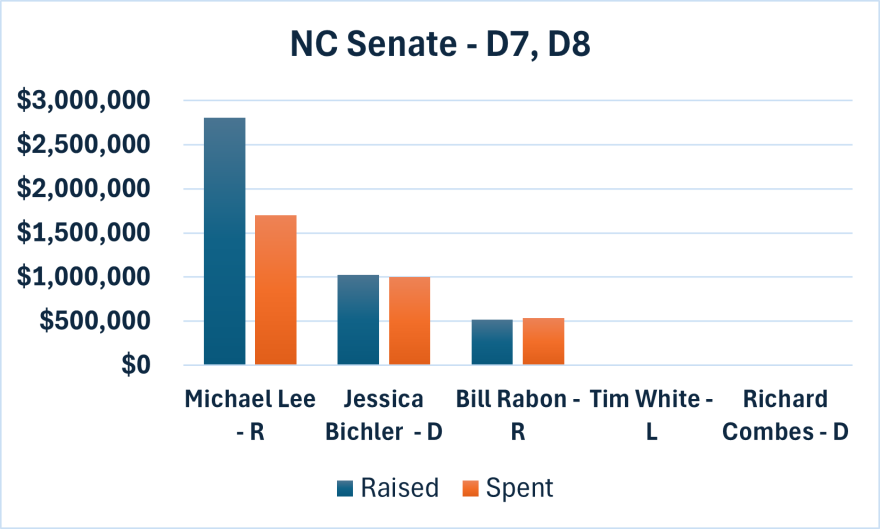
Republican incumbent Senator Michael Lee — $2.8 million

Lee raised $2,805,965 by the end of Q3, including in-kind donations of $959,174 from the North Carolina Senate Majority Fund (Lee is the Senate Majority Leader and was a frontrunner to succeed Phil Berger as Senate President Pro Tempore). Lee raised $412,624 from other political committees (including PACs) and $1,410,660 from individual donations.

PAC donations came from dozens of organizations representing real estate and development, healthcare, and energy production. In Q3, maximum $6,800 PAC contributions came from Duke’s employee PAC, Blue Cross Blue Shield of NC, North Carolina Advocates for Justice (representing trial lawyers and legal professionals), NC Beer and Wine Wholesalers, NC Home Builders Association Build PAC, NC State Farm Agents PAC, the PAC for Nelson Mullins Riley Scarborough PAC (a lobbying firm that represents New Hanover County among other clients), the North Carolina Association of Electric Cooperatives, the North Carolina Automobile Dealers Association, North Carolina Dental PAC, North Carolina Healthcare Facilities, OrthoCarolina PA, Wilmington Anesthesiology PAC, and the Southern States Police Benevolent Association. Also, while a nonprofit and not a PAC, the Catawba Indian Nation made a maximum donation.

Lee also received over 160 individual contributions in Q3, more than two dozen of whom gave the maximum amount, including developer Roy Carroll and software developer James Goodnight. Donations also came from two influential philanthropic families who gave the maximum: influential conservative businessman James Authur ‘Art’ Pope and his wife Katherine both gave $6,800; the McNeil family, which runs Liberty Healthcare and has also philanthropically supported UNCW, gave $27,200 between brothers John “Sandy” McNeill Jr. and Ronald “Ronnie” McNeill and their wives.

The Lee campaign spent $2,360,692 in Q3 ($2,606,531 from the beginning of the race). His top expense was just over $1.7 million spent in the third quarter on media buys through Louisiana-based marketing and consulting firm People Who Think, LLC. Much of the roughly $960,000 spent by the Senate Majority Fund went to direct mail advertising. Smaller but notable expenditures include $63,308 paid to Meta for social media ads and $24,365 paid to Kentucky-based Starboard Strategy, LLC. The campaign also paid $13,431 in credit card processing fees and $10,319 for campaign operating expenses to Debbie Bowden, who works for Lee’s law firm.

Lee had $297,631 remaining cash on hand at the end of Q3. His campaign also received at least a dozen donations after October 17, totalling at least $50,000, as well as additional in-kind support from the Senate Majority Fund.

Democratic challenger Jessica Bichler — $1 million

Democrat Jessica Bichler raised a total of $1,026,629 by the end of Q3, including $622,131 from the North Carolina Democratic Party, $318,259 in individual donations, and $47,773 from other political committees (including PACs).

According to state campaign finance records, Bichler received nearly 3,000 individual donations ranging from $1 to $50 in Q3. Top individual donations over this period included $6,800 from Sanford OBGYN Lisa Jones, $6,300 from former Democratic State Senate candidate Marcia Morgan, $5,000 from Sanford physician Jeffery Keith Smith, $5,000 from attorney Anna Oliver, and $4,000 from Robert Katz of Boulder, Colorado.

Top political committee donations from Q3 included $6,800 from the pro-choice EMILY’s List PAC, $6,150 from Planned Parenthood Votes! NC PAC, $5,500 worth of in-kind support from the Chicago-based Progressive Turnout Project, $5,000 from the Jane Fonda Climate PAC, $3,823 (including in-kind support) from the NC Sierra Club, $3,000 from Greater Than, a Vermont-based women’s issues PAC, and $2,000 from Democratic Women of NC.

The Bichler campaign’s total expenditures were $997,945, nearly all spent in Q3. That included in-kind support from the state’s Democratic Party, which covered staff pay and benefits, mobilization, legal costs, and other expenses.

The top expenditures were $597,417 on Illinois-based SP Media group for broadcast ads, followed by a $205,501 digital buy from SWAY, a communications and production firm located in Chevy Chase, Maryland. Other expenses included just over $12,000 in contract services for Jonathan Garza, a campaign manager in Raleigh, just under $12,000 for social media services from Durham-based strategist Emma Larsen, and $7,000 for compliance services from Raleigh-based Maven Strategies.

Bichler had $28,683 on hand at the end of Q3, though she received over $100,000 in additional support from the North Carolina Democratic Party since October 17, according to 48-hour reports filed with NCSBE.

NC Senate District 8

Senate District 8 covers Bladen and Columbus counties, and “the notch,” a portion of downtown Wilmington. Republican incumbent Bill Rabon retained his seat in the 2026 midterm election.

Republican Incumbent Bill Rabon — $518,188

Rabon brought in a total of $518,188, with more than half coming in during the third quarter. The majority of his $532,052 expenditures was the $446,850 he spent on other candidates and political committees. He began the campaign with $39,309 cash on hand.

Twenty-five of his 70 donations were $6,800 or over. Rabon received a total of $305,950 from PACs (political action committees, which do not have a formal affiliation with a particular party), and $31,136 from political party committees, which are affiliated with the party. Of the PAC donations, $123,050 came in during the third quarter of the campaign.

Rabon received some large last-minute donations in late October: a $15,478 contribution from the NC Senate Majority Fund, and a $6,800 donation from Michael Rabb, of Florida.

Individual contributions in general picked up in the third quarter, with $128,900 of the total $181,100 the candidate raised from individuals coming in during this period.

Overall, though, committee spending far outpaced individual spending.

The NC Realtors PAC trailed the NC Senate Majority Fund for second-place among donors, giving a total of $13,600 over the course of the campaign. Charter Communications PAC came in third, at $11,800.

PACs that gave $6,800 were Blue Cross and Blue Shield of NC, the Carolina Asphalt Pavement Association, Centene Corp, Duke Energy, NC Association of Electric Cooperatives, NC Beer and Wine Wholesalers, NC Home Builders, NC Hospital Association, NC Restaurant and Lodging, and the University Development Coalition.

The Catawba Indian Nation and Providence Anesthesiology Associates PAC gave Rabon $4,000 each.

McGuire Woods Federal, Reynolds American, and Rocket State each gave $3,000, while the NC Farm Bureau, NC Nursery and Landscaping Association, and Syngenta Corp each gave $2500. Carolink, East Rising, Lowe’s, the Norfolk Southern Corporation Good Government and the NC CPA PACs all gave $2,000.

Rabon’s largest contribution was $275,000 to the NC Senate Majority Fund. A $6,800 donation to Friends of Chris Stock, who is running for NC Senate District 18, came in a distant second. Rabon also donated $3,950 to the Brunswick County GOP, and $3,000 to Friends of NRA.

Democrat Rick Combes — $2,158

Democratic challenger Rick Combes has received a campaign total of $2,158, with $639 coming from the Brunswick County Democratic Party in the first quarter of the campaign, and the remainder from individuals. He received $349 from individuals in the third quarter and no further funds from any committee. His total operating expenditures were $1,457, with the majority, $1,178, spent in the third quarter. He had $324 cash on hand at the end of Q3.

Libertarian Tim White — $780

Libertarian challenger Tim White, of Bolivia, Brunswick County, ran a mostly self-funded campaign, which he said during a candidates’ forum was a deliberate choice. He received a total of $780, with $640 coming in during the third quarter. According to campaign financial disclosure documents, he spent exactly as much as he received. Expenses were not itemized, and the donor for the initial $139 contribution in the first quarter was not named.

House District 17 

House District 17 covers north and western Brunswick County, including Leland. Republican incumbent Frank Iler maintained his House seat in the 2026 elections.

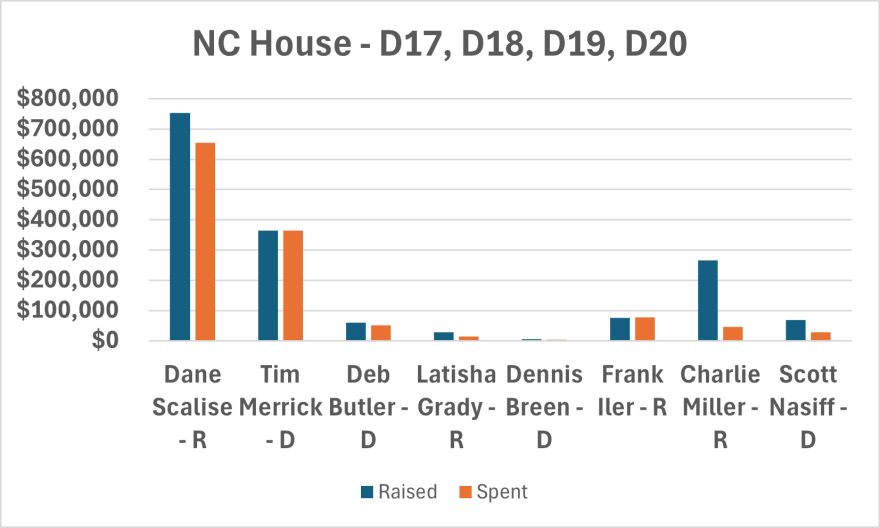
Incumbent Republican Frank Iler — $75,540

Iler received a campaign total of $75,540, with $20,876 raised during the third quarter. He began the campaign with $7,138, and he spent a total of $77,556, with $14,950 going to other candidates and political committees.

Iler’s PAC donations came out to $31,629, with $11,776 coming in during the third quarter. Unlike some other GOP candidates, the majority of his contributions, $43,171, came from individuals, rather than PACs or political committees. He received no money from political party committees. Thirteen of his 30 donations were $1,000 or more, with half a dozen of those exceeding $2,000.

Iler’s largest donation was $10,000 from the Carolina Asphalt Pavement Association, followed by an individual donation of $7,000 from Debbie Sloan Smith, a Realtor. The NC Auto Dealers Association PAC gave $4,052, and the NC Realtors PAC gave $4,000. George A. Sloane III, another realtor and private individual, gave $3,500. The NC Association of Electric Cooperatives gave $2,700, the Carolink PAC gave $1,500, and Duke Energy Corporation PAC gave $1,000. The Frank Williams Committee, of Leland, contributed $1,977.

Iler’s largest expense was $36,108,69 for website, email, mailer and digital ad services from Frontier Political Group. He paid $15,000 to the NC House Republican Caucus for “operating expenses.” He sponsored a dinner by the Brunswick County Republican Party with $3,150. He paid Pioneer Specialties, a vendor out of Leland, $2,811 for campaign novelties like hats and hand sanitizer, and he spent $428 on credit card processing fees.

Democrat Dennis Breen — $8,912

Challenger Dennis Breen received a total of $8,912, with $6,287 coming in during the third quarter. The majority of his contributors were individuals, with many of them donating through ActBlue, the Democratic fundraising platform. He received no money from Democratic Party-affiliated committees.

The smallest sums he received were three donations for $9.44 from unnamed donors through ActBlue, the democratic fundraising platform. Breen himself contributed a check for $2,500 to his committee, Breen for NC 17. His next two highest donations were for $600, from Anita August, and $500, from Susan Bridges, both listed as retirees.

Breen’s total expenditures were $6,141, with the majority, $4,362, spent during the final quarter of the campaign. He spent money on printing, billboards, and web hosting.

House District 18

House District 18 covers large parts of Wilmington. Democratic incumbent Deb Butler maintained her NC House seat.

Democrat incumbent Deb Butler — $60,649

Butler raised $60,649. Butler’s top donor was Daniel Cameron, who gave $1,000. Topping her receipts were PACs: NC Association of CPAs and NC Realtors, who both gave $2,000, followed by NC Association of Electric Cooperatives, which gave $750.

She also had 18 donors who gave between $100 and $500. The APCI Association Insuring America gave $500. The Democratic Women of Pender County donated $200.

For expenditures, Butler spent a total of $51,798. She spent $24,900 on television ads with WECT News. She also gave $10,000 to the NC House Democratic Caucus and $5,000 to the Democratic Party. She also spent $3,087 on campaign software. Her other spending was for website payments, the New Hanover County NAACP and credit card processing fees.

Republican challenger Latisha Grady — $29,103

Republican challenger for NC House District 18 Latisha Gray raised $29,103. For Quarter 3, she had upwards of 30 total donors. Her top donor was D Logan, president of Logan Homes, who gave $11,800. Other top donors were Susan Meyers, managing partner at Eastern Carolina Broadband, who donated $1,825, followed by Jean Cooley, $1,260.

The NC Republican Party gave $1,139, followed by the New Hanover County Republican Party, which gave $1,139.

For Grady’s expenditures, she spent $14,459 mainly on print campaign materials ($4,354) with New Hanover Printing. She also spent $2,634 on a fundraising event and $1,268 on campaign shirts with Port City Apparel. Grady also paid agriculturalist and political organizer Immanuel Jarvis $715 for a speaking fee at one of her campaign events; she also paid $750 for a podcast appearance fee for Philatherapy.

House District 19

House District 19 covers southeastern and coastal Brunswick and southern New Hanover County. Republican incumbent Charlie Miller maintained his NC House seat.

Republican incumbent Charlie Miller — $266,371

Overall, Miller’s campaign raised $266,371, including $209,926 in individual contributions (plus a small amount, $175, in aggregated contributions), $2,601 from political parties, and $46,717 from PACs and other political committees. In Q3 alone, Miller raised $94,250 from individuals, $2,206 from political parties, and $26,000 from PACs.

Top individual donors in Q3 included family nurse practitioner Robb Cass, who gave $6,800 (and $11,800 overall), Nelson Blanks, manager of Southport’s Frying Pan restaurant, who gave $6,000, Davis Herring, Jr. who gave $5,000, and real estate broker Sherol Lappala who gave $3,750, real estate broker Bonner Herring who gave $3,400. Miller also received $6,800 from Cynthia Uter, of Fort Lauderdale, Florida, after Q3, according to a 48-hour report.

PAC donations in Q3 included several energy-sector organizations: Duke Energy’s employee PAC gave $5,000, the NC Association of Electric Cooperatives gave $1,000 (and $4,000 overall), and Dominion Energy’s PAC gave $1,000.

Other top PAC donations included $2,000 from the NC Dental Society ($3,000 overall) and $2,000 from the NC Realtors PAC ($5,000 overall), and $2,000 from NCFIREPAC (created by the Professional Fire Fighters and Paramedics of North Carolina). Miller also received $2,500 from Republican State Senator Bill Rabon’s committee. The Eastern Band of Cherokee Indians also made a $6,800 donation.

Miller’s total expenditures were $242,579, with $134,726 in Q3. Much of his expenses came in the form of donations to candidates, parties, and other organizations.

The campaign gave $50,000 to the North Carolina Republican Party, $25,000 to the North Carolina House Republican Campaign Committee, $12,950 to the New Hanover County GOP, and $7,550 to the Brunswick County GOP. It also gave $10,800 to the Brunswick County Sporting Dog Association and

$7,600 to the Friends of the NRA.

Campaign expenses included $10,666 for North Carolina-based Capen Consulting, $10,507 at the Edgewater 122 restaurant in Southport, $3,235 for campaign hats, and $ 2,180 for meetings with constituents.

Miller ended Q3 with $46,595.98 cash on hand.

Democrat Scott Nasiff — $68,811

Nasiff has raised $68,811, including $25,147 in Q3. Most of that, $62,835, was from individual donations ($22,523 in Q3). Overall, Nasiff has also raised $2,337 from aggregated smaller donations (under $50), $2,140 from political party committees, and $1,500 from PACs.

Top donors include Thomas Ruehle, who gave $3,070 overall, Leo Pacyna, who has given $2,065 overall, and Mark Fields, who has given $1,020 through Q3. Nasiff also received $1,500 from the NC Progressive House Caucus PAC and $500 from the Brunswick County Democratic Party.

Top expenses include $27,692 for SWAY, a communications and production firm located in Chevy Chase, for internet ads. Nasiff’s campaign also spent $2,268 on the State Port Pilot and $1,575 on the Brunswick Beacon for print ads, as well as $2,351.67 on Demprinting.com for yard signs.

Nasiff’s campaign has spent $50,553.33 through Q3, and had $18,258.08 cash on hand at the end of the quarter.

House District 20

House District 20 covers the northern part of New Hanover County. Democrat Dr. Tim Merrick has won the NC House 20 seat; however, Republican Dane Scalise is in the range for a recount. If the margin more or less holds, he can file that request at the canvass on Friday, November 13.

Republican Dane Scalise — $753,896

Scalise, who is a New Hanover County commissioner, raised $753,896, of which $423,297 came from individuals and $327,363 came from PACs or other political committees. The North Carolina House Republican Party gave him $286,461 mainly for media, surveys, and other advertising.

His second largest donor was the IIANC PAC, an independent insurance agents PAC, at $7,800.

For Quarter 3, Scalise had just over 100 donors, including individuals, PACs, and political committees.

His top two individual donors were engineers Stephen Bright and John Talbert of Talbert and Bright who both gave $7,000 each. Christopher Perry of Perry’s Emporium gave $6,800 as did homemaker Kelly Thomas, and the NC Homebuilders Association PAC.

Other major PACs who gave to Scalise were Wilmington Anesthesiology PAC ($4,000), Southern States PBA PAC Fund ($4,000), Island Preservations ($3,000), NC Health Care Facilities Association PAC ($3,000), NC Realtors PAC ($2,000), NC Automobile Dealers Association ($1,026),

PACs who gave $1,000 included Back to One PAC (film technicians PAC), NABIP-NC (Association of Benefits and Insurance Professionals), NC Beer and Wine Wholesalers Association PAC, and the NC Dental Society PAC.

For political committees, the Lower Cape Fear Republican Women’s Club gave $2,250. He also has a legal expense fund worth $3,000.

He also filed two recent 48-hour reports, with attorney John Hearne giving $1,000.

Scalise has spent $655,454 on campaign mailers, social media ads, contributions to the NC House Republican Caucus, campaign commercials, and processing fees.

His top expense was $109,560 to Arena Mail and Digital, followed by $70,000 to the NC House Republican Caucus, and $50,000 to Poolhouse Agency LLC for a media buy.

He also spent $30,915 on campaign consulting with Capital Communications Inc. Other over $10,000 expenditures were with Game Changers ($23,250), Fire Horse Films ($18,076), Campaign HQ, for campaign texts, ($13,289), and campaign processing fees for Anedot ($10,058).

Scalise also paid treasurer Debbie Bowden $3,968, and the New Hanover County GOP $3,300 for the Deb Hays Memorial Golf tournament, in honor of the former Wilmington planning commission and New Hanover County commissioner. He also gave $250 to each of the Republican candidates running for school board – Josie Barnhart, Dr. Amy Dunning, Pat Bradford, and Chris Sutton.

Dr. Tim Merrick — $364,177 

Merrick, who is a New Hanover County Board of Education member, raised $364,177, about half came from over 1,000 individuals, and around 60 of those donors gave at least $1,000; and the other half came from PACs or political organizing committees.

Merrick emailed WHQR on Election Day that his campaign had roughly raised around $518,000. Most of those additional funds were raised after the Quarter 3 deadline of October 17.

Merrick has had three 48-hour filings recently. One was for $50,000 from the North Carolina Democratic Party. Their total investment in Merrick was $155,194. Lawyer Robert Zaytoun gave $1,000, and Mary Vogelsong also gave that amount.

His top individual donor is veterinarian Kari Snook, who donated $11,050, followed by James Kelly of Lerrink Partners, an equity research firm, who gave $9,000.

For PACs supporting Merrick, Jane Fonda Climate PAC gave $5,000 and Planned Parenthood Votes! South Atlantic gave $4,000. Progressive Turnout Project gave $1,750.

Merrick spent $364,568 – and has a negative balance in his ‘cash on hand’ of $390. His main spending went to television advertisements with K Squared Media LLC ($76,960) and Old Town Media LLC ($64,582). He also used Express Land Strategies, LLC, for consulting on fundraising, spending $27,553. He paid Rachel Hatfield $24,980 to help him run his campaign.

Other funds were spent on processing campaign donations, on software programs, and on fundraising events.


At Port City Daily, we aim to keep locals informed on top-of-mind news facing the tri-county region. To support our work and help us reach more people in 2026, please, consider helping one of two ways: Subscribe here or make a one-time contribution here.

Leland multi-use path awarded nearly $1M for engineering

0
A 0.29-mile multi-use path to extend from South Navassa Road to Loop Road is coming to Leland. (Port City Daily/File)

LELAND — A 0.29-mile multi-use path to extend from South Navassa Road to Loop Road is coming to Leland.

The Wilmington Urban Area Metropolitan Planning Organization awarded the town $973,600 as part of its Fiscal Year 2029-2030 Locally Administered Projects Program. These funds will go toward preliminary engineering and construction of the 10-foot-wide multi-use path.

The path will improve connectivity and provide safe, accessible transportation options for pedestrians and cyclists. It will connect to an existing multi-use path and connect residential developments, including Village Road, the Town’s Gateway District, Sturgeon Creek, and future recreational amenities, according to the town.

Leland considered the project a high-priority as part of its Integrated Mobility Plan, and it aligns with the Gullah Geechee Heritage Trail Feasibility Study and the WMPO 2050 Metropolitan Transportation Plan.

WMPO’s Locally Administered Projects support transportation improvements regionwide, including federal-aid highways, bridges, tunnels, public roads, pedestrian and bicycle infrastructure, and transit capital improvements. Other projects awards LAP funds this year include S. Lake Park Boulevard Sidewalk for $921,600 in Carolina Beach, New Centre Drive Sidewalks and Pedestrian Signals for $1.696 million in Wilmington and Medical Center Drive Sidewalk and Roadway Improvements for $1.84 million, also in Wilmington.


At Port City Daily, we aim to keep locals informed on top-of-mind news facing the tri-county region. To support our work and help us reach more people in 2026, please, consider helping one of two ways: Subscribe here or make a one-time contribution here.

We appreciate your ongoing support.
UNCW hosts senior art exhibition through December

0
UNCW's Cultural Arts Building on May 22, 2023. CAB houses the Departments of Music, Theater, and Art & Art Histroy. PHOTO BY: BRADLEY PEARCE/UNCW
A group exhibition created and installed by the graduating class of studio art majors at UNCW is on display through early December. (UNCW/Bradley Pearce)

WILMINGTON — A group exhibition created and installed by the graduating class of studio art majors at UNCW is on display through early December.

“Afterimage” opened Thursday, Nov. 5, and will hang through Friday, Dec. 11, in the Cultural Arts Building Art Gallery. The theme touches on memory, nostalgia, and human connection.

The graduating seniors part of the exhibit include Itzel Avellaneda-Cruz, Scout Baker, Branden Collazo, Carter Cordle, Callahana Goodman, Talon Jones, Kesler Lilly, Ella Page, Hannah Payne, Oliver Rice, CJ Yopp, and Emily Worth. They’re showcasing a variety of media.

CAB Art Gallery is located on UNCW’s campus on the ground floor near the main entrance to the Cultural Arts Building. Its hours are Mondays, Tuesdays, Wednesdays, and Fridays from 10 a.m. to 4 p.m. with extended hours on Thursdays from 10 a.m. to 7 p.m. The gallery will be closed on Nov. 26 and Nov. 27 for Thanksgiving.

For more information on the gallery or the exhibition click here.


At Port City Daily, we aim to keep locals informed on top-of-mind news facing the tri-county region. To support our work and help us reach more people in 2026, please, consider helping one of two ways: Subscribe here or make a one-time contribution here.

We appreciate your ongoing support.
Cape Fear Community College hosts fall open house

0
To learn more about the programs offered at Cape Fear Community College, a fall open house will open to the public. (Port City Daily/File)

WILMINGTON — The public will have a chance to learn more about the programs offered at Cape Fear Community College at its fall open house.

The event takes place on Tuesday, Nov. 10, from 4 p.m. to 6 p.m. at the Joe and Barbara Schwartz Center, 610 N. Front Street. It consists of opportunities to connect with faculty and staff concerning programs CFCC offers — around 170, including cosmetology, aviation, and health sciences.

Attendees will also learn about financial aid admissions and dual enrollment and tere also will be a guided tour, games and giveaways.

Registration for the event is open here.


At Port City Daily, we aim to keep locals informed on top-of-mind news facing the tri-county region. To support our work and help us reach more people in 2026, please, consider helping one of two ways: Subscribe here or make a one-time contribution here.

We appreciate your ongoing support.
Endowment awards $500K community grants to 39 organizations

0
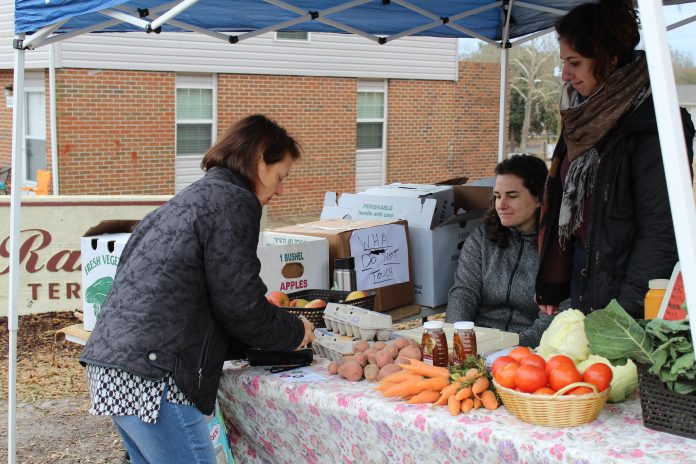
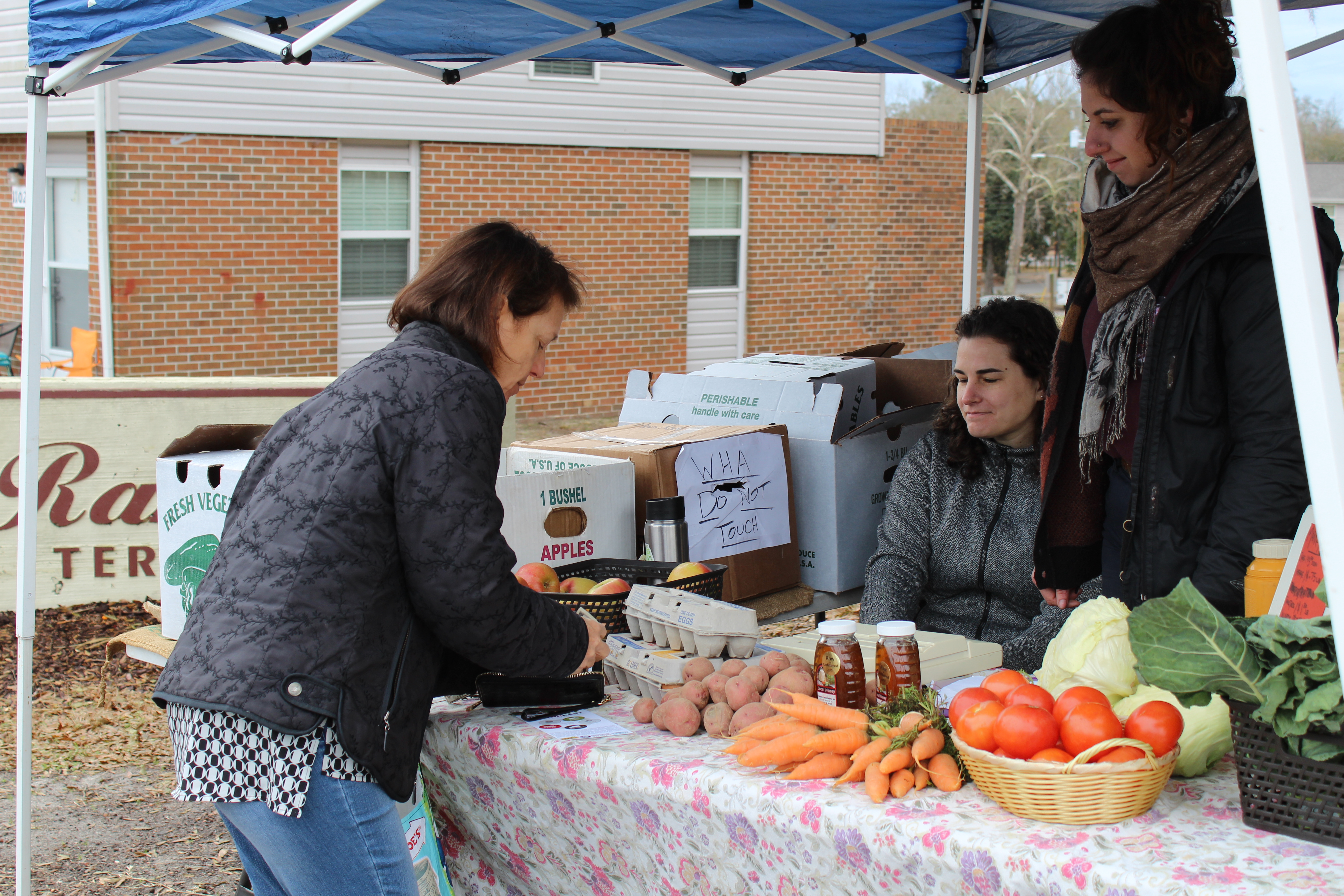
Feast Down East hosts a weekly fresh market open to the public every Friday selling fresh produce sourced from local farmers in Southeastern North Carolina. (Port City Daily photo/OLIVIA PARR)
Feast Down East received $12,000 to support the Farmers Fighting Hunger program by covering a portion of food costs, providing fresh, local food to NHC partner agencies while investing in the local agricultural economy. (Port City Daily/FIle)

WILMINGTON — The Endowment’s fall community grant cycle is investing $500,000 to more than three dozen nonprofits for varied causes, from literacy to mental health, environmental to arts.

Thirty-nine grants are awarded this cycle, to support the Endowment’s four pillars in social and health equity, education, community safety, and community development. The community grants program opens every fall and spring, with The Endowment giving away 80 grants, from $5,000 to $15,000, in 2026, totaling $1 million.

“The Community Grants Program gives us an opportunity to support the organizations and people making a difference across New Hanover County,” Endowment CEO Sophie Dagenais said in a release. “Each grant cycle also helps us listen and learn from those working directly in our community. Their ideas, experiences, and insights strengthen our understanding of local needs and help inform how we continue to invest in New Hanover County.” 

The Endowment received 142 applications requesting $1.88 million in total; 67 had never received Endowment funding. Applications were independently reviewed and scored by pillar-based subcommittees at The Endowment staff and its Community Advisory Council members. 

“These grants support everyday needs that make a difference in people’s lives, a bed to sleep in, food on the table, a ride to essential services, and opportunities to learn and connect,” Shannon Wick, Endowment network associate, said.

Grant funds must be used by July 30, 2027, and all nonprofits are required to file final impact reports due by Aug. 30, 2027. 

Fall awards include:

2Share Inc: — $15,000 to purchase approximately 75 to 100 beds for children, adults, and seniors at no-cost to low-income NHC households in need. 

Accessible Coastal Carolina Events, Sports & Services, Inc. — $13,724 to support the ACCESS Fit program, providing twice a week fitness exercise to adults and older adults, including virtual programs for homebound participants. 

Alliance for Cape Fear Trees — $15,000 to build the infrastructure needed to plant, distribute, and care for trees throughout NHC through the purchase of an enclosed trailer to transport trees, mulch, and tools, field equipment, an iPad for data collection, and personnel. 

Arid Serenity Association Inc. — $15,000 to improve the safety, reliability, comfort, and energy efficiency of a substance-abuse recovery meeting facility through infrastructure improvements and building repairs. 

Autism Society of North Carolina Inc. (ASNC)— $10,000 to purchase new playground equipment for an after-school and summer camp program for children with autism in NHC. 

Bread for Life Senior Pantry (BFL) — $15,000 to purchase food and supplies to be distributed to participants and support operational expenses to operate the food pantry, such as rent, electricity, insurance, and office supplies. 

Brooklyn Arts Music Academy (BAMA) — $15,000 to support Music Camp instructor fees and provide approximately 18 full and partial scholarships for low-income children, expanding access to summer music education through individual instruction, ensemble participation, masterclasses, and performances. 

Camp Schreiber Foundation — $9,400 to support organizational vehicle operating costs for 15 young men in NHC high schools to reach tutoring, summer jobs, structured out-of-school time, college visits, and volunteer runs.

Cape Fear Literacy Council (CFLC) — $15,000 to support a strategic planning facilitator to focus on programmatic integrity, sustainability, succession planning, and physical space to continue to improve services and work toward long-term sustainability. 

Catholic Charities of the Diocese of Raleigh Inc. — $15,000 to support the Clean Start Mobile Laundry Project, providing free mobile laundry services and social work support to unsheltered residents of NHC and disaster impacted communities. 

City of Wilmington – Police Department (CoW PD) — $15,000 to support the Police Activities League (PAL) program to connect police officers with youth in NHC by engaging them in positive sports and activities to improve their quality of life, present developmental opportunities, and offer the prospect of a brighter future. 

Climb USA Inc. — $9,500 to support the CLIMB Launchpad through outreach, education, and collaboration to address the need to elevate the wealth status of under resourced youth and families in the Sea Breeze and Myrtle Grove communities through investment education and capital markets engagement. 

Coastal Therapeutic Riding Program — $15,000 to expand access to equine-assisted activities and therapies for adults in NHC, with a focus on veterans and adults with disabilities through approximately 135 subsidized therapeutic riding sessions. 

Corporation for Inquiry — $14,730 to support Science of Reading education, expansion of decodable books, and teacher stipends to strengthen early literacy outcomes for K-2 students in NHC, while building teachers’ and families’ capacity to support evidence-based reading instruction. 

Diaper Bank of North Carolina (DBNC) — $5,000 to support the Adult Incontinence Access Initiative to sustain adult incontinence product distribution through existing NHC partner network. 

Dreams of Wilmington Inc. — $15,000 to provide daily afterschool programming at three sites for early middle schoolers through high schoolers, addressing Impact Zone’s core goals: reducing youth involvement in violence, mitigating adverse childhood experiences, and strengthening the education-to-workforce pipeline. 

Family Support Network of Southeastern North Carolina Inc. (FSN SENC) — $15,000 to strengthen its Foster Care Wrap Around Support Program for foster and kinship caregivers in NHC through monthly caregiver support groups offering peer connection, a community meal, childcare, and evidence-informed education. 

Feast Down East Inc (FDE) — $12,000 to support the Farmers Fighting Hunger program by covering a portion of food costs, providing fresh, local food to NHC partner agencies while investing in the local agricultural economy.

Film Partnership of NC (FPNC) — $15,000 to fund the paid workforce placements for CFCC Film & Video Production students from NHC through hands-on mentorship experiences and credited work opportunities. 

Financial Protection Law Center — $15,000 to provide free access to justice and assistance for individuals with low incomes and low wealth in NHC by expanding existing outreach and services through staff attorney support to conduct outreach throughout the County, attend partner events, and meet with eligible residents to help obtain property tax relief. 

Five 14 Revolution Inc. — $10,000 to implement Empower DB, a cloud-based client management system that will replace the outdated software and allow to better track services, client progress, and outcomes to benefit survivors of human trafficking and exploitation in NHC. 

Going Beyond the Pink (GBTP) — $14,500 to fund facility fees, curriculum and material development, assessments, marketing, and a facilitator stipend through the BLOOM Breast Cancer Support group for approximately 15 to 20 breast cancer patients and survivors per month. 

Hope Abounds. Inc. — $15,000 to expand its patient advocacy, medical navigation, and education services for children and adults undergoing cancer treatment, their caregivers, and families residing in NHC by providing individualized needs assessments, resource navigation, financial-assistance referrals, practical support, educational resources, and ongoing advocacy throughout treatment. 

IndependentWorks — $9,400 to sustain and expand the Community Without Walls program, a social and educational program for adults with intellectual and developmental disabilities by funding a customer relations management software and programmatic expenses. 

Jo Ann Carter Harrelson Center Inc. — $11,000 to support the Dollars & Sense financial literacy workshops to address an urgent and significant need in New Hanover County for accessible financial literacy programming for families that are seeking financial assistance for their housing crisis. 

Louise Wells Cameron Art Museum (CAM) — $15,000 to support the Art, Mind, & Body, a free weekend of programming, bringing healthcare organizations, community providers, and arts-based wellness programs together in a welcoming, non-clinical setting to approximately 700 NHC residents. 

NAMI – Wilmington — $7,500 to support increased access to Peer Connections Support Groups and Family Support Groups for NHC residents through free, welcoming, stigma-free spaces where adults with mental health conditions can connect with others, learn about mental health, and find resources and encouragement.

Outreach of Cape Fear — $12,000 to provide free or substantially reduced access to soccer year-round to NHC youth by offsetting the cost of fall, spring, and summer soccer league, soccer balls, equipment, protective gear, and uniforms. 

Paul E Gregory Foundation for Charity Inc. — $8,246 to purchase professional-grade construction tools to expand and enhance its Be What’s Next Construction Career Exploration Lab (CCEL), a mobile workforce development classroom where NHC students between 5 and 18 can learn about the construction industry through hands-on experiences. 

Purpose Church International Inc. — $15,000 to support a 6-month program serving approximately 25-30 NHC adults age 55+ through monthly gatherings and a Senior Prom Social to create consistent opportunities for social connection, wellness, digital literacy, and access to community resources. 

Sleep in Heavenly Peace Inc (SHP) — $10,000 to provide a minimum of 32 NHC youth-in-need with a bed to enhance sleep quality, improve academic performance, and increase family stability. 

United Way of the Cape Fear Area (UWCFA) — $15,000 to provide flexible emergency assistance to vulnerable households during extreme winter weather events, preventing utility shutoffs, supporting emergency sheltering, and ensuring access to safe warming resources, prioritizing older adults, individuals with disabilities, families with young children, and households experiencing financial hardship. 

VENTURE CHRISTIAN CHURCH — $5,000 to support the Venture Kids Club, a free weekly after-school program serving approximately 20-25 elementary-aged children in the Market North community through consistent enrichment programming, meet practical needs that can affect the child’s success and confidence, and strengthen relationships with participating families. 

Vigilant Hope Inc — $15,000 to launch a mobile community center to serve low-to-moderate income Southside adults and children, homeowners and renters, youth seeking opportunities, and other local organizations by hosting Family Fun Nights and Homeowner Supports. 

Wilmington Chapter of Medical Assistants — $8,000 to expand educational activities, professional development, networking, outreach, and member engagement through attendance of 80 current and prospective medical assistance from NHC at the 2027 NCSMA Conference. 

Wilmington Chapter of the Links, Incorporated — $15,000 to support the Wilmington Chapter of the Links mentoring program through an educational and cultural experience to Chicago to connect 20 girls and 5 adults at Snipes Academy of Arts and Design to real-world people, places, art, and opportunities.

Wilmington Children’s Museum Inc. — $15,000 to support the Children’s Courtyard project to transform a portion of the museum’s existing outdoor space into an accessible, comfortable, and functional outdoor classroom for children and their caregivers in NHC. 

Young Mens Christian Association (YMCA) of Southeastern North Carolina Inc. — $15,000 to support the YMCA Senior Connections Pilot using existing YMCA transportation capacity to reduce social isolation, improve access to healthy food and essential services, and support healthy aging among older adults in NHC. 

Young Scientist Academy (YSA) — $15,000 to support the Connecting Community and Careers initiative through linking NHC students with local STEM employers, building technical workplace skills for careers in healthcare, advanced manufacturing, marine science, and clean energy. 


At Port City Daily, we aim to keep locals informed on top-of-mind news facing the tri-county region. To support our work and help us reach more people in 2026, please, consider helping one of two ways: Subscribe here or make a one-time contribution here.

Food Truck Tracker: Nov. 6 – 13

0
Made in Venezuela will be in Holly Ridge this weekend. (Courtesy Made in Venezuela)

WILMINGTON — Port City Daily publishes the Food Truck Tracker every Friday, so folks can know where to access the best mobile eats while planning their weekend activities.

All schedules, which will run Friday to Friday, are subject to weather conditions and cancellations. The addresses of where the food trucks will be parked are alphabetized at the bottom.

Run a food truck and want to be included? Send schedules every Thursday by 8 a.m. to [email protected].

Weekly Schedules

CHEF DRIVEN
Chef Steven Winters operates this locally owned and operated food truck to serve up meals on-the-go using local, homemade, and high-quality ingredients.

  • November 6 — Anderson Elementary School, 5 p.m. – 8 p.m.
  • November 12 — DrumTrout Brewing Company, 5:30 p.m. – 8 p.m.

EASTSIDE
Eastside specializes in subs using from-scratch recipes and organic, all-natural products.

  • November 6 — Wilmington Brewing Company, 5:30 p.m. – 8 p.m.
  • November 7 — Trask Family Farm, 11 a.m. – 4 p.m.; Mad Mole Brewing, 5 p.m. – 8 p.m.
  • November 11 — Broomtail Craft Brewing, 5 p.m. – 8 p.m.
  • November 12 — Biggers Market, 5 p.m. – 8 p.m.
  • November 13 — Mad Mole Brewing, 5 p.m. – 8 p.m.

THE FOXES BOXES
The Foxes Boxes is coming out of a five-year hibernation with a new traveling den to bring you fresh food and meaningful connection!

  • November 7 — Flytrap Brewing, 1 p.m. – 4 p.m.

GLIZZIES ON THE GO
Glizzies on the Go is a food stand providing you with your finest pop up hotdog experience.

  • November 9 — Leland Brewing Co., 5 p.m. – 8 p.m.

GUSTU PERANO
A play on authentic Peruvian flavors, brought to you by NCRLA Chef of the Year and Peoples’ Choice winner.

  • November 6 — DrumTrout Brewing Company, 5 p.m. – 8 p.m.
  • November 7 — Flytrap Brewing, 5 p.m. – 8 p.m.
  • November 11 — Flytrap Brewing, 5 p.m. – 8 p.m.

ISLAND SQUEEZE
Gourmet fresh-squeezed lemonade, all-natural and eco-friendly, made to order — serving Wilmington, NC, and area beaches.

  • November 7 — Trask Family Farms, 10 a.m. – 3:30 p.m.; Cape Fear Kite Festival, 11 a.m. – 4 p.m.
  • November 8 — Trask Family Farms, 10 a.m. – 3:30 p.m.; Cape Fear Kite Festival, 11 a.m. – 4 p.m.

JABBA’S HOT & SWEET DIPPING SAUCE
Serving wings, shrimp burgers, Jabba dog, fried bologna, chicken and rice, and more.

  • November 6 — Eagle Island Fruit & Seafood, 11:30 a.m. – 2:30 p.m.

MADE IN VENEZUELA
Serving arepas, empanadas and other Venezuelan specialties.

  • November 6 — Summerhouse Clubhouse, 5 p.m. – 7:30 p.m.

PEPE’S TACO TRUCK
Bringing authentic tacos, tortas, quesadillas, and burritos to our friends in New Hanover and Pender counties.

  • November 6 — Flytrap Brewing, 6 p.m. – 10 p.m.
  • November 10 — Eagle Island Fruit & Seafood, 11 a.m. – 1:30 p.m.
  • November 13 — Flytrap Brewing, 6 p.m. – 10 p.m.

PORT CITY PLATES
A food truck that serves Rochester, NY-style trash plates to the Wilmington area. Read more here.

  • November 6 — Riverfront Park, 4:30 p.m. – 7:30 p.m.
  • November 7 — Veterans Parade, 10 a.m. – 2 p.m.
  • November 11 — Cape Fear Community College, 11 a.m. – 1:30 p.m.; Scapegoat Taproom, 6 p.m. – 8 p.m.

PORT CITY QUE
Brisket, ribs, pulled pork, and other serious barbecue classics. Based out of Rocky Point, but spotted all over Wilmington.

  • November 6 — Hudson Hardware, 11 a.m.– 2 p.m.
  • November 11 — Eagle Island Fruit & Seafood, 11 a.m. – 1:30 p.m.
  • November 12 — Napa Auto Store, 11 a.m. – 2 p.m.
  • November 13 — Hudson Hardware, 11 a.m.– 2 p.m.

RUDE BWOYS JERK BBQ
The rude bwoys of barbecue bring sweet and spicy eats to Cape Fear. Known for sandwiches, barbecue bowls, nachos, tacos, and more, as well as signature sides like curry chickpeas and collard greens.

  • November 13 — DrumTrout Brewing Company, 5 p.m. – 8 p.m.

SMOOTHIE STAR
Science says your body LOVES real, whole foods—so Smoothie Star, sister truck to Well-Fed Ed, serves up smoothies and wellness shots that fuel you the right way!

  • November 5 — University of North Carolina Wilmington, 11 a.m. – 2 p.m.
  • November 12 — University of North Carolina Wilmington, 11 a.m. – 2 p.m.

WASABI WHEELS
A family-owned sushi franchise has hit the road after 30 years. Serving sushi, orange and teriyaki chicken bowls, egg rolls, poke bowls and more.

  • November 6 — Stevenson-Hendrick Honda, 11 a.m. – 1:30 p.m.; Broomtail Craft Brewing, 5 p.m. – 7:30 p.m.
  • November 7 — Mad Mole Brewing, 1 p.m. – 4 p.m.; Flying Machine Brewing Co., 5 p.m. – 8 p.m.

WELL-FED ED
Simple, vibrant and delicious dishes for the Wilmington area.

  • November 6 — Waterline Brewing Co., 5 p.m. – 8 p.m.
  • November 7 — Old River Farms, 11 a.m. – 2 p.m.
  • November 11 — University of North Carolina Wilmington, 11 a.m. – 2 p.m.
  • November 13 — Corning Inc., 11 a.m. – 1 p.m.

WHEELZ GOURMET PIZZA
Your neighborhood food truck, serving Wilmington the best gourmet, Neapolitan-Brooklyn-style pizza in the area.

  • November 9 — Flytrap Brewing, 5 p.m. – 8 p.m.

WILMYWOODIE
Wilmington’s first and only wood-fired pizza truck, serving up unique and delicious creations as well as the classics.

  • November 6 — LBC Bottle Shop, 4 p.m. – 9:30 p.m.
  • November 7 — LBC Bottle Shop, noon – 9:30 p.m.
  • November 8 — LBC Bottle Shop, noon – 8 p.m.
  • November 11 — LBC Bottle Shop, 4 p.m. – 8:30 p.m.
  • November 12 — LBC Bottle Shop, 4 p.m. – 8:30 p.m.
  • November 13 — LBC Bottle Shop, 4 p.m. – 9:30 p.m.

Find a location

  • Anderson Elementary School — 455 Halyburton Memorial Pkwy.
  • Biggers Market — 6250 Market St.
  • Broomtail Craft Brewery — 6404 Amsterdam Way
  • Cape Fear Community College North Campus — 4500 Blue Clay Rd., Castle Hayne
  • Cape Fear Community College Wilmington Campus — 411 N. Front St.
  • Cape Fear Kite Festival — 1000 Loggerhead Rd., Kure Beach
  • Carolina Beach Farmers’ Market — 400 Lake Park Blvd. S, Carolina Beach
  • Corning Inc. — 310 N. College Rd.
  • DrumTrout Brewing Company — 3710 College Rd Suite 143
  • Eagle Island Fruit & Seafood — 2500 US-421
  • The Eagle’s Dare — 420 N. 3rd St.
  • Edward Teach Brewing — 604 N. 4th St.
  • End of Days Distillery — 1815 Castle St.
  • Fermental Beer & Wine — 600 S. 17th St.
  • Figure Eight Island Yacht Club — 15 Bridge Rd.
  • Flying Machine Brewing Company — 3130 Randall Pkwy.
  • Flytrap Brewing — 319 Walnut St.
  • Freya’s Haus — 55 Scotts Hill Loop Rd.
  • Good Hops Brewing — 811 Harper Ave., Carolina Beach
  • Hendrick Toyota Wilmington — 5640 Market St.
  • Hudson’s Hardware — 6301 Castle Hayne Rd., Castle Hayne
  • Jerry’s Barber Shop — 11975 US-117, Rocky Point
  • LBC Bottle Shop — 15670 US-17, Hampstead
  • Leland Brewing Co. — 133 Fayetteville Rd.
  • Mad Mole Brewing — 6309 Boathouse Rd. Unit C
  • NAPA Auto Parts — 413 US-117 S, Burgaw
  • New Hanover County Health & Human Services — 1650 Greenfield St.
  • Oasis at Riverlights — 4027 Watercraft Ferry Ave.
  • Ocean Front Park and Pavilion — 105 Atlantic Ave., Kure Beach
  • Ogden Park — 615 Ogden Park Dr.
  • Old River Farms — 8711 Old River Rd., Burgaw
  • Outer Dunes Brewing Company — 7976 Market St.
  • Palate Bottle Shop & Garden — 1007 N 4th St.
  • Poplar Grove Plantation/Farmers Market — 10200 US-17
  • PPD Building — 929 N. Front St.
  • Riverfront Park — 10 Cowan St.
  • Riverlights — 810 Cupola Dr.
  • Salty Turtle Beer Company — 103 Triton Ln., Surf City
  • Sandpiper Brewing Company — 624 E. Ocean Rd., Holly Ridge
  • Satellite Bar and Lounge — 120 Greenfield St., #6123
  • Scapegoat Taproom — 2789 Compass Pointe South Wynd NE, Ste. 4, Leland
  • Seagate Bottle Shop — 6005 Oleander Dr.
  • Southport Tap and Cellar — 827 N. Howe St., Southport
  • Stevenson-Hendrick Honda — 6720 Market St.
  • Stevenson-Hendrick Mazda Wilmington — 5911 Market St.
  • Summerhouse Clubhouse — 261 Spicer Lake Dr., Holly Ridge
  • Surf City Brewing Company — 402 Alston Blvd. Ext, Hampstead
  • Tipsy Goat Bottles & Taps — 1930 Castle Hayne Rd. Suite 120
  • Trask Family Farms — 3650 Blue Clay Rd., Castle Hayne
  • University of North Carolina Wilmington — 601 S. College Rd.
  • The Vault CB — 612 N Lake Park Blvd., Carolina Beach
  • The Venue at Wilmington Brewing Company — 800 S. Kerr Ave.
  • Waterline Brewing Company — 721 Surry St.
  • Wilmington Brewing Company — 824 S. Kerr Ave.
  • Wrightsville Beach Brewery — 6201 Oleander Dr.
  • Wrightsville Beach Farmers’ Market — 12 Seawater Ln., Wrightsville Beach
  • Wrightsville Beach Park — 3 Bob Sawyer Dr., Wrightsville Beach

Tips or comments? Email [email protected].

At Port City Daily, we aim to keep locals informed on top-of-mind news facing the tri-county region. To support our work and help us reach more people in 2026, please, consider helping one of two ways: Subscribe here or make a one-time contribution here.

We appreciate your ongoing support.

Multiple people charged in Halloween Front Street altercation

0
Wilmington Police Department (Port City Daily photo/Alexandria Sands)
Four people have been charged with resisting or obstructing an officer after a brawl took place in downtown Wilmington following Halloween celebrations. (Port City Daily/File)

WILMINGTON — Four people have been charged with resisting or obstructing an officer after a brawl took place in downtown Wilmington amid Halloween celebrations.

A fight broke out just after 12:30 a.m. on Nov. 1 on Front Street as Wilmington Police Department officers intervened. Four people have been charged in connection to the incident:

  • Rashaud McIntyre, 31 
  • Randell Wilson, 28 
  • Tyquan Clanton, 30 
  • Brandon Johnson, 24

A video circulating social media shows multiple people throwing punches. Two are costumed, including one man dressed as Deadpool and engaging in a spin kick. An officer attempts to break up the incident, however, the men continue to engage. One person appears to have been detained in the video.

Three men, McIntyre, Wilson, and Clanton, received a $1,200 unsecured bond, according to the WPD, which has continued investigating the incident this week.


At Port City Daily, we aim to keep locals informed on top-of-mind news facing the tri-county region. To support our work and help us reach more people in 2026, please, consider helping one of two ways: Subscribe here or make a one-time contribution here.

We appreciate your ongoing support.