


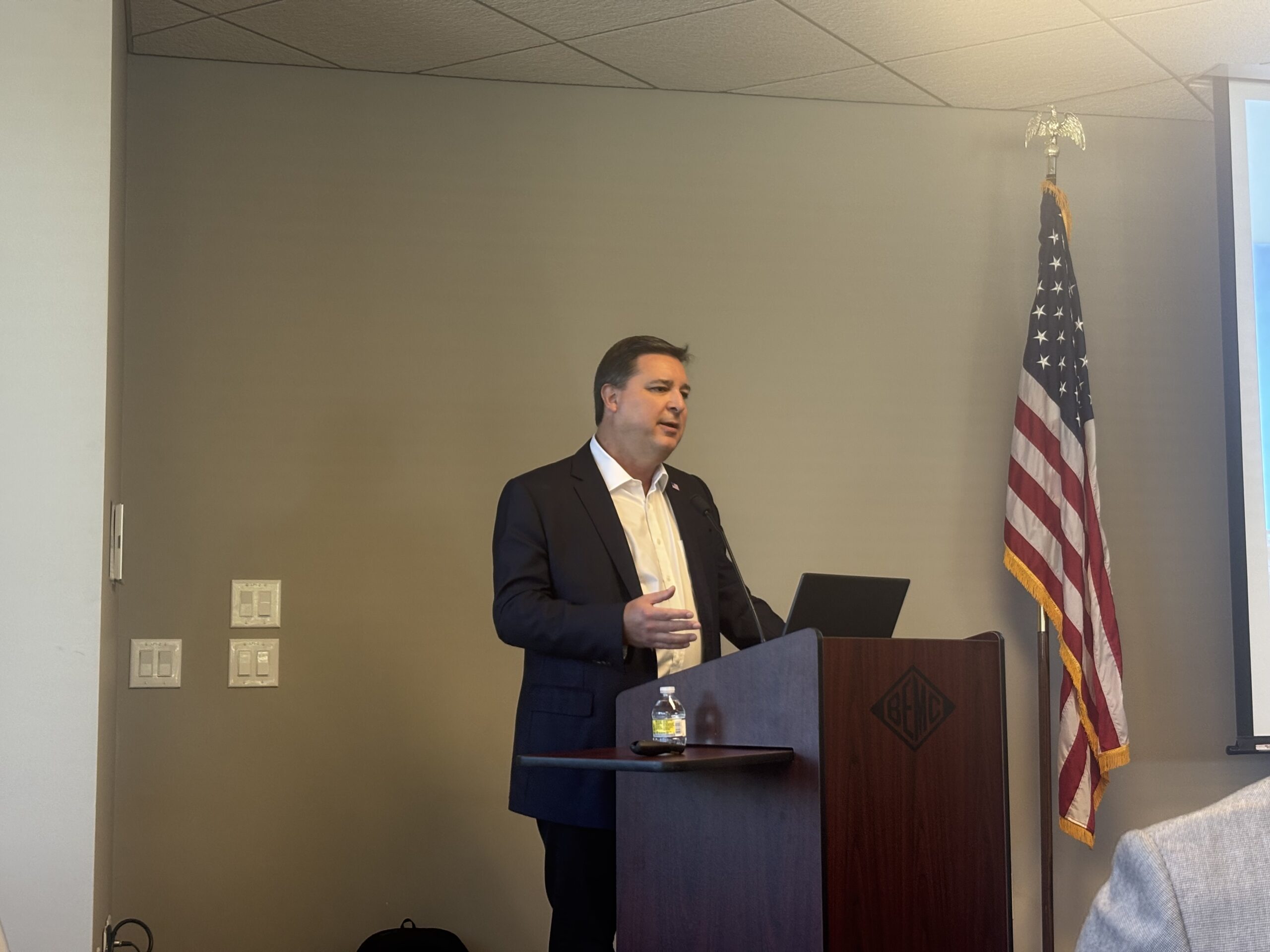
BRUNSWICK COUNTY — At an event hosted in Brunswick County Tuesday, one politician who some of the public has been calling to see more of made an appearance. District 7 Congressman David Rouzer attended Brunswick County Transportation Summit to speak about transportation policies, but also addressed the Cape Fear Memorial Bridge.
Rouzer made an announcement that he would try to find a way to extend the grant deadline for the bridge replacement by a year or find additional funding — though the former is more likely.
“I can’t promise an end result, just my best effort,” he said.
READ MORE: Congressman Rouzer announces $43.6 million grant for railroad upgrades
The Cape Fear Memorial Bridge connecting Brunswick County to New Hanover County is scheduled to be replaced starting September 2027. Both design options — 65 feet and 135 feet — are going to cost more than $1 billion; $242 million in federal funding has been secured via the Bridge Investment Program.
The North Carolina Department of Transportation will provide an additional $85 million if the bridge is tolled to make up the rest of the cost, which would be $773 million. Almost all residents in the region oppose the toll, pointing out it is unfair for locals to pay for a bridge that would service the whole state.
The WMPO would have to rescind its submission of the bridge as a tolled project by February, which means it may not get state funding — and it could affect the grant funding. The grant funds need to be officially obligated to the project by September 2027. Rouzer said he hopes to extend this deadline to give localities more time to shore up funds.
He explained an extension could be achieved through a “continuing resolution”; this provides temporary funding until it can be appropriated through standard budgeting bills.
“It’s not easy, but it’s not unprecedented,” Rouzer said.
Continuing resolutions are typically used to prevent government shutdowns, such as one that took place last fall. They help continue funding during shutdown periods and when it comes to helping with the grant extension, Rouzer said it would work similarly to an omnibus bill with a provision included.
To secure additional funding for the bridge replacement, Rouzer said it would come from the Infrastructure for Rebuilding America grant. It provides monetary support for freight and highway projects with federal significance. Rouzer noted the grant was competitive and the less likely solution because of the $242 million already secured.
When pressed if he could persuade the Army Corps of Engineers to update their plans or pursue additional studies, Rouzer explained USACE is extremely stringent in its rules. Local governments have passed resolutions asking the Corps to conduct an additional study to re-determine the height needs for the new bridge.
The Army Corps of Engineers’ 1996 study about the types of vessels passing under the Cape Fear Memorial Bridge was the basis for the height requirements for the new bridge. The study found the bridge needed to reach 135-foot clearance, either through a fixed bridge or movable span, to accommodate current and projected ship sizes.
However, ships of this caliber are not frequenting the Cape Fear region as much anymore, due to industry — like energy infrastructure company Kinder-Morgan — moving from downtown Wilmington. Mayor Bill Saffo told Port City Daily previously the current bridge only lifted to 135 feet 69 times in the past year, mostly for recreational purposes. The number decreased from 381 bridge openings in 2019 to 168 in 2023.
Local leaders have requested the USACE conduct a Section 216 Review, to determine what kind of ships are serviced by the bridge today and the bridge height required for those accommodations.
However, Rouzer said part of the issue with the Cape Fear Memorial Bridge project comes in timing. He mentioned during the summit, transportation costs escalate around 30% every year a project is delayed. He also told guests “time is money,” something echoed by his grandfather who was a tobacco farmer in Johnston County.
The replacement bridge has been discussed for more than two decades though serious conversations regarding its need, due its end-of-life span closing in, has been in the works for more than five years. The bridge was first built in 1969 and its parts are becoming obsolete to replace.
Rouzer told Port City Daily he wished the state applied for the grant after the full cost was determined. According to NCDOT, at the time of the grant application, the full cost — including construction, utilities and right-of-way acquisition — was determined to be about $486.5 million. In addition to inflation, the cost increased in part due to changing federal regulations, the complicated design process and additional construction needs.
“We can’t extend it forever,” Rouzer told Port City Daily of the grant deadline. “At some point in time, you’re going to lose those dollars, but hopefully we can buy a little extra time.”
Rouzer also addressed public outcry about his lack of visibility in the New Hanover region. First elected in 2014, Rouzer last hosted a town hall in 2017 at Brunswick Community College to receive constituent feedback and hear public concerns.
In 2025, Indivisible Wilmington held a mock town hall called “Where’s Rouzer?” to highlight the elected congressman’s lack of public presence.
Rouzer has routinely declined to attend candidate forums in the region — including Port City Daily’s held jointly with other media such as WECT and WHQR in the last four years. He also hasn’t answered the same media group’s candidate questionnaires.
His last interview with Port City Daily was in 2021 and recently his mobile office hours drew criticism from some locals. He hosted hours in Pender, Brunswick and Bladen and Columbus counties earlier this month; New Hanover wasn’t included. Some constituent reached out to Port City Daily stating they drove to Surf City in hopes of speaking with him personally, but only found his team was there instead to field questions.
To Port City Daily on Tuesday, Rouzer countered the notion of inaccessibility; his district makes up eight counties including Bladen, Brunswick, New Hanover, Pender and Columbus and partially Robeson, Sampson and Cumberland counties.
“I’m in and around all these communities all the time,” Rouzer said. “In fact, people come to me many times and say: ‘You’re the most approachable politician that we know, elected official that we know.’ I talk to anybody and everybody that wants to talk.”
He explained both to Port City Daily and attendees of the summit that it took three months to plan Tuesday’s visit to Brunswick County.
“Now, I have obligations sometimes to help other members in other parts of the country, and of course I have a huge obligation in terms of being in Washington D.C. to represent the area,” Rouzer added. “This is a year where we’ve been exceptionally busy in Washington D.C. We’ve been in Washington more than we have almost any other year because we had so many things we were trying to get done.”
Port City Daily, WHQR, WECT and UNCW’s The Seahawk reached out to Rouzer in July to attend its October forum; his challengers Kim Hardy (D) and Maad Abu-Ghazalah (L) attended. A week before the event, Rouzer’s team said he would not be there but didn’t offer a reason why upon being asked.
Port City Daily also reached out to Rouzer’s press team to inquire when and where he was last in the district prior to Tuesday’s event. Spokesperson Caroline French didn’t answer outright, but stated: “Congressman Rouzer lives in New Hanover County. When he’s not voting in Washington or traveling for work, he is home and working across southeastern North Carolina.”
Brunswick County Commissioner Frank Williams hosted the summit to discuss transportation needs regionwide. Several speakers were invited from the North Carolina Department of Transportation, the Wilmington Metropolitan Planning Organization and other local transportation authorities.
Rouzer serves on several transportation-related committees in the House of Representatives — the House Infrastructure and Transportation Committee, the subcommittee on highways and transit, and the subcommittee for railroads, pipelines, and hazardous materials. Rouzer hopes to increase funding to the state when it comes to infrastructure.
WMPO Executive Director Mike Kozlosky revealed a $7.9-billion funding gap between the region’s needs and projects in the next 20 years. Furthermore, board leaders explained there is currently only $150 million available from the state for the region.
Projects slated for Brunswick County from the WMPO include updates to U.S. Highway 17 in Leland and completion of the Gullah Geechee Heritage Trail.
The WMPO is made up of local leaders in New Hanover, Brunswick and Pender counties. Williams is the vice chair of the board and he also is the chair of the Cape Fear Rural Planning Organization, also represented Tuesday by Director Sam Boswell. Representatives from the Grand Strand Area Transportation Study, including panelist Chris Clark, attended too. They discussed how they plan and prioritize projects in their respective areas, which is usually based on funding availability and areas of greatest need.
Williams said the county — and region in general — needs more money to complete projects started years before. He pointed to the Hampstead Bypass in Pender County, which has been discussed since 2011 but started construction in late 2025. He also noted the CFRPO’s legislative goals, which include adding evacuation routes as a factor to receive priority funding.
“I also think high growth areas need to be somehow taken into account,” he said. “If an area is growing faster than the rest of the state, percentage wise, that somehow needs to be a factor.
Brunswick County is the fastest growing county in the state, according to the Office of State Budget and Management, and is the sixth fastest growing county in the country. This has led to concerns from residents and commissioners alike that the county is playing catch-up in its infrastructure improvements. NCDOT Division 3 engineer Trevor Carroll echoed this sentiment in saying NCDOT’s infrastructure improvements in the area have been reactive to growth the region, rather than proactive.
Rouzer pointed to a bipartisan bill that passed the House Transportation and Infrastructure Committee 62-2 in May of this year, “BUILD America 250 Act,” to help solve funding problems. It allocates $580 billion over five years to support federal highway, transit, freight, rail and safety programs nationwide but does not specify how much is allocated to the states. It still has to be voted on by the entire House of Representatives and then the Senate before becoming law.
“The more flexibility a state has, the more money the state has, the less time it takes to complete these projects, which means there are going to be so many more projects that are going to be achieved,” Rouzer explained to Port City Daily. “And that is the single best thing we as Congress can do: Give the states the flexibility, give them the certainty and stability, ’cause that helps to bring down costs.”
Several projects in the region have increased in price aside from the Cape Fear Memorial Bridge. For example, the widening of N.C. Highway 211 was initially estimated to cost $121 million in 2019 and in 2021 the contract awarded was for double that amount. It also still has yet to be completed.
“So please get engaged and make your jurisdictions’ voices heard,” Williams said. “But to do that, you have to understand the process you’re engaging in.”
Have tips or suggestions for Emily Sawaked? Email [email protected]
At Port City Daily, we aim to keep locals informed on top-of-mind news facing the tri-county region. To support our work and help us reach more people in 2026, please, consider helping one of two ways: Subscribe hereor make a one-time contribution here.
We appreciate your ongoing support.
