


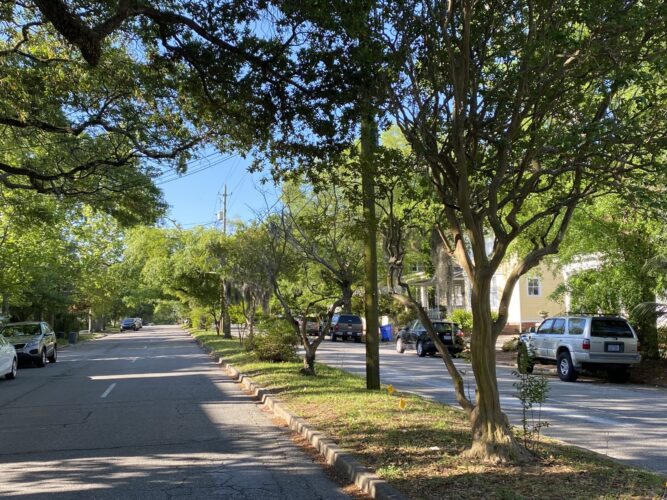
WILMINGTON — The City of Wilmington has started examining its tree ordinance, though the takeaway from a recent discussion offered no quick fix to accommodate all the city’s values, particularly when it comes to saving trees and creating more housing.
Earlier this month, the city convened a group of developers, architects, environmental experts and affordable housing advocates to discuss the city’s tree ordinance.
The group — which included Paul Stavovy of Cape Fear Community Land Trust, arborist and advocate Joshua Shields, James Freeman of Freeman Landscapes, and Isabelle Shephard of the Alliance for Cape Fear Trees, among others — were tasked with giving the Wilmington Tree Commission feedback on the current ordinance and ideas on how to improve it.
Currently, the city requires developers to mitigate the removal of protected trees, either by replacing them at a rate of 200% or paying a fine, which can reach into the thousands of dollars. The city also has specifications for what size trees can be planted as mitigation and how far apart they should be spaced; though this can get complicated when determining what species are accepted and how they can fit into the site design. Additionally, some developers choose to pay mitigation fines rather than navigate the ordinance, prompting outcry from tree advocates and environmentalists.
Though the convened panel advanced specific changes, the overall message to the city included a redevelopment of its tree regulations, in tandem with its other priorities: the need for housing, natural area preservation, flood mitigation, parking needs, stormwater regulations. The group suggested any changes should allow staff and developers the flexibility to tailor tree mitigation to the site, rather than emphasizing a one-size-fits-all approach.
“When you’ve got different groups of people who care about different things that are all trying to come up with their ideal policy and shove it together into one, you get this weird creature that doesn’t make any sense, like a three-headed dog,” Business Alliance for a Sound Economy CEO Jared Patterson — who used to work in the city’s communications department — said.
Dave Spetrino, prominent developer and one of the panel’s most outspoken members, pushed for the tree ordinance to be easier to follow. He said, even though he takes extra measures to preserve trees, he is always weighing the cost of preserving a tree, incurred through changing site designs and layouts, against the cost of just removing the tree altogether.
Port City Daily asked the city for a rough estimate of how many developers choose to pay the fines for removing trees rather than save trees or replace them after removal. After publication, the city said it has released 80 development projects for construction over the last two years, of which 22, or approximately 27%, included a payment in lieu of tree mitigation.
“It’s important to note that payment in lieu is just one way developers can meet tree mitigation requirements and is intended as a last resort when mitigation cannot be achieved through other means,” a city spokesperson provided. “The City encourages developers to meet these requirements through tree planting and offers mitigation credits for activities such as relocating trees, planting trees larger than the minimum required size, and preserving non-regulated trees.”
Spetrino and Allison Engebretson, landscape architect at Paramount Engineering, both advocated for the city to update its suggested list of trees for planting and categorize them based on priority. For example, supplying developers a list of trees they can earn incentives for planting — such as species native to Wilmintgon — followed by a list of preferred trees and then a list of trees they should not plant, such as invasive species.
The group also recommended the city ensure trees on the lists are able to be procured, some noting the sizes can be unreasonable at times.
The panel also suggested the city evaluate lots and preservation efforts as a whole rather than mandating mitigation strictly on how many trees are removed and planted.
Additionally, Alliance for Cape Fear Trees representative Jim Gregory — the city has allocated $100,000 over the next two years for the alliance to maintain more than 300 trees, plant and care for 175 trees and distribute 1,000 trees— noted the city could also reconsider how it regulates critical root zones. The code mandates tree removal — triggering mitigation — if development activity disrupts 20% of a tree’s critical root zone, even if, Gregory said, the tree has a good chance of survival.
Roger Shew, geology and environmental science professor at UNCW, also suggested the city consider safeguarding natural areas rather than focus solely on tree preservation. He noted shrubs and grasses are just as valuable to the environment, plus they can be more resilient in hard-to-plant areas.
Others suggested the city focus on preserving tree canopy, or how much foliage shields the ground from sunlight, rather than how many tree types should be preserved. The city’s canopy has dropped from 48.1% in 2016 to 41.4% in 2020, according to the Alliance for Cape Fear Trees.
Several members of the discussion wanted to see the ordinance shift focus from “tree islands” — essentially requiring a tree to be placed sporadically in a parking lot, for example — and instead promote “pocket parks,” essentially small areas of trees or green space.
Spaced-out trees are intended to provide shade respites across large expanses, though several discussion members said they would prefer the preservation of tree groupings.
The developers also asked if the city could give credit saving tree groupings, even if the species are not protected trees. Right now, developers will be punished for removing one protected tree, but could remove as many unprotected trees as they want. just the same as saving one protected tree, such as a live oak.
Additionally, Spetrino thought the tree ordinance should have different applications based on the size and quality of properties.
“I think infill should be exempt from this whole thing,” he said, arguing any developer transforming a small property — mostly concrete or barren — into a better use for the community should not be held to the same tree planting or removal standards.
Spetrino said the city should come to terms with its more urban areas lacking trees, like downtown. He questioned the necessity of requiring a few trees to be planted on an infill lot, particularly in cases where properties are located near a municipal park.
While his push to avoid tree requirements on infill lots didn’t generate excitement from the other committee members, most supported different standards for different lots.
Even with suggestions on improving the ordinance, the conversation turned to the city’s competing values. Liz Carbone, a board member at Cape Fear Collective and the Wilmington Housing Authority, pointed to Hillcrest, located in downtown Wilmington’s south side and undergoing redevelopment, as a prime example of competing values.
The Wilmington Housing Authority is to double the size of Hillcrest, one of its oldest complexes constructed in the 1940s. The 550-unit redevelopment is set to be completed in five phases, the first of which has drawn scrutiny because of plans calling for the removal of six 100-year-old live oaks.
As reported by WHQR, the Wilmington Board of Adjustment granted WHA a variance to remove the trees. A variance is required for any removal or 20% critical root zone disruption of a specimen tree, which are specifies of exceptional size, form or rarity. However, City Manager Becky Hawke has said the city will not waive mitigation fees — which the manager can do for affordable housing or government-assistated projects — associated with removing the trees, estimated at $122,000.
Additionally, Shields, a long-time arborist, has pointed out some inaccuracies with WHA’s tree removal and mitigation plan, particularly whether one of the trees marked for removal is in a protected class or not. The city did not uphold this objection, but found that Shields was correct in other discrepancies he pointed out. The city noted WHA will need to rectify any mistakes before Hillcrest’s site plans are approved by the technical review committee.
“I lose sleep at night thinking about the fact that we might lose out on permanently, deeply affordable housing for people in our community who desperately need it over a tree, a singular tree, that is beautiful, don’t get me wrong,” Carbone said during the tree discussion.
She continued by claiming the tree may only have a lifespan of another 10 years due to the development occurring around it, while the housing being built would provide 100 years of affordability. Carbone also argued the tree ordinance should give grace to affordable housing projects.
Her comments prompted the panel to ponder how a continuously urbanizing city can accommodate its environmental and housing goals.
Many had one answer: build up.
The discussion members, including Carbone, advocated for the city to get comfortable with higher buildings, particularly residential developments with increased height in the more urban areas of the city.
“We need people to come to meetings and be advocates for height,” Carbone said.
Hence, as the discussion members pointed out, advancing tree preservation might need to go hand-in-hand with other adjustments in the land code.
After publication, the city told Port City Daily the Wilmington Tree Commission’s subcommittee on tree ordinance review will meet again on Nov. 4 to home in on initial amendments; proposed amendments are anticipated to be presented at a Wilmington Planning Commission public hearing in early 2027, along with a plan for additional amendments later in the year.
At Port City Daily, we aim to keep locals informed on top-of-mind news facing the tri-county region. To support our work and help us reach more people in 2026, please, consider helping one of two ways: Subscribe here or make a one-time contribution here.
We appreciate your ongoing support.
