


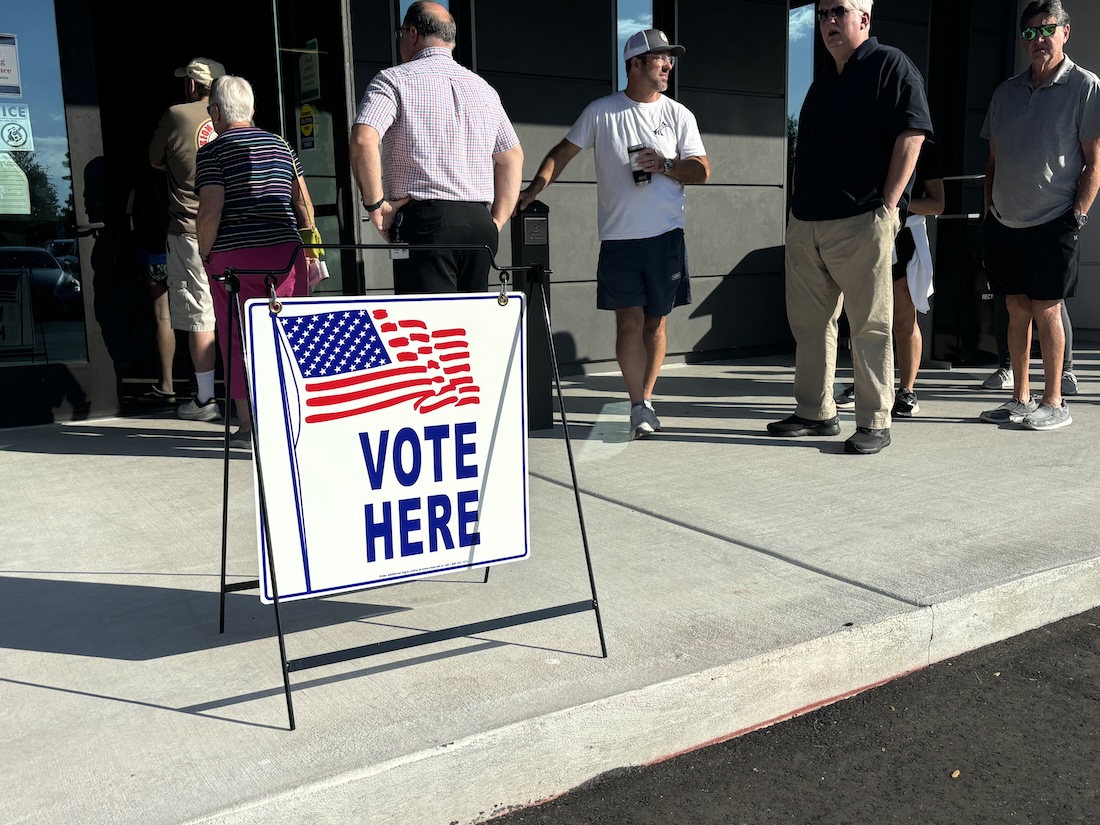
SOUTHEASTERN N.C. — More than one-third of voters have turned out early for the 2026 midterm elections statewide, according to the North Carolina Board of Elections’ data. The amount of early voters also increased by 30% compared to 2022’s midterms; these trends mirror voter turnout in the tri-county region as well.
Early voting officially closed across North Carolina on Halloween – Saturday, Oct. 31 — at 3 p.m. Ballots cast so far total 2.8 million statewide, compared to the 2.1 million during the last midterms in 2022. This accounts for both mail-in and in-person balloteers.
Unaffiliated voters make up the top registration in the state, coming in at 3.1 million, followed by Democrats at 2.34 million and Republicans at 2.33 million. Libertarians fall behind at more than 46,600 voters and the Green Party with more than 5,000.
READ MORE: 2026 Voter Guide: Election Day is Tuesday, Nov. 3
“Democratic and Unaffiliated turnout rates are up a lot, while the Republican turnout rate is up slightly,” according to Western Carolina University political science professor, Chris Cooper.
In Cooper’s blog, “Anatomy of a Purple State,” he notes how registrants are up this year by 59% Democratic, 38% unaffiliated and 11% Republican.
Democrats have long been early-voters, though during the presidential election both parties turned out heavily. Only 20% of Republicans and 18% of Democrats waited until Election Day to vote in 2024.
This year in North Carolina, Democrats make up 46.20% of early-voters, followed by unaffiliateds at 31.29% and Republicans at 31.64%.
Why does it matter? Well, it’s unclear how unaffiliated voters may sway an election’s outcome and North Carolina is one of many considered a battleground state this year, as Republican Thom Tillis’ U.S. Senate seat is up for grabs.
A Democrat hasn’t won the U.S. Senate in North Carolina since 2008. Currently, Republicans have the advantage in Congress, 53-47, over Democrats. Only four seats are needed by Democrats in 2026 to control the majority.
Vying to secure Tillis’ seat, former Gov. Roy Cooper holds a 9-point lead over Republican Michael Whatley, according to a recent East Carolina University poll. The poll was conducted from Oct. 26-29 and has Cooper at 54% to Whatley’s 45%, with a 3.5 percentage-point plus-or-minus scale.
Though early-voting numbers don’t show which candidates are voted for, North Carolina has been considered a purple state for years, meaning both Republicans and Democrats hold leadership positions across varied statewide seats. For instance, while the state’s General Assembly chambers have been controlled by Republicans for the last 16 years, North Carolina has had a Democratic governor for almost a decade in the same timeframe.
Currently, Republicans hold a 30-20 majority in the 50-member North Carolina Senate and have 71 of 120 state House seats, compared to 47 Democrats and two unaffiliated legislators. Republicans hold a supermajority in the Senate, but are one seat short of a three-fifths supermajority in the House of Representatives.
For Democrats to secure the North Carolina House majority, the party needs 61 seats, while Republicans need 72 to be veto-proof.
How do voting numbers compare locally?
Seemingly, when looking at voting numbers statewide compared to the tri-county region, many are in line with similar margins.
In New Hanover County, the State Board of Elections tracks 69,709 people have cast in-person or mail-in ballots of the 190,214 registered voters. That equals around 37% more early-voters than 2022’s midterms.
“We’re genuinely quite impressed and thrilled with the turnout that we’ve seen for early voting,” the New Hanover County Board of Elections Director Eric Navagh told Port City Daily on Friday, Oct. 30.
New Hanover County unaffiliated voters also lead early-voting numbers at 25,795. By comparison, Democrats have 22,468 and Republicans come in at 18,778.
Of Brunswick County’s more than 151,000 voters, 62,424 are early voters. The number is up from 45,780 in 2022 — or roughly a 31% increase. The county trends highest with Republican voters at 23,452, though unaffiliated early-voters are close behind at 22,461. Democrats make up 13,972 of the early votes.
So far, Pender County has welcomed 17,255 voters from its more than 55,000 registrants. In 2022, the county had 13,099 early voters, amounting to an almost 32% increase in the 2026 early-voting term. Pender’s unaffiliated voters are the second highest — 5,655 — behind Republicans at 6,916. Democrats make up 4,126 of early voters.
Mail-in absentee ballots are still being accepted at the boards of election in the tri-county region, with staff and the boards carefully vetting them; however, any that arrive with a signature not matching the name on the voter’s application or with an inner envelope not properly sealed will be tossed. Also, absentee ballots that arrive after the polls close on Election Day, even if they’re postmarked on or before Election Day, will not be counted; the grace period no longer applies, due to election law changes.
The absentee ballots can be delivered in person to the county board of elections before 7:30 p.m. on Election Day. Voters otherwise can monitor the progress of their absentee ballots through the state’s BallotTrax system. If their mail-in ballot hasn’t arrived by Tuesday, Nov. 3, they can choose to vote in person before the polls close. Just ask elections officials to cancel the mail-in ballot and vote at the registered precinct instead.
Also, absentee voters with ballots that have a curable deficiency — such as not signing a ballot or forgetting an ID exemption form — will be notified by elections board staff. There is a grace period to correct deficiencies, set for Nov. 10.
“Our office has been regularly reaching out to voters to make sure that they’re aware of those,” Navagh said, praising New Hanover County staff for its diligence and attention to the discrepancies. “As it gets closer and closer to Election Day, the timing is hard for that to be fixed for folks that cast their ballot — especially folks that might be outside of New Hanover County, but the law requires us to reach out to those folks to allow them that time. Curable deficiencies are due to our office the fifth business day after the election so that can be handled.”
All results on Election Day are not finalized until the canvass, scheduled statewide for Friday, Nov. 13.
At Port City Daily, we aim to keep locals informed on top-of-mind news facing the tri-county region. To support our work and help us reach more people in 2026, please, consider helping one of two ways: Subscribe here or make a one-time contribution here.
We appreciate your ongoing support.
