


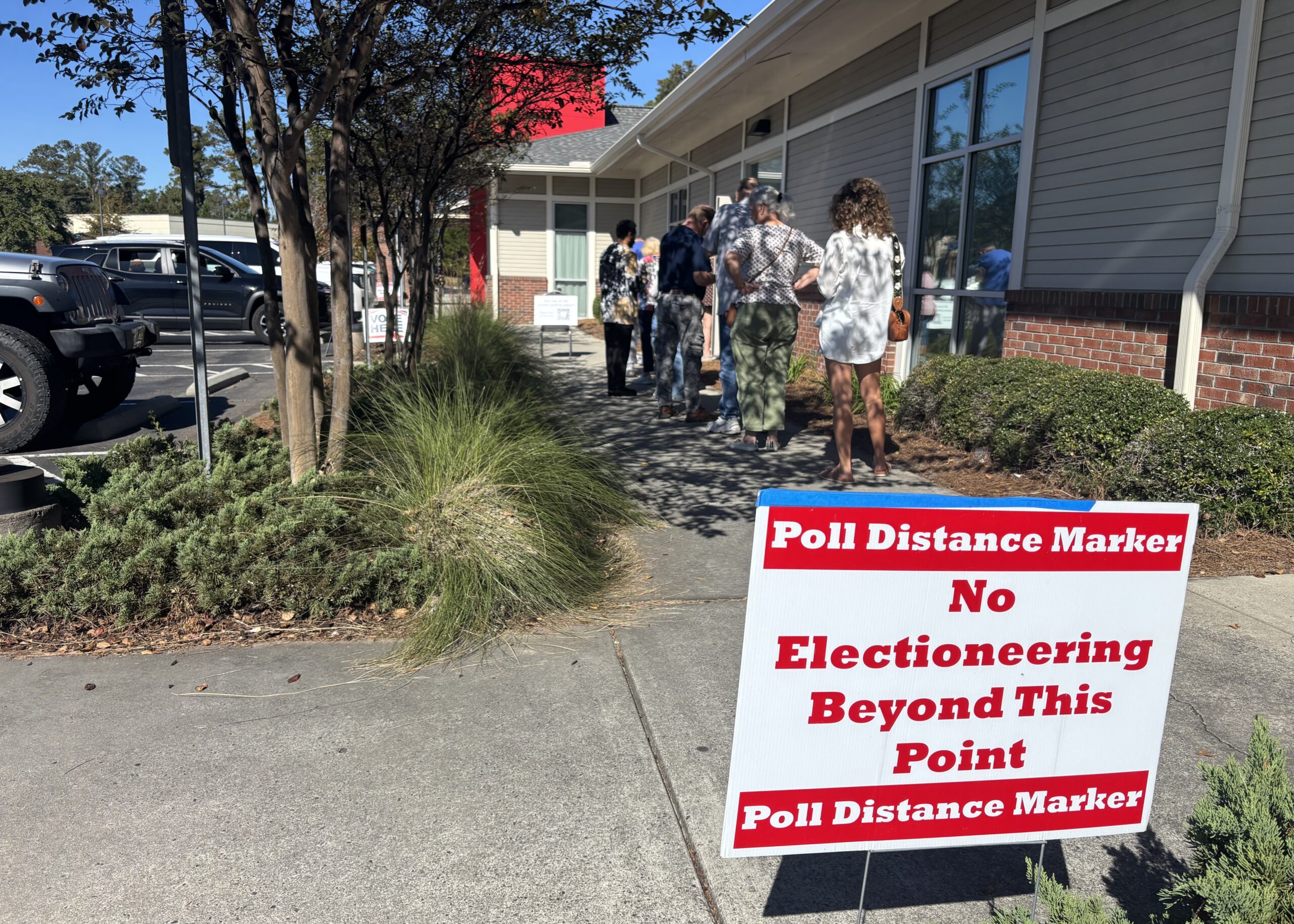
SOUTHEASTERN N.C. — As the polls opened at 6:30 a.m. across the tri-county region, varied precincts prepared to welcome voters for the final push of the 2026 midterm elections.
New Hanover, Brunswick and Pender counties have commissioners, board of education members, and legislators on the ballot this year, among judges, sheriffs, clerks of court and the constitutional amendments. Voters cited a multitude of issues, from the high cost of goods to area growth to teacher pay, as concerns that helped guide them at the polls.
At the Homer E. Wright Event Center in St. James Tuesday, newly minted Southport residents Sonny and Connie Wooten were concerned by overdevelopment in the area.
READ MORE: Early voting up 30% statewide — and more locally
“I think infrastructure should precede the development,” Sonny Wooten said, pointing to county services, such as water use, and roadways being strained.
The North Carolina House District 19 race between Democratic candidate Scott Nasiff and incumbent Charlie Miller, who has served since 2021, was a race the Wootens were watching closely, though they declined to say how they were voting.
Miller has not responded to Port City Daily’s previous requests about development concerns, but Nasiff said a few weeks ago he would consider allowing the local government to institute impact fees on developers to pay for infrastructure. This is disallowed in North Carolina and needs approval from the state’s General Assembly. Nasiff has also said he would sponsor a bill allowing a local government to approve or deny a development, based on whether infrastructure is in place — roads, schools, water systems, fire and police.
Meanwhile, Brunswick County voters Terry and Bob Wynne had their eye on the U.S. Senate race, featuring Democratic candidate and former governor Roy Cooper facing off against Republican, and President Donald Trump favorite, Michael Whatley. Cooper has a 9-point lead, according to a new ECU poll.
The Cooper race also struck a cord with Republicans Jim and Jennifer Ashford, who moved to Brunswick County from Charlotte in the last few years.
“He handled Covid horribly,” Jennifer Ashford said, calling the former’s governor’s actions “Draconian.” “Cooper was very, very controlling.”
Cooper shut down the businesses on March 17, 2020, and staggered opening essential businesses that May in a three-phased approach statewide, requiring heavy social-distancing measures. Retail stores, commercial travel, restaurants, child care and personal care businesses, among others, were allowed to open in the spring, while bars, gyms, amusement parks and movie theaters remained closed until that fall. A group of bar owners ended up suing Cooper over the measures.
“He should have considered we’re a purple state and you don’t need to just close down,” Jim Ashford added. “He overreached and it was odd what he chose to be essential and it looked like it was driven from his party.”
While the Ashfords noted they weren’t super fans of Whatley, they conceded they would rather see him in office.
The Wynnes were concerned about government overreach too. Terry Wynne said her parents lived in Cuba under Fidel Castro’s reign and lost everything they worked for.
“I’ve seen what communism does to countries, and I think the ignorance of people believing the very subtle lies is devastatingly horrific,” Terry Wynne said. “And we can lose everything out of ignorance.”
Though conservative-leaning, the Wynnes are independents, much like the unaffiliated voters leading registration statewide with 3.1 million — or 40% of the voter makeup.
“It’s a declaration of being open-minded,” Terry Wynne said.
Republican Shawn Canniff at the Leland Cultural Arts Center cited similar fears about country’s direction “going socialist.”
“I like border security. I like an ID to vote,” Canniff said. “I don’t think illegals should vote.”
The Wynnes and Caniff were partial to casting a ballot on Election Day proper, both believing it should be a national holiday and day off for voters. They also take issue with mail-in absentee ballots.
Terry Wynne said she understands if someone needs an absentee ballot for extreme circumstances, but calls their current prolificity troublesome, “with so many controversies going on.”
“I personally know two people that received ballots from different states and they live here now,” she said. “And they’ve been taken off the rolls there, but they still receive ballots. I mean, it’s just ridiculous.”
Brunswick County has received 2,561 absentee ballots according to the State Board of Elections data; overall during early voting, 62,606 mail-in and in-person ballots were cast. Absentee ballots are accepted until the polls close at 7:30 p.m. on Election Day and can be dropped off in person.
If mailed, the ballots have to arrive before the polls close and can be tracked here; though a voter can alson let a precinct worker know to cancel their absentee ballot and cast one in-person instead.
Also at the St. James polls Tuesday morning, candidates were making rounds. U.S. Congressman David Rouzer, running for re-election for the House of Representatives District 7, was on site meeting with voters. One person approached to pray with him, as constituents and GOP volunteers circled around him, heads bowed.
Rouzer has held office since 2015 and faces off against Democratic candidate Kim Hardy and Libertarian Maad Abu-Ghazalah.
“What I’ve seen so far is a lot of enthusiasm,” Rouzer told Port City Daily.
Rouzer didn’t attend any candidate town halls or forums in the tri-county region this year, though did appear at a Brunswick County transportation summit on Oct. 20. As exclusively reported by Port City Daily, he announced at the event he will try to secure a one-year extension of the federal grant deadline or additional funding for the Cape Fear Memorial Bridge replacement, but also conceded it wouldn’t be easy.
On Tuesday the congressman said he was heading to Pender County, Sampson County and Cumberland County during his Election Day polling tour. District 7 serves a population of more than 820,000 people and eight counties, including New Hanover, Pender and Brunswick.
“There’s only so much you can do the day before or the day of the election, as far as affecting the outcome,” Rouzer said, “but this is a good way to spend the time, hit various precincts and say hello to people, and thank the volunteers and pollworkers.”
At the Leland Cultural Arts Center precinct, one poll worker, Johnnie Simpson, said she had volunteered during elections for “many years” and was the chief judge at the arts center since it opened a decade ago.
“It’s fun and you learn a lot,” she said. “This was a popular early voting site for the last two-and-a-half weeks.”
Marie Burton, a registered Democrat, clarified she usually votes early at the arts center but was too busy this year and instead had to go to her precinct in Navassa.
On a local level, the retired teacher was focused on the Brunswick County Board of Education, which has four candidates running for districts 3 and 4 — only one, Steve Gainey, is an incumbent.
“My big thing is, when you have board members, if they’ve never been in the classroom, to me, I think it’s hard because you’re not in it, you don’t see it. So you can make your opinions from outside,” Burton said and pointed to overcrowded schools and the need for more teachers paramount among her considerations. “But I don’t know how they’re going to get more teachers when you have so many leaving the profession and you have new hires coming in who don’t last a year.”
She specified concerning broader issues, such as inflation and the cost of living, from fuel to housing to grocery prices. Brunswick resident Webster Burrier echoed the sentiment and supported the constitutional amendments on the ballot, including the levy on property taxes capping how much can be paid to local governments and the state income tax cap at 3.5%.
“Anything that we can do to keep a little extra money, even if it’s a couple $100 a year staying in the people’s pockets,” Burrier said. “I know in the grand scheme it was obviously going to be a trade-off for other funding.”
As previously reported by Port City Daily, many believe if a sales or property tax is capped, less money will be available to pay for needed services in a growing state, which means fees could appear elsewhere for constituents to pay. Others say it’s a way to ensure the government spends within its means.
Burrier thought North Carolina had a leg up in some of its state-funded projects already, citing roads being better here as compared to Pennsylvania, where he once lived. Growing up in a family of Republicans, Burrier said in 2016 he switched to independent.
“A lot of people in my generation, they’re 20s into early 30s, and starting to kind of get fed up with the duopoly,” he said of the two-party system.
Burrier was among the 400 voters that came through the Leland Cultural Arts Center Tuesday afternoon, while across the bridge in New Hanover County, the Martin Luther King Jr. Community Center had a slower day with around 160 people casting a ballot by 1:30 p.m.
Emma Hanes said she was voting for candidates who will ensure current SNAP benefits remain in place and free lunches are available at schools. The latter is something Democratic New Hanover County Board of Education candidate Wendy Dale was platforming for this season. The school board also was a race Hanes had her eye on.
“I’m trying to be more involved in the local community,” she said, though didn’t clarify who she was voting for.
However, she thought female representation and diverse perspectives remained important, no matter if at the local, state or federal level.
According to poll worker Steve Dano, early voting was busier at the MLK Community Center site. Numbers show around 7,429 voters cast a ballot there ahead of Election Day.
“We had lines wrapped around the building,” Dano said.
Military Cutoff Road Northeast Library was the busiest during early voting, with 18,948 voters. On Election Day, 420 had come through by 3 p.m.
Republicans Anthony and Linda Giovannucci were there after creating their own practice ballot over the Halloween weekend — what they dubbed a “Frankenstein model” in support of a mixed-bag of candidates. The Giovannuccis focused on state and federal issues, particularly calling for an end to the “senseless wars.”
“Republicans had a couple years to get it right. I didn’t think they did a great job, so it’s time to mix things up a little bit,” Anthony Giovannucci said, adding the U.S. Senate and House aren’t doing their jobs either, “letting the executive branch run away and do what it wants.”
He pointed to needless spending on the creation of a ballroom and arch, which President Trump has championed in D.C., but also said he agreed with the current administration’s immigration policy, admitting as well that it went too far.
Over in Pender County, Brooke Loven said she was focused on more of local issues: “We’re building up the community way too fast.”
Loven was at the Hampstead Annex. According to poll workers there, around 700 people moved through the annex on Election Day, while, overall, the county had 17,255 early voters from its more-than 55,000 registrants this year.
Pender County has grown roughly 25% in the last decade and is consistently listed among the top five fastest-growing counties in North Carolina. Matthew Edwards said overcrowding is also something he wants to see addressed — in schools, on the roads, with infrastructure.
“Everything,” he said. “I’m kind of skeptical on what’s gonna change … it’s just steadily in decline here, in my opinion, but hopefully we’ll get some change and maybe we can slow that down a little bit.”
The Pender County Board of Commissioners will have three new members coming onto the board after this year’s election, as former Republican commissioner Brad George stepped down this year and either Democratic Tim Zizack or Republican Shayne Frey will be elected in his stead. Jerry Groves isn’t seeking re-election and Republican Andy DeVane does not have an opponent, meaning he is the presumptive winner for district 3. Chair Randy Burton lost the primary for district 2 and either Democratic candidate Brookey Hardee or Republican Ryan Collins will take his place.
In their election questionnaires, almost all candidates told Port City Daily development — while inevitable and part of a growing tax base — needs to come with adequate preparation and resources to avoid systems from being stilted.
Pender County voter Wendy Kittlaus had a close eye on the commissioner races and said the most important attribute for any of the winners is to utilize common sense.
“The perception of them is they don’t know how to work together … arguing all the time,” she said of the current board.
Case in point: At the commissioners’ Monday night meeting, Chair Burton called out his colleague Jimmy Tate — the presumptive winner for district 4 this election — due to a social media post Tate made. Tate indicated the county was “almost in a state of emergency from horrible commissioners running the county.” Burton brought it up at the meeting and asked the county manager if he had any knowledge of an “impending state of emergency,” to which Colby Sawyer said no under state statute definition, made by the governor, county or other entity when it comes to natural or manmade emergencies.
Tate retorted: “I’m not going to dignify myself to the belittleness of using public citizen comment to attack a fellow commissioner. I’ll leave that to you all. … I can post what I want on social media, to say if I feel like we are in a fiscal state of emergency. And anyone with a level of intelligence can understand that.”
Kittlaus also pointed out the board of education funding debacle this year, when the Pender Board of Education asked for an increase of $4 million to maintain existing services. However, commissioners initially gave $1.3 million but after pushback held a joint meeting with the school board to provide the remainder of the funding.
Polls close at 7:30 p.m. statewide and anyone in line at that time will be able to cast a ballot. Port City Daily will post preliminary voting results from the State Board of Elections; all results are not finalized until the canvass is complete.
At Port City Daily, we aim to keep locals informed on top-of-mind news facing the tri-county region. To support our work and help us reach more people in 2026, please, consider helping one of two ways: Subscribe here or make a one-time contribution here.
We appreciate your ongoing support.
