


BRUNSWICK COUNTY — Impact fees were at the forefront of a recent commissioner candidate forum, often floated as a way to help curb development and address infrastructure needs — or at the very least have developers foot the bill for the growth. However, most impact fees have not been allowed in the state of North Carolina since 2016. Still, legislature approval could allow some governments special authority, which Brunswick County has recently added to its legislative goals.
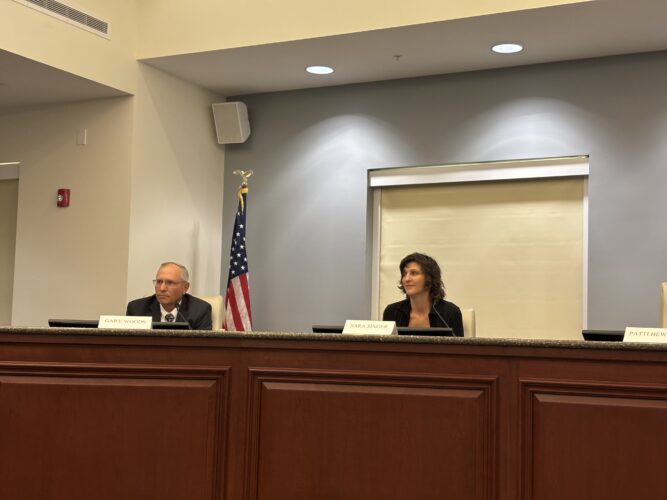
During Port City Daily’s Oct. 14 candidates’ forum — held jointly with WECT and WHQR — both Brunswick County Democratic commissioner candidates, District 1’s Gary Woods and District 2’s Sara Singer, thought impact fees would help slow the rapid growth coming into the county and bring the county’s infrastructure up to speed.
There are roughly 50,000 units in the pipeline countywide, some with approvals dating back to 2017, according to the county’s GIS development tracker.
READ MORE: Brunswick wastewater expansion to cost hundreds of millions as development outpaces capacity
ALSO: 800-home Brunswick development approved despite road connectivity, flood concerns
“Impact fees are going to slow some of it down,” Woods said, before also advocating for other fees, such as for conservation or development proffers — the latter being a negotiated settlement with developers voluntarily agreeing to donate land, build a new fire station or school.
According to consulting firm Novogradac and the National Home Builders Association, impact fees curb development only if they are excessive, as it may raise the cost of construction and deter developers.
However, in general, impact fees would not halt growth, according to Cape Fear Home Builders Association Executive Director Cameron Moore.
“Because at the end of the day, all the cost goes to the consumer,” Moore explained to Port City Daily. “There are fees all baked into the price of the lot.”
The price of a home includes the cost of water and sewer hookups, road improvements, parks and whatever else is part of a developer’s project.
Woods mentioned at the Oct. 14 candidates forum impact fees were listed as part of the county’s legislative goals, as unanimously voted on at a Sept. 8 meeting. These goals will be sent to the North Carolina Association of County Commissioners to be lobbied.
One states: “Request the N.C. General Assembly allow local governments to issue development impact fees and increase the percentage of impact fees to which developers are accountable.”
Republican Commissioner Randy Thompson — vying for his seat against Woods but couldn’t attend the forum due to a work commitment at an emergency conference — confirmed he would like to see impact fees go toward schools and parks.
“Your development community and their lobbyists are going to fight against that, obviously,” he said. “But it is something that needs to be done.”
North Carolina does not allow cities, counties or other localities to charge general impact fees for roads, libraries, schools and parks. Special permission has to be granted by the legislature.
“Other counties have successfully imposed such fees on developers and I have no problem reaching out to counties that have successfully done it to learn their model and then see what we can apply here,” Singer said at the forum, noting she’d like to see impact fees go toward schools and more.
In 1995 Chatham County was awarded special authority to charge school impact fees for developers. The fee is a flat rate of $3,500 per unit.
Port City Daily asked Chatham County how much it made from impact fees, how they’ve helped the county and if it’s increased costs of buying a home (that they know of) and if developers have pushed back. Though an answer wasn’t received by press, the Chatham County Line reported in 2020 the county received $4 million in school impact fees in that year alone.
The law banning impact fees was decided by the North Carolina Supreme Court in a 2016 lawsuit Quality Built Homes v. Town of Carthage. The town was issuing impact fees to developers for sewer and water preemptively without a law allowing it and the court ruled it exceeded its authority.
The lawsuit spurred the passage of 2017’s House Bill 436, which created system development fees for water and sewer only. Legislators wanted to create a legal, uniform mechanism for localities to keep up with their growth without putting the cost burden entirely on ratepayers.
Locally, Brunswick County and Leland have already faced lawsuits for these fees. In 2019, they were sued by Plantation Building of Wilmington for issuing $1,150 in water and $4,000 in sewer capacity recovery fees per unit for water and sewer hookups. Though legislation had passed by the time the suit was filed, the fees were remitted from 2015 through 2017 before the law, and the governments called them capacity fees at the time.
The court ruled in the company’s favor. Both Leland and the county settled in 2022; Leland paid over $5 million per court order and then $6 million in settlement costs and the county forked up over $15 million.
Currently, Brunswick County collects system development fees for water and wastewater, which, as of July 1, 2025, costs $3,282 per bedroom, according to the county. Per General Statute 162A-207, developers must pay 75% of the cost to enhance or expand water and sewer utilities for their specific project. The remaining 25% is typically paid by the county and ratepayer.
Thompson wants the sewer and water fees picked up in full by developers.
“I just think it’s unfair,” he said of citizens even being on the hook for 25%. “They’ve already paid for their services. Why would they want to pay for others coming in and utilizing the services?”
Port City Daily reached out to the other commissioners to ask if they would support asking legislators to implement impact fees and to get their thoughts on the matter but did not hear back by press.
Port City Daily also reached out to Sen. Bill Rabon (R-Brunswick, Columbus, New Hanover), Rep. Charlie Miller (R-Brunswick, New Hanover), Rep. Frank Iler (R-Brunswick) — as well as Miller’s opponent, Tim White (L) — to ask if they would support enacting legislation to allow Brunswick County to implement an impact fee. None responded by press.
Iler’s challenger, Dennis Breen (D), told Port City Daily he would introduce impact fee legislation if elected.
“Overdevelopment is choking all our infrastructures. Schools in particular are hurting,” Breen said. “Developers need to pay their fair share so we can balance growth with development.”
Nasiff said during the forum he would be interested in introducing this legislation.
“I also believe that developers should be paying impact fees,” he said. “I mean, right now, they come in, they build, they take their money, and they leave. And so, who is left paying for all of this? You and I. I don’t believe that’s fair.”
He told Port City Daily on Thursday he would want to apply that to New Hanover County too.
“I think we need to give more power back to the counties because they know what’s best for the people than the people in Raleigh do,” Nasiff said.
Have tips or suggestions for Emily Sawaked? Email [email protected]
At Port City Daily, we aim to keep locals informed on top-of-mind news facing the tri-county region. To support our work and help us reach more people in 2026, please, consider helping one of two ways: Subscribe here or make a one-time contribution here.
We appreciate your ongoing support.
