


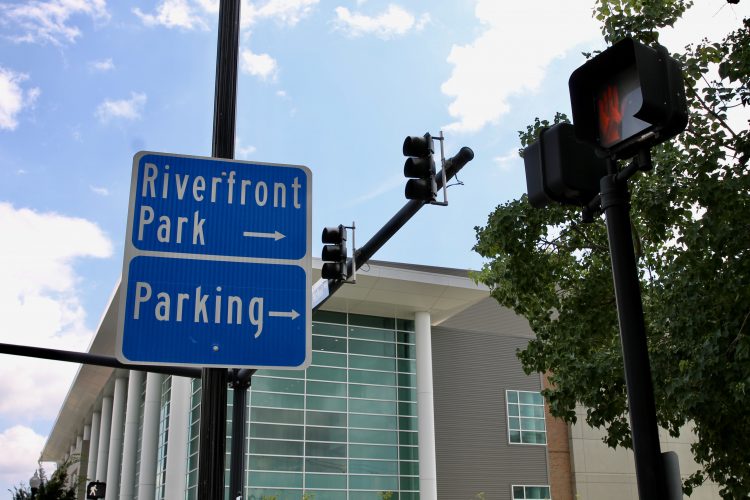
WILMINGTON — The City of Wilmington is adding Riverfront Park to the list of World Cup watch parties, despite currently challenging a local business over noise emanating from its own event screenings.
Last Friday, the city announced it would host a “Final Match Watch Party” on July 19, with gates opening to Riverfront Park at 2 p.m. The event is free to the public, though food and beverages will require purchase. Activities, lawn games and soccer drills will commence until 3 p.m., when the match starts.
READ MORE: The Rift outdoor screenings in limbo after Wilmington Board of Adjustment hearing
The city is advertising the event as a “family-friendly” watch party of the World Cup, different from local bars hosting similar screenings. Slainte Irish Pub, The Husk and The Rift all have their own events planned. However, the latter appeared before the Wilmington Board of Adjustment last month contesting the city’s definition of “outdoor amplified sound.”
The board of adjustment hearing followed a Jan. 14 citation the city issued to The Rift for playing “outdoor amplified sound” within the 1,000-foot required setback. The Rift has a 15-foot outdoor LED screen where it has been screening movies, reality shows and sporting events for months, including World Cup matches. It plans to exhibit the semi-finals throughout this week and the final match on Sunday.
Per the city’s update to its land code in 2021, “outdoor amplified sound” is not allowed within 1,000 feet of a single-family residential zoning district. Prior to 2021, nightclubs were not a permitted use in the community business district, generally located near residential areas.
When nightclubs became a permitted use, the city added “outdoor seating and activity area” standards, including the setback requirement, to reduce impacts on neighbors.
After receiving the citation, The Rift’s owner, Justin Smith, asked for the city to define outdoor amplified sound. The city defined the term, but its definition would not allow The Rift to continue its outdoor screenings, despite the bar’s staff attesting screenings didn’t exceed 65 decibels, the limit in the city’s in the noise ordinance.
The board of adjustment hearing took place on June 18, though Port City Daily provided breaking coverage of the issue on June 24.
The city explained its watch party has been in the works since the last week of June, when the USA team was still in the tournament. The USA was eliminated on July 6 in its match with Belgium.
Port City Daily asked the city to explain how its watch party event would not violate the setback requirements constricting The Rift. City spokesperson Amy Willis wrote in an email the 1,000-foot setback rule does not apply to the central business district, where Riverfront Park is located.
The Rift is zoned community business, bound by the setback requirement along with several other zoning districts, including:
- HDMU, Historic District Mixed-use
- UMX, Urban Mixed-use District
- CS, Commercial Services District
- RB, Regional Business District
- O&I, Office & Institutional District
- LI. Light Industrial District
“Riverfront Park also regularly hosts concerts and other large-scale events with amplified sound, both day and night,” Willis wrote. “From a land-use perspective, the Watch Party is not unique in that regard.”
Port City Daily asked Smith for comment on the city’s event; he said he couldn’t speak on The Rift specifically, but rather as a business owner in general. He thought there may have been a need for the city to utilize Riverfront Park if the U.S. was still in the tournament, but without them, he thought it most definitely took away from small businesses.
“There have been many businesses that have planned and enjoyed a bump in business from the World Cup,” Smith wrote in a text to Port City Daily. “I am pro-Live Oak Pavilion but I think it should be there to enhance and support small businesses not compete with them.”
Port City Daily asked the city if it believes its event deters small, local businesses trying to draw in customers with their own watch parties. Willis said the city sees its screening as complementary and hopes it will bring even more people downtown.
“We hope people make a day of it, supporting downtown restaurants and businesses before and after the event, and choose the watch party experience that works best for them,” Willis wrote.
Whether the city had plans to continue hosting similar events at the park in the future, Willis said the July 19 watch party will offer participants a chance to provide feedback on its programming.
“While the park serves as a venue for major Live Nation events, it is also a community asset,” Willis wrote. “The City is exploring opportunities to activate all of its spaces with diverse, accessible programming that gives residents more ways to enjoy these amenities throughout the year.”
Meanwhile, The Rift is awaiting a revised definition of outdoor amplified sound.
Smith and his attorney Gray Richardson were successful in their dispute of the city’s definition, as reached by Director of Planning and Development Linda Painter.
Painter’s definition said outdoor amplified sound is “the use of equipment operated by the associated business that is designed to increase any sound or noise in volume or intensity by means of electrical power.” Because The Rift cannot comply with the land code’s 1,000-foot setback requirement, this definition, should it have taken effect, would prohibit The Rift from playing sound alongside its screenings. Smith said The Rift, which pivoted from a live music venue after issues with the city last year, needed the screenings to retain business.
Richardson argued the definition should align with the city’s noise ordinance — that outdoor amplified sound be defined as any noise being projected beyond 65 decibels. The board of adjustment ultimately instructed Painter to come back with a different definition, citing a desire for it to be more congruent with the noise ordinance.
On Monday, Smith confirmed to Port City Daily that he has not been provided a new definition. Port City Daily asked when Painter would proffer one if the definition would be submitted as a land code amendment, as suggested in the June 18 hearing. Willis replied “there has been no decision on next steps.”
At Port City Daily, we aim to keep locals informed on top-of-mind news facing the tri-county region. To support our work and help us reach more people in 2026, please, consider helping one of two ways: Subscribe here or make a one-time contribution here.
We appreciate your ongoing support.
