


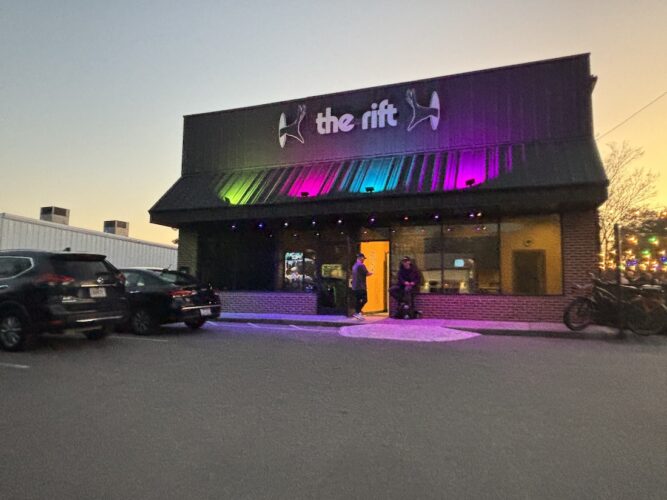
WILMINGTON — The Wilmington Board of Adjustment spent around three hours weighing the definition of “outdoor amplified sound” last week, and while the definition reached would apply across the city, it would also negatively impact the business model of one Cargo District East establishment.
Justin Smith, part owner of The Rift, appeared before the board of adjustment on June 18 to appeal the definition of “outdoor amplified sound” as determined by Linda Painter, the city’s director of planning and development.
The City of Wilmington’s land development code, most recently updated in 2021, puts restrictions on outdoor amplified sound but does not define it.
Painter’s definition, applicable to non-residential land uses, defined the term as “the use of equipment operated by the associated business that is designed to increase any sound or noise in volume or intensity by means of electrical power.”
While the most obvious example of outdoor amplified sound would be for concerts or musical performances, it would also apply to television volume. And The Rift has a 15-foot outdoor LED screen.
The Rift regularly hosts watch parties for sporting games and movies on the outdoor screen; it recently displayed the NBA Finals and Stanley Cup games to large turnouts. This week’s lineup includes World Cup games and the reality show “Love Island.” It also has indoor TVs for people to watch.
The land code prohibits outdoor amplified sound, currently undefined, within 1,000 feet of a property zoned for single-family residential use. If Painter’s definition of outdoor amplified sound were to go into effect, it would apply to The Rift’s screenings. Because the business cannot comply with the land code’s 1,000-foot setback requirement, The Rift would essentially need to cease its outdoor screenings or play the content silently, either of which could be a detriment to business.
“We need it to operate,” Smith said.
Smith’s attorney, Grady Richardson, argued the city’s definition was “incongruent” with the city’s noise ordinance, which prohibits persistent sound above 65 decibels. Thus, The Rift could allow someone to play an acoustic guitar and sing as long as the performance didn’t exceed 65 decibels.
“What does it matter if it’s electrified versus non-electrified, so long as you’re complying with the noise ordinance?” Richardson said during the hearing. “And the simple answer is: It doesn’t matter.”
Ultimately, the board voted unanimously to reject Painter’s definition on the basis it created an “absurd result.” The decision was reached after several hours inclusive of guidance from outside counsel, testimony from a former city administrator, another appeal from an upset property owner near The Rift, and board hand-wringing over its purview.
Planning staff are now tasked with bringing back a new definition, one that will eventually be presented to city council for codification.
Where it started
The Rift, located off Wrightsville Avenue, opened in March 2025 with the original intention of being a venue to support live music, events and even theater performances, as reported by Port City Daily. The Rift is outfitted with a 40-foot-by-20-foot stage, where the LED screen is placed.
After the hearing, Richardson shared with Port City Daily that the city informed Smith The Rift was not allowed to have live music without a special use permit. The city’s land development code allows eight nonprofit events and two special events per year.
However, Smith shared one of these performances resulted in a written warning for breaking the noise ordinance. Despite other noise complaints, Smith said this was the only instance where the complaint was merited and disciplinary action was imposed.
Smith said the venue hasn’t held live music since. Instead, The Rift’s owners pivoted to the LED screen, an investment typically costing upward of $15,000.
“We wanted to show movies and sports and the NFL,” Smith said at the hearing. “We were shifting gears from — as we found out after we opened — from being a live music venue.”
Smith said the city approved of the screen. During Richardson’s questioning of Painter during the board of adjustment hearing, Painter said she recalled the approval being “very limited.” This meant the screen was to be used for showing images and the city’s approval did not address sound.
Richardson provided Port City Daily with the written permission in the form of an email from Kathryn Thurston, the city’s former zoning administrator that resigned in December 2025. The email states a large panel in which images can be displayed is not a violation of City Code Section 18-210, which restricts outdoor seating and activity areas.
Port City Daily asked Richardson if the city understood sound would be played from the screen when approved; the attorney said yes. A City of Wilmington spokesperson noted Thurston was administrator at the time and could not speak to conversations she had with the property owner.
During the hearing, Smith said his team has been operating the TV in accordance with the noise ordinance, using a decibel meter to measure sound levels around the business. He attested noise from The Rift consistently stays below the 65-decibel mark on the sidewalk outside the business but increases to 72 decibels with traffic noise.
Nonetheless, The Rift received a zoning violation on January 14 for hosting outdoor amplified sound within the 1,000-foot required setback.
The notice states: “This includes facing speakers from the inside to travel outside as well as having the doors open and music traveling outside of the business. Music must be confined inside businesses and all outside speakers must be removed.”
The notice also violates dimensional setbacks for outdoor seating areas.
Smith said he met with city staff about the citation several times, which prompted him to request staff provide an interpretation of what outdoor amplified sound meant.
Painter’s definition was provided to Smith on Feb. 27; Richardson then filed an appeal to the decision on March 30, which triggered a board of adjustment hearing. Richardson confirmed with Port City Daily that Smith voluntarily removed its exterior speakers in February while awaiting a decision from the board of adjustment.
The board of adjustment operates quasi-judicially, meaning matters heard before them are presented like a court case, with the ability to present evidence and call witnesses.
When city staff make a zoning interpretation, these decisions are then appealed to the board of adjustment because of their impact on property owners’ rights. During the hearing, Painter explained these interpretations are commonplace for developers or property owners seeking clarity on the land code to ensure they’re allowed to use their property for its intended purpose.
Smith wasn’t the only one to file an appeal, however.
The June 18 meeting included a hearing on an appeal from Kevin High, a homeowner who lives within the 1,000-foot radius of The Rift — 957 feet away exactly, he claims.
Richardson told Port City Daily High has made the vast majority of noise complaints against The Rift, which number into the dozens.
“My client has tried numerous times to reach out to the one complainant to try to work together to resolve their issues, but my client has never received any response from the complainant,” Richardson said.
High reported noise from The Rift disrupts his daily life multiple nights a week from 3 p.m. until midnight, when the bar closes. High reported losing sleep, and thus work productivity, over the noise and is not able to enjoy his property and have friends over due to the persistent sounds permeating his surroundings. High said the noise is probably not loud enough at his home to violate the city’s noise ordinance but is it consistent enough to be aggravating.
“[It is a] constant burden on your life,” High said.
However, the board of adjustment did not get to the meat of High’s reason for appealing Painter’s definition of outdoor amplified sound; the board dismissed the appeal before the hearing because they deemed High did not have the standing to appeal.
Because the board of adjustment makes decisions via quasi-judicial hearings, those making an appeal or serving as a witness must have standing — essentially, the ability to prove direct impact to them or their property or providing expert testimony on behalf of either party.
The board determined High, via his attorney Corrie Lee, did not prove suffering of special damages — meaning any harm unique to him as opposed to other community members — as a result of Painter’s interpretation of outdoor amplified sound.
The board dismissed High’s appeal in a 3-2 vote, Chair Jeff Hovis and BOA alternate Greg Thompson dissenting, though they didn’t offer up reasons for their dissent.
The hearing
After dismissing High’s appeal, the board of adjustment moved to Smith’s case. Much of the conversation was mired in a central conflict around the BOA purview.
The city brought in Trey Ferguson, a litigator and local government attorney, to provide guidance on the quasi-judicial proceeding, the board’s scope and decision-making options.
Ferguson explained the question before the board is whether Painter followed the correct procedure in defining outdoor amplified sound. If the board believed she did not, they have the option to rewrite the definition or send it back to staff.
However, if the board believed the correct procedure was followed, it should by default lead to a correct definition.
The board seemed hesitant to point to any error in Painter’s ways, but some members also struggled with accepting the definition, knowing the restrictions that would come with it would impede a business’ operations. It would prevent The Rift and any other business within 1,000 feet of single-family residential zoning from hosting watch parties with sound too.
However, Ferguson and city attorney Shawn Evans pointed out the board’s only job was to agree or disagree with the definition of outdoor amplified sound. The board has no authority about where outdoor amplified sound is allowed and what setbacks are required for businesses intending to use it. Both of those decisions are legislative, not judicial, and are decided by policymakers — i.e. city council.
“We’re not here to determine how it’s going to be applied, but we’re being told how it’s going to be applied, and how it’s going to be applied does have an impact on my decision because it’s so restrictive that it can’t be applied in a manner that is consistent with anything dealing with the noise ordinance,” Moore said.
Thompson asked Richardson to explain how the new definition changes what business owners can do in relation to the noise ordinance.
Under current city code, all businesses have to keep their noise levels under 65 decibels. However, the land development code sets further restrictions on outdoor amplified sound, though doesn’t define what constitutes outdoor amplified sound.
Under Painter’s definition, a business would not be able to emit any electrified sound if they didn’t have the proper setbacks, even if that sound was under the decibel level allowed in the noise ordinance.
Richardson suggested the definition should align with the noise ordinance — that outdoor amplified sound be defined as any noise being projected beyond 65 decibels.
Moore questioned why Painter didn’t match the definition to the noise ordinance. Under Painter’s definition any electronic sound above 0 decibels would be a zoning violation.
“If I plug in a bugzapper and a bug hits it, that’s amplified sound,” Moore said.
On behalf of the city, Evans said, in his opinion, the noise ordinance is a “backstop.” Moore replied he didn’t think the two could be segregated.
Ferguson clarified to the board they could choose to define the term as Richardson had.
Board member Alain Norman and alternate Jim Downey expressed they were comfortable with the definition and letting legislative bodies handle the implications of the definition.
However, Moore made a motion to remand the definition back to staff; it passed unanimously.
When the new draft definition is finished, Smith will again have the opportunity to appeal the definition. If the board decides against him, Smith could then appeal to Superior Court, whose decision would be final.
During the hearing, Painter noted staff are planning on submitting the approved definition to city council as an amendment to the land code. The Wilmington Planning Commission would also review the amendment before the council’s final vote. Thus, the definition would then have the opportunity for review by legislative bodies in conjunction with the rest of the land code.
At Port City Daily, we aim to keep locals informed on top-of-mind news facing the tri-county region. To support our work and help us reach more people in 2026, please, consider helping one of two ways: Subscribe here or make a one-time contribution here.
We appreciate your ongoing support.
