


WILMINGTON — State regulators faced sharp opposition this week during a public hearing on proposed PFAS and 1,4-dioxane rules, as residents raised concerns about the lack of enforceable limits, deadlines, or penalties on polluters.
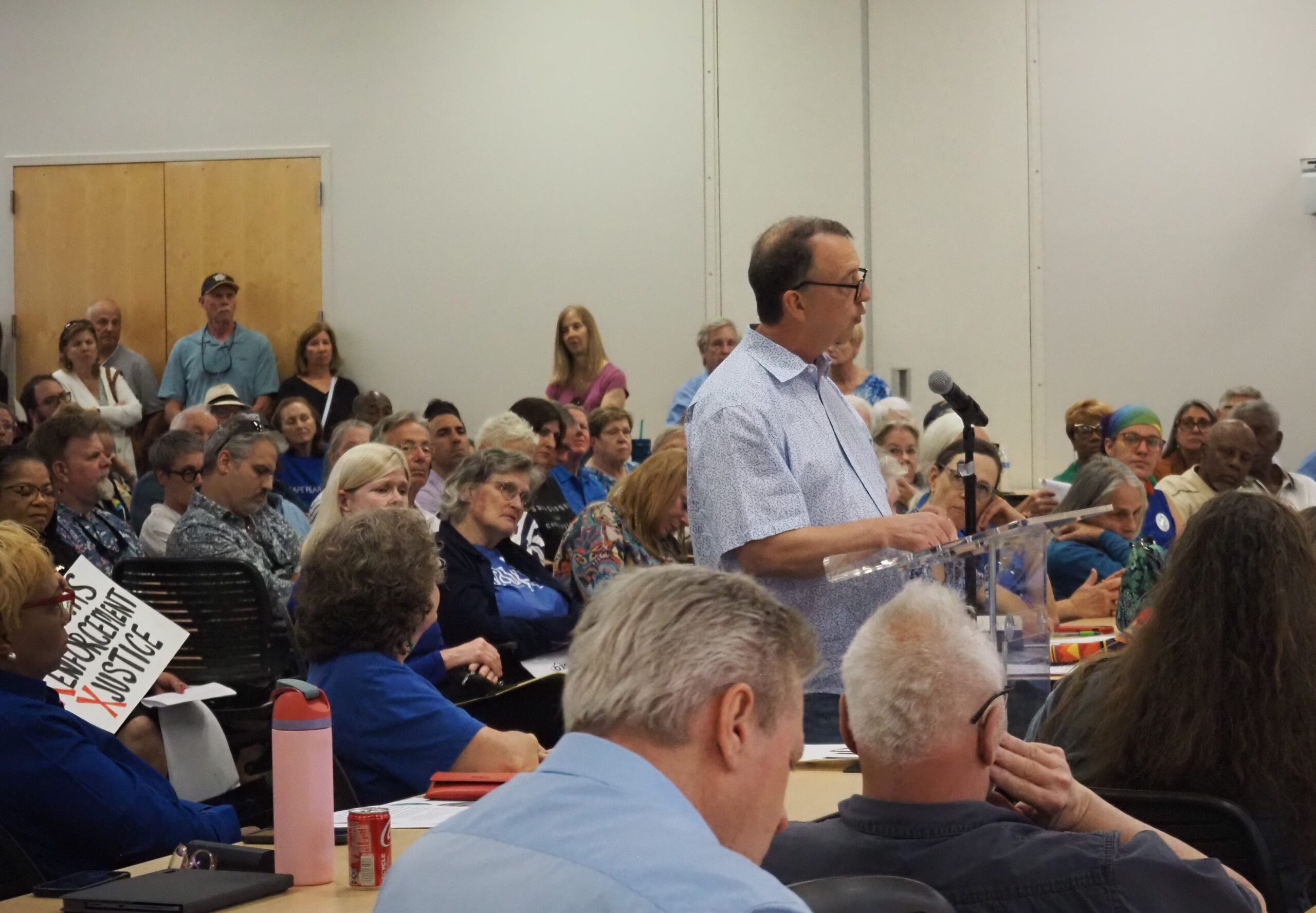
An overcrowded Wilmington City Hall had roughly 200 residents, environmental advocates, and public officials, clustered seat-to-seat — and for those standing, shoulder-to-shoulder — to hear from North Carolina Environmental Management Commission officials.
READ MORE: Vote coming on PFAS, 1,4 dioxane rules that critics say allow polluters to police themselves
ALSO: PFAS contamination found in saltwater fish species tested in Cape Fear River
At issue are two draft rules under consideration by the EMC. The proposals would require industrial dischargers to monitor PFAS pollutants, also known as “forever chemicals,” and 1,4-dioxane, a synthetic industrial chemical classified as a likely human carcinogen, and develop plans aimed at reducing their presence in the environment over time.
The proposals do not include enforceable discharge limits, firm deadlines, or automatic penalties, which residents criticized as allowing companies to track contaminants without facing consequences or leading to meaningful reductions in pollution.
Speakers repeatedly focused on the draft’s gaps, arguing the absence of enforceable numerical limits is the central weakness of the proposal. They believed the framework allows pollution to continue, as long as facilities are monitoring and filing reports.
“Minimization is not enough — we want to see elimination,” resident Chancellor Woodruff stated, capturing a refrain echoed throughout the hearing.
Many people in attendance wore blue in support of the Cape Fear River, while others held signs: “Stop making us pay to clean up their mess,” “No limits, no due dates, no accountability makes no sense,” and “Abolish the EMC.” Of roughly 60 people who spoke, none voiced support for the proposed rules.
Yvonne Bailey, one of 15 members of the Environmental Management Commission, and two North Carolina Department of Environmental Quality Division of Water Resources officials — municipal permitting unit supervisor Karen Preston and deputy director Michael Pjetraj — were present to record public comments.
Preston opened the hearing with a brief presentation outlining the rulemaking timeline, expected costs — which could escalate to $129.5 million for discharging facilities — and requirements for polluters on sampling, reporting, and contaminant reduction plans.
Under the proposed framework, facilities who discharge wastewater containing PFAS or 1,4-dioxane would be required to conduct quarterly sampling, track pollutant levels, and submit reduction plans to the state, outlining steps they intend to take to reduce concentrations over time.
State regulators describe the approach as a “monitoring and minimization” model focusing on tracking pollution and encouraging gradual reductions through facility-level plans rather than strict governmental regulations.
In practice, however, the rules do not require dischargers to achieve specific reductions in pollution. They set no numeric discharge limits, no required percentage cuts over time, and no fixed deadlines for reducing discharges into waterways, a common point of concern with residents.
“These proposed rules do not reduce the discharges of these pollutants, and they will not protect the public or the environment,” said Erin Carey, deputy director of the North Carolina Sierra Club. “What they will do is codify the self-regulation of an industry that has repeatedly avoided accountability.”
By the time public comment began, the tone in the room had hardened into a mix of frustration, urgency, and exhaustion — a reflection, speakers said, of years of debate over PFAS contamination in the Cape Fear River basin and what many see as insufficient regulatory response.
“We pay you, not the corporations, and I hope you listen and do the maximum rather than the minimum to protect us all,” Jessica Thomas told state officials.
PFAS contamination in the Cape Fear River has been most closely associated with Chemours’ Fayetteville Works facility in Bladen County. Compounds including GenX were discharged into the river system and later brought to public attention in a series of investigative reports in 2017.
The chemical company has been operating under a 2019 consent order with NCDEQ, Cape Fear River Watch, and downstream utilities. The agreement requires Chemours to install and maintain air emission controls, capture and treat PFAS compounds at the source, and reduce or eliminate off-site discharges of compounds such as GenX. It also requires monitoring of groundwater and surface water, installation of treatment systems, and providing filtration or alternative water supplies for impacted private wells.
State regulators continue to oversee compliance through required reporting and ongoing sampling, as remediation and long-term contamination monitoring at the site remain active.
The proposed rules do not have automatic penalties tied to continued high levels or failure to reduce discharges. This leaves enforcement to case-by-case discretion by state regulators within the North Carolina Department of Environmental Quality rather than fixed standards as a rule.
“The people of North Carolina need health-based rules that protect people and require industry to keep their pollution out of our river,” Kemp Burdette, executive director of Cape Fear River Watch, said. “These so-called minimization rules are actually quite the opposite. They would allow industry to continue to discharge PFAS and 1,4-dioxane, even increase the amounts that they discharge, with absolutely zero penalty.”
Among people referencing the history of PFAS in the Cape Fear River was Vaughn Hagerty, the journalist who broke the news almost a decade ago. Hagerty now works as the public information officer for the Cape Fear Public Utility Authority.
“Regulatory frameworks that save polluters a few bucks while putting at risk the health of North Carolina families — that I hope we can all agree is a horrible idea, assuming your priority is the health and well-being of North Carolina families,” Hagerty said. “Should this bad idea be approved, when we get a repeat of 2017, responsibility will be laid directly at the feet of the individuals who made those bad decisions.”
Several speakers focused heavily on health concerns tied to PFAS exposure, pointing to fish consumption advisories in the Cape Fear River and a 2025 N.C. State study of 119 Wilmington-area residents that found PFAS compounds in every blood sample tested. The university researchers also detected PFAS in seafoam along the area beaches.
PFAS are linked by the U.S. Environmental Protection Agency to an increased risk of kidney and testicular cancer, immune system effects, and endocrine disruption. 1,4-dioxane, classified by the EPA as a likely human carcinogen, has been associated with liver and kidney damage following long-term exposure in contaminated drinking water.
“In 2020, my husband was given a terminal diagnosis of an extremely rare neuroendocrine cancer that was so unusual that they didn’t even have a treatment option known,” said Regina O’Donnell, a nurse practitioner who worked in palliative care for 18 years. “It’s anecdotal, but I’ve seen increases in young people with lower cancers, Parkinson’s disease … glioblastomas are very common now, where they didn’t used to be.”
O’Donnell added she hoped funding tied to the proposed framework could instead be redirected toward long-term health research focused on residents of the Cape Fear region and the effects of PFAS exposure.
State officials estimated the rules would cost about $129.5 million in total for regulated facilities to be in compliance. This includes $93.3 million for industrial users to develop monitoring and minimization plans and $26.5 million for implementing the plans at discharge sites.
Individual facilities would be responsible for paying to carry out approved plans, with costs ranging from $100,000 to more than $1 million per site depending on facility size and required changes.
For many in the room, however, proposed costs come on top of expenses already being borne by utilities and ratepayers, not polluters.
CFPUA has spent about $91 million in PFAS-related costs to date. It includes installation and ongoing operation of its granular activated carbon filtration systems at the Sweeney Water Treatment Plant, which remove PFAS to undetectable levels from Cape Fear River water.
However, 1,4-dioxane is more difficult to treat with conventional filtration methods. The utility uses ozone and biological filtration, which can reduce concentrations of the compound in finished drinking water, though it is not fully removed.
In recent months, CFPUA data shows 1,4-dioxane levels in treated drinking water have consistently remained below the U.S. Environmental Protection Agency’s 0.35 parts-per-billion health advisory level. The utility is exploring treatment methods for the compound.
“What about the cost that people are paying to install water filters on their homes or to purchase bottled water or to have their homes connected to city water? What about the people who can’t afford to mitigate PFAS?” Jonelle Kimbrough, executive director of Sustainable Sandhills in Fayetteville, said. “To even mention the cost and the burdens of industrial discharges and publicly owned treatment works is an affront to the people of the state.”
CFPUA treatment expenses have translated into higher bills for residents. It implemented a $5.39 average monthly rate increase on July 1, 2022, which utility leaders said was driven roughly 70% by PFAS treatment costs tied to Chemours discharges. A second 4.6% rate increase followed in 2024, linked in part to rising operating expenses for the filtration systems. According to budget discussions a few weeks ago, as reported by Port City Daily, more rate increases could be on the way.
“The proposed voluntary minimization plans are ineffective. They are essentially empty façcades that do not solve the problem,” Ken Waldroup, executive director of the Cape Fear Public Utility Authority, said. “Instead, the proposed rules bury the problem and shift the burden from active dischargers to downstream utilities and the public. Downstream utilities are the last line of defense … and we are the ones who end up carrying the financial and social burdens caused by upstream PFAS dischargers.”
CFPUA and other downstream utilities, including the Lower Cape Fear Water and Sewer Authority, are involved in an ongoing federal lawsuit filed in 2017 against Chemours and DuPont seeking to recover costs associated with decades of PFAS contamination in the Cape Fear River. The case remains ongoing in federal court, with litigation centered on reimbursement for treatment, monitoring, and other response measures taken since contamination was identified. CFPUA officials expect a trial to take place in 2027.
Following the Wilmington public hearing, the EMC will now consider public comments before moving toward a final decision on the rules. The public comment period remains open until June 15. Those interested can submit written comments online.
The EMC is expected to vote on whether to adopt the rules in fall 2026. Final approval by the state Rules Review Commission would follow between late 2026 and early January 2027.
Have tips or suggestions for Charlie Fossen? Email [email protected]
At Port City Daily, we aim to keep locals informed on top-of-mind news facing the tri-county region. To support our work and help us reach more people in 2026, please, consider helping one of two ways: Subscribe here or make a one-time contribution here.
We appreciate your ongoing support.
