


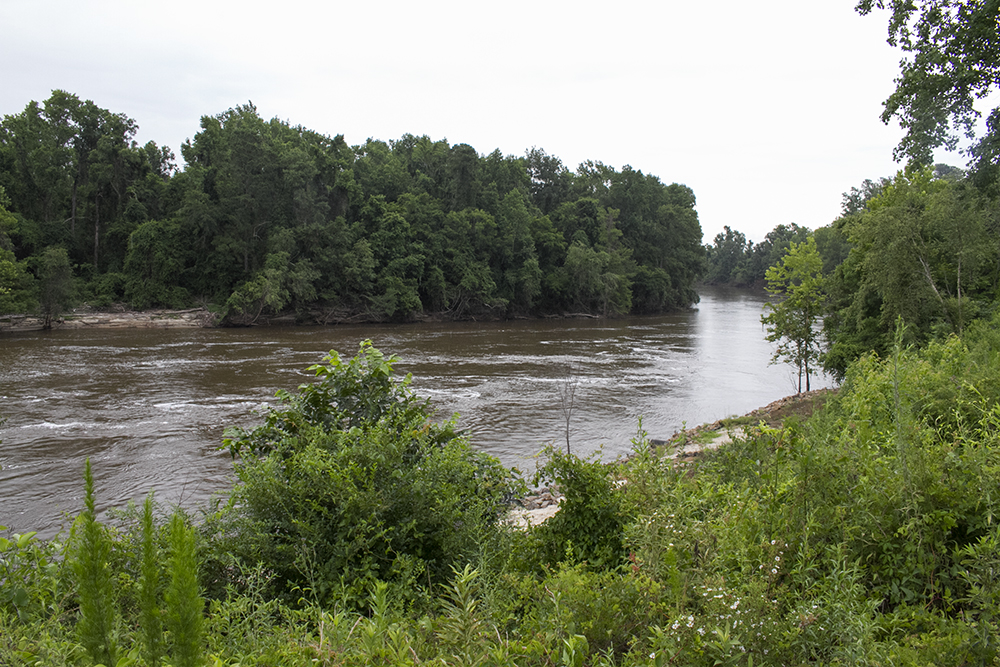
NORTH CAROLINA — Next week, the North Carolina Environmental Management Commission is scheduled to vote on new regulations for chemicals PFAS and 1,4-dioxane. The proposed “monitoring and minimization” rule would require industrial facilities to sample their wastewater and, if the compounds are detected, submit a plan to the North Carolina Department of Environmental Quality to reduce levels over time. However, it leaves out discharge limits and has some critics calling the rules “toothless.”
The vote, scheduled for Jan. 7 and 8 in Raleigh, represents a shift in strategy from 2024, when state scientists proposed setting hard caps on the concentration of chemicals allowed in the water. Under the current draft, there are no fixed numeric limits and no automatic civil penalties for facilities who continue to discharge the chemicals, provided they are following a state-approved minimization plan.
READ MORE: Council considers resolution against Chemours, as testing reveals unregulated PFAS in river
ALSO: CFPUA assesses treatment options for 1,4 dioxane, pilot-test could come next year
The new rules were developed in March 2025 following a directive from the EMC’s Water Quality Committee to focus on identifying the source of the pollution rather than installing concentration levels. The previous 2024 draft proposed a limit of 0.35 parts per billion for 1,4-dioxane and near-zero levels for eight PFAS compounds, including PFOA, PFOS, GenX, PFBS, PFBA, PFHxA, PFHxS, and PFNA. Often called “forever chemicals,” PFAS are associated by the Environmental Protection Agency with an increased risk of kidney and testicular cancer, and liver damage.
1,4-dioxane is a synthetic industrial solvent the EPA classifies as a “likely human carcinogen,” linked to liver and kidney toxicity.
EMC Water Quality Committee Chairman and EMC Commissioner Steve Keen noted in a previous public meeting from March 2025 much of the current draft’s language originated from the NC Water Quality Association. The NCWQA represents the state’s largest public utilities — including the Cape Fear Public Utilities Authority — but is often criticized by environmentalist groups as a pro-industry lobby because it also advocates for industrial dischargers.
NCWQA members Asheboro, Greensboro, and Reidsville successfully sued the state in 2024 to overturn 1,4-dioxane limits, a move currently being challenged by the Southern Environmental Law Center. Despite being a member, CFPUA executive director Kenneth Waldroup has distanced the utility from the proposed rules, noting in a May 2025 letter to the EMC that regulation without enforceable targets is “no more than an action in name only providing empty promises to the people of North Carolina.”
By allowing the association to help write the rules, critics like the SELC argue the EMC essentially allowed chemical dischargers to set their own terms.
The 15-member EMC body — appointed by the governor, General Assembly leaders, and the agricultural commissioner — is charged with reviewing and enacting rules for NCDEQ. The commission is considering the regulatory package as a single item, though it technically consists of two rules addressing different classes of contaminants. The first targets three specific PFAS compounds — PFOA, PFOS, and GenX — and the other rule for 1,4-dioxane.
PFOA and PFOS are “legacy” chemicals phased out of production years ago, but continue to persist in the environment and contaminate local waterways. In contrast, GenX is a modern replacement chemical still actively manufactured at the Chemours Fayetteville Works facility.
Although the EPA established federal limits of 4 parts per trillion for PFOA and PFOS in 2024, the agency moved in May 2025 to rescind protections for several other chemicals — GenX, PFHxS, PFNA, and PFBS. It leaves North Carolina without any enforceable federal or state limits on GenX discharge, meaning the monitoring and minimization rules currently before the EMC are now the only active regulatory proposal on the table for the compound.
There is currently no enforceable federal limit for 1,4-dioxane, though the EPA maintains a non-enforceable health advisory level of 0.35 parts per billion.
Both proposed rules require facilities that detect the substances to submit a mitigation plan to NCDEQ. The plans would outline how a facility intends to lower its discharge and be subject to a state review every two years.
For downstream communities like Wilmington, the primary question is how the lack of hard discharge limits affects water treatment costs. In 2024, an NCDEQ fiscal analysis suggested setting numeric limits at the source of pollution could save the state $9.96 billion over 36 years, primarily by reducing the need for expensive filtration at municipal water plants.
The Cape Fear Public Utilities Authority installed granular activated carbon filters in 2022 for $46 million, to remove PFAS to non-detectable levels in the water, but the filters are less effective at removing 1,4-dioxane. Unlike PFAS, which sticks to the carbon filters, 1,4-dioxane stays bonded to water molecules and passes right through them.
To manage 1,4-dioxane, CFPUA utilizes ozone and biological filters at the Sweeney Water Treatment Plant, which breaks down the chemical rather than just trapping it. While the current system removes about 52% of 1,4-dioxane from raw water, the utility is exploring alternative and potentially expensive methods to remove the chemical completely.
Because the proposed rule does not mandate a specific reduction in upstream pollution, local filtration systems would remain the primary line of defense. Hannah Nelson, attorney at the Southern Environmental Law Center, wrote in a December 2025 letter to the commission the rules represent a “polluter wish-list” allowing industries to continue discharging toxic waste without facing consequences.
“By moving to a monitoring-only model, the state is allowing these companies to prioritize their profits over the health of communities downstream,” Nelson said to Port City Daily. “Water utilities and their ratepayers are ultimately left paying the bill for infrastructure that should have been funded by the polluters themselves.”
However, the NC Water Quality Association defends its approach as a “practical necessity.” In a letter to the EMC from September 2024, supported by the cities of Greensboro, Asheboro, and Raleigh, association attorney Paul Calamita argued setting immediate numeric limits would place an expensive burden on municipal taxpayers and utility ratepayers. He contended many local wastewater plants were never designed to remove industrial chemicals like 1,4-dioxane and would require “large capital investments” for infrastructure upgrades, the cost ultimately trickling down to ratepayers.
CPUA’s GAC filters have led to two specific rate increases on Wilmington taxpayers since 2022. The initial jump went into effect on July 1, 2022, when the average monthly bill increased by $5.39 — a hike CFPUA leadership said was 70% driven by the need to treat Chemours’ PFAS. A second 4.6% increase followed in 2024, attributed to a $1.3 million rise in annual operating expenses for the GAC filters.
CFPUA is pursuing a federal lawsuit against Chemours to recover treatment costs, which, if successful, CFPUA director Waldroup noted in 2022 would lead to a reduction in customer rates.
Because the substances are costly to treat, the NC Water Quality Association maintains the state should first find exact industries that are sending chemicals to city wastewater treatment plants. The association contends mandating strict reduction targets is unrealistic until the state better understands the source.
SELC’s Nelson countered, without numeric limits the new rules do not provide enough incentive for industries to change their practices.
“NCDEQ’s rules would have made sure that polluters kept their pollution below a level that it determined would not threaten health,” Nelson said. “In contrast, the EMC’s polluter-written rules do nothing to reduce pollution from industry or wastewater treatment plants. There is no level that dischargers must meet, and there are no consequences if a polluter fails to reduce its toxic pollution at all.
The SELC also warns the new rules remove public transparency. While the state currently tracks 40 different “forever chemicals” at various facilities, the proposed framework would only require industries to report data for three — PFOA, PFOS, and GenX.
In practice, SELC attorney Jean Zhuang argues this creates a “redaction loophole.” Because labs typically test for dozens of chemicals at once, a facility will receive a report showing the full extent of its pollution.
“In practice, this means that dischargers will receive a lab report showing the levels of dozens of PFAS compounds and will then redact all but the PFOA, PFOS, and GenX data,” Zhuang wrote.
The timing of the EMC’s vote is significant due to the REINS Act, H.B. 402, which became law in August 2025. The act requires any regulation with a projected financial impact of $20 million or more over five years must be approved by the General Assembly, regardless of its public benefit.
Implementing numeric limits for PFAS and 1,4-dioxane would likely exceed the $20-million threshold because of expensive infrastructure costs required to remove the compounds. Since many facilities across the state would need technology like CFPUA’s GAC filters, the total cost statewide would be in the hundreds of millions. The city of Pittsboro already operates its own GAC system, while Greensboro and Fayetteville are currently in the process of constructing GAC facilities.
“The REINS Act made it very difficult for strong — science-based rules to get passed,” Nelson stated. “We know that rules designed to protect water quality can be expensive, but they come with a lot of benefits and often more benefits than costs.”
The EMC Water Quality Committee will meet Wednesday, Jan. 7, to consider and vote on the proposed rules, with the full EMC is expected to take a final vote on Thursday, Jan. 8, at 9 a.m. Both meetings will be held at the Archdale Building in Raleigh and are open to the public, though a livestream is also available.
If the EMC moves forward with the proposal, it does not immediately become law. Instead, the vote starts a mandatory 60-day public comment period, a window advocates say is the last chance for residents to influence the outcome.
“I hope that the EMC listens to the public opposition to these rules and changes their mind,” Nelson said. “I hope they realize that their job is to protect the water we drink and the communities that rely on it, not polluters’ profits.”
If denied, the state would remain without formal rules for the chemicals and the process to establish those rules would effectively restart.
NCDEQ leadership did not respond to requests for comment by press. A spokesperson for the agency cited limited staff availability during the holidays and indicated a formal response would not be available until the first week of the new year; this will be updated upon their response.
Have tips or suggestions for Charlie Fossen? Email [email protected]
At Port City Daily, we aim to keep locals informed on top-of-mind news facing the tri-county region. To support our work and help us reach more people in 2026, please, consider helping one of two ways: Subscribe here or make a one-time contribution here.
We appreciate your ongoing support.
