


NEW HANOVER COUNTY — The Cape Fear Public Utility Authority gave a glimpse this week into needed rate increases to accommodate rising costs — including from PFAS litigation — and the replacement of the Southside Water Reclamation Facility.
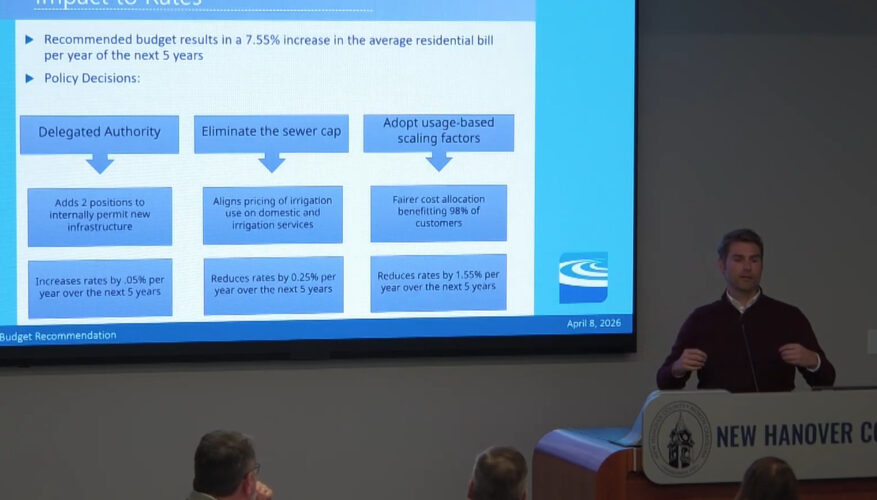
At the CFPUA board’s April 8 meeting, staff said a recommended budget would result in a 7.55% annual increase in the average residential bill incrementally for the next five years. However, the board could choose to go lower, such as around 5.8%, depending on measures taken in other areas, such as fees, expenses and expenditures.
READ MORE: CFPUA billing structure under scrutiny as city fees linked to increased water shutoffs
If the board favored the lower end, it would bring the total increase for CFPUA customers over the next five years to 29% — but that is also on top of the 27% increase over the last four years. Thus, by 2031, residents could have experienced a 50% increase in rates in the last decade.
CFPUA’s rates went up by 8.46% in 2023, 4.6% in both 2024 and 2025, and 6.85% in the fiscal year 2026 budget.
“We’re generally in the middle of the pack right now with rates,” CFPUA Executive Director Kenneth Waldroup told the board Wednesday. “We’ve been kind of lower on the lower end of that, if it wasn’t for PFAs in terms of water and sewer rates.”
Increased rates would cover inflationary needs, as well as rising healthcare costs for CFPUA employees, but the authority is also seeing a $1.5-million increase in litigation costs — which have surpassed $10 million — due to over PFAS. In October 2017, CFPUA filed a lawsuit against Chemours and DuPont in federal district court over Gen X and other PFAS compounds the companies deposited in the Cape Fear River. CFPUA has invested $43 million in Granular Activated Carbon filters to remove PFAS at our Sweeney Plant along with other PFAS-related costs, though it argues Chemours and DuPont should pay for the mitigation.
The largest driver of the rate increase is the planned replacement of the Southside plant, the River Road facility that treats wastewater from much of Wilmington and the southern portion of New Hanover County. At 53 years old, much of the facility’s infrastructure is beyond upgrading and needs an overhaul. The project will also expand Southside’s treatment capacity from 12 million gallons per day to 16 in order to meet current and future demand. CFPUA currently diverts a portion of the flow into the Southside facility to its other Northside plant.
The plant is estimated around $400 million; site work began last year and the facility is planned for a 2031 completion.
“City investment, county investment, and CFPUA’s investment [in infrastructure], to date, the cost of that is around a billion dollars … in one project, we’re talking about increasing that by 40%,” Chief Finance Officer John McLean said.
CFPUA has taken measures to reduce costs already. For instance, customers that opt for physical bills are charged a fee of $1 and the authority established a special irrigation rate of $7.73 per 1,000 gallons, both charged implemented last year.
McLean said the rate increases needed for the plant have provided the impetus to look at its revenue policies, including eliminating the sewer cap. The cap sets a maximum amount of sewer service charges for residential customers based on their water usage, since sewage can’t precisely be measured. If it changed, residential customers would be billed for sewer usage above 15,000 gallons per month, but at the same rate.
Eliminating the sewer cap would allow CFPUA to reduce the rate change percentage from 7.55% to 7.3%, according to staff.
CFPUA staff is recommending the sewer cap and another cost-saving option: going from a scaled-based measuring process on maximum possible usage per meter to a “usage based” scaling method. Doing so would increase fixed charges for customers that have a meter of 2 inches or greater. 98% of customers don’t meet that threshold.
It would also allow CFPUA to reduce the projected rate increase from 7.55% to 6%.
Both policy changes equal a 1.8 point reduction; however, CFPUA is also planning on adding two new positions in next year’s budget. So those needs will add 0.05% to expenses.
An adoption of all three changes would still result in a 5.8% rate increase, compared to 7.55%.
However, there is a downside for the usage-based scaling factors — approximately 856 customers would see double-digit rate increases, some at or above 50%.
Waldrup told the board he is attempting to talk to the top 20 customers who would experience the largest increases; if lucky, he hopes to talk the top 40 or 50, though all 800-plus customers would receive a notification of the change. CFPUA also plans to hold a public hearing on the budget, including the meter scaling change, on May 13.
“You may have a room full of folks from that group coming in on the 13th asking you not to do this increase,” Waldroup told the board. “We believe in management and transparency, so we’d rather them know it’s coming and give you an opportunity to hear their feedback before you make that decision.”
Waldroup added the top users would likely be in opposition, though 98% of customers — most likely less knowledgeable and vocal about the change — would benefit from the “rebalancing.”
Still, Waldroup said he and his team were doing everything to “bend the curve” of the rate increase, including seeking federal and state funding opportunities.
New Hanover County commissioner and CFPUA board member Rob Zapple suggested staff include a paragraph justifying the rate increase to the public.
“It’s also worth pointing out the absolutely necessary function of pursuing the capital improvements that we are seeking — that is not an option, must be done,” Commissioner Dane Scalise said. “Furthermore, we have continuing efforts to bring some amount of money back to our ratepayers and our taxpayers for the work that we’ve had to do with PFAS, and hopefully there is going to be some payoff at the end of the day to bring back dollars that we’ve had to outlay on the front end.”
The board did not take a vote on rate increases Wednesday.
[Ed. Note: This piece has been updated with several corrections, including to Waldroup’s name spelling and CFPUA’s infrastructure investments. PCD regrets the errors.]
At Port City Daily, we aim to keep locals informed on top-of-mind news facing the tri-county region. To support our work and help us reach more people in 2026, please, consider helping one of two ways: Subscribe here or make a one-time contribution here.
We appreciate your ongoing support.
