


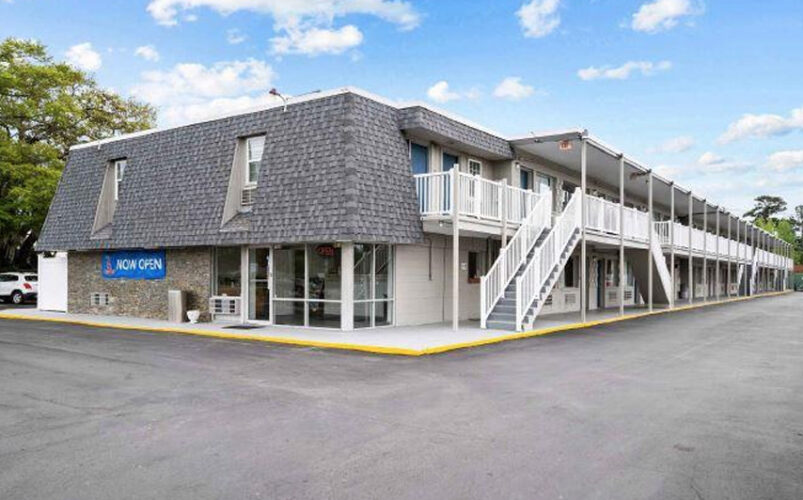
WILMINGTON — An adaptive reuse project converting 76 hotel units into studio apartments was given a resounding rejection by Wilmington City Council Tuesday night, with council members and the city manager expressing quality of life concerns for the potential residents.
“I’m a lot appalled by this, actually, because it seems like a money grab to me,” council member Kevin Spears said. “There’s nothing really satisfying for future tenants here.”
Premier Hotels LLC requested to rezone 4118 Market St. — currently the Studio 6 Motel — from regional business to MD-17, high-density multiple-dwelling residential district with a conditional district. Part of the deal would be 20 of the hotel’s units set aside as workforce housing.
READ MORE: Hotel-to-housing development moves forward for council vote
The proposal had already been granted three variance requests allowing it to subvert some areas of the land code — and thus, provide less parking and open space than required and retain the property’s density, more than allowed on its acreage. Additionally, representative Nicholas Silivanch — New Hanover County GOP Chair John Hinnant is also behind the project — said his client did not plan to renovate the units, which already have “kitchenettes.”
The project has raised a would-you-rather scenario for those reviewing it — it’s a rare opportunity to be able to immediately inject affordable housing units into the market. However, doing so in this case requires signing off on a proposal that doesn’t conform to city standards in several ways.
The Wilmington Planning Commission, in a 3-1 vote, favored the additional housing, with some commissioners also noting the variance requests were needed because the city doesn’t supply a process for adaptive reuse projects. The recommendation was made despite planning staff’s request for denial, citing a lack of amenities — open space, pools, gyms, etc. — and enough parking for every unit.
The city council ultimately chose to side with staff. The unanimous decision came after City Manager Becky Hawke — who doesn’t usually involve herself in development deliberations — stepped in to defend staff’s reasoning, noting their opinion wasn’t in support of bureaucracy for bureaucracy’s sake.
“We recognize people are struggling and people may not have a lot of means so they’re going to take a roof over their head,” she said. “But is this an actual place that we would want to be providing for people in our community?”
Several council members, including Chakema Clinton Quintana and JC Lyle, said they would not choose to live in the units themselves, though the latter council member said she was not judging anyone that chose to.
Silivanch acknowledged the rooms are small — 250 square feet — and would most likely only be marketable at or below the $1,100-dollar rent, though all utilities would be included. The 20 workforce units would be limited to a rent of $1,083, calculated based on 80% of the area median income.
The intention, Silivanch said, is to turn the lights off on the motel and then back on as affordable housing. He added each of the rooms were renovated following 2018’s Hurricane Florence.
“The choices that are available to the people in this room for where we would choose to live are maybe different than other folks,” council member Cassidy Santaguida said.
Santaguida, along with Lyle, indicated they were open to the project; Lyle said she wanted the city and Silivanch to “meet in the middle” on development standards. The biggest problem, she said, was the parking.
The developers plan to provide 68 spaces for the 76 units, allowable through one of the granted variances to the code. Planning staff pointed out if Silivanch offered the entire property as workforce housing he would not have needed the variance, though Silivanch was averse to this at the planning commission meeting, citing a need to ensure some units remain profitable if HUD lowers the maximum rent that can be charged for workforce units.
“Most of the residents don’t have cars because they can’t afford them,” Silivanch said. “So this is like a restart spot in life, or it’s an entry level spot.”
The council took issue with that assumption, noting people that can afford a $1,100 rent can most likely afford a vehicle, plus the property makes no allowance for visitors. Lyle suggested Silivanch talk with neighboring businesses about leasing parking spaces.
Silivanch defended the parking offerings, noting his River City Apartments has a five to 10-spot shortage but a 96% occupancy rate with a waiting list. He also pointed out the property is 50 feet away from a Wave Transit stop and is within walking distance to a grocery store (a Food Lion is half a mile away) and other restaurants where residents could also seek employment.
Clinton-Quintana pushed back on the assertion about jobs, noting people that worked at nearby establishments — 7/11, Food Lion, Hooters — probably couldn’t afford an $1,100 rent.
Council member Salette Andrews said while she would love to see people give up their cars, it wasn’t feasible to expect people to with the current transportation options available. Wave Transit, while working to improve on-time performance and consistency, is not considered a “choice rider” system where those that have the option to drive choose to ride the bus instead.
Lyle was also worried about the lack of room for cars to turn around onsite; if drivers wanted to loop back around the building, they would need to exit onto Market Street and reenter.
The council member then asked Silivanch if he would consider adjusting down his rent prices to fit into the 60% area median income range. Silivanch said they could do that; it would bring the rent limitation to $928 for the 20 designated workforce units.
However, council seemed to stop entertaining the proposal after Hawke’s comments on her quality of life concerns.
The city manager questioned whether only one person would be living in the apartments, surmising couples or families could try to rent the space to save money. Though refusing families would be considered discrimination under the Fair Housing Act, North Carolina law, the apartment complex could potentially limit the number of individuals living in a room through occupancy standards (the federal guideline is 2 per bedroom plus 1) and fire code.
Still, Hawke said the apartments would not even meet the definition of an efficiency apartment. While it’s typical for efficiency apartments to only have kitchenettes — mini-fridge, microwave and two-burner stove — Hawke pointed out the proposed apartments wouldn’t even have a stove, instead only a hot plate.
The U.S. Department of Housing and Urban Development defines efficiency apartments as sub-500 square feet, but typically in the range of 300 to 500 square feet, smaller than typical studios; Silivanch’s proposed apartments would be on the lower side.
“We would be able to do away with many of these conversations [over breaking the land code] if the rooms were combined,” Hawke said. “To do a true adaptive reuse would make these actual living spaces for these residents.”
During the rezoning request’s public hearing, three residents spoke against approving it, one calling it “exploitation of people in desperate places.”
When the proposal was ultimately voted down, many in council chambers clapped.
Tips or comments? Reach out to journalist Brenna Flanagan here.
At Port City Daily, we aim to keep locals informed on top-of-mind news facing the tri-county region. To support our work and help us reach more people in 2026, please, consider helping one of two ways: Subscribe here or make a one-time contribution here.
We appreciate your ongoing support.
