


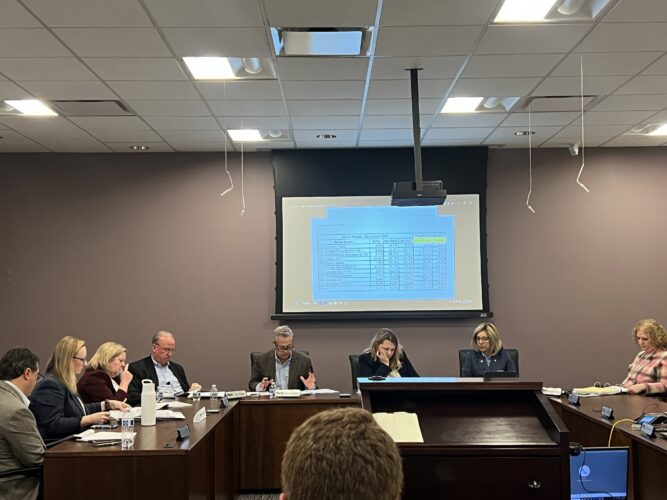
NEW HANOVER COUNTY — After Wave Transit’s long-term trajectory and struggling on-time performance came under the microscope at a December workshop, the Cape Fear Public Transportation Authority board received some, but not all, answers on Thursday: The transit system may have to reckon with a $4-million deficit at the end of next year.
READ MORE: City, county misaligned on Wave Transit vision, delay vote on recommended performance shifts
Eric Credle, New Hanover County Chief Finance Officer and CFPTA board member brought up the fact that the authority is currently pulling from reserve funding to balance its budget and would not be able to indefinitely. Wave’s finance director, Erica Walters, said she thought the authority would be able to use reserves for one more fiscal year before facing a $1.9-million deficit.
On top of the $1.9 million could be another $2 million currently being paid by the state to run RideMicro, a point-to-point service similar to Uber. It currently services more than 300 riders across Brunswick, Pender and New Hanover counties.
Though it’s been in operation in some form since 2021, RideMicro is still considered a pilot program with funding set to run out in December 2027, according to Wave Transit Executive Director Mark Hairr.
“We have regular communication both about current operations, performance and future funding,” Hair said at Thursday’s meeting. “No indication yet at this early point whether there could be funding beyond 2027.”
Thus, should the pilot fail to receive further state funding, Wave Transit’s anticipated funding deficit could rise as high as $4 million to keep Wave Transit operating the same as today.
CFPTA board member and County Manager Chris Coudriet implied Brunswick and Pender counties would most likely need to come to the table to discuss funding their portion of the program. New Hanover County has double the amount of vehicles running the operation, according to Wave’s Deputy Director John Dodson.
“Sooner rather than later, we have to raise with the boards that allocate that there is a deficit of revenue,” Coudriet said.
Per Wave Transit’s current budget, the authority has a current planned revenue stream of $14.75 million, almost $7 million coming from federal grants. State funding, outside of the RideMicro grant, is $700,000 with around $750,000 in passenger fares planned for collection.
The City of Wilmington and New Hanover County, whose representatives make up a majority of the CFPTA board, have committed $1.9 million and $1.2 million respectively.
The looming deficit would be in place should Wave’s bus system operate as it does today, though some board members expressed at December’s workshop the current level isn’t cutting it. Wave’s on-time performance data backs that up.
Last month, not a single one of Wave’s bus routes met Wave’s target on-time performance metric of 88%. Some routes reached into the 80s, including the 101 Princess Place at 84.7%, 201 Carolina Beach Road at 83.9% and 106 Independence Boulevard/Medical Center Drive at 80.7%.
The routes with the worst on-time performances were 107 College Road, 109 College Road/Medical Center Drive and 210 Greenfield Street to Monkey Junction, all with on-time performance scores around 50%. The three routes were the only ones in the double digits for being 10 or more minutes late — Route 107 at 15.5%, Route 109 at 24.9% and Route 210 at 29.8% of the time.
December wasn’t a fluke for these three routes either. They are consistently late throughout the year due to heavy traffic, despite the authority implementing the Reimagine Wave plan, which overhauled the entire system to improve efficiency, in January 2025.
“I don’t want the staff to feel like it’s all doom and gloom from the board; there’s some very good news on here, it’s just that on-time performance is just something that’s just been nagging for years and it would be nice to be able to see what we can do,” Wilmington’s city attorney Meredith Everhart said.
The chronic lateness prompted Wave Transit staff to come up with tweaks to the routes to help alleviate the lateness. The changes were presented at the December workshop, with the goal of having a public hearing on them at Thursday’s meeting — that timeline was derailed by the board’s scrutiny.
Wave’s suggestion, based on available funding, was to adjust the routes, which would result in some reductions in the frequency of service. Everhart and City Manager Becky Hawke said they weren’t supportive of making cuts to the current level of service.
“To just cut back and cut back and cut back … if you’ve got frozen groceries from Walmart and it’s taking you two hours to get home, you know, your kids are never going to get ice cream again,” Hawke said at the December meeting. “It does not, in my opinion, meet the needs of the people who need it most by continuing to reduce service.”
Dodson admitted during December’s meeting that the best option, should money be no object, would be to deploy “tripper buses” — essentially more buses to deploy during times of increased demand. To make this a reality, WAVE would need more funding for both the buses, which could take a year to arrive, and drivers.
Coudriet said, from the county’s current perspective, he couldn’t get behind asking the commissioners to allocate more funding to Wave only one year into the implementation of a new route layout.
The differences in opinion, while another example of a growing policy divide between the county and city, prompted Hawke to suggest the board discuss long-range visions for Wave, analyze what it would take to get there and be frank about what each entity would be willing to spend. Though ultimately, the board asked Wave staff to come back in January with a cost analysis for the tripper buses. Though, that information didn’t materialize at Thursday’s meeting.
Emails obtained by Port City Daily show Thursday’s agenda included an update on December’s discussion as a nonvoting item, though it appears not to have made it to the final agenda.
“We recently had a very productive discussion with the chair and vice chair, kind of getting into some details on the issues we’re looking at in terms of reliability, on-time performance, the specific areas that are being impacted, like we’ve talked about,” Hair said Thursday. “So we’re continuing to compile some information, look at different ideas.”
The director said the full board will get an update when the information has been compiled, though didn’t set a date.
Meanwhile, problems persist for Wave riders. Thursday’s meeting featured a public speaker who wanted the board to ensure a route service to the New Hanover County Orthopedic Hospital on Wrightsville Avenue. Route 103 used to stop at the facility but no longer does; now the closest stop is on the 206, about a mile away.
Everhart and Hawke said they were struggling with the idea of not having a stop at the hospital and asked staff to look into adding a stop or covering the facility under the RideMicro program.
Tips or comments? Reach out to journalist Brenna Flanagan here.
At Port City Daily, we aim to keep locals informed on top-of-mind news facing the tri-county region. To support our work and help us reach more people in 2026, please, consider helping one of two ways: Subscribe here or make a one-time contribution here.
We appreciate your ongoing support.
