


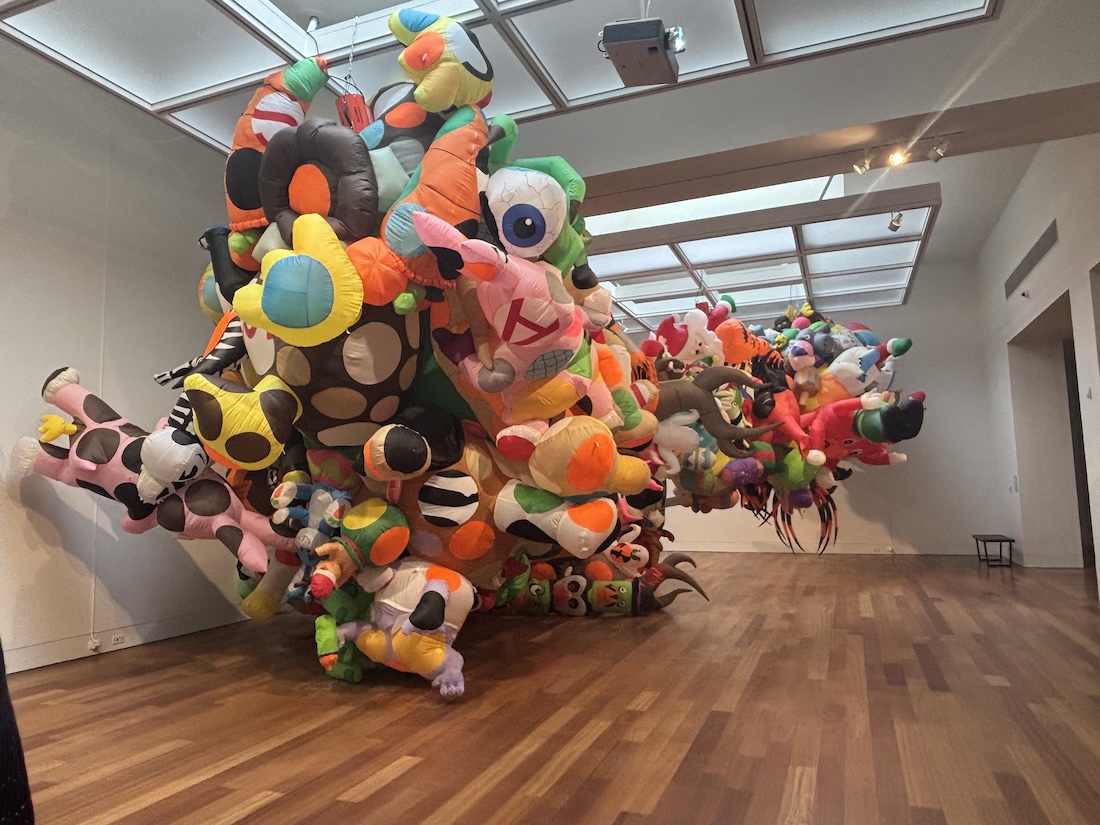
WILMINGTON — R2D2’s body fuses into Chewbacca as turkey feathers peek from behind. Santa Claus’ head and arms form into a trifecta of stacked Halloween pumpkins. Eye balls, spider legs, fish tails, chicken beaks and reindeer noses are stitched together into tunnels of vibrant color and wacky shapes.
These visuals are only part of Nick Cave’s “Augment,” fused-together holiday inflatables now on display through August at Cameron Art Museum in “Fresh Air: Inflatable Sculptures.” The exhibit features a multitude of artists, such as the renowned pop icon Andy Warhol, Japanese sculptor Momoyo Torimitsu and Jerusalem-born artist Tamar Zohara Ettun, among others. Together, they offer viewers a look at consumer culture, environment, the relationship between body and space, and resilience.
“We really want to show that art can be surprising, art can be whimsical and fun, and thought-provoking,” CAM Executive Director Heather Wilson said during a tour earlier this week.
READ MORE: Wilmington native and ‘first female rapper’ to be inducted in NC Hall of Fame
Curating a show centered on inflatables has been in the works for years, but recently the genre has taken off and is especially popular with younger audiences. It’s part of CAM’s goal to attract young newcomers to the museum, Wilson said.
“I just got back from London and the museums there are full of youthful energy,” she added. “And we’re seeing our audience demographics changing, too — we want to be able to offer them an experience that they don’t have to go Raleigh or D.C. or New York to have.”
Perhaps one of the most vivid pieces on display comes from Chicago-based sculptor, painter, dancer, and performance artist Cave. His sculpture of repurposed holiday decorations has become a commentary on happiness, connection and diversity.
Ben Billingsley, the associate curator for CAM, explained during a tour on Tuesday that Cave hand-cut, stitched and sewed together more than 1,000 pieces of varied inflatables and lawn ornaments once used during Halloween, Thanksgiving or Christmas at people’s homes.
“Like this Thanksgiving turkey,” he pointed out. “So this piece is meant to be about happiness, but think about how happiness is kind of fragile. Right? And how we have to piece it together. To me, one of the best parts about ‘Augment’ — just think about the last time you were in a family holiday situation. Because you all know, everybody has that one uncle that’s gonna say the wrong thing at the table and disrupts the calm. So if you imagine trying to hold a big group of different people under an umbrella of happiness, that’s the theme here.”
Cave’s work on display at CAM is only two-fifths of its actual full size. Its entirety went on display originally in the Boston Cyclorama in fall 2019, before being moved in a “Joy Parade” to a building in a historically diversified area slated to become a library. Other artists christened the move by wrapping the building in collages they created prompted by one question: “What brings you joy?”
“So it went from a more affluent neighborhood to a less affluent neighborhood and connected all of the people along that journey,” Billingsley described of “Augment.”
The original installation poked from the windows of the building and remained on display until Massachusetts shut down in March 2020 due to the Covid-19 pandemic. The work’s meaning suddenly shifted, highlighting the importance of connection, diversity and acceptance during a frightening time when social distancing and isolation became the norm.
Building community has become the centerpoint of its display in other museums since.
“It’s now about joy and resilience,” Wilson said.
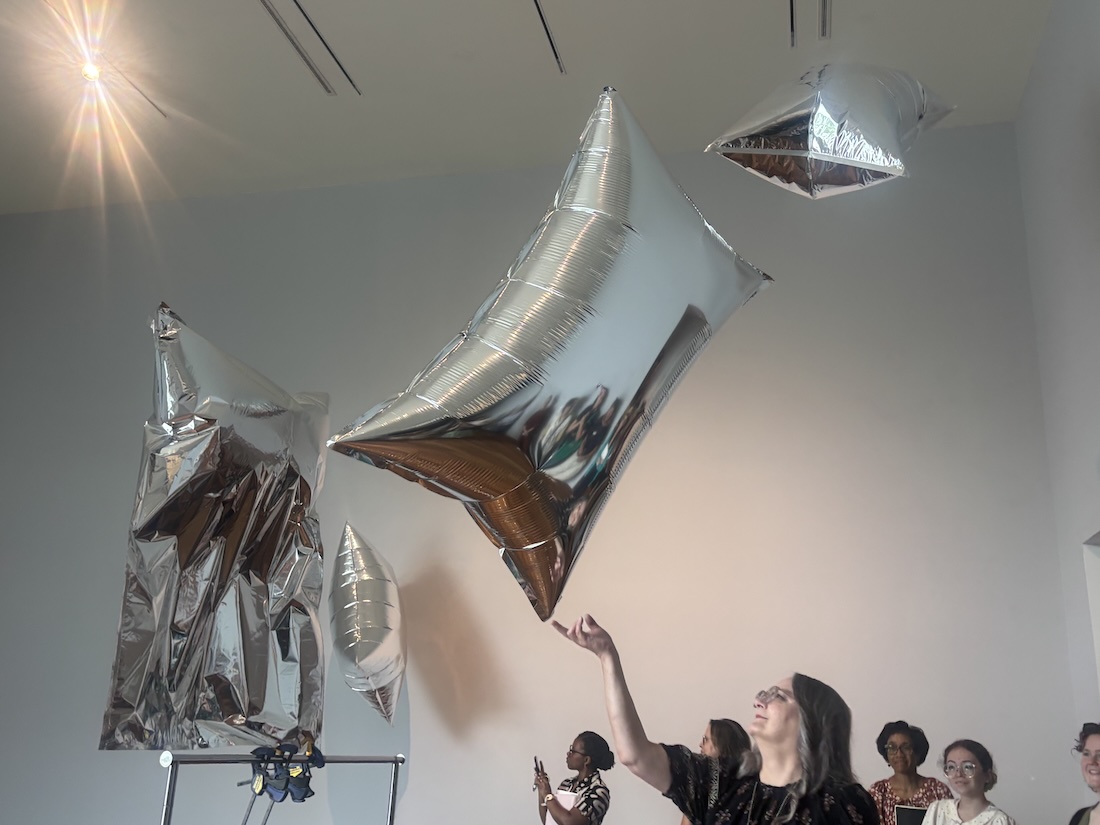
“Fresh Air: Inflatables” is anchored by notable pop icon Andy Warhol’s “Silver Clouds,” to remain on display through September. Around 80 or so silver Mylar pillows, made of Scotchpak — used in 1966 to pack sandwiches in — float throughout Studio One and reflect back surroundings to the viewer.
During its debut 60 years ago at the Leo Castelli Gallery in New York City, “Silver Clouds” was meant to challenge traditional art exhibitions, allowing visitors to engage with art made from everyday objects and normally untouchable in a museum setting. Disillusioned by painting and sculpture — and the flak he received from other artists of the time challenging his legitimacy — Warhol created the balloons with the help of Billy Klüver, a Swedish-born electrical engineer at Bell Labs.
The balloons — which naturally aren’t original to the very first exhibit but have been replicated to go on museum tours everywhere — must maintain a perfect mixture of air and helium. This is to ensure they don’t stick to the ceiling or are heavy-grounded along the floor but create a balance to float near a person.
Audiences are encouraged to engage their reflections, which Billingsley suggested with a “two-finger touch” — gentle, so as to not destroy the balloons.
“We only have so many to refill,” he said.
The balloons require daily maintenance from Bob Unchester, director of exhibitions and collections, to ensure they flit about the room, as the helium molecules slowly leak and the buoyancy is also impacted by temperature and atmosphere.
“So if you think of this as originally being made in 1966, this is the earliest inflatable we’ve got,” Billingsley said, when comparing it to Cave’s pandemic creation, “and artists all on that spectrum.”
However, Warhol’s piece isn’t the only interactive display. Visitors are also encouraged to enter Tamar Zohara Ettun’s “Orange Inflatable,” which takes on a spaceship-like design from the outside. Viewers are encouraged to unzip it and enter the 10-foot space for a place of calm and meditation.
Billingsley described Ettun’s work as representing a “somatic experience,” how we deal with trauma held in our bodies, not just memory.
“This piece is to separate you out of everyday life, and give you a chance to just kind of commune with yourself or with a group of your friends inside,” he said.
Also featured is Torimitsu’s “Somehow I Don’t Feel Comfortable,” consisting of oversized pink bunnies, measuring almost two stories tall. They greet visitors first into the Hughes Gallery, cramped and squished, their beady eyes piercing down over onlookers.
“It’s deceptively cute,” Billingsley said of the cartoonish looking sculptures. “So part of the concept behind the piece is this idea of how we’ve weaponized things.”
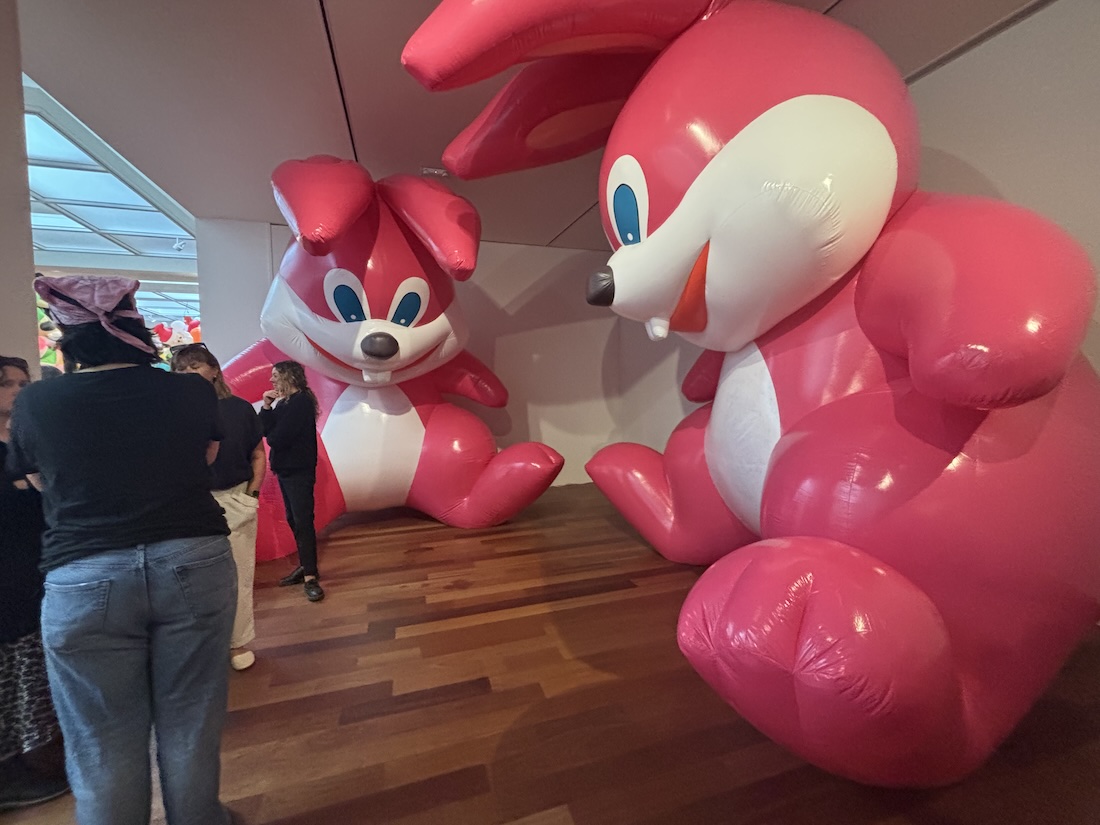
Torimitsu’s work centers on marketing cute, delicate creatures into commercial mascots that teeter on menacing. It leaves the viewers asking about over-corporatization of cuteness and consumer goods, a la Hello Kitty.
Also on display are Nancy Davis’ “Carnival Eyes/Spring Break” consisting of weather balloons blown up inside of corsets, yet made to look like eyeballs peering at museum visitors. There are multitudes of commentary regarding body image and beauty standards, while Scottish artist Claire Helen Ashley centers on the environment and natural world. She brings to life her residency on the Scottish Isles with three inflatables consisting of a sea urchin and standing stones. It questions humanity’s engagement with its surroundings.
Billingsley called Ashley’s work the most environmentally friendly in the show; she made the pieces from Tyvek and used bioplastic paint created out of Scottish seaweed and water-based elements, as well as dirt from the isles, Azomite rock dust and more. Sensory bags will be given out during tours with materials so folks will be able to get a feel for it. Ashley also filmed images of the sculpture at the isles during the course of a day, which overlay the inflatables and a blower creating the sound of the wind and ocean.
Nicole Banowetz also leans into the environment with “Nexus,” a large-scale representation of microscopic animals.
“These are based on single-celled creatures that excrete silica to create these baskets around themselves for protection,” Billingsley explained.
The community will be able to view all exhibits as they open on Friday evening to the public. On Saturday, June 20, there will be a Community Day, 10 a.m. to 5 p.m., meaning everyone can attend and view the exhibits for free. Plus, art-making sessions will take place, including with one Tamar Zohara Ettun.
There also will be indigo dyeing, basket weaving and Adinkra stamping workshops held in tandem with another CAM exhibit, Jonathan Green’s “Rooted in Memory.” The exhibit features paintings of the Gullah-Geechee people, as well as traditional sweetgrass baskets, quilts and stamps indicative of their heritage.
CAM is also planning “A Night of 1,000 Andys” this September, encouraging participants to dress up like Warhol, his muses or his artwork, as a DJ spins tunes and other activities take place in celebration of “Silver Clouds.”
Learn more about all events and exhibits here.
At Port City Daily, we aim to keep locals informed on top-of-mind news facing the tri-county region. To support our work and help us reach more people in 2026, please, consider helping one of two ways: Subscribe here or make a one-time contribution here.
