


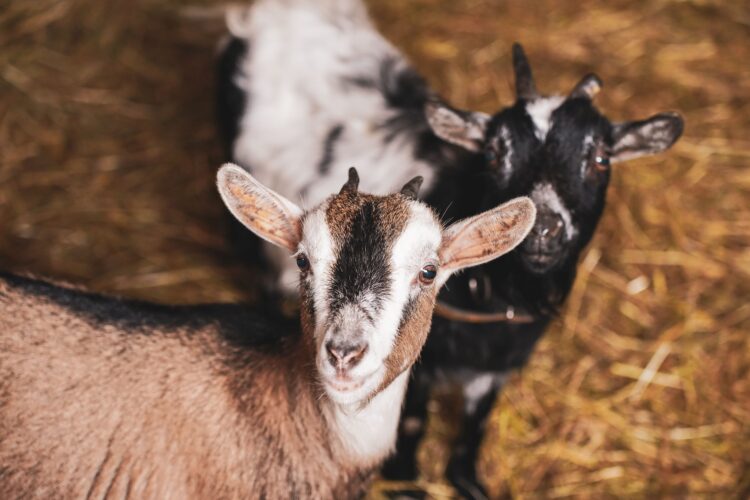
WILMINGTON — Though the passage of its budget took center stage on Tuesday, the Wilmington City Council also discussed an amendment to make way for new city residents — goats.
The city has been exploring using the grass-eating livestock as an all-natural landscaping solution amid dense greenery in city parks. The item first came up at council’s meeting last month and then again at Tuesday night’s session in relation to a change to the city’s domestic animal waste ordinance.
The change would allow governmental entities engaged in legitimate government activities to be exempt from animal waste requirements.
READ MORE: City passes budget in 4-3 vote, tax rate increasing
Deputy City Manager Thom Moton explained the city currently has domesticated animals working in both the fire and police departments and it would not behoove officers to stop and pick up waste during an emergency. As the city’s agenda documents state, the city also wants to use livestock to “help manage noxious weeds and vegetation” as modeled by communities across North Carolina and beyond.
For example, the City of Raleigh contracts with Goats on the Go, using around 30 goats to target invasive species like kudzu along the steep banks of the Rocky Branch Greenway Trail and Dorothea Dix Park.
Port City Daily reached out to the city with several questions, including cost for the program, about the goat initiative after Mayor Pro Tem Kevin Spears brought it up in the May 18 meeting.
“I keep hearing about goats, and so I’m just gonna keep talking about goats until I see a goat or until I don’t see a goat,” Spears said.
In response to Port City Daily’s questions, a city spokesperson said staff were still evaluating the concept and no vendor or contract had been finalized.
On Tuesday, after a question from council member Cassidy Santaguida, Moton said the city’s goal is to finish the logistical requirements needed by the end of the summer.
“Believe it or not, this industry is heavily regulated, so there’s some federal requirements, tagging that has to be secured,” Moton said. “So it’s a little bit longer than we would like but we’re going as fast as we can.”
The U.S. Department of Agriculture requires goats to be tagged with identification numbers to track animal health and tamp down on disease — particularly a degenerative disease called Scrapie — spreading among the livestock. Moton said this process takes about six weeks.
Moton continued to share information upon council prompting, including that the cost of maintaining the goats annually would be “negligible” but not zero. Moton estimated it would be a few thousand dollars annually.
Council member Chakema Clinton-Quintana asked how many goats the city was getting, which Moton said six to eight, though four to six would be working and the others would be spare.
“Do we need a babysitter and are there baby goats?” Clinton-Quintana asked.
Moton said the intention is that goats would work, indicating they would not procreate, and the city is working with partners, though did not name them. The city would own and be responsible for the goats — rather than leasing them through a vendor — but it is not clear who will be responsible for caring for them or where they will be housed.
Ultimately, the vision is for the goats to be deployed in areas without much foot traffic, to limit any adverse reactions or harassment with the public. Additionally, the goats will target thick vegetative areas and places hard to maintain — slopes, for instance, or near infrastructure or in an environment easily damaged with traditional landscaping methods.
However, Moton said the goats are envisioned to be used for educational purposes, noting Halyburton Park would be a good location for public interactions, much like the Wilmington Police Department do with the horses used for downtown patrol. Staff have also explored the possibility of putting cameras on the goats to see them at work.
Mayor Pro Tem Spears said if they’re working goats they should also earn a living wage, referencing council’s earlier budget passage setting employee pay at at least 60% of the area median income, currently $45,531.
“They’ll have plenty of water, shelter and all the green vegetation they can consume,” Moton said.
Spears also facetiously asked if the alligators at Greenfield Lake know the city is bringing in goats. Moton said staff will be tasked with ensuring the protection of the livestock when on and off duty.
Council member Salette Andrews was the only person critical of changing the ordinance for the goats, noting she wanted to make sure staff were picking up after them. Moton clarified the intention would be for staff to clean up in one sweep after the goats were done in an area, but the ordinance change was needed to ensure they weren’t violating policy by not picking up after each dropping.
Ultimately Andrews would be the sole vote against the ordinance change.
At Port City Daily, we aim to keep locals informed on top-of-mind news facing the tri-county region. To support our work and help us reach more people in 2026, please, consider helping one of two ways: Subscribe here or make a one-time contribution here.
We appreciate your ongoing support.
