


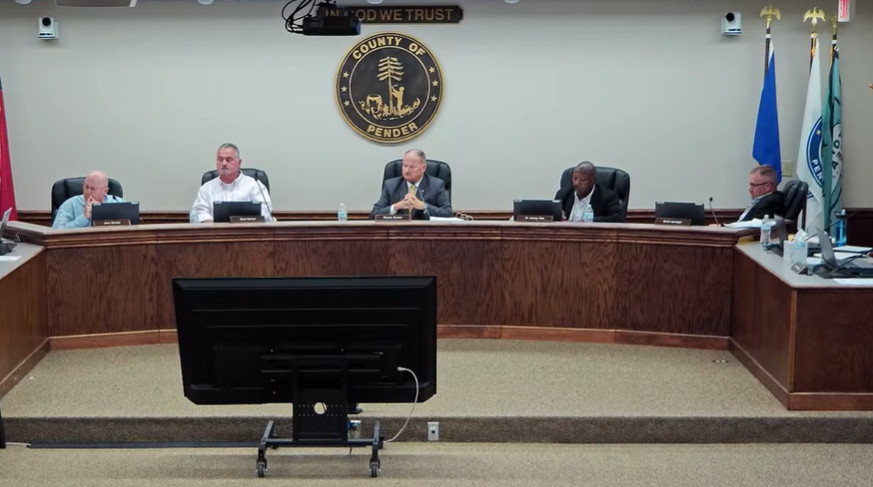
PENDER COUNTY — Earlier this week, the Pender County Board of Commissioners adopted the 2026-2027 fiscal year budget for $236.6 million, which uses the 2025 valuations and tax rate of $73.75 cents per $100 value. It’s another reversal in an uncertain budget season, two weeks after County Manager Colby Sawyer suggested using the 2026 revaluation rates and $42.51 cents per $100 value.
However, there was no support for the first tax rate suggestion by any commissioner, due to it being 2 cents above revenue neutral — meaning the county brings in the same revenue as the previous fiscal year — and additionally costing taxpayers more.
“The board has made it clear that they do not want an increase in the effective tax rate,” Sawyer told the commissioners this week. “Staff had worked very very hard to try and find ways to continue to cut our expenses to get us back to no tax increase.”
READ MORE: Commissioners unsupportive of Pender County manager’s tax rate exceeding rev-neutral
Also, since the first budget draft, the North Carolina House and Senate has passed Senate Bill 889, which freezes 2026 valuations for approximately nine counties, including Pender, for one year. This would leave the counties basing their budgets on 2025 numbers.
As such, Sawyer said the final choice to use 2025 property valuations is a result of the bill, now moving to Governor Josh Stein’s desk. If Stein vetoes it, the bill could be up for a General Assembly override.
[Stein signed Senate Bill 889 into law on until Friday, June 20.]
Brandi Cobb, the county’s communications manager, told Port City Daily the board would hold a special meeting, should the bill fail, but “they just don’t know what that would look like.”
Commissioners are largely in favor of the Senate bill with Commissioner Jimmy Tate, on Monday night, thanking the House and Senate for passing the legislation. Tate has been vocal against the new revaluation numbers, calling Vincent Valuations’ data inconsistent.
Commissioner Chair Randy Burton encouraged the citizens of Pender County to reach out to representatives about passing the bill as well.
“I can’t help but to ask the audience and those folks at home to, if you would, proactively get on the phone to the governor’s office and lobby for him to pass 889,” Burton said.
$73.75 cents per $100 value is expected to bring in $69.3 million in revenue, compared to $66.5 million brought in last year. This is due to the county’s tax base growing by $1.64 billion since FY 2025-26. Pender has experienced a 2.72% population increase in a single year, bringing its population to 74,072 and resulting in the increased tax base.
The adopted tax rate deviates from the $42.51 cent tax rate, which was 2-cents above rev-neutral, proposed in the first budget and based on 2026 revaluations.
To compare the two, a person with a $300,000 valued home from 2025 would pay $2,200 a year in taxes on the $73.75 cent rate. If that home escalated in value by 110% — the average in Pender County per the 2026 revaluations, done every seven years county-wide — it would be worth $630,000. That same homeowner would then pay around $300 more at $2,550 annually at the $42.51 cent rate.
The decision on which valuations to use, as well as the added challenge of legislative uncertainty, caused the board to change their decisions several times in their approach to the budget.
It began in April, with criticism of substantial property value increases prompting the commissioners to unanimously vote to suspend the 2026 revaluation and revert to 2025 property tax values for the budget. Thereafter, staff learned it was problematic, according to advice from the North Carolina Department of Revenue and the UNC School of Governments, both of whom said the move could run afoul of state law.
Interim county attorney Katherine Barber-Jones — Pender County’s attorney, Trey Thurman, retired in the midst of the reval quagmire in April — later informed the board their decision to pause valuations was likely not within the realm of their authority, but rather under the General Assembly. Thus, she said it could result in legal action, such as a lawsuit from taxpayers claiming “unlawful taxation” or enforcement from the NCDOR for suspending revaluations without the approval of the General Assembly.
In May, one month after the commissioners decided to use 2025 numbers, the board reversed course and voted 3-2 to reinstate the 2026 revaluations. Vice Chair Brad George and Commissioner Jimmy Tate were the dissenting voices with Tate citing a need for lower tax rates, hoping the bill put forth by Senate President Pro Tempore Phil Berger in April would pass and pause new revaluation numbers. Berger put forth the bill in hopes of providing a temporary solution to the high property taxes homeowners were facing.
“I’ve traveled to Raleigh several times, heard from the people east to west in regards to Senate Bill 889. I made that initial motion three months ago … and we didn’t know how it was going to go then, but I stood by my vote,” Tate said. “Thank your house members and thank your Senate members when you see them because this is gonna help our taxpayers tremendously.”
What’s in the budget
The adopted budget is $236.6 million in total, $3,705 more than the one first presented due to slight increases in the EMS fund and Fire District fund.
Using the 2026 numbers, 1-cent would have equated to $1.94 million dollars whereas under 2025 numbers, 1-cent comes out to $1.1 million which is slightly higher than the previous year’s $1 million.
The budget passed in a 4-1 vote, with Commissioner Jerry Groves dissenting due to a 13.2% water rate increase.
Sawyer explained escalated costs were on the base rate fee, not on an individual’s total water bill, which includes their use rate. He said it would result in an additional $4 to $4.50 per month to fund utility enhancements.
The enterprise fund — which include utilities like water, sewer, and solid waste service — makes up $27.6 million of the budget. The budget allocates $136.7 million for the general fund.
The general fund’s largest expenditure is $31 million for Pender County Schools. Other significant expenses include $11.5 million for the sheriff’s office, $10.4 million for fire operations, and $10 million for debt service; all of which remain consistent with what was presented June 1.
According to the county manager’s budget message, as a result of losing state education funding, reductions in DSS and Health program reimbursements and cost-sharing, and “grant revenues that had underwritten ongoing services,” there is now a revenue gap of $4.7 million. Regardless of which year rates were used, the revenue gap would remain.
To make up for the loss in revenue and ensure there was not a tax increase, cuts had to be made to the budget. These cuts included outside agency funding, which during fiscal year 2025-26 totaled $2.2 million. Sawyer told the board, aside from outside agencies that received grants or had a contracted obligation, all that funding was removed.
Community members, especially those working for nonprofit organizations, spoke out against the cuts during the budget’s public hearing on Monday.
“When a nonprofit has to close their doors or eliminate a program due to lack of funds, our county services feel the weight because the families they feed, the seniors that they care for, and the children that they tutor do not disappear,” Pender County Christian Services Executive Director Sandy Harris said during Monday night’s meeting.
The organization previously received $5,000 from the county during fiscal year 2025-2026.
“The needs remain and those needs ultimately fall back on the county’s public safety, health, and social services department budgets,” she added.
The final budget was amended after a closed session which is when commissioners, although initially showing hesitancy to use the fund balance for any recurring funds. Instead, they decided to put money toward outside agencies; $50,000 was taken from the $50.6 million fund balance. The money was not allocated for any specific organizations and was instead set aside for the board to determine distribution at a later date.
Community members also expressed concerns about school funding. While Pender County Schools received $1.3 million more from fiscal year 2025-2026, it did not receive its full requested increase amount — $4 million — necessary to maintain current school services.
In order to make advancements, the amount would need to be increased to $6.5 million. Advancements largely include employee pay and salary raises.
Yet, the schools only received a $1.3-million increase in the end, meaning there is a $2.7-million shortfall from the $4 million increase requested to maintain services. The district has yet to make decisions on what will be cut or reduced as priority assessments are ongoing.
Walter Davis, a student at Pender Early College High School, said the budget left schools “more than $2 million short of the bare minimum.”
“Funding our schools and providing a basic education is a duty of the county government and cannot be ignored like this,” Davis said. “What I’m requesting is that no budget is passed until it will fund basic, fundamental, and necessary services. The tax rate may have to go up to make that happen but that is not a choice, it is a duty.”
Superintendent Brad Breedlove of Pender County Schools emphasized to the board during the public hearing the importance of properly funding schools and providing enough for advancements.
“Maintaining services year after year alone does not move us forward. For example the most recent data shows that Pender County student expenditure ranks 113th out of 115 school systems across the state,” Breedlove said. “This is a difficult position, especially when our schools continue to grow and the students and staff continue to increase. Falling short in the baseline of just maintaining services requested in our budget is not simply a reduction in dollars. It is a reduction in people, programs, and services that support our students.”
Bob Fankboner, a spokesperson for Pender County Schools, shared the capital funding and $1.3-million increase in expense funding would be used on long-term infrastructure needs, HVAC, facility maintenance, transportation needs, and technology. However, the amount is not enough to maintain current services and staffing.
Initially the schools had been given $4 million in capital funding, which Tate pushed back on noting the board made a commitment to the superintendent to fund capital improvement needs.
“To hear that we’re ranking at 113 out of 115 while we’re sitting on such a huge fund balance, and I’m not a fan for dipping in the fund balance but I’m also not a fan for kids going to school with mold in the building,” Tate said.
After a closed session, the board came back with the final budget, which had increased school capital funding from $4 to $6 million.
Also announced after closed session: putting $600,000 toward the Union Rescue Squad, a volunteer group whose contract with Pender County EMS and Fire ended last July. The group was originally allotted $1 million as the budget was presented on June 1.
Prior to the closed session Tate had requested money be allocated to the Union Rescue Squad stressing if the budget as presented without amendments was passed, they would be unable to pay personnel.
Once closed session ended and all amendments were made, Tate put forth a motion to vote on the budget saying he believed this was the best they could get without a tax increase. It was seconded by George, with a majority passage.
[Ed. note: The article was updated to reflect Stein signed Senate Bill 889 into law on Friday, after press. Also, a previous version of the article reported budget amendments were made during closed session, but has been corrected to reflect they were made after closed session; PCD regrets the error.]
Have tips or comments for Sophia DePhillips? Email [email protected]
At Port City Daily, we aim to keep locals informed on top-of-mind news facing the tri-county region. To support our work and help us reach more people in 2026, please, consider helping one of two ways: Subscribe here or make a one-time contribution here.
