


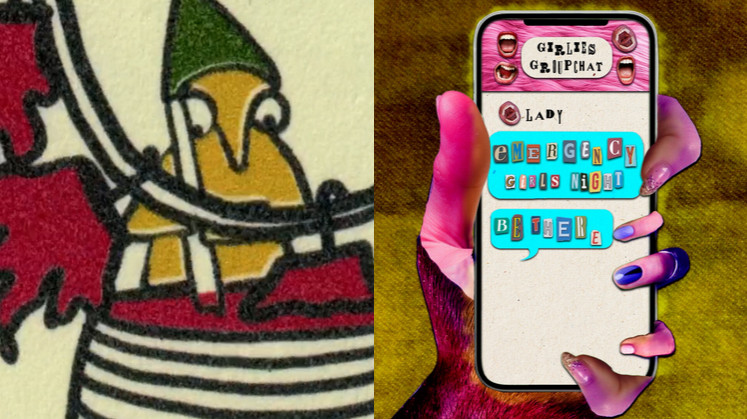
WILMINGTON — Two short animated films exploring distinct and uncommon styles will be available for viewing at this weekend’s screenings at the Cucalorus Film Festival.
Directors Ashley Sengstaken and Kate Renshaw-Lewis each have shorts showcased during the five-day festival. The films embody movement and physical form, and capture what the body is capable of doing and creating, from fruit harvesting to dancing.
READ MORE: The local flair of Cucalorus: 7 films highlight Wilmington, UNCW talent
ALSO: Women behind Gibson’s legendary wartime guitars: ‘Kalamazoo Gals’ hits Cucalorus
While both shorts screened Thursday, they will have repeat screenings for viewers who missed them the first time. Renshaw-Lewis’s film will screen at Jengo’s Playhouse at 1:30 p.m. on Saturday and Sengstaken’s will show on Sunday at 10:15 a.m. at Thalian Hall’s main stage and
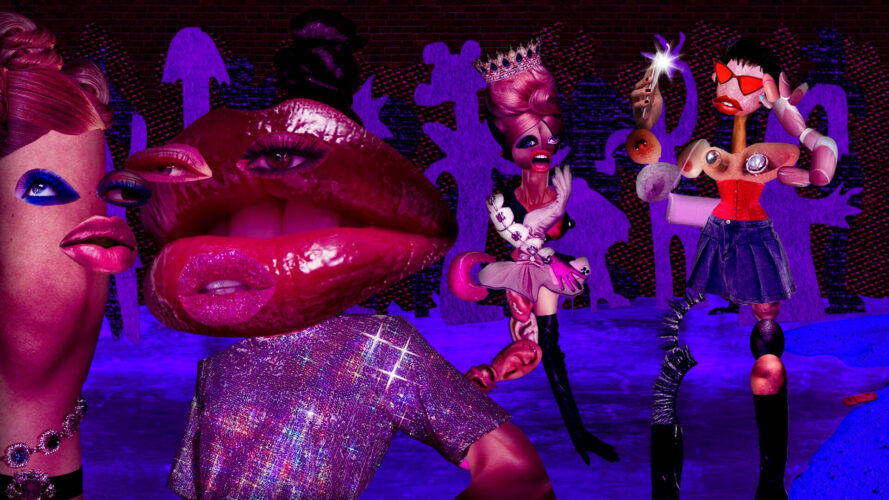
“Girls Night Out”
Thalian Main, Sunday, Nov. 23 at 10:15 a.m., tickets found here.
“Girls Night Out” romanticizes a journey many girls experience — getting ready for a night on the town.
The short starts with a nameless main character watching the series “Suits.” Her friend has been dumped and the main character receives an S.O.S. text to help lift her friend’s spirits. After undergoing what can only be described as a magical girl transformation, with a sparkly outfit change and a Trixie Mattel inspired hairdo, the main character joins her friends out in the town.
“The theme I’m always exploring — which comes through visually — is girly and grotesque,” Sengstaken said. “I am really in love with femininity. I’m really influenced by drag level worship of femininity.”
The plotline was inspired by Sengstaken’s own experiences one night when she and her friends went clubbing, in order to help a pal through heartbreak. It was the summer of 2024, with the rising stardom of Chappell Roan and at the height of Brat Summer. This period of time has been categorized as the summer of partying because of the Charli XCX album, and it also happened to be when Sengstaken and her friends went drinking in Los Angeles.
Sengstaken said she wanted to make a film that captured the chaos of being a girl in your twenties in a world heavily influenced by a push towards conventional beauty. She commented on how she and her friends, like the character in the film, wanted to go out without feeling the impending doom that is the end of another phase of girlhood and youth — or “getting old.”
“It’s the future catching up to you for just a split second,” Sengstaken said, indicating there is already pressure on young girls to fit into a mold of perfection. “I saw 30 around the corner and I was like: ‘I think this is the last time this is going to feel as good as it does.’”
While full of sparkles, fur, and the color pink, she described her work as “weird” and “gross,” but that was what brought her to Cucalorus to begin with. Sengstaken was in need of a refuge.
Sengstaken is a self-taught 2D artist and animator, and relied on collage art to create the characters and setting. The characters’ body parts are made from magazine cut-outs; more specifically, Sengstaken used “desirable” parts — ears, noses, hands, for instance.
A visual artist for a decade, Sengstaken said the idea for the main character came to her before she even started the short film, while designing a poster.
“Girls Night Out” is her first animated film, which took a year to create and clocks in at 3 minutes 28 seconds. The only budget Sengstaken had was whatever she could afford monthly and that usually did not stretch beyond $60, spent on an Adobe subscription for access to Photoshop and After Effects programs.
Sengstaken said the goal of the film was to make going out less scary — something she said she experiences because of presumed judgement. She noted there is an inherent feeling of all eyes being on women in their youth when they’re out with friends, which also comes with the pressure and need to look perfect.
“When I get ready to go out, it’s a lot of being aware of myself and focusing on what society has determined are our flaws,” she explained. “There’s a lot of unavoidable comparisons I do, and I know a lot of my friends do. So getting dressed can feel dark and scary sometimes.”
In the film, the main character and her friends alternate between breaking it down on the dance floor and breaking down on the curb, cigarette in hand. It showcases how chaotic but also how freeing going out drinking and cutting loose with the girls can be. The fleeting lifespan makes it all the more bittersweet.
The short film begins to close at the dialogue of the friends discussing how old they feel, or rather, how they are getting too old to keep partying the way they used to. Sengstaken explained having a rose-colored view of that night, which is what she hoped to capture in the animated short.
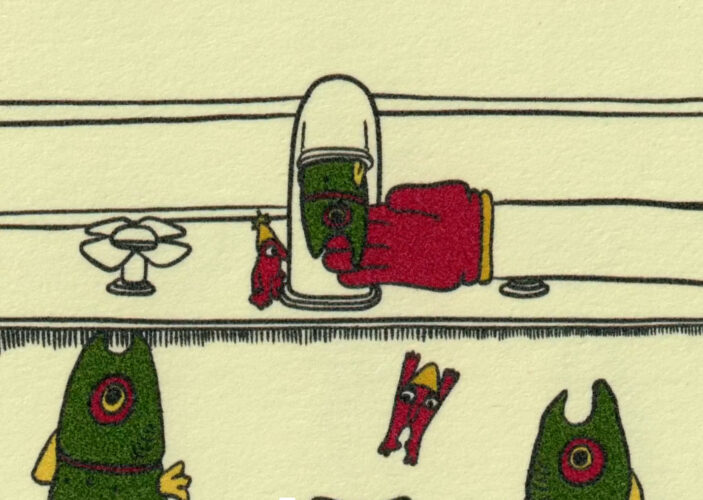
“Busy Bodies”
Jengo’s Playhouse, Saturday. Nov. 22 at 1:30 p.m., tickets found here.
Renshaw-Lewis also explores movement in her new animated film “Busy Bodies,” but to a much different degree. The film tackles themes of overconsumption and provides a more whimsical answer to the question of where our day-to-day items come from.
“Busy Bodies” opens up with an almost egg-shaped timer being turned on by a little creature at the top of a set of stairs. The scene shows the creatures taking lemons from nearly-amorphous trees and carrying them to an assembly line. At the end of the assembly line is an omnipresent hand, not attached to any distinguishable body or person and representative of society’s frequent ignorance or thoughtlessness towards the things we use, often daily.
The objects being created and passed along assembly lines were products that Renshaw-Lewis saw as being mundane — everyday commodities that people didn’t often think about. She chose to focus on rubber gloves, lemons, and fish.
“They’re just around; they’re under the sink,” she said. “But how do we get them?”
Renshaw-Lewis commented how the glove assembly line under the sink was inspired by the Rube Goldberg machines, which are elaborate contraptions made to complete simple tasks — such as making or squeezing oranges for homemade juice. The little creatures under the sink operate their own machine just to give a glove over to a floating hand.
Above the counter, fish can be seen coming from the faucet as the little creatures, each colored differently and wearing varied uniforms, cut the fish into cubes. They then wrap them up and march them down the countertop.
The filmmaker expressed the importance of cohesion in her messaging; not only do the creatures work efficiently and in sync with one another, but they look similar and match the objects they’re assembling or delivering.
“The decision to color the workers was to keep the scene interesting,” she said, “but also keep them in the same family, so they’re seen as cohesive and part of a greater machine.”
Renshaw-Lewis said she wanted the color scheme to be limited to green, yellow, and red, also in part because her method of animation was so time-consuming. Renshaw-Lewis created her film using screenprinting, which she does manually. It involves transferring designs by pushing ink through mesh.
“It came about because I was working with screenprinted animation in short form — shorter than 5 minutes, about 30 seconds,” she said.
The method of screenprinting animation was what inspired “Busy Bodies” to begin with, though she hadn’t ever created a full short film using the technique. Renshaw-Lewis spent three months conceiving the story, though the film took a year to create.
“I was just thinking a lot about process and thinking about what else is something that we’ve accepted but is almost absurdly inefficient,” Renshaw-Lewis recalled. “For me, that was the factory method for production and overconsumption of items.”
The idea of the tiny creatures living in the backyard or cupboard stem from her love of the surrealist notion of hidden worlds. The hidden world in “Busy Bodies” is that of product manufacturing and factories — like forgotten-about workers and hard laborers.
Renshaw-Lewis enlisted a team of four people to help her make the film; she received a $6,000 budget from Ackzilla Entertainment production company and the Museum of Jurassic Technology.
Arius Ziaee did the digital coloring, and Ziaee, Renshaw-Lewis, and musician Alex Edgeworth all contributed to the music and sound production. The film was produced by Eric Ackerman, and Shane Vincent did the sound mixing.
Renshaw-Lewis said they went to the Vintage Synthesizer Museum to play synthesizers for about two and a half hours to record for the film. Renshaw-Lewis played the clarinet, harmonium, and keyboard for the soundtrack. The music is cartoonish and brings life to the short film, which lacks dialogue but is driven the score and sound effects.
The film ends with the assembly line losing a worker, which breaks down the production line and highlights the importance of the individual creator. The creature walks off to go to a different assembly line, watching the lemons get harvested from the sideline. The machine slowly starts to devolve, colors shifting off of the lineart, the lineart going away altogether, and the scenes double in speed.
“Then there’s a reflection back to the scene that started the breakdown … in that scene, the giant red hand appears and turns the worker to make sure they keep working,” Renshaw-Lewis said, indicating that the hand, or society, only gains awareness of the manufacturing system when something or someone falls out of line.
Though she doesn’t plan to return to this story, Renshaw-Lewis is currently animating another film — hand-drawn instead of screenprinted next time around. It also will be financed by Ackzilla Entertainment.
[Ed. note: Change was made to include The Museum of Jurassic Technology as the other company to provide the budget for “Busy Bodies.”]
Have tips or suggestions for Emily Sawaked? Email [email protected]
At Port City Daily, we aim to keep locals informed on top-of-mind news facing the tri-county region. To support our work and help us reach more people in 2026, please, consider helping one of two ways: Subscribe here or make a one-time contribution here.
We appreciate your ongoing support.
