


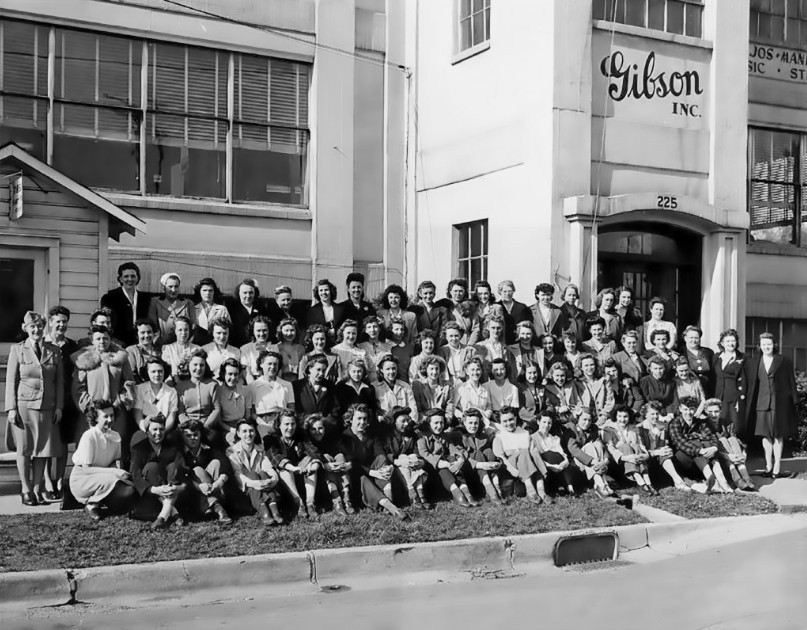
WILMINGTON — Filmmaker David Massar didn’t plan to make a documentary when he joined writer John Thomas on a research trip to Kalamazoo, Michigan. He just brought a camera. What he found was a largely forgotten piece of American musical history — one built by women whose work had gone unacknowledged for decades.
READ MORE: The local flair of Cucalorus: 7 films highlight Wilmington, UNCW talent
ALSO: What shapes Southern foodways? ‘German Soul’ explores family lineage, African-American roots
The material eventually became “Kalamazoo Gals,” a 17-minute short screening at Cucalorus, Saturday, Nov. 22 at 10:15 a.m. at Jengo’s Playhouse. The film outlines how Gibson’s wartime “Banner” guitars — highly valued for tone and craftsmanship — were assembled by more than 70 women during World War II.
Massar’s involvement in the project grew out of conversations with author and music journalist John Thomas, who uncovered the story in his 2013 book “Kalamazoo Gals: A Story of Extraordinary Women & Gibson’s ‘Banner’ Guitars of WWII.”
Massar has spent decades working at the intersection of documentary and narrative filmmaking — directing episodes of “Unsolved Mysteries” in the 1990s and later balancing feature-film production work with independent documentary projects. He joined Thomas on the trip to Kalamazoo to explore whether the story could translate to film, bringing a camera to capture interviews and the old Gibson factory.
Speaking with Port City Daily, Massar said the project advanced spontaneously.
“I didn’t go in with a plan,” he said. “I was just shooting as things happened, and the story started revealing itself.”
Released in February 2025, “Kalamazoo Gals” has already screened at more than a dozen festivals, collecting six awards on its yearlong run including Best Short Documentary at the NYC Indie Film Awards and Best International Documentary Short award at DOC LA.
The trip to Michigan gave Massar an on-the-ground connection to the story Thomas had unearthed, noting the chapter of the company’s history with women creating these guitars remained largely unacknowledged for decades. As the war accelerated and labor shortages hit manufacturing nationwide, Gibson hired local women to staff the line and continue building guitars.
Massar said the women’s experience in textile jobs — some of the work most available to women in the 1940s — gave them unusually refined hand skills suited for precision work.
“They had very well-developed small motor skills from sewing, needlepoint, and other work of the era,” he stated. “John’s theory, and I agree with him, is that with their sensibility they just brought a little bit of finesse to the process.”
Banner guitars — identified by the headstock decal noting “Only a Gibson Is Good Enough” — are now among the most coveted vintage acoustics. Collectors cite strong tonal projection, balanced resonance and unusually consistent build quality across the wartime years. Depending on the model and condition, market prices for Gibson Banner guitars range from about $5,000 to more than $20,000 — a sharp jump from the original 1940s retail price of roughly $50.
During his research, Thomas analyzed dozens of Banner guitars, even X-raying instruments to compare internal construction across the wartime years and figure out the secrets behind their beloved sound. The X-rays showed consistent bracing patterns and clean internal joins, signs of careful workmanship.
Massar also gathered footage during a trip to AmericanaFest in Nashville, where Thomas was speaking about the book. Musicians such as Tommy Emmanuel and Jennifer Nettles picked up Banner guitars, playing and reacting to them on camera, offering some of the film’s most candid moments.
“All of the Nashville material you see in the short — the opening sequence, the interviews, Tommy Emmanuel playing in the music store — was shot spontaneously while we were there,” he said.
Despite the instruments’ reputation, the women who built them disappeared from Gibson’s official record. For decades, the company maintained wartime guitar production had paused and only a few men too old or exempt from military service remained on the line.
Thomas’ research contradicted that narrative, revealing employment records, photographs, factory ledgers and oral histories showing the women staffed the acoustic line through the war. Massar said he and Thomas suspect cultural attitudes shaped the company’s version of events.
“It was a very misogynist culture back in the ’40s,” he said. “Women weren’t considered luthiers, and guitar building was viewed as men’s work.”
While Gibson historically downplayed the women’s role, the company has more recently reengaged with the true story — even sending Stearns a video message for her 100th birthday.
During the Kalamazoo visit, Massar and Thomas met with Irene Stearns, who worked at the Gibson factory during the war and is believed to be the only surviving Banner-era employee. Stearns was 100 at the time of the interview and her recollections anchor the film in firsthand experience.
For Massar, the historical omission of women like Stearns underscores why the project mattered. He said stories like the Kalamazoo Gals risk being lost without active efforts to document them.
“Their contribution to something special like this was erased from history,” Massar said. “It’s very important to put a spotlight on people who were not acknowledged.”
He hopes Cucalorus audiences leave Saturday’s showing feeling energized rather than discouraged.
“I want people to feel positive and inspired to make change and do their best. If this sparks that in any way, that would be ideal.”
Have tips or suggestions for Charlie Fossen? Email [email protected]
At Port City Daily, we aim to keep locals informed on top-of-mind news facing the tri-county region. To support our work and help us reach more people in 2026, please, consider helping one of two ways: Subscribe here or make a one-time contribution here.
We appreciate your ongoing support.
