


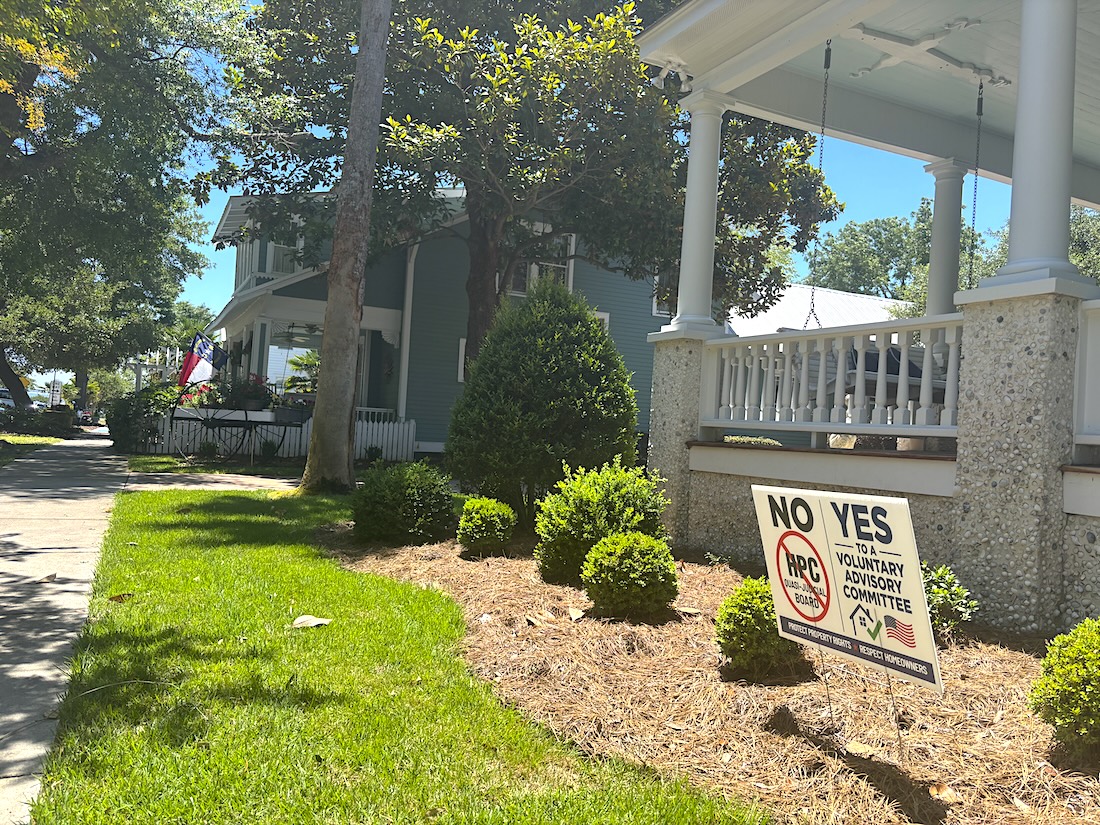
SOUTHPORT — The Southport Historic Preservation Committee has completed its three-and-a-half-year effort drafting regulations for a potential historic overlay district in the city, but one group of residents have considered legal action should it pass an aldermen vote. However, this week the mayor suggested the commission revert from quasi-judicial to a voluntary committee and for the rules to also become discretionary, though no vote has been made to solidify the action.
At a June 2 public hearing — with dozens of residents sporting red T-shirts with “Protect Property Rights” and “No HPC” scribed on them — resident Bob Gardiner reminded aldermen and city staff about a piece of mail they may have received last fall, strongly opposing the overlay district. He and a group of residents with homes in the historic district had their attorney, Samantha Richardson of Narron Wenzel P.A., send the city’s legal representation, Brady Herman, a “cease and desist” regarding further discussions on the historic overlay standards.
“In the event that these new standards are passed, then property owners in the District will file a lawsuit and seek to immediately enjoin enforcement and declare the same void as a matter of law,” the letter states.
READ MORE: ‘Not trying to regulate you to death’: Southport Historic District Overlay receives mixed support
ALSO: Southport budget: Aldermen debate tax-rate increase, employee benefits, park and recs cut
On behalf of her clients, attorney Richardson maintained new restrictions would run afoul of state downzoning mandates — specifically session law 2024-57, passed by the North Carolina General Assembly in Senate Bill 382. The provision restricts any government from making changes that decrease development density or restricts use of a property without written consent from owners.
The letter cites examples in the overlay district’s document of “new restrictions on building height, materials, and appearance” that would negatively impact future use of commercial and residential properties.
Though Southport is on the National Registry of Historic Places, it doesn’t have regulatory standing for its historic district. It established an Historic Preservation Committee in 2022 to work on a 100-page document outlining district standards and how major alterations to historic district properties would need approval via a public hearing, conducted much like a court proceeding and only people with standing could present expert evidence and testimony.
The document outlines big changes to a property requiring a hearing include new construction, alterations, additions more than 144 square feet, relocation or demolition of a home. It also includes changing the roof, walls, foundation, 50% or more of historic siding, or adding a porch, storm doors and windows, and removing character-defining utilities like chimneys, among other items. These would go before the HPC for approval.
Minor changes include removal of stone or brick on terraces, adding or removing water features, taking out heritage trees, altering lighting, and adding in gutters, among other items. City planning staff would review these for approval, but no application could be denied without HPC action.
If approved, the historic overlay would include 386 parcels, the majority being dwellings; properties in the yacht basin aren’t included. That means any property in the mapped-out area would have to follow regulations the HPC has been drafting the last few years.
The current city zoning map and building code would remain the same for affected property owners, but an approved overlay would strengthen restrictions to some exterior changes made to a property. It also would require applying for a certificate of appropriateness if vast changes indicated altering the building’s historic character or could cause damage to historic materials.
Even if the rules pass, properties would be grandfathered in and their owners wouldn’t be required to update their homes or businesses to be in compliance with new regulations.
Richardson’s letter to the city expressed concerns this could create nonconformities, thus devaluing properties. For instance, if a property is noted as nonconforming, even if grandfathered in with old regulations, an appraiser can note this status making properties harder to sell or finance.
“It would be our position that adoption of the Preservation Commission’s recommendations in full is a violation of North Carolina law and, in certain circumstances, be considered a regulatory taking that would entitle a property owner to damages,” the attorney’s letter adds.
Southport spokesperson ChyAnn Ketchum said the city has not responded to the letter. Upon Port City Daily asking for a reply to accusations of the HPC misaligning with downzoning laws, a comment wasn’t provided. The aldermen also did not respond with their thoughts regarding the letter by press, nor did attorney Richardson on behalf of the residents.
The HPC design standards and regulations in Southport were finalized in April. Last month, Mayor Joe Pat Hatem held a town hall and residents had another chance to speak out at an early June public hearing. Almost 100 voices from both events, if not more when including those who wrote in, have offered input. The majority on June 2 were against the move.
Nearly every speaker, on both sides of the aisle, expressed support for preserving Southport’s historic character. The disagreement centered on whether a historic district overlay and Historic Preservation Commission are the right tools to get there. Signs have peppered lawns in the historic district suggesting a voluntary committee be instituted instead.
Gardiner, who lives on Caswell Avenue, claimed the rules were put forth out of unjustified fear: that someone would move into the fast-growing region, particularly Southport’s historic area, and build a modernized home that doesn’t fit the district’s mien.
“That’s the thought of a few who want to needlessly regulate those already living there,” Gardiner told the aldermen on June 2.
Many opponents cited government overreach and called the standards too restrictive, with terms like “compatible” and “congruence” often used in upholding historic character but being subjectively defined according to the eye of the beholder. James Carroll took up this notion when talking about a renovated apartment he did on Howe Street last year. Carroll said he added cornice, trim, half columns, painted masonry and even a porch, which most would be disallowed if the regulatory document was in place today.
“That’s 90% what we did to the building,” Carroll explained. “Congruence is both legally and practically impossible to prove with certainty. There is always subjectivity; congruence will be according to who is voted to the Historic Preservation Commission. … And after a first legal appeal or challenge, it will be more rigid over time because the city will be scared of potential liability. So the standards will be to protect the city legally and congruence will have nothing to do with it.”
His wife, Betsy, told aldermen she thought the overlay district created a solution to a problem that didn’t exist, particularly when looking at the history of families and their generational descendents that have upkept properties in the region for more than 100 years without government input. Betsy called out the Dosiers, Herrings, Harrelsons, Spencers, Davises — more so, she did not think the government should act as a homeowners association to enforce rules.
“The town has survived because it meets the demands of its people,” she added, “who know the difference from shared community value and government mandate.”
Gwen Tanner owns Mad River Design Studio and Store, a 30-year company that has done many renovations on the area’s historic properties. She said the business has been successful due to voluntarily keeping up with the spirit of Southport — “not because we had to comply with a set of rules.”
Tanner believes HPC guidelines are too restrictive without allowing for “practical creativity” and embracing the historic charm Southport has become well-known for.
Kathy Cabrall, who lives on W. West Street, asked who exactly would be ensuring appropriateness of character and interpreting the document fairly. Would it be attorneys? Or the quasi-judicial members, not voted on by the public?
Resident Gabriel Zato of North Atlantic Street further worried how some historic commission members also are city employees. The HPC is chaired by the fire chief, Charles Drew. While Zato was clear he didn’t question Drew’s integrity, he did ask about the quagmire it could put the city in when to it comes to perception from taxpayers.
“The board structure creates a risk of appearance that undermines the process,” Zato said. “Active city employees who serve in decision-making or leadership roles on quasi-judicial boards blur critical lines between staff and a judicator. Even if no improper conduct occurs, it creates a situation where the same individual has operational or enforcement responsibilities tied to the outcome. He is representing the interests of the city instead of as an independent decision-maker.”
From Zato’s point of view, separating a resident’s request for building and modification changes from the town’s utility, emergency needs or access may overlap, even if as an implicit bias.
Not everyone at the public hearing was against the district. Bonnie Bray, who has run for an alderman seat and formerly served as Southport’s finance director, is an HPC member. She pointed out only 20 pages out of 100 center on rules and 18 categories consist of routine maintenance that don’t even require a homeowner to engage staff to make changes.
“Read the minutes, there are no incidents of staff being incompetent,” she added, pointing to a common complaint throughout the public hearing, as well as another refrain: the commission consists primarily of people who don’t live in the district.
Bray defended the board, saying at the beginning of its formation some were living in the historic district proper. Though, amid Bray’s 3 minutes at the lectern, people from the audience shouted back noting it wasn’t the case anymore.
One was Larry Cabral, who took to the dais at the aldermen’s June 11 meeting to publicly apologize. Cabral told the local leaders: “I disregarded your request for decorum and civility. I publicly apologize to Mrs. Bray for defending her position, which she had every right to do.”
There have been many remarks made throughout the last year or so on the historic overlay district and adjoining rules that its implementation was effectively dividing the city. One came from Bonner Herring, a multi-generational Southport resident on the HPC board, but thought the rules only represented a handful of people and the majority’s concerns were being overlooked.
“Why not use them as just a guide?” Herring has said of the document, adding heavy-handed regulations mandated on another person’s piece of land isn’t part of Southport’s DNA, “which is to be free-spirited.”
Representation, Gardiner told the aldermen during the June 2 HPC public hearing, mattered.
“This is a committee of unelected citizens to hold judgment over other people’s property,” Gardiner said. “This is wrong. If some aldermen are not moved by the clear majority of citizens speaking out and not listening to the will, it falls short of trust they gave.”
Making the Historic Preservation Committee all-voluntary
Though the historic regulations, commission or overlay district were not on June 11 aldermen’s agenda, Mayor Joe Pat Hatem decided to address it at the opening. He called out many familial names that have become synonymous with Southport, as well as addressing every speaker during the mayor’s town hall and public hearing.
“I hear you,” Hatem said. “This board hears you.”
The mayor recognized the majority of speakers in recent months were against the district and wanted alternatives. He announced the Historic Preservation Commission would move forward as an all-voluntary advisory committee, not a quasi-judicial board.
“Historic preservation is still a major focus for our city,” Hatem said Thursday. “But the method is not agreed upon. I believe we have a compromise in which we can move forward and allow the city staff and HPC to revise the present documents so citizens will have guidelines to help them, if they so choose.”
Hatem also pointed to Senate Bill 1047, a regulatory reform act, moving through the North Carolina legislature. It states an historic district can only be put in place if 50% of those living in the district request it and a local government must adopt by a three-fifths vote. Though the bill hasn’t passed and is in the Senate Committee of the Judiciary, Hatem took notice.
“I’m estimating tonight that if that vote was taken today, under the new guidelines as an historic voluntary committee, that it would pass by more than 50% easily,” Hatem said. “That is where we are; give us time to bring it forward. Your input will be there.”
Resident Cathy Cabral thanked the aldermen during June 11 public comment for making the commission voluntary: “I look forward to seeing the revised guidelines.”
However, resident Siegfried De Smedt, sporting a red shirt that’s become a visual stoplight for the historic overlay, wanted the move solidified. He said without a vote, it’s “empty words.”
“I hope tonight we can put those words into action,” De Smedt said. “Have a vote that you are dismantling, abandoning the HPC and that you are replacing it with a voluntary group of people who care for Southport. But if you don’t vote tonight for the promise you made this evening. It’s just hollow words. Can we move beyond the phase of hollow words and promises?”
Shortly thereafter, Alderman Rebecca Kelley put a motion on the floor before the board got into their weekly agenda items. She asked to add HPC for discussion.
“Mr. Mayor,” she said, “based on what you said earlier about the HPC, I would love for us to add it as the first item on the agenda to formalize what you said and have a vote to send it back to staff for guidance and back to the HPC for the new guidelines to come forward to us again.”
It was seconded by Marc Spencer.
“We can’t just forget the fact we have an ordinance establishing something,” aldermen Lowe Davis said, noting they had to follow a process to dismantle the HPC ordinance and start anew.
Alderman Robert Carroll wanted to call the vote about adding it to the agenda, but said the board could just ask the city manager “without doing any of this.”
“The motion was to add it to the agenda and then to dismantle it,” Hatem said, to which Kelley corrected him.
“It’s to give guidance to staff,” she repeated.
Alderman Paul Gross chimed in about the committee working on the document for three-and-a-half years and having received ample public feedback. Gross counted 62 comments at June’s public hearing being an “80/20 no,” he said. The alderman agreed with De Smedt about formalizing the process and voting to reject the document in its current form.
Carroll said the agenda was already packed and requested calling the vote again. Hatem prompted a raise of hands about adding HPC as the first agenda item, to which Gross, Spencer and Kelly agreed, while Davis, Carroll and Karen Mosteller voted no, with Hatem breaking the tie.
“Guidance has been given to staff,” Hatem said. “We’re going to revise our term paper, not shred it, and if you can’t believe me, well, that’s on you — that’s not on us. We are going to give staff time to revise it and bring it back.”
Port City Daily reached out to the aldermen, mayor and city to ask when and if a vote could happen in the future. A spokesperson for the city responded the aldermen are “still working to review all options related to an advisory committee” and would have to vote to change the ordinance, but a date hasn’t been decided upon.
At Port City Daily, we aim to keep locals informed on top-of-mind news facing the tri-county region. To support our work and help us reach more people in 2026, please, consider helping one of two ways: Subscribe hereor make a one-time contribution here.
We appreciate your ongoing support.
