


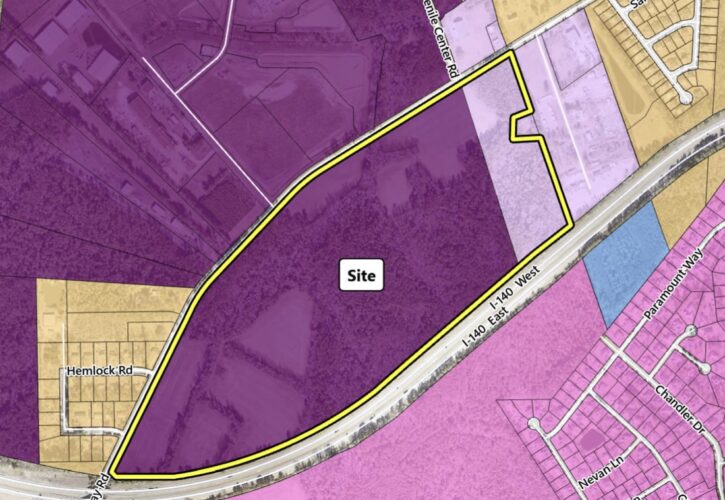
NEW HANOVER COUNTY — A large swath of land, near I-140 on Blue Clay Road, could become residential units after commissioners approved a rezoning earlier this month.
READ MORE: 60-unit development rezoning approved in Surf City to help business growth
ALSO: Traffic, flooding concerns stall 200-home Brunswick County project
On Nov. 3, Cape Fear Development, along with town staff’s Senior Planner Zachary Dickerson, gave a presentation about rezoning the 3100-4200 block of Blue Clay Road from an industrial development zone (I1 and I2) to a residential multi-family, low-density zone (RMF-L). The 108 acres at the center of rezoning is part of a larger 814-acre tract.
The proposal passed 4-1. Commissioner Stephanie Walker dissented because of the lack of site plans, though they’re not required for straight rezoning approval and don’t require conditions to be set forth.
One of the biggest gripes from those who spoke against the project was the lack of foreknowledge about what would be developed on the property. Senior Vice President of Cape Fear Development, Mike Brown, said it would not be cost-efficient to have completed site plans this early in the game.
“On 108 acres, the reality is: To develop this property out thoughtfully and over time, would probably take five to 10 years,” he said, surmising it would cost around $400,000 to do the planning, studies, a traffic impact analysis, etc. “Only to come in and figure out if you get the rezoning or not. You are at risk of [losing] hundreds of thousands of dollars.”
Cape Fear Development is behind projects like Autumn Hall, Proximity, Hudson Renaissance, and Riverwood Apartments. It’s also part of the public-private partnerships with New Hanover County Government for Project Grace and the government center, which includes building luxury apartments called “Proximity Government Center” next door.
The development needing commissioners’ approval will be located near Blue Clay Business Park and Trask Family Farms. The goal is to provide a variety of housing types, from single-family to multi-family detached homes, row-style houses to duplexes to townhomes.
Commissioner Rob Zapple originally opposed the project, but eventually favored it due to its flexibility within the housing market.
“My first thought was: ‘Oh my God — a series of huge apartment buildings there!” Zapple said. “That’s not what I’m hearing.”
Brown said there are no plans currently to build condos, like Cape Fear Development did with The Proximity in Carolina Beach, though it is permitted under the RMF-L zoning, so developers could choose this option. There wasn’t any discussion about the number of buildings, bedrooms, layout or design, nor were the total units determined. But the maximum allotted for the zoning is 1,080; however, the project intends to fall under. The maximum height allowed in the district is three stories.
Walker had concerns about flooding in the area, given the block consisted of some wetlands and swamp forest that were hundreds of years old. According to the UDO, a project containing 5 acres or more of the swamp forest or pocosin wetlands must have additional buffers and be conserved.
“I know we need housing,” Walker said. “I just want to say that out loud. I know we need housing, but if it’s going to come at the cost of potential flooding and things like that, that does concern me.”
Brown explained the stormwater basin would be a series of smaller ponds instead of one large one. A ditch system currently in place will be supplemented with the stormwater program to modernize it and a water pump also would be on site.
He added the developers are prepared to improve the water runoff situation for nearby residences.
Brown assured the project would include greenspaces, a walking trail, and provide an easement for a nearby cemetery.
“We pride ourselves on low impact, or giving considerations, to the land around us and honoring the trees and the green space,” Brown said. “A key component of the efforts has been making sure each community is complimentary to the natural environment and has functional outdoor spaces to help us create an authentic sense of place and high quality aesthetic.”
Nadine Brimage was one of two people who spoke at the meeting against the development. She was concerned with Grady Cemetery, particularly when it came to privacy of people visiting and proximity to the development.
Brown assured the developers have already spoken with the family who owns the cemetery and confirmed the easement was agreed upon to ensure adequate access. The development would not encroach.
She also was wary over the development infringing upon the wildlife and nature in the area, explaining how the 3100-4200 block was home to hawks and wild turkeys, and Venus flytraps, trumpet flowers and vines.
“You’re getting rid of all that environment that is native to North Carolina, which makes it North Carolina,” Brimage said.
Adrianne Garber also spoke against the development and asked why the proposal couldn’t be a conditional zoning. A conditional zoning would allow commissioners and the planning board to put restrictions on developers to follow. It would also mean that nothing outside of what was originally proposed would be developed; there would have to be an entirely new and additional proposal to make changes.
Brown said Cape Fear Development wouldn’t have as much flexibility to develop different kinds of housing units if they did a conditional rezoning.
Dickerson explained staff would have preferred the conditional rezoning, but it was ultimately the developer’s decision which zoning to seek. He added the current rezoning proposal was compatible with the CAMA Land Use Plan from 2016.
Garber called the plan outdated due its passage in 2016, blaming it for overdevelopment countywide.
“The schools in this area are already over capacity,” she said, as at build-out the development could generate just over 200 more students. “The applicant should focus on the current zoning for the lot. They could build a facility that creates jobs for our community.”
Garber spoke at October’s planning board meeting, too, wherein the seven-member board, absent of three votes, approved the proposal 3-1. Planning board member Clark Hipp was the only dissenter, stating he was uncomfortable with the lack of information on design plans and lack of community input. There was no community meeting, according to Hipp, normally required of conditional rezoning applications but not of straight rezoning.
Traffic impacts also concered Garber, which she presented to both the planning board and commissioners. She thought Blue Clay Road would be inundated with vehicles due to the development and pre-existing residences and businesses, as well as the proximity to I-140. North Carolina Department of Transportation traffic volume maps along Blue Clay Road from I-140 to North College Road show roughly 7,400 vehicles travel there daily.
Based on the maximum number of units allowed under the RMF-L zoning, traffic was estimated to be around 358 trips in the morning and 485 trips in the afternoon and evening, according to Dickerson’s presentation. This is less than the current zoning could bring in: 627 morning and 552 evening trips. Brown noted the site plans will require a traffic impact analysis to be completed.
As part of the rezoning request, commissioners also agreed to remove the SHOD designation. Projects that fall in SHOD — or Special Highway Overlay Districts — follow a set of extra rules and regulations when it comes to landscaping and construction along major roads and highways. The current development is near I-140, meaning it falls into the overlay district.
Concerns were raised over landscaping setbacks affecting the scenery from Blue Clay Road and I-140. Its removal can create aesthetic inconsistencies and make traffic flow harder to control, as SHOD creates cohesion. Brown explained removing SHOD requirements ushered in more flexibility when it came to innovative designs, technology improvements, and the like, though developers still adhere to the county’s UDO and land use plan.
Despite reservations, the motion to approve the rezoning passed.
Commissioner Dane Scalise, who was among those that expressed satisfaction with the proposal, leveled with Brown.
“Mike, you got to do a good job. People are going to be mad if you don’t do a good job. I’m going to yell at you if you don’t do a good job,” Scalise said. “I know you will do that because I know you, and I know the people you work with … It isn’t just an opportunity to turn a buck, and I know you don’t think about it like that. Make a great product.”
Want to read more from PCD? Subscribe now and then sign up for our morning newsletter, Wilmington Wire, and get the headlines delivered to your inbox every morning. You can also sign up for our text club and get updates straight to your phone; text JOIN to 910-800-6397.
