


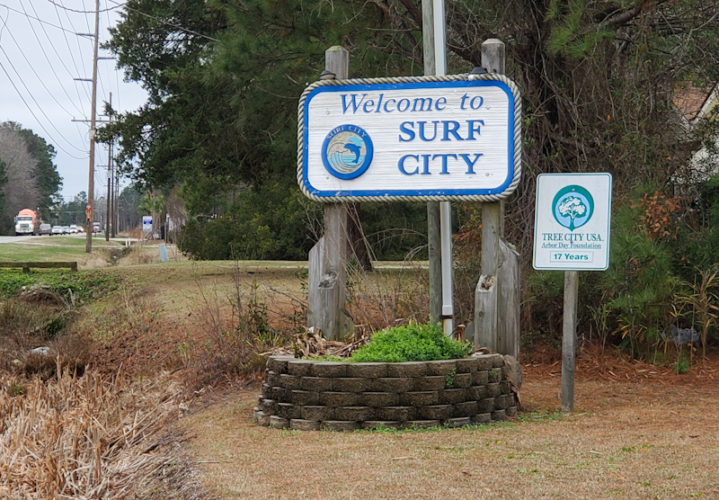
SURF CITY — More businesses are one step closer to setting up in Surf City in a recently approved conditional rezoning, though residents and council members alike shared concerns over the town’s sewage and traffic capacity.
READ MORE: Surf City welcome center rezoned ahead of proposed lease agreement
ALSO: Surf City hones approach to wastewater capacity between small and large developments
On Nov. 5, the Surf City Town Council approved the conditional rezoning of property at Dandelion Lane, located next to Cape Fear Community College’s north campus at 610 and 640 North Carolina Highway 210 E. The 8.42-acre property was zoned office and institutional and the developers requested it to become an extended commercial zone.
Council was unanimous in its vote to approve the rezoning; Mayor Teresa Batts recused herself because she stated she represents the developers as a real estate agent. The remaining five council members had questions regarding sewer capacity, traffic impact analysis and the type of businesses allowed to go into the development.
Owned by the Bennett and Bonnie Hunter Revocable Living Trust, the property is being built by Tidal Development Company, LLC. New construction will bring in 36 flex spaces and an additional 24 units to be used for commercial or office purposes. The site needed rezoning because O&I prohibits flex space units.
Flex spaces are designed to promote business development through multi-use buildings allowing for a range of businesses to co-locate. However, the extended commercial district does not allow for vape shops, bars, and tattoo shops, though dining establishments, clothing and accessory shops, and a daycare could all be part of the new project.
No businesses have been announced yet to go into the development.
According to Town Manager Kyle Breuer, the goal for the town is to promote job growth and diversify Surf City’s economy, currently reliant on tourism-based businesses.
“Having that flex space, I think, presents another opportunity for new jobs to be created that aren’t just specifically focused on the tourism industry,” Breuer said.
The property on Dandelion Lane is within the “job growth corridor,” he explained, off of North Carolina Highways 210, 50, and 17. Nearby are Surf City Brewing, a Dollar Tree and Starbucks.
However, some council members expressed concerns over traffic concentrating businesses along the routes.
“How many students are going to go through there per day?” Mayor Pro Tem Jeremy Shugarts asked in relation to the traffic concerns along Highway 210, with its close proximity to CFCC. “Knock on wood we don’t have any problems.”
The property’s current layout has only one space to enter and exit the lot — and could be strained with the possibility of more traffic incoming upon build-out, as well as CFCC students traveling for work and school. The suggested solution was an impact analysis and a possible traffic control plan, discussed with the NC Department of Transportation.
The developers are set to complete a traffic impact analysis, as their current plans require one to be presented when site plans return to council within the next year.
Town staff’s biggest issue was with Surf City’s sewage system and wastewater treatment capacity, currently at 760,000 gallons per day. In 2024, Surf City’s system treated 238 million gallons of wastewater.
“Because of their timing, by the time [the developers] get through site plan approval, the town may no longer have sewer allocation to issue for new developments,” Community Development Director Jeremy Smith said.
There is a waitlist for residential developments currently, but there is still availability, 72,000 gallons per day, for commercial projects, according to Breuer.
The town’s wastewater allocation, he said, is divided into three parts: residential, non-residential, and a reserve saved for special projects or economic development opportunities. While there is zero capacity for residential, the town’s reserve is 48,000 gallons per day.
The wastewater allocation policy, adopted December 2024, defines what percentage of the wastewater treatment capacity goes to residential, non-residential and reserve. For non-residential projects, such as the Dandelion Lane project, it can be no lower than 30% of the town’s total capacity, with residential not exceeding 50%.
Priority is given to non-residential properties with “quality development projects,” mixed-use development projects, and major employer industries. The Tidal Development project will fall in line by providing a wide range of diverse employment and business opportunities.
Though Tidal Development’s sewage needs have not yet been defined (to come with the site plan), developers will have to install a septic tank if the city is at capacity. The timing of the site plan approval may leave the project without sewer capacity.
Concerns over the septic tank were brought up by both council and the public last Wednesday, with Councilman Hugh Cannady concerned on whether the company would still be able to function properly and safely with a septic tank.
“That’s why I want to clarify: is there any concern of the town if this project did have to go on septic for a limited period of time that they wouldn’t be able to function in a safe and proper manner?” he asked.
Septic tanks do not have the same capacity as the public sewage system does, Smith verified to Port City Daily. Septic tank capacity has a state minimum of 1,000 gallons per day, but the capacity is otherwise dependent on what businesses are brought in. For instance, a restaurant may need a higher septic tank capacity, due to dishwashing needs, than, say, a clothing store or office space. All is yet to be determined.
Breuer described a septic tank as its own wastewater treatment option, but instead of going to an underground basin, like public sewer systems do, the treated wastewater goes into the soil.
Smith told council the septic tank was just a fallback plan for the developers, who plan to get the site plans secured before the sewage system is at capacity.
The last concern came from resident Teri Poplaski, who worried what would happen if the developers backed out of the project. She questioned if different, more undesirable businesses would develop there. Cannady assured Poplaski that wasn’t the case.
“If they back out and somebody picks it up and buys them out, they’re tied to that plan. If a gas station wants to come, they have to come [to town council] again and ask for approval for everything they have,” Cannady said.
The technical review committee — made up of professionals like the fire marshal, or representatives from the NC Department of Transportation representative and Pender County Environmental Health, for instance — will ensure the development follows all city codes and regulations. The committee will review the system’s design and whether or not the soil could absorb the treated wastewater.
Site plans are expected to be presented in 2026.
[Ed. note: The article has been amended to correct the spelling and pronouns of “Terry Paplaski” to “Teri Poplaski”.]
Have tips or suggestions for Emily Sawaked? Email [email protected]
Want to read more from PCD? Subscribe now and then sign up for our morning newsletter, Wilmington Wire, and get the headlines delivered to your inbox every morning.
