


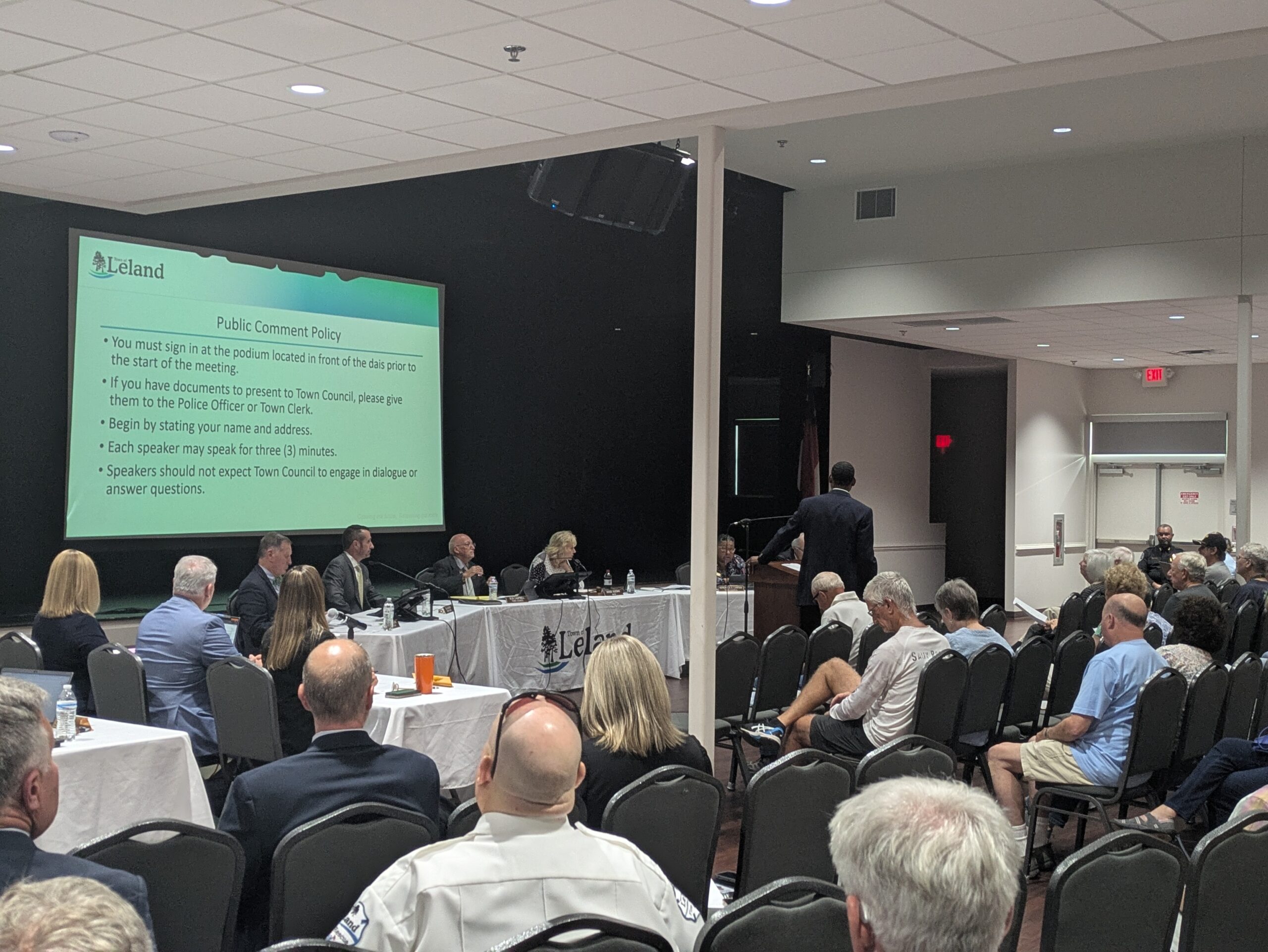
LELAND — A 1,400-acre development was at the center of discussion in Brunswick County’s largest town Monday evening, clearing the path for a mixed-use project drawing public debate. The Town of Leland held two public hearings: one for the annexation of 1,200 acres into Leland, and the other for the rezoning of the property.
READ MORE: Leland Town Council moves forward with Jackey’s Creek annexation
ALSO: 12,500-home community proposed for Brunswick County
“If I understood correctly, the purpose of annexation is so the developer gets to use the town of Leland utilities and resources,” resident Rhonda Florian said. “Well, why do we have to allow them to use our resources? Why should we, the current homeowners and tax payers of Leland, pay for these developers to come in and get to use our utilities? You know who is actually going to pay for that: It’s going to be us, the taxpayers, and we don’t want it. We don’t want annexation.”
Florian, who started Better Government 4 Leland in 2024 to speak out against the 17% tax rate hike the town council passed in 2024, was one of nearly 100 residents in attendance at the Leland Cultural Arts Center. The majority were in opposition to the Jackey’s Creek project. To be located off of Highway 17, near the intersection at Village Road, it will consist of 4,582-units, both single-family homes and apartments, as well as restaurants, offices, retail and a new school.
It’s not the first time Florian has been vocal about development of that acreage of land. She started a petition in 2023 against a proposed baseball stadium Leland was considering building there, in collaboration with the Texas Rangers. Florian’s petition garnered 2,500 signatures, though the project fell through.
Because Jackey’s Creek developers requested annexation at that time, the land was grandfathered in and doesn’t fall under the moratorium on voluntary annexations placed on the town in 2023 due to the passing of House Bill 267.
Regardless of speakers against the project, Leland Town Council unanimously approved both the annexation and rezoning requests for Jackey’s Creek development Monday. The council got the ball rolling for the project last week, by unanimously approving a sufficiency agreement, required by state statute when a developer requests an annexation.
Council member Bill McHugh explained he supported the annexation because, in the end, Jackey’s Creek Investors LLC could just as easily develop the property without it being in the town’s limits. Then it would essentially fall under Brunswick County’s jurisdiction, leaving them to make all the decisions.
“This is going to ensure that what goes there is better than what could go there,” McHugh said.
Also, the property is already within Leland’s fire district. Thus, with or without annexation, the town’s fire department would still have to provide services to the area, McHugh explained. He argued that by annexing into Leland, the future residents of Jackey’s Creek would pay the town for fire services they receive from the Leland Fire Department.
In addition to Florian, almost a dozen people spoke against the development with concerns centered on traffic, the environment, and flooding. Resident Gloria Kidd expressed frustration about congestion and frequent accidents along town roads. Although a traffic impact analysis for Jackey’s Creek is currently under review by town staff, Kidd expects the town’s roadways to be overburdened by the project.
“When I came here 20 years ago, this was a simple truck-stop community with lots of potential,” Kidd stated. “But in this short time, you have turned it into a chaotic, poorly designed town. What potential it did have.”
Speaking to the immediate impacts of the Jackey’s Creek development, council member Veronica Carter noted the project will be built in phases over the course of multiple years. Therefore its impact on the town’s infrastructure will not be felt all at once and give the town time to catch up to the growth through improvements.
Resident Suzanne Walker was upset over the potential environmental impacts. Walker was worried the property would be clear-cut, resulting in large-scale open-burning of trees affecting neighboring residents’ air quality. A tree survey has not yet been completed for Jackey’s Creek, but will be required in accordance with the town’s site plan review process.
“Breathing is imperative for all of us, and when you clear-cut these trees, you’re taking away people’s ability to breathe,” Walker expressed. “I want you to think about the future, I want you to think about your children, your grandchildren, and your grandchildren’s children.”
Only one resident spoke in support of the development. Joanne Levitan, who lives next to the site, said she favored annexation because the property would be developed according to Leland’s more stringent codes rather than Brunswick County’s less restrictive ones. For example, Leland’s ordinances require developers to adhere to a specific stormwater design manual, whereas the county relies on more general state and federal guidelines.
“It’s going to be built up anyway,” Levitan stated. “We are much better off being able to have the town of Leland control it than having Brunswick County control it and that’s what I’m in favor of.”
After voting for the annexation, the town approved rezoning the property into two sections with distinct uses. Approximately 928 acres of the site would be zoned as a planned unit development. This would be the primary area for single-family homes, apartments, day care centers, and senior living.
The other 512 acres would be zoned as a FlexCode area.
Levitan was also in support of the rezoning of the project, favoring the FlexCode due to its focus on interconnectivity.
This zoning approach emphasizes walkable, integrated communities rather than staggering commercial and residential uses without interconnection. By allowing a mix of single-family homes, apartments, retail, restaurants, and offices in close proximity, it intends to create a pedestrian-friendly environment where residents can easily traverse between shops and homes.
The FlexCode was brought in by the town in 2011 in an effort to modernize zoning practices. Leland’s Gateway District was zoned under the FlexCode in 2013, marking the first time its standards were applied to an area in town.
The zoning also was a central feature of council’s discussion and a key reason the rezoning request was approved. Both Mayor Pro Tem Bob Campbell and Mayor Brenda Bozeman favored it. Campbell noted he had not seen a previous project so committed to walkability and Bozeman praised the idea of residents living within walking distance of shops and restaurants.
The land owners’ attorney, Joe Taylor with law firm Murchison, Taylor and Gibson, spoke briefly on their goals for the project — Taylor was adamant it would be unlike any other community in Brunswick County. He added the development team has been working on the project for the last two-and-a-half years.
“What we’re presenting tonight is something entirely new, a different way of developing in Brunswick County,” Taylor said, noting the FlexCode zoning is at its “heart and soul.” “It’s an entirely different place that really values the property and tries to pay attention to the neighbors, the citizens, and the town.”
The Leland Planning Board will be discussing text amendments to FlexCode zoning during its meeting on Sept. 23. Some include establishing design standards for playgrounds, allowing spatial adjustments around heritage trees, and removing bedroom limitations for accessory apartments.
Though a site plan has yet to be presented to the community, the Jackey’s Creek developer will work with town staff to submit detailed plans for each section of the development. They will be assessed by the town’s technical review committee to ensure the development meets all ordinances and standards. Once the TRC approves the plans, the developer can apply for building permits to begin construction, a timeline yet to be revealed.
Have tips or suggestions for Charlie Fossen? Email [email protected]
Want to read more from PCD? Subscribe now and then sign up for our morning newsletter, Wilmington Wire, and get the headlines delivered to your inbox every morning.
