


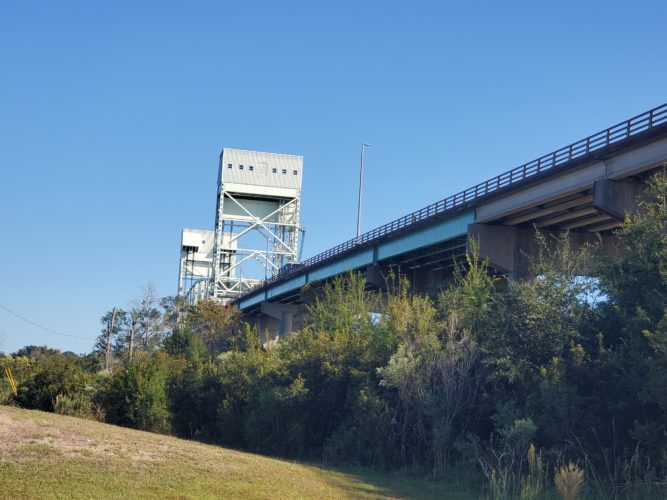
WILMINGTON — The countdown clock for the Wilmington Urban Area Metropolitan Planning Organization to decide whether the Cape Fear Memorial Bridge replacement will move forward as a tolled facility has been set to eight months.
In February, the transportation authority must vote to either withdraw the project — which would eliminate any state funding and planning for the bridge replacement — or consent to it being tolled. This deadline would give the WMPO and state enough time to get the project “shovel ready” by September 2027, a requirement to keep the $242-million federal grant.
The federal Large Bridge Grant, awarded in July 2024, is the largest funding allocation to the Cape Fear Memorial Bridge replacement. There are two options in contention: a 135-foot fixed bridge or a 65-foot bridge with a movable span that can open to 135 feet. Both options are estimated at $1.1 billion, more than double the estimated $450 million from 2024.
READ MORE: Tri-county transit sales tax explored to avoid CFMB toll, fund more projects
ALSO: 2 airport improvements are only local projects prioritized in NCDOT’s next STIP
The North Carolina Department of Transportation has allocated $85 million in its State Transportation Improvement Plan, passed in July 2025. Unless another funding source is identified, the only way to fund the remaining $773 million is through tolling the new bridge.
The February deadline was discussed in a June 22 meeting hosted by the Historic Wilmington Foundation, who has representatives on the bridge replacement project’s working group along with the WMPO, NCDOT, U.S. Army Corps of Engineers, U.S. Coast Guard and U.S. Department of Transportation.
“They have to finalize the grant agreement with the federal government, hit all their required deadlines, and request funding from the Federal Highway Authority,” Silvia Kochler, the foundation’s executive committee member, said in the meeting. “That would happen by September of 2027 and then they hope to award contracts to actually build the bridge by December 2027.”
NCDOT later confirmed this timeline was correct.
“The WMPO would need to continue to support tolling of the project for it to move forward to the next step, which is the completion of the Environmental Document,” a spokesperson told Port City Daily.
The document NCDOT referred to is an environmental assessment to evaluate the social, economic, and environmental impacts of proposed transportation projects. NCDOT told Port City Daily the assessment will include information on the project’s impacts to traffic, and the homes and businesses in the bridge’s footprint.
As presented at the Historic Wilmington Foundation meeting, the 65-foot movable span bridge — the design of the current bridge, but with additional lanes and a bike path — could be constructed in the existing bridge right-of-way.
The new 65-foot structure would be built beside the current bridge and maintain the same traffic pattern, where the off-ramp deposits onto Dawson and Third streets. Though because of the higher cost of parts for a movable span bridge, the bridge costs just as much as the 135-foot fixed version and will cost more to maintain.
The ramps of the 135-foot version would extend to S. Fifth Street. Kochler claimed NCDOT determined historic homes at the base of S. Second Street — previously thought to be in the NCDOT’s right-of-way acquisition footprint — would no longer be lost. The Historic Wilmington Foundation has previously stated an entire block of Fifth Street would also be destroyed.
We can’t confirm right-of-way impacts at this time. Once the Environmental Assessment is complete, we will have a better idea of potential impacts to buildings, businesses and homes for each alternative.
Kochler said the impact to S. Second Street residences would instead be “grime, it’s noise, it’s congestion, it’s ugly sight lines” and “cutting that community off from downtown.”
There was a third option. under consideration: a 100-foot fixed bridge, plus or minus 35 feet. Though this design was ruled out after the U.S. Army Corps of Engineers and U.S. Coast Guard issued a minimum height requirement for the replacement structure in May 2025.
The determination was that any bridge that could not reach 135 feet in clearance would be “injurious” to the Wilmington Harbor Navigation Project. Authorized in 1930 and again in 1996, the project allows for the periodic maintenance of the Wilmington harbor to retain its depth of 38 feet. The USACE’s memo on the determination stated any bridge less than 135 feet in height would limit the waterway’s potential, despite the fact that the number of vessels needing the bridge to be raised have declined by 63% since 2019.
Kochler said at the meeting the U.S. Army Corps of Engineers’ “hands were tied” due to certain definitions about clearance and requirements in the 1996 regulation. The board member added NCDOT attempted to change the legislation in support of the 100-foot bridge but there was “no support anywhere for that legislative attempt.”
NCDOT could not confirm whether these conversations occurred. When Port City Daily asked for additional information from the foundation, Executive Director Carol Bullock said she did not know further details.
The 100-foot bridge would have cost less than its other bridge companions, though NCDOT never released the cost estimate for this version. Instead, Cape Fear residents are on track to fund nearly $800 million with tolls, either through the North Carolina Turnpike Authority or a private company.
NCDOT has exhausted all grant options available for the project, pointing to alternative funding options as the remaining solution. In July 2025, the WMPO convened a subcommittee to explore alternative options and landed on further investigating a tri-county sales tax.
The tax would be used to fund bonds issued for transportation projects across Brunswick, New Hanover and Pender counties. A separate transit authority would oversee the tax allocation, modeled off the 1% sales tax and authority permitted by the state legislature for Mecklenburg County and approved by the county’s voters.
The subcommittee last convened in September 2025. Port City Daily asked the WMPO why the group stopped meeting and if the sales tax — which would also need state and voter approval for implementation — was still on the table.
A WMPO spokesperson told Port City Daily funding discussions have continued through the full WMPO Board, despite the end to the subcommittee’s meetings. When Port City Daily followed up on the last time the full board discussed the sales tax option, the spokesperson pointed to the last subcommittee meeting, where the subcommittee recommended the tri-county sales tax.
“In the meantime, the WMPO is exploring all possible funding options,” spokesperson Tessa Jones wrote.
If the WMPO were to move forward with the sales tax and develop a structure for authority over it, the North Carolina General Assembly would need to pass a bill permitting it and voters would need to pass the sales tax amount in a referendum. The only ballot available for the referendum before the February deadline is this November’s election.
The next step for the Cape Fear Memorial Bridge project is the NCDOT’s release of the draft environmental assessment. This was scheduled for spring 2026, but NCDOT told Port City Daily the document would be published “later this summer.” The public will be given a chance to comment on the assessment before it is finalized, though meeting dates have not been set.
The NCDOT says it is on track to meet the federal grant obligations by September 2027.
At Port City Daily, we aim to keep locals informed on top-of-mind news facing the tri-county region. To support our work and help us reach more people in 2026, please, consider helping one of two ways: Subscribe here or make a one-time contribution here.
We appreciate your ongoing support.
