


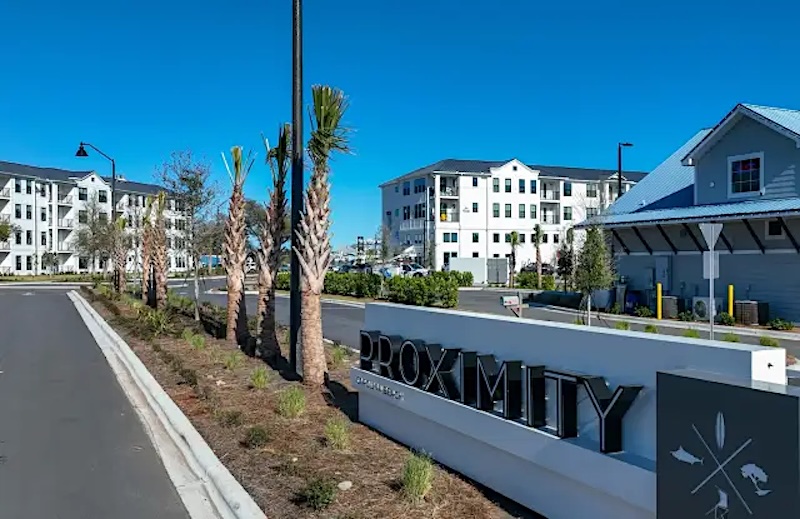
CAROLINA BEACH — Short-term rentals at The Proximity in Carolina Beach are now in effect. A split vote among town council ushered in the conditional zoning change, despite multiple residents pleading with elected leaders to thwart Cape Fear Development’s plan to rent some of its properties for less than 90 days.
“I don’t feel like they heard us at all or took any of our concerns into consideration,” Proximity resident Christina Bowen told Port City Daily Wednesday.
On Tuesday evening, Bowen was one of a dozen or so people who spoke during the almost two-hour public hearing regarding the change. Cape Fear Development — the number one property taxpayer in Carolina Beach — originally asked for the conditional zoning to allow 10% of The Proximity’s 250 units to be rented for less than 90 days. They had to get permission from council since prohibition of short-term rentals was one of numerous conditions in place when The Proximity received its zoning approval from the town in 2021.
READ MORE: The Proximity’s short-term rental plan could get narrower path forward
Co-owner Mike Brown also requested a change to the development’s site plans to show where amenities are located. Carolina Beach’s special event ordinance requires a site plan to pinpoint amenities in order for the property owner to host events without requesting a permit from the town every time. No one had a problem with this change, as Proximity developers always had plans to hold farmers’ markets, group exercise classes or bring music in the courtyard area.
However, the short-term rental amendment was a larger discussion, with almost every resident at the mic in opposition. Council member Vince Losito and Mayor Pro Tem Deb LeCompte sided with them and voted against the request, though Mayor Lynn Barbee, and council members Jay Healy and Wayne Rouse favored it, so the vote passed 3-2.
Rouse’s motion allowed 15 units to become short-term, 10 short of the full 10%; Brown said ahead of the vote that the development team would be happy with that amount.
When Rouse, who served on the planning and zoning commission for nine years before being elected to council last year, read his motion, he said he was inclined to “lean into” planning and zoning’s favorable vote from last month. The seven-member commission decided 5-2 to allow for short-term rentals at The Proximity, though it suggested council allow only 12 units and limit it to 31 days or longer. The commission also suggested the rentals be allowed above commercial businesses only.
Town attorney Noel Fox told council during Tuesday’s meeting the town could not regulate short-terms. The attorney added, had the applicant not imposed any condition on short-term rentals, the town could never have brought it forth to begin with, as state law disallows local government authority in the matter.
Rouse’s motion didn’t address the suggested time limit of 31 days nor which units had to be short-term. He changed the unit count only after Brown brought it to the forefront — something he pointed out to Port City Daily after the meeting.
“My questions were thoughtfully placed,” Rouse said. “The applicant mentioned in the meeting: ‘We’d be happy to accept 15 units.’ I made sure to never suggest it.”
Last month, the planning and zoning commission landed on the 12 short-term units after commissioners debated doing five, eight or 10. Brown maintained then, too, he would be happy with 15 but also was clear he did not want to put a time limit on how long someone could stay, as reported previously by Port City Daily.
Rouse said he respects and trusts planning and zoning, but wanted to exercise caution and not run afoul of North Carolina General Statute 160D-1207.
Barbee told Port City Daily, furthermore, the town follows North Carolina’s Vacation Rental Act to define vacation rentals, which sets the timeframe on anything less than 90 days.
“That propagates throughout the state,” the mayor said. “We don’t have another definition of short-term rental and couldn’t create one on the fly, even if we really wanted to.”
Town staff and the mayor pointed out short-term rentals don’t appear in Carolina Beach’s unified development ordinance, except in the conditional zoning of The Proximity. Short-term rental is only used once in the land-use plan otherwise — regarding a minor suggestion to guide short-terms away from residential neighborhoods and into commercial areas.
The Proximity is in a highway zoning district, which allows mixed-use. Community Development Director Jeremy Hardison told council Tuesday that is the place where the town would want short-terms located.
Enforcement also was a consideration Barbee weighed when it came to putting a timeline on how many days a lease could be.
“Who would make sure they were only rented for 31 days?” the mayor asked rhetorically when speaking to Port City Daily.
He didn’t think town staff could enforce it.
Port City Daily inquired how the town would ensure only 15 units are being rented for short-term in The Proximity; Barbee pointed to New Hanover County’s tax department. Occupancy taxes are collected by the county, which Hardison said at Tuesday’s meeting are spent on items like beach nourishment funds, providing lifeguards and addressing other needs impacted by visitors to the island.
“My belief is that we can look to the county taxing authority and say: ‘Are they paid for more than 15 units?’” Barbee said.
Hardison said staff cannot require separate reporting or certification requirements to document the number.
“However, if information is received indicating that the 15-unit limit may have been exceeded, staff may investigate the matter and request information necessary to determine compliance with the approved CZ conditions,” Hardison wrote in an email to Port City Daily.
‘What changed after accepting the condition?’
The mayor homed in on the condition the developers agreed to back in 2021 during the meeting. He asked Brown what had changed exactly since prohibiting short-term rentals in the conditional zoning years ago.
Brown told planning and zoning last month it was hard to keep tenants in units located above businesses due to noise complaints, so the company wanted to pivot its business model. To council this week, he added there could be seasonal needs for varied workers to stay in town longer, whether executives or traveling nurses, but also for families and friends of tenants who want a furnished apartment during a visit.
“It was not part of the long-term plan to be in front of you asking for this,” Brown said Tuesday. “We’re in the apartment community business, we are not in the hotel business.”
There seems to be some debate, at least for Rouse, on who originated the no short-term rental condition to begin with. It’s been heavily referred to as self-imposed, but Rouse said in his research he could not narrow down who exactly brought it up first in 2021.
Rouse and Barbee both said they looked through council meeting minutes, community meeting notes and discussions with staff. Though it was set in stone in the conditional zoning, Rouse worried if the town couldn’t prove who originally brought forth a short-term rental condition, it would put the council in murky water should a challenge ever make it before a judge.
During Tuesday’s public hearing, Bowen passed out information to the council members and pointed out the Oct. 14, 2021, planning and zoning meeting addressing Cape Fear Development proposed conditions. She pointed to cofounder Brian Eckel mentioned throughout.
According to the minutes: “The conditions the applicant is proposing for the property is the prohibition of short-term rentals within the residential units … Mr. Eckel said he and his team members have solicited community input about this project via numerous opportunities and incorporated many of the suggestions into the plan. … Mr. Eckel said all of the leases will be one year long, but they want to give tenants the ability to sublease for a minimum of 90 days if necessary.”
The short-term rental condition was made in addition to others, including installing a pedestrian traffic signal at Winner Avenue and Cape Fear Boulevard, putting in a multi-use path and providing interconnectivity to the public, among others. And Cape Fear Development agreed to them all.
Resident Maureen Lewis was one of the people who met with Eckel and Brown, among other members of The Proximity team, to see conceptual designs in the early stages of the project.
“The biggest concern was short-term rentals and The Proximity promised not for at least 10 years,” she told council. “Town leaders relied on the commitment. Whether it was written or sealed with a handshake, the developers made a promise to the community and now wants to reverse it — and that’s deeply disappointing.”
Brown told council Tuesday, he also didn’t see short-term rentals as big of a concern from his own community meeting notes, though traffic and stormwater were.
To Bowen, it didn’t matter who brought it forth first if the town and developers agreed to it.
Council member Vincent Losito said the self-imposed condition by Cape Fear Development was enough for him to believe the town had more standing. He thought the chance of a lawsuit would be “very, very remote.”
“My understanding is it does give the town more authority to enforce that ordinance,” the council member told his colleagues Tuesday.
Though conversations about litigation were never had with Cape Fear Development, Barbee, speaking on his decision to grant the request, clarified he prefers to avoid the courts and any legal fees potentially imposed on town taxpayers.
This also was of concern to Rouse: “I was trying to be cautious with the residents’ money that I represent — and that’s all residents.”
Still, Losito thought Cape Fear Development’s reasoning for the conditional zoning change wasn’t as convincing. He said The Proximity’s high rental rate indicated a strong enterprise status.
“I’ve been a businessman my whole career, and I support business — and there’s times where businesses need to pivot when something’s not working,” he said. “But a 97% success rate is not — if you’re going to pivot from that, you’re only going to pivot in a bad way.”
Mayor Pro Tem Deb LeCompte agreed. She told Port City Daily the margins are less than even New Hanover County’s vacancy rate, which stands around 11.93%, at least two times higher than Cape Fear Development.
“They’re at 3% to 5%,” LeCompte said. “I don’t see how you call that a failed business model.”
The public speaks
Residents spoke for more than an hour over a litany of issues at The Proximity: security being lax without working fobs and locked gates, overflowing trash, elevators not properly functioning, coyotes on the land, people breaking into the pool, parking problems and more.
Lori Carlin told council she decided to move to The Proximity due to its “safe environment,” but worried a transient population would lessen those protections. She also questioned if Bell management, which runs The Proximity, could handle more responsibility alleging short-staffing issues already are in place.
Michelle Alberda — who isn’t a Proximity resident — said she attended the open houses the developer had with the community to garner feedback and make changes to the project before approval. She called the move to amend the short-term condition a “bait and switch” that would have long-lasting implications.
“They may not own the Proximity forever either, and the rules you put in place will be around for a while,” Alberda added, noting the amendment runs with the land.
Another person pulled a records request from Carolina Beach Police Department over the last year regarding incident reports at The Proximity. Robin Tkatch went down a list of reasons police have been called there, including theft, larceny, domestic violence assaults, drug use and more.
“I respect our residents’ rights, but I take strong exception to the characterization that some have made about how we operate this property,” Brown said, adding Bell management team also vet their renters stringently and puts them through a criminal background check. “Do I think Proximity is a drug–ridden, crime-ridden community? I don’t think that’s consistent with reality.”
Most residents who showed up Tuesday thought they had been bamboozled by an unkept promise.
“It is about changing a condition that many residents relied upon when deciding to make The Proximity our home,” Bowen told council. “Never have I seen a significant condition of a development approved and reversed simply to accommodate a change in a developer’s business model.”
Brown told the council all 15 short-term units would not be converted immediately but noted the change gives them flexibility.
One resident, Mike Mytych, called this flexibility a “loophole.”
“We teach our children and adults that commitments matter, that rules should be honored, and there should be accountability,” Mytych reminded council, noting a vote to change the conditional zoning would erode that trust.
Donna Shea reminded that the residents in attendance — and those who emailed complaints ahead of the meeting — would be remembering council’s votes by the town’s next election season.
Both LeCompte and Losito believed it was wrong to change conditions on residents who signed up to live in one of the 250 luxury apartments, with the expectation that lease agreements in place are between six and 18 months. Upon Losito asking about the current terms, Brown responded: “There’s no provision in our lease that makes a representation to our residents that there will be no leases of less than 90 days.”
Losito also was concerned the change would open “pandora’s box” further, allowing more tenants at The Proximity to turn their own apartments into short-term rentals. He cited “anecdotal evidence” it is happening currently.
Resident Bowen revealed to council The Proximity model unit was operating as a short-term rental since last October. Port City Daily asked the Town of Carolina Beach if it was aware of the usage and in violation of the conditional zoning ordinance, as well as if any notices or fines were issued to Cape Fear Development. None were issued, according to Hardison, who also said staff was aware of the model unit after the planning and zoning meeting in August.
“The owner stated that the unit was being provided as an amenity for residents to reserve when they needed an additional room, and that the unit must be booked by a current lessee and charged to that lessee,” Hardison wrote in an email Thursday. “At that time, staff did not conduct any further investigation or issue a notice of violation or fine. The property had an application under review that, if approved, could potentially address the use in question. Staff therefore intended to allow the pending application to proceed through the appropriate review process before taking further enforcement action.”
Mayor Barbee said he thought it was a gray area, since a model unit is not necessarily rented to begin with but used to sell a tenant on the property overall.
“And they’re not advertising it outside, only allowing it to tenants,” he said. “Was it outside the original intent? Yeah. … I probably would not have done that if it were my decision.”
Upon mentioning units that could be dedicated for friends and family of tenants who want to stay at The Proximity, Brown pointed to one person in opposition, John Farley, who had inquired about its use before; though it didn’t come to fruition.
When Farley stepped up to the lectern, he said he doesn’t plan to leave the complex and remains hopefully issues brought forth by his neighbors will be addressed by Cape Fear Development, even if they weren’t brought to light until the planning and zoning meeting last month.
He also pointed to a 55% short-term rental rate already on the island offering plenty of options elsewhere and thought adding more would strain infrastructure further. Compiled with the development’s 97% rental rate, Farley said: “There does not appear to be a compelling need. … So who wins? Cape Fear Development. And who loses? Proximity and all island residents.”
During the meeting, Barbee asked Cape Fear Development if it would let the tenants who had a problem with short-term rentals out of their lease, to which Brown confirmed.
“I feel for the tenants,” Barbee told Port City Daily. “I really do. This was a tough one.”
Rouse concurred.
However, they thought many complaints throughout the evening were beyond council’s scope of authority and more in line with tenant-landlord issues. LeCompte agreed, but told Port City Daily she believed the residents were trying to show how allowing short-term rentals could exacerbate problems more.
To council members Tuesday, LeCompte also said many communities people move into have an HOA to complain to if something goes awry. Seeing as the zoning condition about no short-term rentals was a contract between the town and developer, she felt an obligation to consider resident feedback.
Attorney Fox told council during the meeting, while the tenant issues were “relevant in some arena, it may not be relevant to the decision” council should vote on: “You are not going to be able to address things related to trash or safety, or those types of things.”
LeCompte said she has faith in Cape Fear Development to work through problems that have come to light.
“I think Mike Brown is an honorable man,” she told Port City Daily.
Rouse said he heard from residents after the vote, both for and against the final decision. Some expressed to Port City Daily the change could set precedent for Cape Fear Development to come back and request more short-term rentals. Rouse said at least now he can pinpoint exactly where the development team requested 15 units.
“But I really just think this is a design challenge they want to correct,” Rouse said.
Proximity resident Bowen is trying to see the positive side of the outcome, noting many of her neighbors have now become tighter since banding together to push back against the change.
“It feels like we are looking out for each other a little more closely now,” she said.
At Port City Daily, we aim to keep locals informed on top-of-mind news facing the tri-county region. To support our work and help us reach more people in 2026, please, consider helping one of two ways: Subscribe here or make a one-time contribution here.
We appreciate your ongoing support.
