


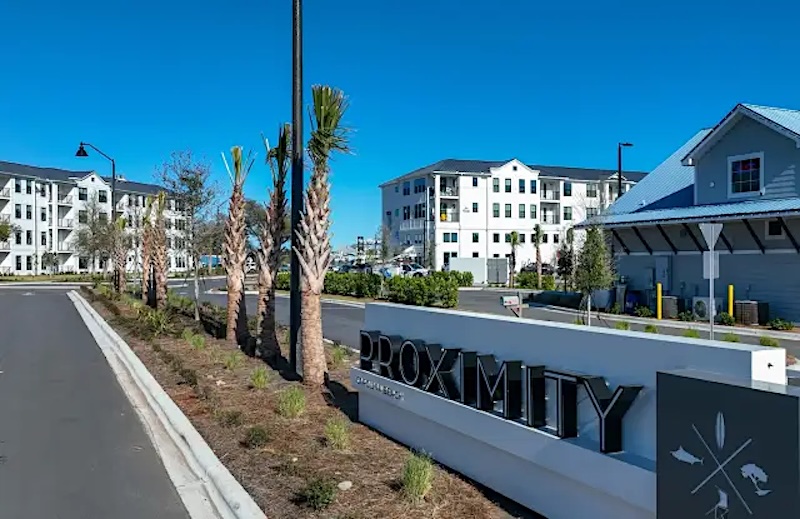
CAROLINA BEACH — An almost three-hour debate ensued among the Carolina Beach planning and zoning commission last week over an application to modify a conditional zoning permit. It was submitted by Cape Fear Development regarding The Proximity, a 250-unit mixed-use development on the island, which wants to allow 10% of the complex’s properties to be leased under 90 days.
The request was opposed by some Proximity residents, who thought it would open the door for VRBO or Airbnb vacationers, bring in unwanted security problems, and increased noise and trash — further impacting issues they say already are in place at the complex.
“This completely negates what we signed up for as leasees and community members,” Taylor Bailey said, adding had he known short-term rentals were back on the table for discussion he never would have sold his home to move into the complex with his daughter.
READ MORE: 3 local restaurants announced for Proximity, community pool memberships also on deck
ALSO: Large-scale Carolina Beach development gains momentum at latest hearing, faces town council next
At the Aug. 13 meeting, most planning commissioners disagreed with the proposal as is and worked through various ideas to come to a compromise. In a 5-2 vote, they recommended town council, who has the final say, allow 12 units to be leased for periods of 31 days or more.
Planning commissioner Ethan Crouch, one of the two who voted against, opposed any lease changes out of the gate.
“I’m a hard no on this,” he said, reminding the commission — which Crouch was on when Proximity was approved — that they put forth lease restrictions in the original conditional zoning permit for a reason. “The biggest issues back then, they were stormwater, traffic impacts, and short-term rentals — nobody wanted them.”
Cape Fear Development’s Mike Brown tried to assuage residents and the board that the goal wasn’t to bring in short-term lease vacationers. He said the company wanted “optionality,” as it’s attempting to course-correct a few units located over commercial businesses that have been problematic to rent out due to noise.
“We just want flexibility to do lease terms,” he said of the 10% consideration to lease under 90 days. “We don’t even have 25 units that are vacant. We aren’t asking anyone to move out to adopt a new business plan.”
The idea, according to Brown, was born from some Proximity residents who expressed interest in having a fully-furnished friends-and-family suite available for rent when people visit them; Proximity’s property management group, Bell Partners, utilizes this in other developments it manages, Brown said. Plus, he thought a shorter lease option could attract seasonal workers.
The goal was to provide fully furnished units above commercial spaces that have been problematic.
“But we don’t want the headache and inconvenience of having the bachelor party on the weekend — that’s not to our benefit or resident benefit,” Brown said.
Residents push back
No one spoke in favor of Cape Fear Development’s plan from the seven or so who took the mic at the public hearing — the majority of whom were tenants of the complex.
Resident Christina Bowen was one of the first people to move into The Proximity when it opened in early 2025. She requested the board reject the request.
“I chose The Proximity as a single woman because it was promoted as a safe, secure, upscale community residence,” Bowen said, “not as a vacation rental property, per the development agreement. Since January, we have seen a decline in conditions under new management. Maintenance is understaffed, trash regularly overflows and residents receive higher rents for fewer services.”
She said residents have begun installing cameras at their doorways due to security gates not activated and key fobs unavailable. She thought opening up any units for transient lodging would add more problems.
Donna Shea agreed, noting she sold her home in the Fort Fisher area last year to downsize.
“Our facility does not have security,” she said. “I don’t want to have to worry about if my car is going to be broken into or if my packages are going to be stolen.”
A 2021 study from PLOS One, a peer-reviewed scientific journal published by the Public Library of Science, found a proliferation of short-term rentals in a neighborhood can contribute to higher rates of crime in the area. Though it doesn’t mean the tourists staying there are bringing the crime with them, the study found the lack of ongoing communal support erodes a natural ability for a neighborhood to prevent crime.
Proximity resident Christian Dilger said recently 15 teens broke into the pool on a Sunday night and he had to ask them to leave since security isn’t on site.
“If they do this, with 25 apartments and four or five people anytime on vacation, that can be 100 or 150 strangers just at our pool,” he said. “And at night, does anyone really want the after-problem from god knows where? Partying next to you in an apartment you’re paying two grand for?”
A community meeting was held ahead of the planning and zoning hearing regarding the conditional zoning amendment. On June 11, eight people attended and one was Howard Fineman, a director at Federal Point Yacht Club, which also has homes located adjacent to The Proximity.
Fineman said no one at the meeting was in favor of the short-term rentals proposal. More so, he called Proximity an “attractive nuisance,” explaining they had to post no trespassing signs to deter Proximity’s people from utilizing the yacht club docks; many come to watch weekly fireworks shows on them, according to Fineman.
“At some point in time, we will probably have to start calling the police and have someone arrested,” he said, “not something we want to do. But they do violate our personal property frequently and I believe 25 more units would further exacerbate that situation.”
Fineman also pointed to the amenity portion of the application, which Brown requested in addition to lifting a ban on short-term leases. Currently, the group has to get permits to host events on site, due to not labeling site amenities on its site plan. Brown wants to address it and once corrected, they’ll be able to hold certain events without permits needed, to include outdoor exercise classes, farmers markets and music.
It has always been the goal for The Proximity’s lawn and communal area to engage residents and everyone at the meeting agreed these events would be a great addition.
Fineman asked to include limited hours to prevent noise from further emanating into the nearby neighborhood. At the community meeting, he said the development team agreed to 10 p.m. on weeknights and 11 p.m. on Friday and Saturday.
Proximity neighbor John Farley pointed to a letter he received in the mail on Wednesday, one day before the planning meeting. In it, management noted the 90-day lease agreement was a hotly contested topic addressing concerns “at that time that it could become a large-scale short-term rental project,” referring to 2021’s conditional rezoning.
“Well, that’s still the concern,” Farley said, adding residents outside of The Proximity also are concerned.
Steve Jabe, who doesn’t live at The Proximity, told the board it should also consider whether allowing short-term rentals would mean residents could sublease.
Board discussion
Many residents complained about not being informed of the leased days reduction until it was announced via the planning and zoning agenda. This unsettled planning commissioner Lynn Conto, who thought the lack of transparency was short-sighted.
“I’m just thinking about where your bread and butter is,” Conto told Brown. “And, honestly, not asking their input before this goes public, I can understand their issue.”
Brown agreed, stating in hindsight he should have reached out to tenants first. Though his thought was to dig into it with them if the conditional zoning amendment passed, as to work through wants and needs together.
“That’s on me — I wasn’t trying to get approval and slip it past them,” he said, adding all the issues brought up before the board was news to him and ones he planned to address with the Bell management team.
More so, Conto couldn’t square what Cape Fear Development’s request was, as Brown kept shying away from the notion it would be for short-term vacation rentals.
“If it walks like a duck and it talks like a duck and it looks like a duck, guess what?” she said. “In North Carolina to establish residency, you have to be a resident for 90 days.”
Brown added The Proximity didn’t even have 25 units open, only seven, and the goal wasn’t to immediately turn the full 10% ask into short-terms: “I just don’t want anyone to jump to conclusions, that’s what we’re doing.”
“They didn’t jump to a conclusion,” Chair Jeff Hogan said. “You asked for 25 units; you asked for 10%. The assumption has to be that you want 25 units.”
“And you didn’t ask for 5% either,” commissioner Todd Piper added.
Also broached: delineating which units and buildings in the complex were affected by noise; Brown confirmed the 906 and 1000 Lake Park Blvd. addresses both included apartments above commercial businesses. One resident has complained about early-morning music coming from the exercise facilities, he said, or increased chatter and TV volume from restaurants.
Commissioner Melanie Boswell questioned why the team, which boasts on its company website $100 million in developments in the last five years, didn’t plan better. Cape Fear Development is the company behind the adjacent Publix complex and also has worked with New Hanover County government on Project Grace — not to mention it has multiple other Proximity complexes, including at Watermark Marina near Riverlights.
“Why should we have to change your plan that you agreed upon because this is a sound issue?” Boswell asked. “I know Cape Fear Development has the ability to soundproof and upgrade those units to make them livable and enjoyable.”
A suggestion was made to turn the problematic units into offices.
Though the company soundproofed and attempted to fix noise attenuation, they still received complaints about vibrations through surfaces, Brown informed.
Boswell was against supporting 25 units for a short-term lease and pointed to the abundance of accommodations in Carolina Beach to suit travelers otherwise. This was highlighted further by Conto, who shared her own researched data that around 8,800 short-term units are available on the island, with anywhere between 15,000 and 20,000 occupants on any peak season day.
Conto thought if planning and zoning agreed to add more short-terms, they should address security measures at The Proximity for its residents and put a time restriction on future asks: “10% today becomes 30% tomorrow.”
Other commissioners empathized over security as well; Bill Carew, who lives in Wilmington Beach near short-term rental properties, called the constant comings-and-goings of people “dicey.” Boswell said her family chose a neighborhood where short-terms are frowned upon, something she sought due to having grandchildren she prefers to keep in a “safe environment.”
However, Carew thought homing in on security was more of a landlord-tenant issue, out of planning and zoning’s purview.
Brown did promise to take up all residential concerns he heard that night, explaining trash overflow was due to a recent change in valet service. According to the company representative, Cape Fear Development budgeted for security fobs and videos as part of next year’s budget; Conto suggested they make it more of a priority this year.
Piper suggested the commission consider reducing the request of leased days from 90 to 31.
Brown didn’t favor making a minimum and asked the board to give Cape Fear Development discretion and trust to use the lesser terms “wisely” and “thoughtfully.”
“It takes away the ability for that friend and family coming for the weekend,” he said.
“When you say it that way, it looks like you want to put an Airbnb in there,” Hogan said, which Brown again denied.
Boswell added: “If it’s truly for family, 31 days and up would be appropriate — even a traveling nurse does a lease for 30 or 90 days. The only time you get into wanting less than 30 days is for a vacation rental.”
In addition to the days of reduction, the unit count was amended to be less than 10%. Boswell said she would not vote for anything over five, though others suggested eight, 10, a dozen or more.
Planning commissioner Brad Jones was a proponent of finding common ground to work with the company. He commended Cape Fear Development for adding the upscale complex to Carolina Beach, including businesses and restaurants that “created buzz in the area.” He also pointed to the traffic light installation at Winner Avenue and Lake Park Boulevard as a much-needed addition: “It saves lives.”
Part of the conditional zoning permit, Brown said the company was only supposed to invest $300,000, but ended up paying $400,000 after the town couldn’t cover the overage.
Hogan echoed Jones’ sentiment, recognizing not many people are chomping at the bit to spend $80 million on the island.
“We’re a tough group, so I appreciate your time and thank you for your resilience,” Carew added. “I can understand when you start a business, a year later you find you have different things you need to do. Our job is to listen to an applicant, understand their needs but also make sure it’s not damaging to the community and residents. I think you guys care about that too.”
Carew asked what unit count Cape Fear Development could live with: “15 — does that give you enough head room?”
Brown concurred.
After reminding residents in attendance that planning and zoning would not be the final decision, Crouch encouraged the audience to continue discussions and share concerns with the town council. Council will take a vote on Cape Fear Development’s request at its Sept. 8 meeting, already scheduled.
As promised, Crouch did not support the short-term proposal, questioning the company’s good faith. The commissioner reminded that the development team also amended town code, which previously prohibited this kind of development in the highway business district; in cases of mixed-uses, it was required for ground floors to be reserved for commercial space. However, Cape Fear Development wanted to build some residential-only buildings as part of The Proximity. At least two buildings consist of ground-floor commercial and another, building five, was supposed to include more business.
While planning and zoning didn’t agree to the change to town code in 2021 — town council did — Crouch said at the time, he requested for the phasing of the site’s build-out be added as a condition. It didn’t go anywhere and now, he pointed out, building five is for sale.
“So it doesn’t appear the applicant is going to complete that condition and deliver us with the amount of commercial space that we agreed to specifically,” Crouch said.
He motioned to recommend council approve amending Cape Fear Development’s site plan to show amenities and thus host events, but to deny 10% of its property be exempt from lease requirements; it failed 2-5.
Piper then made a motion to recommend council approve the amenity site plan addendum and allow 12 units to be leased for 31 days or more in buildings one and two only, located at 1000 and 906 Lake Park Blvd. It passed.
At Port City Daily, we aim to keep locals informed on top-of-mind news facing the tri-county region. To support our work and help us reach more people in 2026, please, consider helping one of two ways: Subscribe here or make a one-time contribution here.
