


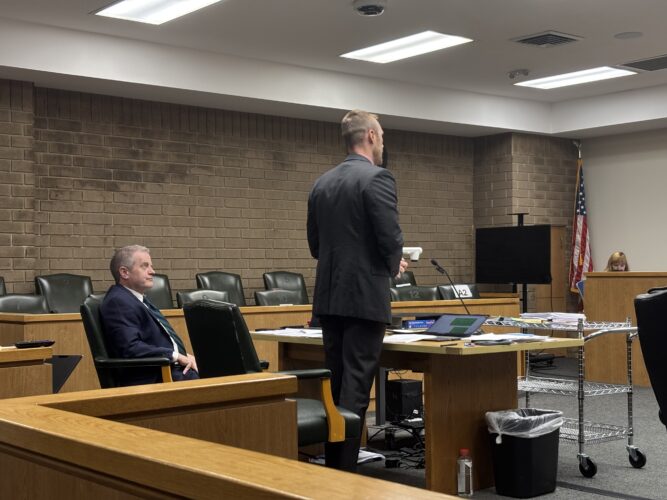
WILMINGTON — In the TRU Colors double homicide trial, the last two law enforcement witnesses were called to the stand Thursday and Friday, to mark the end of the prosecution’s evidence. The defense has, over the past four weeks, attempted to poke holes in witness testimonies and deny the admissibility of digital forensic evidence; this culminated in a failed attempt to dismiss the case on Friday to no avail. Closing arguments instead began Monday.
However, in the state’s final argument, new testimonies and documentation suggested defendants Omonte Bell and Dyrell Green were both connected to and bragged about the murder of Koredreese Tyson, who was killed alongside Bri-yanna Williams, on the morning of July 24, 2021. Tyson’s girlfriend, M’Kaila Walker, was shot in the arm. Green and Bell are on trial, though a third person, Raquel Adams, was also found guilty in a separate trial last May. Yet, the defense suggested the text message evidence was neither concrete nor a confession of guilt and that lead investigator Det. Jeremy Boswell overlooked likely suspects. They even put forth an alternative: Walker’s half-brother.
On June 11 and June 12, the prosecution called two New Hanover County Sheriff’s Office detectives to the stand: Timothy Bould, who was tendered an expert in gang activity in Wilmington; and Jeremy Boswell, the lead detective on the case. While Bould’s testimony primarily involved decoding remaining text messages for the jury, the prosecution used his expertise to suggest Green and Bell were proud to be involved in the incident.
READ MORE: More fingerprinting evidence turns up negative for Tru Colors defendants, victim’s sister testifies
ALSO: DNA, fingerprints reviewed in Tru Colors case, prosecution combs through phone records
CATCH UP: Cell records, video evidence take center stage in TRU Colors murder trial
Defendants Green and Bell are accused of having broken into the home of TRU Colors Brewing COO George Taylor III to conduct the crimes. TRU Colors was a brewing company that hired active and rival gang members in an effort to curb gun violence; Tyson, Bell and Adams all worked at the company.
Green and Bell are both charged with two counts of first-degree murder and one count of attempted first-degree murder. They are also charged with one count of conspiracy to commit first-degree murder for Tyson’s death and two counts of first-degree burglary and robbery with a dangerous weapon.
While Bell is accused of having driven the vehicle to the Providence Road home, Green has been implicated in the breaking and entering leading to the deaths. However, both defendants have pleaded not guilty, and their attorneys have asserted the prosecution did not have concrete evidence placing them at the scene of the crime nor in a conspiracy to commit the crime.
Timothy Bould and the last text messages
Much like with Major TJ Waddell’s expert testimony, the defense objected to Detective Bould because they claimed his expertise was through law enforcement, which has a biased lens. The defense thought his position as a law enforcement officer rather than a traditional academic expert would result in prejudicial testimony.
As with Waddell, Judge Frank Jones approved of Bould’s being declared a subject matter expert and denied the defense’s motion to dismiss his testimony because he did not think his testimony would be prejudicial and was a reasonable expert.
Bould’s primary purpose was to inform the jury about what gangs exist in the area, noting five larger gangs in Wilmington: the Gangster Disciples, Double ii Bloodset, Rollin’ 60s Crips, G-Shine Bloods and the Nine Trey Bloods. As has been explained throughout the trial, Bell and Green are both members of the Double ii Bloodset, alongside Adams; Tyson was the North Carolina “governor,” or leader, of the Gangster Disciples. The two groups are known rivals, which the prosecution has argued throughout the case was the motive for Tyson’s death.
Bould was able to interpret messages and nicknames upon the prosecution’s requests. Notably, Assistant District Attorney Sean Spiering asked him about one of the names Green went by on his phone and email: SleepyGDK. “Sleepy” is Green’s nickname and “GDK,” Bould said, was short for Gangster Disciple Killer.
He also read out Adams’ response to a text sent by Tyzheem Nixon on July 22; Nixon is an alleged co-conspirator who was in prison at the time of the murders. He has not been charged for the incident.
Nixon allegedly asked: “Is he dead yet?” meaning Tyson, commonly brought up in the last few weeks.
The response from Adams: “His driving skills is ass bro.”
The prosecution would later suggest this text exchange meant the only reason Tyson was not killed two days earlier was because Bell’s driving skills weren’t up to snuff.
Bould continued reading messages between Nixon and Bell, wherein Nixon accused Bell of “driving slow asf on drills.”
“A drill is an act of violence,” Bould explained.
He also mentioned two deceased Double ii Bloodset members written about by Bell in text threads. The first was named Joseph David Williams, or Jose, an 18-year-old Bloodset gang member killed by the Gangster Disciples in 2013. The other was called “Lo” or “Polo,” referring to Daiquan Jacobs, a high-ranking drug trafficker for the Double ii Bloodset killed in May 2020.
“Its only right Merk style for Lo and Jose,” the next message indicated.
Bould explained “Merk” was the name for a violent Double ii Bloodset member, so his interpretation of the message was to get violent retribution for the fallen members.
The defense pointed out, though, the prosecution didn’t have a lot of text messages authored by either defendant, as most of the interactions about the killings happened between Adams and Nixon. Meleaha Kimrey, Bell’s attorney, added none of the provided information or texts were a straightforward admission of guilt.
However, the prosecution suggested the messages between Nixon and Adams were indicative of their position being higher up in the gang, particularly Nixon. Bould provided that while neither Green nor Bell might have had actual issues with Tyson on a personal level, he surmised they would kill him upon orders from the higher ups.
Bould explained the military-like hierarchy in gangs and said any disobedience would result in disciplinary action. Even if the defendants didn’t have a connection or rivalry with Tyson, specifically, if Nixon or any other higher up told them to kill him, Bell and Green would be expected to do it, the prosecution theorized.
The examination of Jeremy Boswell and the jail call
Detective Boswell, the last person called by the prosecution, provided insight into the investigation and the swathe of evidence put forth by the state. He described working on the case as “unique” because of the “sheer volume” of moving parts and information. The defense claimed the large scope of the investigation meant Boswell couldn’t give an accurate or thorough testimony, with Kimrey specifically poking holes in his memory.
Boswell stated if a detective unit was assigned a case, typically, one person from that unit would be the lead and would divvy up tasks to the rest of the team. In the TRU Colors homicides, Boswell said he employed several units and law enforcement agencies, making for a much larger team than he was used to, and while he couldn’t recall all details from memory, he knew who did.
The prosecution also established Boswell was not familiar with either defendant until he got a lead on them, so the defense could not argue Bell and Green were targeted by investigators.
During Boswell’s testimony, too, the prosecution presented the jail call between Bell and Williams’ sister, Arrion Williams-Dixon, who testified on the stand last Wednesday, June 10. He was the one who collected the recording and verified the evidence in front of the jury. The prosecution believed the jail call was indicative of Bell’s affiliation with the crime.
Williams-Dixon received a call from Bell while he was in the NHC Detention Center in August 2022. In the audio, he tells her he had no idea what was happening when her sister, Bri-yanna, died.
“I feel like you’re lying to me and I feel like it’s a form of betrayal,” she said in response, “because I would never have done anything like that to you.”
Bell remained adamant during the call he had no role in what happened and didn’t know it was going to happen. Williams-Dixon repeated she didn’t believe him because even if he didn’t “pull the trigger,” he was affiliated with who did it and knew what was going to happen.
The cross-examination of Det. Boswell
Kimrey was the first person to cross-examine Boswell last week. Her goal was to frame his investigative work as incomplete and neglectful of other suspects. Kimrey suggested there were other gang members more likely, and in some cases just as likely, to have killed Tyson. This included Walker’s half-brother and gang member Malachi Cooper, Isaiah Lewis, Tyron Newkirk and another gang-affiliated member living in the Providence Road home at the time of the murders, Eric Marshall.
Kimrey began questioning Boswell’s knowledge of the previously mentioned suspects and people he spoke to. For example, Kimrey had Boswell explain Newkirk became known to officers because his fingerprints were on the property. Eventually, she homed in George Taylor III’s testimony, involvement and treatment.
“A nine millimeter handgun was found under the bathroom sink or the vanity in George Taylor III’s bathroom, correct?” she asked
Boswell confirmed; but Kimrey explained the gun wasn’t registered to Taylor, to which Boswell said there wasn’t a gun registry. The gun could be unregistered for a number of reasons — if it was gifted, ownership transferred, or it was bought on the street. However, Kimrey suggested the unregistered gun was suspicious.
When she brought up George Taylor Jr., the father of the homeowner and TRU Colors Brewing owner, arrived on the scene, alongside former District Attorney Ben David, she said they conversed immediately after the incident while at the Providence Road home.
Boswell said Taylor Jr. arrived to give clothes to his son, who was just in his underwear but not allowed back inside due to the incident at hand. Kimrey went on to confirm Taylor III was considered a suspect because investigators and law enforcement were not aware of his involvement.
“You recall saying in a report that George Taylor III had been cooperative until after he spoke with his father, and then he advised he was no longer giving consent [for] anything to be heard?” Kimrey asked Boswell, to which he affirmed.
She then pointed out, Taylor was never interviewed alone thereafter, always in the presence of his father.
“The question I was really asking is: It is not standard procedure to interview a grown man, who is a potential suspect, with his daddy in the room?” Kimrey pressed.
Just as Boswell was replying Taylor did not receive “special treatment,” Judge Jones cut him off by stating it was “appropriate” to stop; court went over time on Thursday afternoon so the cross-examination of Boswell had to be completed when court restarted.
When Kimrey picked up Friday morning questioning Boswell, he said Marshall’s fingerprints found by the staircase were brushed aside because they were only noticeable in common points of entry and thus not unusual to be where Williams’ body was found at the bottom of the stairs. Bell’s attorney also had Boswell explain Tyron Newkirk was a suspect, but the police were unable to locate him and dropped the search.
Kimrey implied Cooper’s involvement in the crime was evident through his connection to Walker and his gang affiliation with the Bloodset. Kimrey also noted, “gang members are willing to injure their own family members,” referencing Waddell’s previous expert testimony. She suggested Cooper killed Tyson and shot Walker in the arm.
She also suggested the robbery or burglary was done by Cooper, because he went to Miami the August after Tyson died. Kimrey asked Boswell if he ever wondered how Cooper afforded the trip. The detective did not. Kimrey suggested he was able to get money from stolen goods from the Providence Road home.
Green’s attorney, Matthew Geoffrion, piggy-backed on making Boswell’s investigation seem inconclusive, though he did not linger on alternative suspects. Aside from demonstrating Green’s minimal presence in the phone message records, Geoffrion brought up testimonies from previous witnesses in the trial. Particularly, he pointed to Walker, who testified May 28, and DeMarcus Gaines, who testified the same day. Gaines told the Wilmington Police Department Green threatened to kill him in the days after Tyson was killed. The two of them went gambling with Cooper and Gaines’ older brother on July 23, the night before Tyson and Williams died.
Per Walker, Geoffrion said she was reportedly upset with Williams because she alleged Walker and Gaines slept together. Walker said this wasn’t true and she didn’t recall being upset with Williams.
Boswell explained he did not personally interview Walker after the incident to determine her thoughts and state, though he said her mother kept in contact afterward. Geoffrion suggested Walker’s mother was trying to dissuade officers from looking into Cooper.
Geoffrion also suggested Gaines only brought up Green as a suspect in the case because he had been pulled over during parole and found to be carrying a stolen firearm and marijuana. He believed Gaines only brought Green up in order to be let off for the firearm and drugs.
However, Boswell said he was already looking into Green by that point.
Geoffrion then circled around to Ryan Barber — a Gangster Disciple and drug addict who regularly purchased drugs from Green; Green also received a tattoo from him. Geoffrion has consistently attempted to expunge any mention of or connection to Barber because he suggested there was no concrete evidence of Barber having anything to do with the case. Geoffrion also said the connection between Green and Barber was purely transactional.
Through his questioning, Geoffrion revealed the importance of Ryan Barber’s residence. As it turns out, Williams’ phone was tracked to Barber’s Southgate residence after her death, though her phone was never recovered by police. The prosecution suggested her phone was brought to the Barber residence after the murders because it was close to the crime scene and home to someone Green knew.
Motions to dismiss
After Boswell stepped down from the stand, the jurors were permitted to leave for the rest of the day, since the prosecution rested its case and matters needed to be discussed outside of the jury’s purview.
Both Kimrey and Geoffrion filed motions to dismiss all charges filed against their clients citing insufficient evidence, but both denied.
Geoffrion suggested evidence presented against his client up until that point was insufficient and could not concretely place Green at the scene of the crime, nor in a conspiracy to kill Tyson. He said the only conclusive evidence the prosecution has against his client is a recording of him from July 23, 2021 saying, “I don’t give a fuck about no Thug,” while at the Taco Bell Walker and Williams worked at.
“This is a 21-year-old man at a fast-food joint who’s been told to move a car and he spouts off and says some things,” Geoffrion said. “That is not motive. That is being impolite. It is being maybe slightly aggressive. It is not motive.”
Geoffrion continued saying association to Adams, already convicted, was not proof enough.
The prosecution, Carriker, mentioned seven pieces of evidence relating specifically to Green. Carriker countered the Taco Bell recording was evidence of animosity toward Tyson and there was not “much to dispute.” He also pointed out phone calls with Williams — which Geoffrion previously argued she and Green were friends — provided Green with the Providence Road address. Carriker said Green got information about Tyson — if he was alone, for example — supplied by WIlliams throughout the night, evidenced by her phone calls.
Carriker stated Bell and Green are shown traveling south from Fulton Avenue in Castle Hayne to downtown Wilmington alongside Adams, at which point Bell and Green’s phones are no longer trackable, like Adams’.
“And they don’t come back and resume, come alive, until 6:14, Bell and [Green]’s phone,” Carriker said. “That is a powerful coincidence and piece of evidence.”
Kimrey’s motion to dismiss included inconclusive evidence proving her client was at the scene of the crime. She also said the court could not prove Bell wanted Tyson, or anyone else, dead.
In fact, Kimrey noted on the phone call the prosecution claimed was indicative of Bell’s involvement, he adamantly denied any role in Williams’ death, while her sister repeated what she heard elsewhere. That, according to Kimrey, could be considered hearsay.
“This phone call, the jail call, shows a consciousness of guilt when he is asking for apologies to be made to her family, and also an admission to being in a position where he, Omonte Bell, couldn’t have stopped it,” Carriker responded, noting Bell was the one who called Williams-Dixon.
He also explained Bell’s involvement in the crime was evident by messages between Nixon and Adams saying Bell’s slow driving was the reason Tyson wasn’t dead by July 22, 2021.
Carriker then said it was far too much of a coincidence for Bell to be arrested next to a car that looked nearly identical to the one seen in the doorbell camera and collected surveillance footage. He also noted the surveillance images overlapped with the cell site locations and phone records provided by law enforcement to prove the accuracy of their theory of travel and collusion.
The defense will now have an opportunity to present their evidence to the jury.
[Ed. note: The article has been amended to remove an incorrect transcription of a phone call played during testimony. Port City Daily regrets this error.]
Have tips or suggestions for Emily Sawaked? Email [email protected]
At Port City Daily, we aim to keep locals informed on top-of-mind news facing the tri-county region. To support our work and help us reach more people in 2026, please, consider helping one of two ways: Subscribe here or make a one-time contribution here.
We appreciate your ongoing support.
