


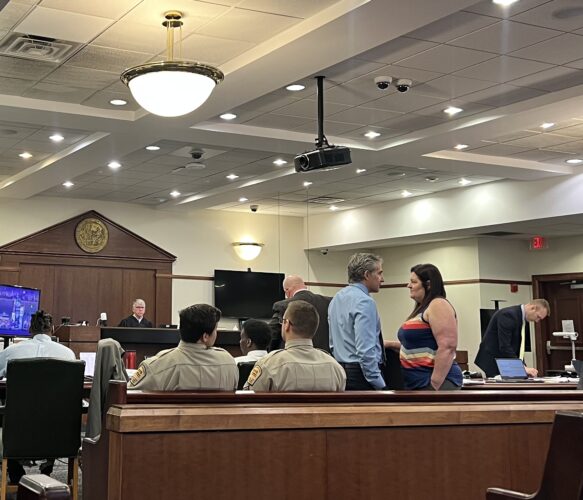
NEW HANOVER COUNTY — The Tru Colors double homicide case against Omonte Bell and Dyrell Green continued Thursday and Friday. While the majority of the time was spent delving into the defendants’ phone records, the prosecution brought forth witnesses from the North Carolina State Crime Lab to testify on the physical evidence recovered from the scene.
The state called three forensic scientists to the stand Friday morning — Jessica Pappas discussed the firearm recovered at the scene, Lora Weiss provided insight into DNA evidence, and Lauren Taddeo spoke to fingerprinting.
On the morning of July 24, 2021, Koredreese Tyson and Bri-yanna Williams were killed in the home of George Taylor III, whose father started Tru Colors Brewing by employing active, rival gang members; Tyson was in a rival gang to Bell and Green. M’Kaila Walker, Tyson’s girlfriend, was also there that night and suffered gunshot injuries. One person, Raquel Adams, has been convicted of Williams and Tyson’s murders; Bell and Green are now being tried for first-degree murder, attempted first-degree murder and, in regards to Tyson’s death, conspiracy to commit first-degree murder.
READ MORE: Cell records, video evidence take center stage in TRU Colors murder trial
Weiss, who conducted a DNA analysis on evidence from the crime scene, shared results did not locate Bell nor Green’s DNA on those items. Both Pappas and Taddeo were asked to analyze a firearm recovered from the Providence Road home’s downstairs bathrooms; neither defendants’ fingerprints were found, per Taddeo’s report.
Pappas’ said in her analysis of the firearm, a handgun, it did not match the bullets and cartridge casings found at the scene, indicating it was not the firearm used in the killings. Additionally, the cartridge casings found at the scene were determined to come from two guns, indicating two guns were fired at the scene.
The defense, Mathew Geoffrian on behalf of Green, and Meleaha Kimrey on behalf of Bell, asked one question on cross examination of Pappas: whether it would be possible for one person to shoot multiple guns. She answered yes.
Geoffrian also made a point of asking Taddeo on cross examination if she gathered fingerprints from the gun or from other areas while at the crime scene; she said no to both.
Prosecutor Doug Carriker then chimed in to ask Taddeo if she would know if the New Hanover County Sheriff’s Office, which has its own ability to do fingerprint analysis, performed its own probe. Taddeo affirmed she would not know if it occurred.
It’s unclear if the sheriff’s office actually conducted their own fingerprinting and if the prosecution plans to bring that evidence forward.
While the experts from the crime lab did not unearth evidence tying Bell or Green to the Providence Road house in their samples, Weiss also took specimens from a facemask and a neck gator. Both were found in the black Volvo believed to have been used by the defendants the night of the murder. The facemask’s DNA was linked to Bell.
Additionally, Weiss analyzed samples collected from the Volvo with an M-vac, essentially a vacuum designed to collect evidence. From this, Green and Adams’ DNA did not match and were actually ruled out, Weiss said. Bell’s DNA was found in the driver’s side backseat. Bell’s DNA was the second contributor in the various DNA samples gathered, meaning one other person’s DNA came up more often in the sample before his.
For the defense, Geoffrian asked Weiss to confirm if it is common for a person’s DNA to show up in cars that they drive often; she said that is true.
Due to scheduling conflicts, the three experts took the stand Friday in the middle of testimony from Detective Eric Kelley, who has spent the last three days going through phone records connecting to Bell and Green.
Kelley’s testimony included the methodical cataloguing of Bell and Green’s text messages, calls and app activity in the months and days leading to and after the July 24, 2021, homicides.
Ultimately, what the phone data showed was a lack of activity for almost a two-hour period encompassing the murders, which are believed to have occurred around 5:30 a.m.. The lack of Bell and Green unlocking their phones or even background app activity was portrayed in contrast to a larger volume of activity occurring in the hours preceding and immediately following the murder.
The prosecution also used the cell data to bolster the path they believe Adams, Bell and Green took in the Volvo before and after the events at Providence Road (catch up on Port City Daily’s Thursday report here).
Phone data
The prosecution used text messages, particularly involving Green, to establish connections between the defendants and others surrounding the case.
Records show the two frequently communicated with Adams (a.k.a. Lil Flex), Tyzheem Nixon (a.k.a. Weatherman), and Malachi Cooper (a.k.a. Cutt).
However, Kelley’s research did not uncover electronic interactions among either defendant and Tyson, Walker and George Taylor III, whose home was the site of the murder. Bell’s phone did not include texts or calls with Williams, though Green’s did.
Kelley found around a dozen calls between Williams and Green between July 11, 2021, and July 19, 2021. Additionally, the prosecution revealed it uncovered data from one of Green’s phones, indicating Williams sent him the address of the Providence Road home on July 18, six days before she and Tyson would be murdered there.
This evidence was found after Kelley’s initial 93-page report, much of which was detailed Thursday; the detective attended forensics training from the International Association of Computer Investigative Specialists, which prompted him to revisit Green’s phone and try to unearth more data.
The detective said he found a piece of data with an Apple Maps location tied to it, which he then decoded to be 6708 Providence Road. Call records obtained in his investigation also showed Williams and Green were on the phone with each other around the time the address was sent.
Kelley was not asked to answer why Williams did this and the prosecution did not speculate on the matter before the jury.
The prosecution also explored the relationship between Green and Kelly Sidberry, who was called to the stand Friday. Sidberry resided at 1315 Castle Street at the time of the murder; it’s one of the locations prosecution has traced Green and Bell to before driving to the Providence Road house.
Prosecutor Sean Spiering questioned Sidberry about how close she was with Green, how often they talked in July 2021, and how often he came to her house. Sidberry said they were and remain close, admitting to talking with Green 202 times since he’s been in jail and putting money in his account several times. When it came to text exchanges with him, though, Siberry often said she couldn’t remember sending the texts associated with her number.
“I’ve had a lot of things going on within five years,” she said on the stand.
When the prosecution pushed further, the defense objected, stating Sidberry had already answered she didn’t know and suggesting the text messages hadn’t been authenticated as coming from her. Judge Frank Jones allowed the prosecution to continue.
In the days before the murder, Sidberry also texted Green she would never “jeopardize his freedom” and went to stay in a Best Western hotel during the events at the Providence Road house at the urging of her uncle. Siberry admitted she did so because she was scared, but not scared of Bell and Green.
Spiering also asked Sidberry if she knew Bell stood on the front porch of her house or in her house on July 24 at 10 a.m. She said she didn’t see him. The prosecution pointed to text messages between her and Green where she said the two needed to “get in and out” before her child’s father found out they were there.
On cross examination, Geoffrian asked if Sidberry knew who killed Tyson and Williams; she said no.
On Thursday during Kelley’s rendering of the phone activity, the prosecution also brought up text messages between Bell and Green, to the overruled objection of the defense.
Per messages retrieved from Bell’s phone, Green tells Bell to delete his messages and Green asks Bell if he’s good; Bell tells Green to stop talking to people, to which Green replies that he doesn’t know what he’s talking about.
Bell’s messages with Adams also show Adams telling Bell to “tighten up” on July 24 after the murder and Bell saying he’s “not worried.”
Bell’s phone also showed several calls with Green and Adams on July 24.
Kelley will continue his testimony on the defendants phone data and other digital evidence on Monday.
At Port City Daily, we aim to keep locals informed on top-of-mind news facing the tri-county region. To support our work and help us reach more people in 2026, please, consider helping one of two ways: Subscribe hereor make a one-time contribution here.
We appreciate your ongoing support.
