


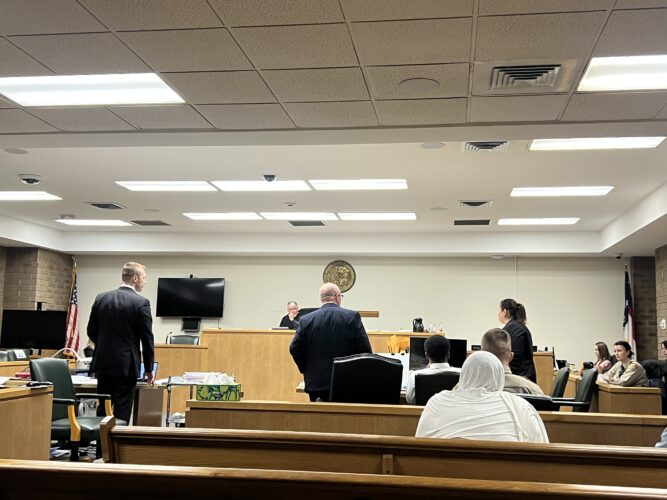
WILMINGTON — As the Tru Colors double homicide trial nears the end of its second week, the state continues to rely on text messages and calls, most recently from victim Bri-yanna Williams’ sister, even as another fingerprint analysis doesn’t match defendants Omonte Bell and Dyrell Green. Both are accused of killing Williams and Koredreese Tyson on July 24, 2021, along with Raquel Adams, who was convicted last year.
On Tuesday, the state called Lucas Feldeusch, latent fingerprint examiner for the New Hanover County Sheriff’s Office, to the stand. Last week, lead prosecutor Doug Carriker alluded to the state bringing forth more fingerprinting analysis after the testimony of Lauren Taddeo, who conducted a fingerprint analysis at the North Carolina State Crime Lab of one of the handguns found at the scene. Taddeo’s exam did not render a match to Green or Bell.
Feldeusch was given several fingerprints lifted from the scene, the home at 6708 Providence Road, using a powder distributed across a surface and then copied onto a card. He said four cards he was given had value, meaning he was able to discern the fingerprint and compare it to documented prints for Bell, Green, and Raquel Adams .
READ MORE: DNA, fingerprints reviewed in Tru Colors case, prosecution combs through phone records
None of the four fingerprint cards enabled Feldeusch to identify Bell, Green or Adams; one came back inconclusive for Green, another produced the same result for Bell; otherwise, the defendants’ prints were excluded from the cards.
The results on the four cards also came back either inconclusive or excluded for Williams and Tyson. The only print Feldeusch was able to identify was for the previous owner of the 6708 Providence Road home.
Feldeusch also analyzed prints from the Volvo the prosecution believes Adams, Bell and Green rode together in to the scene. The only prints found were for Bell on the driver side interior and exterior.
Carriker asked Feldeusch in what circumstances prints could not be determined; Feldeusch said environmental factors may play a role, along with the condition of one’s hand and surface. Carriker questioned if wearing gloves would make it unable to pick up prints; Feldeusch said yes.
The prosecutor also asked Feldeusch if it was possible to date prints; Feldeusch responded no, and prints could last on a surface for months, years, and in some documented cases, decades.
The sister testifies
On Wednesday, the prosecution called Williams’ older sister, Arrion Williams-Dixon, to the stand for questioning about her relationship with Bell and conversations between the two before and after her sister’s murder.
The prosecution wanted to frame their questions for Williams-Dixon around four phone conversations she had with Bell: one on the night of July 23, less than 12 hours before the murder, a call with Bell after the murder, a jail call with Bell roughly a year after the murder and a 2020 call where Bell and Tyzheem Nixon allegedly asked her for assistance in “setting up some “opps” — or opposition rivals or enemies.
Meleaha Kimrey objected to the use of the 2020 call on the basis of Williams-Dixon not bringing it to law enforcement’s attention until March 2026. She was overruled.
Before the jury was seated, defense attorney Matthew Geoffrion objected to discussing all the calls because they only involved Bell, not his client Green. Geoffrion said if the calls were admitted he would most likely need to bring up another motion to sever the case, meaning Bell and Green would get their own separate trials.
The defense has made several attempts to sever the case, once at the outset of the trial and, much like the case with Williams-Dixon’s calls, evidence was presented that implicated one defendant but not the other or Judge Frank Jones has denied the motions every time.
Geoffrion didn’t make a formal motion to sever, though Judge Jones agreed to tell the jury they must only consider the calls in relation to Bell.
When the jury returned, prosecutor Sean Spiering asked Williams-Dixon to describe her relationship with Bell; she said they met in 2017 and became good friends in 2018, though they were more akin to “brother and sister.”
Spiering then asked her to describe the 2020 call with Bell.
Williams-Dixon told the court Bell was trying to get her to date one of his friends and hang out with them at an event. Then Nixon grabbed the phone to ask to borrow her car to “go after some opps.” When Bell got the phone back, he asked her to flirt with people in a rival gang. The names of specific individuals or gangs weren’t used in either request, she said.
On cross-examination, Kimrey targeted Williams-Dixon’s inconsistencies in her story versus what she told a detective in March.
Kimrey questioned if Williams-Dixon told anyone about the call with Bell after it happened; she informed her best friend immediately after, and later her parents when Bell was arrested in August 2021. Kimrey questioned why the call wasn’t important enough to tell law enforcement in the interviews conducted after her sister’s death. Williams-Dixon said it was an emotional time and she didn’t realize the “relevance” of the call until after Bell was arrested.
Kimrey also reaffirmed no names of the “opps” were mentioned in the 2020 call and asked Williams-Dixon if there were more than two gangs in Wilmington. Williams-Dixon said she only knew of two, and when Kimrey started reading names of other gangs, including the Crips, Williams-Dixon said she saw those as subsets of or affiliated with either the Gangster Disciples or Bloods.
Williams-Dixon was asked directly if she was instructed to do anything in that call.
“Flirt with an ‘opp,’” she said, but reasserted a person wasn’t specified.
Kimrey said that wasn’t what she told the detective in March. Kimrey said the detective asked what she “believed was meant” by Bell and Nixon’s language, suggesting Williams-Dixon’s was interpreting the conversation to mean she should flirt with an “opp” a certain way with a five-year hindsight. Williams-Dixon said that was incorrect and she was directly requested to do so.
Kimrey also picked apart Williams-Dixon’s July 23 call with Bell for inconsistencies. Kimrey asked if Williams-Dixon told the detective the call happened around 1 a.m. — which would’ve been around four hours before the murder — and Williams-Dixon said “probably.” Kimrey pointed out the call actually occurred at 7:21 p.m.
Kimrey also pointed out Williams-Dixon told the detective Bell called her, when actually she called him, and the call lasted 20 minutes, as opposed the recorded call time of 42 minutes.
Williams-Dixon also confirmed she informed the detective Bell didn’t tell her he was with Malachi Cooper or Adams, she just heard what she thought were their voices on the call. She also confirmed she told the detective that Bell was on the Southside of downtown Wilmington all night. Williams-Dixon answered she might have said that.
The prosecution also asked Williams-Dixon to describe two other calls with Bell, one being a call after the murder of her sister. According to Williams-Dixon, Bell didn’t know she and Williams were sisters and apologized multiple times, even asking her to offer his apology to her parents. When she asked him if he had anything to do with her sister’s murder, Bell said no and “in the end you’ll see the truth.”
Kimrey asked Williams-Dixon if it was possible Bell was offering condolences for her loss and if him doing so would be odd given their close relationship; she replied yes and no, respectively.
Bell also spoke with Williams-Dixon from jail after his arrest; Williams-Dixon said she believed this was about a year after her sister’s death. She told the prosecution she was playing nice on the call in the hopes of getting more information out of Bell. Spiering alluded to the call potentially being played for the court.
On cross-examination, Kimrey also questioned if Williams-Dixon knew her sister was going over to the house at 6708 Providence Road. She did and affirmed she didn’t want her sister going for fear of getting caught up in violence, though Williams-Dixon admitted to attending events there in the past.
Kimrey also asked if many people knew Tyson lived at the house and if she knew Tyson had enemies; Williams-Dixon said yes to both.
Defense pokes at phone data
The multi-day testimony from Detective Eric Kelley ended on Tuesday with his cross-examination, where the defense offered alternative narratives for Bell and Green’s phone activity the detective detailed last week.
Geoffrion and Kimrey homed in on the lack of user activity on both Bell and Green’s phones from 4:41 a.m. to 6:14 a.m. on July 24, 2021.
Last week, the prosecution demonstrated there was a lack of Bell and Green unlocking their phones or even background app activity during the time encompassing the murder around 5:30 a.m., in contrast to a larger volume of activity occurring in the hours preceding and immediately following the crime.
During questioning, Kimrey asked if Kelley was ever able to make determinations about a person’s lifestyle from phone records, such as someone’s typical bedtime or wake up time. He said it is possible sometimes, but described Green and Bell’s phone activity “all over the place,” so he wasn’t confident making a lifestyle analysis.
Kimrey noted Bell’s phone showed dormancy over a similar time period the morning of July 25 and questioned why Kelley didn’t expand his analysis to include a wider range of time. He suggested the time frame was limited due to the amount of phones he had to analyze.
Kelley was also asked if it was possible Green and Bell were asleep during the time their phones showed no activity; he responded it was absolutely possible.
The detective also questioned the meaning of some of the text messages involving Bell and Green, including Adams’ message to Bell: “Bro you better tighten up and sleep on some bullshit. At Geoffrion’s question, Kelley said he couldn’t rule out that meant “get some sleep.”
Kelley was also asked about Bell’s text to Green saying to stop worrying at 8:15 p.m. on July 24; he affirmed this could be family-related, as suggested by Geoffrion.
Geoffrion also questioned if the steps Bell’s phone counted from 6:14 a.m. to 6:33 a.m. could be from Bell’s father’s house on 12th Street to 1315 Castle Street, where the defendants are expected to have been located. Kelley said it’s possible, though he didn’t complete a step count.
The prosecution has also concluded Green was gambling at a home on Fulton Avenue; Geoffrion questioned why Green’s phone shows he was there due to WiFi analytics on July 24 around 3 a.m. and at another time later that evening. Kelley said WiFi analytics can be finicky — other analytics picked up a location on Causeway Drive as well — and thus Kelley said he didn’t have high confidence in placing Green at the Fulton address at both times. Geoffrion claimed there wasn’t sufficient follow-up done to be sure.
Geoffrion also asked Kelley questions on why someone resets a phone; after the murder, Green is alleged to have factory reset one of his phones, referred to by the court as Q8. The state obtained another phone he was using, referred to as Q9, which is where most of the data on Green’s activity came from.
Geoffrion asked Kelley if it was possible the phone was reset because it was being sold to Green; Kelley said he couldn’t rule out that possibility and affirmed resetting a phone for this purpose was common practice.
The defense attorney noted the Q8 that was reset was a newer model than the Q9. There were also messages from Green on Q9 claiming the phone was no longer working and then a text from Q8 where Green said the device was his new phone.
When cross-examination was over, Carriker began to ask Kelley if anything from his research would rule out a certain scenario; he was cut off by the defense’s objection. The jury was removed before continuing so as not to potentially reveal information that they should not hear.
Carriker continued to ask Kelley if he could rule out the following scenario: the defendants left their phones at 4:41 a.m. at 1315 Castle St. before driving to the Providence Road house.
Geoffrion argued the question would be conjecture and impede on the jury’s role to decide whether the information provided could rule out that scenario. Carriker defended the inquiry as a “summarizing question” that would be asked and then dropped. Geoffrion pushed back again, asserting the surmise wasn’t in the scope of a forensic analyst’s testimony and it wouldn’t be within the prosecution’s scope to stress their theory with the question.
Judge Jones sustained the defense’s objection.
When the jury returned, the prosecution was allowed to ask Kelley if any item illuminated during cross examination called into question his methodology or the integrity of the information he testified to; Kelley said no.
Aside from the testimony heard on Tuesday and Wednesday, there was also much discussion outside of the jury’s presence about whether additional text messages and jail call recordings were admissible. By Wednesday, the jail calls had yet to be decided on, but the prosecution ran through a list of texts it wanted to add in.
In support of them being presented, Spiering brought up case law he claimed supported the admittance.
An exasperated Geoffrion said he wished he had the time and resources to review the case law being sent to him daily, but he doesn’t because state law limits a defendant to one attorney for non-capital offenses. Meanwhile, he pointed out, the state has two attorneys.
Judge Jones sustained the defense’s objections to about a quarter of the text messages brought forward.
The rejected evidence includes a July 24 text from Bell stating “no loafing out here with no blicky,” referring to a gun. Kimrey argued the text didn’t say whether Bell was asking for a gun or offering a gun to anyone and noted the streets were dangerous after the murder.
Another rejected text stated: “Close eyes on y’all kids, no pillow talking to these bitches, love my bloodos.” Bell was alleged to have sent it on July 24 just after 10 a.m. Spiering argued this was evidence of Bell giving instructions; Kimrey argued that interpretation was made by the state and the text was hearsay.
The prosecution did not say when the text messages admitted would be read or when the jail calls would be played.
At Port City Daily, we aim to keep locals informed on top-of-mind news facing the tri-county region. To support our work and help us reach more people in 2026, please, consider helping one of two ways: Subscribe hereor make a one-time contribution here.
We appreciate your ongoing support.
