


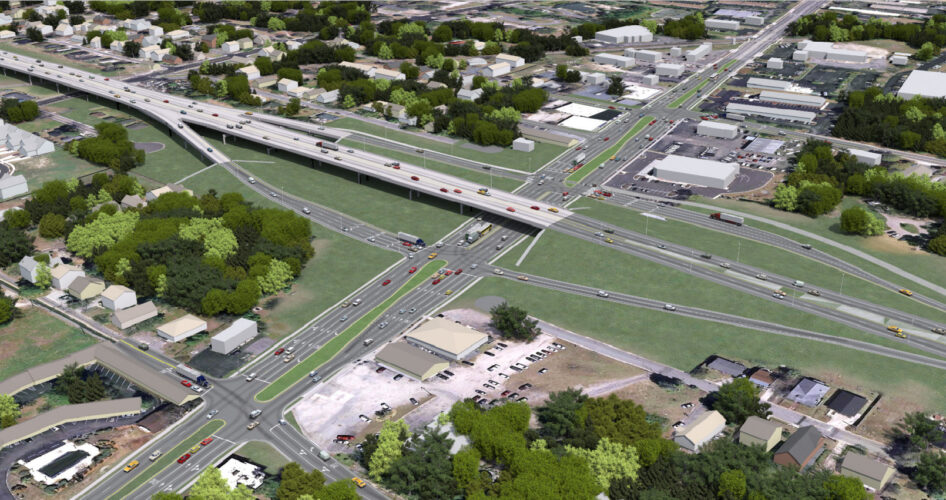
WILMINGTON — A north-south corridor that has been discussed by area leaders and transportation organizations locally and at the state level for five decades will no longer move forward.
The Wilmington Transportation Metropolitan Planning Organization voted 12-1, to remove the Independence Boulevard Extension from the North Carolina Department of Transportation’s 2026-2035 State Transportation Improvement Plan. New Hanover County Commissioner Bill Rivenbark was the only dissenting vote, saying NIMBYism can’t keep thwarting progress in a growing city with escalating congestion.
“Every time we get ready to do something, everybody says, ‘Well, you can’t do that.’ You know, at some point in time, we got to do some things and fix the traffic problem,” he said. “And I think a lot of the traffic problem is, people don’t know how to damn drive.”
READ MORE: ‘People over traffic’: Neighbors concerned over Independence Boulevard expansion
ALSO: Wilmington council opposes Independence Blvd. extension, backs street safety, repaving
CATCH UP: Independence Blvd extension increases by $55M, NCDOT pushes construction to 2028
The estimated $424-million project to extend Independence Boulevard — 1.7 miles from Randall Parkway to Martin Luther King Jr. Parkway — dates back to 1972. It has been identified in WMPO’s strategic plan as a priority, its long-range plan Cape Fear Navigating Change 2050 and in the STIP, which prioritizes state funding for projects. However, the Independence Boulevard Extension only had preliminary engineering money, but didn’t have rights-of-way acquisition, utility relocation or construction financing secured.
The NCDOT suggested Independence Boulevard Extension be removed from the STIP, according to WMPO Director Mike Kozlowski, following a public hearing held in December 2025 and thereafter the city’s passage of a resolution against the project.
Around 100 or so residents and business owners affected by the construction plans attended the hearing or wrote in to NCDOT, many against the project. Due to its required elevated design — to accommodate CSX, which doesn’t entertain at-grade railroad crossings — the extension leaves roughly 100 homes and businesses needing to relocate.
Kozlowski added since the project is not fully funded, the removal could free up money for division needs in other areas. However, he suggested to keep the project in the long-range Metropolitan Transportation Plan as a placeholder only — to show the demand for north-south connectivity in Wilmington. Currently, only a few routes exist citywide, such as Kerr Avenue to Martin Luther King Jr. Parkway, College Road to I-40, and Third Street to MLK.
“No one cares more about north-south travel than me and Allen,” said Carolina Beach Mayor Lynn Barbee, who also chairs the WMPO board. He was referring to Kure Beach’s mayor, Allen Oliver, also a board member. “But I recognize the city’s closeness to its residents.”
Following NCDOT’s public feedback last winter, the City of Wilmington passed a resolution unanimously against Independence Boulevard Extension’s forward movement. City council member JC Lyle and Mayor Pro Tem Kevin Spears both are on the WMPO board and favored DOT’s removal request.
“We need to find other options that don’t cost our community as much,” Lyle said, referring to monetary implications but more so the value in preserving people’s homes. “We were a different city in 1972. At the time, preserving well-established neighborhoods was not a priority of the city. That has changed.”
Most people impacted by the routes are primarily low-income and minority groups that live from Covil Avenue crossing Market Street and onto Princess Place Drive.
Navassa Mayor and WMPO member Rose Terry was against the disruption of families, a common public refrain amid feedback.
“And it’s very expensive to live here so families can’t relocate,” Terry added.
Spears said he would be the first to vote for the removal, while backending it with advocacy to research other north-south travel options. The Wilmington Mayor Pro Tem said in conversations with Division 3 Engineer Trevor Carroll, Kozlowski and community members that a Kerr Avenue widening seemed promising. But Spears asked why the extension project had to remain in the WMPO’s long-range plan, noting he wanted to finally see it “go away” after rearing its head for years.
Kozlowski emphasized striking it could impact projects already further along in the planning process, such as the interchanges at Kerr and Martin Luther King Jr. Parkway or South College Road and MLK. The board already adopted a travel demand plan that scopes current project models; to remove anything impacting them would trigger a DOT re-evaluation, which could potentially require design updates.
But Kozlowski agreed with Spears about needed alternatives to improve northbound and southbound traffic: “I suggest we put some money in the FY28 budget for a study from a third party in collaboration with WMPO, City of Wilmington and DOT to evaluate opportunities.”
Natalie English, CEO of the Wilmington Chamber of Commerce, spoke at the top of the meeting discouraging the board from voting against any transportation project that could impact economic development in the growing region. The chamber represents more than 1,100 companies and over 40,000 employees and launched a transportation committee to advocate for infrastructure that helps with economic competitiveness, public safety, freight movement, workforce mobility and more.
“Quite frankly, we are increasingly concerned that a vocal minority of opposition voices may be influencing public opinion, and in turn, perspectives of elected officials on projects that are critical to the long term success of our region,” she said, adding the chamber will continue to advocate for projects like the Cape Fear Memorial Bridge replacement and Eastwood Road/Military Cutoff Road flyover, both in the pipeline and causing pushback by residents impacted by construction.
Rivenbark also mentioned the Cape Fear Memorial Bridge outcry during the Independence Boulevard Extension vote. A 135-foot, $1.1-billion new bridge would cause some homes in the historic district downtown to be impacted.
“Everyone’s mad as hell about that because it’s going to affect people on Castle Street and Third Street and different parts there,” Rivenbark said. “And I understand that, but we have to have a bridge and get people to the south part of the county … We can’t say no every time.”
“I don’t think we say no every time,” Spears said.
Brunswick County Commissioner Frank Williams, though not happy about cutting a funded project, said “it is with heartburn that I make a motion” to wipe the extension project from the STIP.
“I agree with many comments Rivenbark shared,” Williams said, adding roadways wouldn’t exist without someone giving up property. “But I think this is a unique situation and the fact DOT supports it is the reason I’m going along with it.”
At Port City Daily, we aim to keep locals informed on top-of-mind news facing the tri-county region. To support our work and help us reach more people in 2026, please, consider helping one of two ways: Subscribe here or make a one-time contribution here.
We appreciate your ongoing support.
