


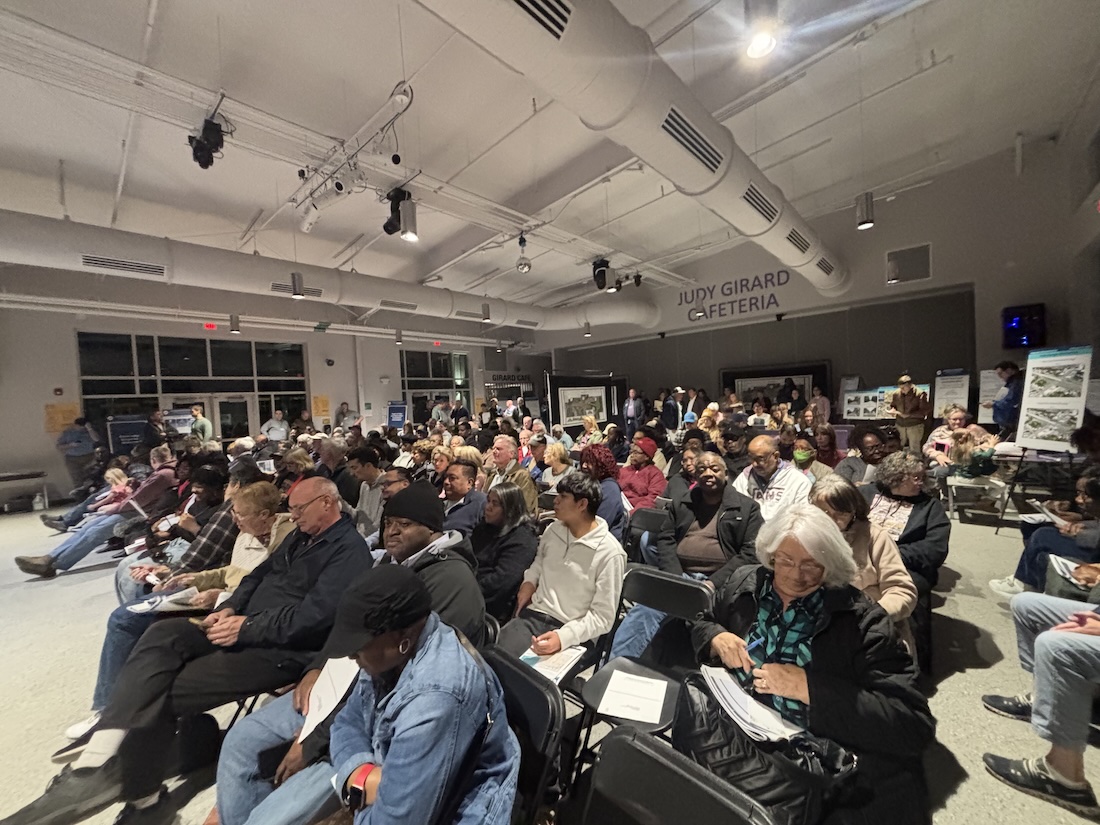
WILMINGTON — A packed house appeared before the state transportation agency at a Monday public hearing, in consideration of a project that would move traffic north and south more easily across Wilmington. The consensus for many people in attendance: The corridor extension isn’t worth the hardship placed on the shoulders of low- and fixed-income families.
READ MORE: Independence Blvd extension increases by $55M, NCDOT pushes construction to 2028
NCDOT is assessing a 1.7-mile extension of Independence Boulevard from Randall Parkway and Mercer Avenue to Martin Luther King Jr. Parkway. It aligns with both the Wilmington Metropolitan Planning Organization’s Cape Fear Moving Forward 2025 Plan and the City of Wilmington’s Pedestrian and Greenway Plan. The goal is to improve motorist mobility across the region and alleviate traffic capacity, while strengthening connectivity at Randall Parkway, Independence Boulevard and MLK Parkway.
Near Independence Boulevard and Covil Avenue, 2023 numbers show 19,000 vehicles travel daily along the road, according to NCDOT’s traffic volume maps. NCDOT expects 33,000 vehicles per day on the Independence Boulevard Extension by 2045.
Around 100 people were in attendance at Girls Leadership of Wilmington Academy, as the North Carolina Department of Transportation had representatives field questions from the public before the hearing. Two dozen or so people spoke as part of the hour-and-a-half public comment portion.
“In 50 years, we are still talking about building a road,” Joe Conyers joked to much laughter in the crowd. “Have you ever built a house without a garage? Let me tell you: Go put the garage on the house. It’ll cost more than the house. That’s what we are doing.”
Conyers, who owns three properties in the project’s vicinity, said he has been to every meeting the NCDOT has had on the project, which has been ongoing for years. Now in his 70s, he quipped the last time he attended a meeting he was 30 years old. Conyers said he had a “whole briefcase of the pamphlets” NCDOT handed out from previous meetings and reminded the audience they may not even see the project come to fruition at this pace.
According to NCDOT spokesperson Veronica Newsome, the corridor extension was placed on the WMPO Urban Area Thoroughfare Plan in 1972.
“This does not indicate when planning or design began, it means the project was included in the plan as a future project,” she said, with initiation starting in 2002 and the first public meeting held in 2011.
The project went on hold in 2014 and picked up again with some funding from the WMPO in 2016 and another public meeting held in 2018. Then it was put on hold again during the Covid-19 pandemic before picking up in 2021. A year later the extension was projected to cost around $214 million, a $55-million increase from the 2019 estimate of $160 million; construction expected by 2028.
In the last seven years, the price tag has more than doubled at $424.6 million and construction and completion timelines are yet to be determined. Insofar funding is only secured for preliminary engineering, but the project overall is to be covered with 80% federal funds and 20% by the state.
NCDOT has not finalized design concepts, though early renderings indicate an elevated roadway, greenway extensions connecting the Cross City Trail to Maides Park and new interchanges at Market Street and Martin Luther King Jr. Parkway. Two alternatives are being considered for the interchange at Market Street: one is a single-point urban interchange (SPUI), while the other is a tight urban diamond interchange (TUDI). It could consist of a majority of three 12-foot travel lanes, with two 12-foot lanes tapering at the interchanges.
Costs to construct for both options are similar, though the right-of-way acquisitions and relocations will increase with the TUDI — to require 71 residential relocations, 37 business relocations and two church or nonprofit relocations. That would affect 19 more structures than the SPUI option: 59 residences, 31 businesses and one church/nonprofit.
The majority of affected properties are located on Montgomery Avenue, 31st Street, Evans Street, Mercer Avenue, Covil Avenue, Independence Boulevard and Market Street.
Loss of property and land was the main concern shared by area neighbors who live in the path of construction. NCDOT offers fair market value for homes when eminent domain is necessary.
Landlord Lisa Moore owns multiple homes on 31st and Montgomery streets and utilized her 3 minutes — allotted to everyone who signed up to speak — to encourage property owners to continue upkeeping their homes so values are at peak. NCDOT typically won’t contact property owners with value propositions until designs are solidified.
“I think this project is something well-needed, but I think there is a lot of information that we also need,” Moore said, noting she has already been in touch with appraisers and lawyers for advice.
Ann Cathey just purchased her property on Evans Street two years ago. A nurse, she said it took everything she had to pay for a home she never thought she could afford to own.
“I’m in the middle of where this is going to take my house,” she said. “I can’t afford to go anywhere else in Wilmington. I have invested a lot in my little house and it was a huge accomplishment for me — to have something my kids will have. And I understand that you [landlords] have properties in the area, but do you live there?”
Applause erupted.
Cathey said urgency should be placed on other needs in the community, such as helping bring down crime. More so she thought the area was targeted due to being low-income.
“You’re selling these people out by saying, ‘Oh, it’ll help traffic,’” Cathey said. “I promise you that it’s not. Go to a real city and see the traffic there. People over traffic.”
Tiffany Salter, a social worker who lives on the outskirts of the project, echoed similar concerns. She was worried the impact would prevent the transmission of wealth, as the area is rife with families who own heir properties, passed down from generation to generation.
“It’s been hard-earned and continually harder to keep,” Salter said. “It’s just really important for everyone to understand that fair market value isn’t going to allow fair relocation. … Let’s talk about how we can get these people fairly relocated in their city where they belong.”
The average price for a home in Wilmington is $450,000 with a one-bedroom rental coming in around $1,400 monthly on average.
Jeff Barnhill, who lives close to the project but whose son inherited a home on Covil Avenue within the footprint of the extension, put the impact further into focus: “The average price of a home on Covil right now is $249,000.”
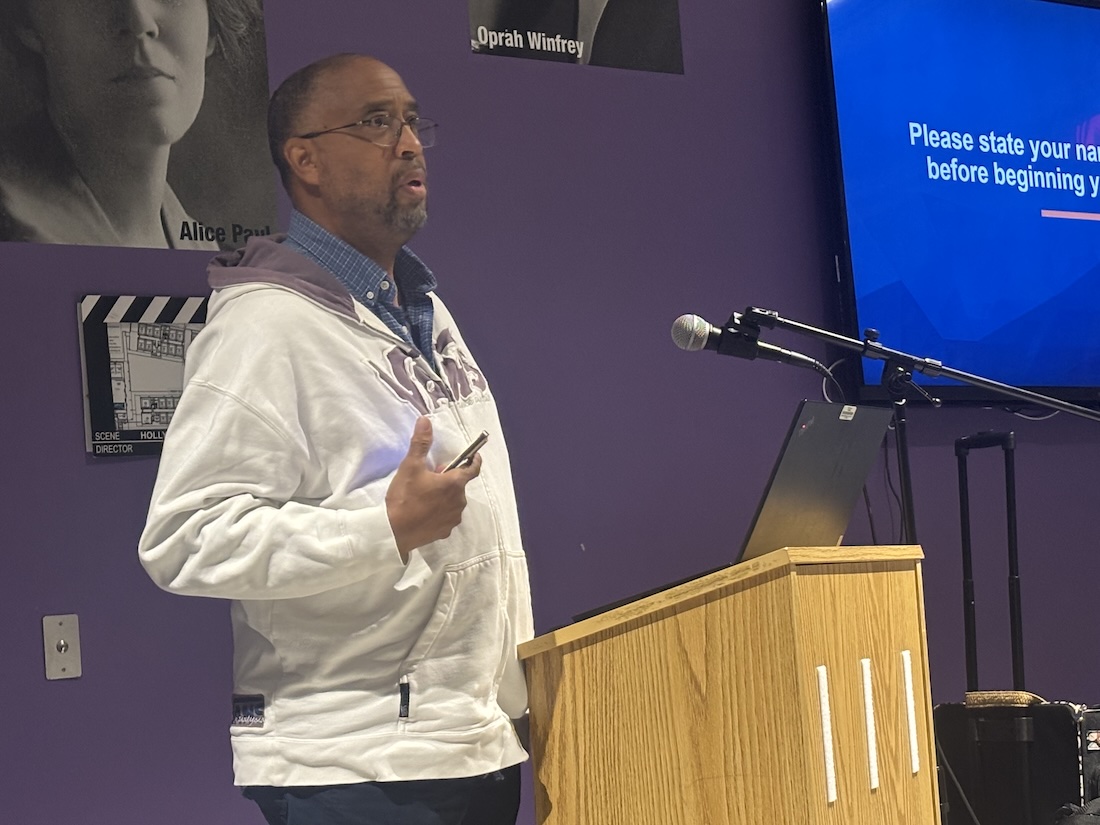
deAndré Corniffe asked if the NCDOT would help with relocation plans, such as moving elderly neighbors who can’t afford it and don’t have family to necessarily help.
Linda Goodman, now retired and who inherited her 31st Street home from her parents in the ‘70s, said through teary eyes that relocating would be impossible at her age.
“It’s not the same as being 20 years old or 30 or 40 years old and having to move,” she said. “And I’m concerned with more taxes involved. I pay enough taxes.”
Charlie Harvin added he has had an easement taken by NCDOT but still had to pay taxes on it. He thought if he’s not volunteering to sell his home, he didn’t think it would be fair to be taxed and wanted assurance that wouldn’t happen.
NCDOT spokesperson Newsome said the owner was responsible for the taxes because he retained the “fee simple title” to the property with the easement. She further explained NCDOT “pays a prorated share of taxes for the area needed and acquired under fee simple right-of-way for the tax year the property is acquired at the owner’s request. This information is provided to property owners at the closing of their claim.”
Corniffe shared the contact of a lawyer who specializes in eminent domain cases and suggested property owners understand their rights in and out to be “kept whole and not taken advantage of” through the process.
Salter added during her public comment that lawyers aren’t always an option for people on fixed incomes and neither are appraisers.
Andrea Swepson, a resident on 31st Street and speech language pathologist for the public schools, wanted to ensure fair appraisals were broached. She asked if the locals would be able to choose their own rather than NCDOT hiring out a firm to do so. NCDOT normally utilizes its own appraisers for right-of-way acquisitions.
Even if properties aren’t purchased for the project, the impact it will have on those left behind also concerned Swepson. She questioned if depreciation will be taken into consideration for homes that would be located facing a highway: “No one likes to live under a bridge.”
Calitto Grissett was dismayed that the project disproportionately affects the African-American community, a large swath of population along the corridor construction path. She said it’s not just a removal of property but of people and culture.
“They remove the decades of memories, struggle, joy, connections,” Grissett said. “When you pave a highway through a Black community, you are paving through the heart of the people. Our community is already fighting education, we are already battling unaffordable housing. We are already watching our neighbors being pushed out, and long-term residences wiped out in the homes they grew up in. … Our homes, our roots, our elderly deserve respect.”
Jamille Robbins, NCDOT’s public involvement, community studies and visualization leader, added the goal isn’t to take people’s properties if NCDOT doesn’t have to: “It saves us both money.”
Concurrently, NCDOT spokesperson Newsome told PCD the department will work with residents to keep them in their existing communities and their social support network “to the extent possible and desired.”
“Early coordination among the City of Wilmington, Wilmington Housing Authority, Wave Transit, and NCDOT relocation assistance staff will occur to identify comparable housing near transit services and pedestrian infrastructure and may be beneficial in minimizing impacts to relocated residents,” Newsome indicated. “NCDOT is committed to exploring enhanced relocation options and efforts.”
Noise mitigation was also brought up at the public hearing. Anne Seymour on Camden Circle asked if the engineers could redesign the concrete walls that will abate traffic noise and avoid disturbing the historic 1940s neighborhood, allowing neighbors to preserve its “charm.” The street consists of a circle and Seymour was concerned blueprints showing a wall would be constructed potentially cutting the circle into a horseshoe.
“Could the proposed new wall be designed, for example, to follow the curve of the circle without encroaching further on the yards of the people who are hard by the existing walls?” she asked. “I have faith in the engineers that they can design a curved-in wall that would work.”
Though cement walls protect neighborhoods from commotion, Seymour wanted assurance it would also cover increased sounds of 18-wheelers, which will then be allowed to utilize the corridor from the Wilmington Port. NCDOT has a noise abatement study underway, according to Robbins, which remains early in the process. He noted information from it will be taken up in future hearings.
Only one person outright favored the project. Bradley Cotton lives on Montgomery Avenue and said he would rather focus on what there is to gain, especially after hearing complaints at city council and commissioner meetings about overgrowth, overdevelopment and infrastructure not keeping pace.
“We’re so far behind, how can we ever get ahead, and a project like this comes knocking at our door and nobody wants to move forward with it — for obvious reasons because everyone has something to lose,” he said. “But I just think keeping projects like this in the mix and having smart growth in development is what the city needs.”
Though the goal is to help thwart overcrowded cars on Market Street and College Road, Barnhill said humans are creatures of habit — and therefore didn’t think the extension would help. It will be the fourth north-south connection in Wilmington, also including Third Street to MLK, Kerr Avenue to MLK and College Road to MLK.
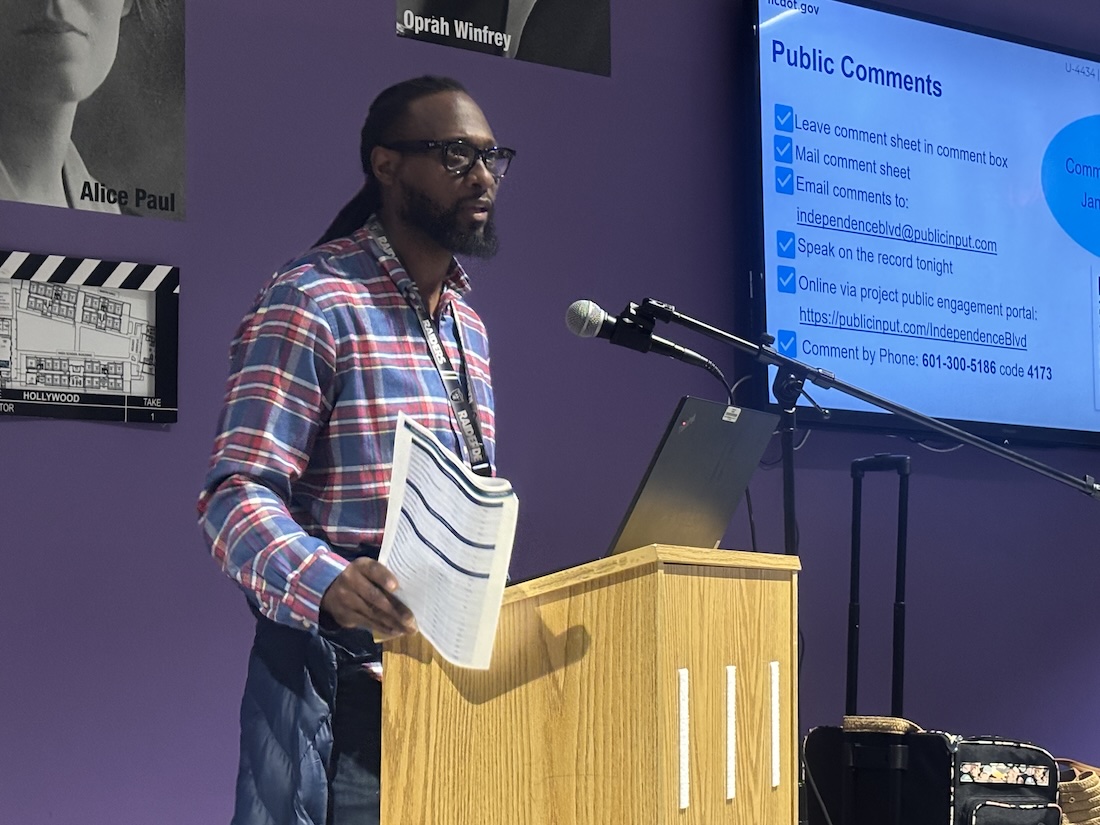
Numerous politicians were in attendance Monday as well, including commissioners Rob Zapple and Stephanie Walker, and city council member Kevin Spears. Spears signed up to speak, stating opposition with each iteration of the project. He expressed surprise that many people were resigned to just accepting it as a done deal and encouraged them instead to stand up against it and fill out a comment by NCDOT’s Jan. 16, 2026 deadline.
“I thought we had gotten rid of it,” Spears said. “Black communities, historical communities, it’s just a loss. I’m super shocked to hear a lot of you people are already cashing the check in the bank. … We don’t want this lingering over our heads another 10, 15, or 50 years. We want to kill this project now, for lack of a better term.”
Once comments close in January, the NCDOT will hold an internal staff meeting with varied branch representatives to go over feedback and respond as necessary. All of it will be weighed with the engineering needs and criteria to help determine a preferred alternative design, with a final environmental impact statement approved by the end of next year or early 2027, as long as Federal Highway Administration funding requirements are met. The right-of-way timeline is still to be determined.
“We have to look at safety, we have to look at the impacts to the human and that natural environment,” Robbins said. “We have to look at traffic service, we have to look at costs. And so we have to do all of that and do a balancing act with those competing factors to make sure that we put out the best product.”
Newsome said the NCDOT will collaborate with local agencies and the City of Wilmington to establish a community working group as well. It will be pivotal in the “development of mitigation measures, including the creation of a neighborhood plan,” she added.
Resident Sue Bullock also spoke Monday and asked DOT to consider carefully who all would be part of these groups.
“As you all know, in January, the current administration did some changing in regulations,” Bullock said. “So the former protections that you might have had under things like NEPA — the environmental protection act — are no longer in force. So it will be up to us as people in the community to work with DOT.”
At Port City Daily, we aim to keep locals informed on top-of-mind news facing the tri-county region. To support our work and help us reach more people in 2026, please, consider helping one of two ways: Subscribe here or make a one-time contribution here.
We appreciate your ongoing support.
