


WILMINGTON — Traffic, pedestrian safety and protection of people’s properties were broached at the first city council meeting of 2026.
Three resolutions passed Tuesday, Jan. 6, with one helping the improvement of two major corridors — Dawson and Wooster streets. Both roadways are due for repavement, though the winning bid exceeded North Carolina Department of Transportation’s funding coverage by $254,000 and had to be amended by council for reimbursement.
READ MORE: ‘People over traffic’: Neighbors concerned over Independence Boulevard expansion
City leaders also addressed lane reductions and safety needs to be implemented on 16th and 17th streets in the Cargo District — a growing area of businesses that also host frequent community gatherings. With more foot traffic crossing busy streets that bring in 25,000 vehicles daily, requests to improve safety measures have been sent to the city from businesses in the district. More parking and pedestrian crossings are in the works.
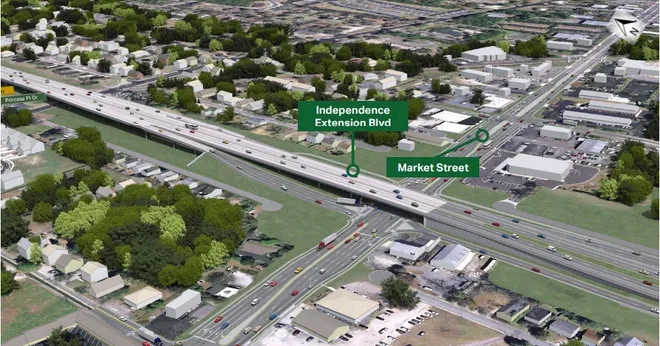
Over in midtown, along Independence Boulevard and Market Street, a 50-year project continues to be batted around to improve north and southbound-moving traffic. While previous councils have indicated support for NCDOT’s 1.7-mile extension of Independence Boulevard, that changed Tuesday, after a new council was sworn in last month.
City council unanimously approved a resolution against the Independence Boulevard extension, siding with many community members who think the project disproportionately impacts and displaces low-income and minority communities.
Below is the breakdown of three measures passed by council this week.
Independence Boulevard Extension
Planning and Development Director Linda Painter presented a resolution objecting to the Independence Boulevard Extension Project before council on Jan. 6. However, the resolution also clarifies the city will work with transportation partners NCDOT and Wilmington Metropolitan Planning Organization to find other ways to better manage traffic flow on the city’s north-south corridors.
NCDOT is assessing a 1.7-mile extension of Independence Boulevard from Randall Parkway and Mercer Avenue to Martin Luther King Jr. Parkway. It aligns with both the WMPO’s Cape Fear Moving Forward 2025 Plan and the City of Wilmington’s Pedestrian and Greenway Plan. The goal is to improve motorist mobility and alleviate traffic capacity, while strengthening connectivity at Randall Parkway, Independence Boulevard and MLK Parkway.
A Draft Environmental Impact Statement was released by NCDOT in the fall and the state department also held a community meeting to garner feedback. Public comment on the statement is open through Jan. 16.
City council last adopted a resolution in support of the project in 2014 — however, it also opposed an elevated design to buffer impacts to surrounding communities.
“The majority of the proposed extension will be elevated above grade,” Painter told council, “for the purpose of crossing CSX corridors.”
NCDOT has not finalized design concepts, though early renderings indicate an elevated roadway, greenway extensions connecting the Cross City Trail to Maides Park and new interchanges at Market Street and Martin Luther King Jr. Parkway. Two alternatives are being considered for the interchange at Market Street: one is a single-point urban interchange, while the other is a tight urban diamond interchange. It could consist of a majority of three 12-foot travel lanes, with two 12-foot lanes tapering at the interchanges.
An elevated design — required since CSX wouldn’t entertain at-grade railroad crossings, Painter said — would impact more properties. Depending on which design is chosen, the changes would mandate relocation of either 59 or 71 dwelling units, 31 or 37 business, one or two churches or nonprofit organizations, as well as impacting 78 acres of forested land, up to 3.9 acres of wetlands and 1,900 linear feet of streams.
The designs include three east-west connections — at Darlington Avenue, Hurst Street and Princess Place Drive.
Painter said the elevated design creates a “physical barrier of Old East Wilmington neighborhoods” and degrades “community cohesion.” The project wouldn’t just impact residents whose homes are included in right-of-way acquisitions but also those left behind with properties that would be adjacent to a major thoroughfare upon construction completion. This could potentially affect property values negatively, Painter added.
“It will be hard for those residents to find comparable homes,” she said, many of whom are lower income or on fixed incomes.
People who attended NCDOT’s public meeting in December spoke to this concern, many pointing out an average home price in Wilmington is $450,000, while their homes on Covil or Mercer avenues, 30th and Evans streets average $230,000.
Thus, city staff believe the project disproportionately impacts title six populations of the Civil Rights Act — in place to protect people from discrimination, based on race, color, and ethnicity.
“The benefits and burdens are not equitably distributed,” Painter said, expressing how motorists looking for a better north-south connection are the ones who will reap the rewards most. “We need to work with WMPO and NCDOT to find alternative solutions for north-south travel.”
Mayor Pro Tem Kevin Spears, who grew up in the project area, attended NCDOT’s public meeting last month and spoke against it. He reiterated opposition Tuesday.
“I’m shocked that even in 1972 this was a thing,” he said, pointing to the NCDOT’s ongoing discussions of the extension for 50 years.
Council member David Joyner wanted to ensure the money hasn’t been put forth in the STIP — NCDOT’s 10-year capital plan that identifies and schedules funded transportation projects. Painter confirmed it isn’t.
Full funding for the Independence Boulevard project comes in at $424.6 million, with 80% covered by federal funds and 20% by the state. Only money for preliminary and engineering designs are in place by NCDOT — construction and completion timelines haven’t been determined either. Though scoring for the project to be funded is expected by spring.
Painter said the project is listed on WMPO’s top six priorities but thought the city should ask for its removal, which also appears in the resolution.
“This is not something we want to see advance,” Joyner said. “Also we need to say what we’re for and not just what we’re against. What connectivity do we want on the north-south corridors?”
Spears added NCDOT and WMPO have been open to discussing other ideas, while Painter included there are projects the city may choose to promote to manage congestion for north-south travel. It could include looking at changes along Kerr Avenue and North College Road.
“But we don’t need to destroy communities to make this happen,” Spears said.
The resolution passed unanimously
Cargo District pedestrian safety improvements
NCDOT also has plans to reduce lanes on 16th Street, as well as improve pedestrian walkways. It has requested city council’s support.
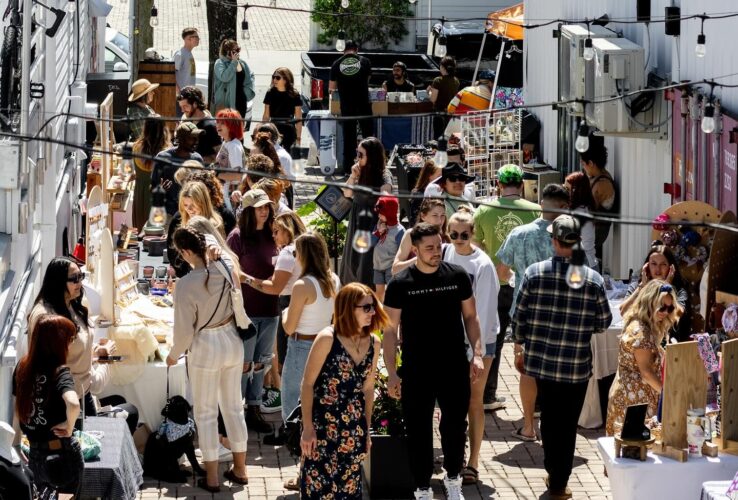
Foot and vehicular traffic has increased in the Cargo District as people cross 16th and 17th streets to dine, shop and mingle at area restaurants, retail businesses and bars. In the last five years, more than 80 businesses have opened in the district. The hub of the Cargo District is located at Castle, Queen, 16th and 17th streets, though it extends from 15th Street west to Delgado Square on Wrightsville Avenue.
Because of increased patronage to the area, businesses have reached out to the city asking for improvements on pedestrian safety and parking.
City council agreed to a proposal to decrease vehicle travel lanes from three to two on 16th Street in one block — from Castle to Queen streets.
Currently, 16th Street is primarily a two-lane road from Princess Place Drive until it crosses Castle Street. With the changes, the lanes will widen again to three once vehicles approach Wooster from Queen Street.
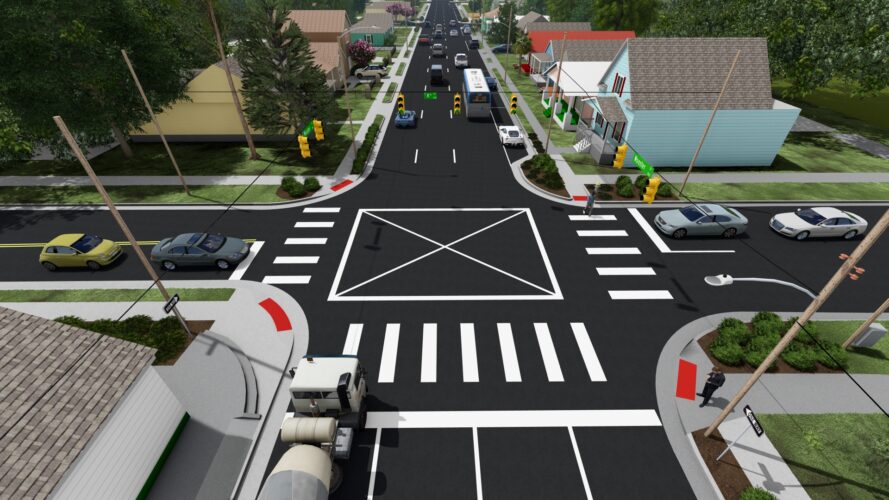
The city’s traffic engineering department also worked with the state transportation agency in the last few months to address pedestrian safety. It plans to raise concrete curb extensions at intersections, improve crosswalk markings at 16th and Castle streets and 17th and Castle streets, as well as install pedestrian signals.
“These modifications support the City of Wilmington’s ‘Vision Zero’ strategies to eliminate fatal and serious injury crashes, frequently consequences of crashes involving pedestrians,” City Traffic Engineer Denys Vielkanowitz told council.
Cassidy Santaguida, one of three new council members, favored the plan: “I travel this road daily. There are a lot of folks crossing here.”
However, she wanted to know why a pedestrian crossing wasn’t included at Queen and 16th streets, which she thought was needed due to frequent walkers moving from CheeseSmith or Starling Bar to the Cargo West Food Court and Azalea Station.
“It’s one of NCDOT’s standards that they don’t typically mark pedestrian crossings where there are not pedestrian control signals,” Vielkanowitz said. “They don’t want to encourage somebody to just step down into traffic unless there is a pedestrian control.”
He added a traffic signal analysis would have to be conducted to warrant putting a signal at the intersection.
During discussion of Independence Boulevard, newly minted council member JC Lyle said she was pleased to see the city concentrating on the safety of its people.
“For decades, we have built our city around roads, for cars,” she said. “These last two resolutions honor that the city is built for human beings and neighborhoods.”
The resolution passed unanimously.
Wooster and Dawson streets repaving
Engineering Project Manager Kyle Burden presented to council an ordinance to increase the amount of money NCDOT will be required to reimburse the city for repaving and milling Wooster and Dawson streets.
The two streets are major corridors in and out of Wilmington, to and from the Cape Fear Memorial Bridge, which draws in more than 50,000 vehicles daily. Burden called it “an area in need of investment” primarily to help increase pedestrian mobility, create a safer environment for vehicles and pedestrians, and improve aesthetics of the thoroughfare.
$1.9 million was originally approved as part of NCDOT’s portion to cover the project, but the resolution states it will cover up to $2.1 million. The two streets are under the state transportation authority’s purview so while the city will put forth costs upfront, funding covered by NCDOT is repaid to the Streets & Sidewalks Capital Projects Fund.
Last fall, the city approved an ordinance and resolution allowing the city manager to enter the agreement with DOT. The city awarded the bid in September, which escalated by $254,000.
The resurfacing will be constructed as part of the Dawson and Wooster Streetscape Project, which also includes reducing travel lanes from four to three on Dawson and Wooster to allow for on-street parking, making pedestrian and ADA improvements, and filling in sidewalk gaps, among other priorities. The overall $5.6-million streetscape was approved in the 2014 Transportation Bond. Construction is slated to begin in February and will take 12 months to complete.
The repaving portion includes Dawson and Wooster streets between Third and 17th streets and part of 16th and 17th streets.
Council passed NCDOT’s supplemental funding appropriation unanimously.
Have questions and tips? Email [email protected]
At Port City Daily, we aim to keep locals informed on top-of-mind news facing the tri-county region. To support our work and help us reach more people in 2026, please, consider helping one of two ways: Subscribe here or make a one-time contribution here.
We appreciate your ongoing support.
