


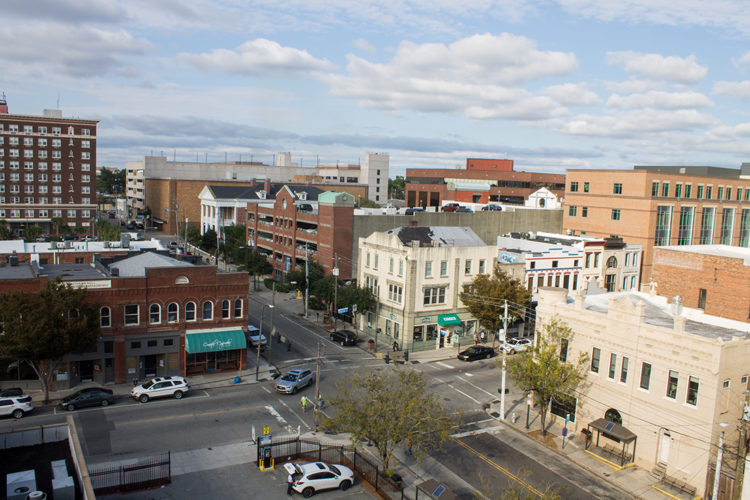
WILMINGTON — Who is downtown Wilmington for and what is its aim? That’s the question the recently finished Greater Downtown Plan aims to broadly answer, though the Wilmington Planning Commission expressed some skepticism during the finished plan’s debut on Wednesday.
The Greater Downtown Plan is intended to outline strategies to address growth and resident concerns in all 18 downtown neighborhoods extending from the waterfront to Carolina Place to Greenfield Lake to the Northern Riverfront area.
READ MORE: Wilmington city manager settles on 5.75-cent increase in budget recommendation
Through four identified pillars and accompanied by goals and action steps, the plan promotes increased housing, better mobility, vitalizing the downtown economy with small businesses and neighborhood services, and using public spaces for community good and events.
The city conducted other small area plans in the 2000s, such as the Northside Community Plan, though the current one, according to the city, is the “first comprehensive effort to establish a cohesive vision for the City’s central core.”
In conjunction with a consultant and a steering committee, the city’s planning department has been gathering public feedback from more than 6,000 residents over two years before releasing its draft plan earlier this year. The Wilmington Planning Commission heard it at Wednesday’s meeting.The commissioners commended staff for their work. Though they didn’t contest the majority of the proposal, there were some qualms raised, including how staff parsed out resident feedback versus non-resident responses.
“If I don’t live in the city, it’s very easy for me to tell the city how I think they should spend their money,” Commissioner John Lennon said.
According to the city, staff only collected demographic information in its phase 1 and phase 2 surveys; in both rounds, around 40% of respondents were City of Wilmington residents and 20% Greater Wilmington residents. Of the Greater Wilmington residents, 47% were white, 43% were Black and 5% were Hispanic or Latino; compared with the demographics of total survey respondents, 84% were white, 5% were Black and 4% were Hispanic or Latino. Additionally, 34% were aged 45 to 64, 22% were 25 to 34 and 20% were 35 to 44.
Port City Daily asked the city if staff believed the community feedback captured a significant diversity of age, race and class but did not receive a response. Previously, a spokesperson pointed out the project team used in-person event locations to reach underrepresented groups. Staff conducted focus groups and open house events across greater downtown, including at the Azalea Festival, Northside Food Co-op Community Dinner and the Food Bank of Central and Northern North Carolina.
Commissioners’ discussion of the demographics raised the question: Who is downtown for? Is it more important for the plan to represent the desires of people who live downtown or the city as a whole? Because, as Commissioner Jack Pollock pointed out, the entire Wilmington citizenry will be strapped with any additional expenses that the plan incurs.
“How do we make that sale?” Pollock asked. “How do we make it relevant to them so that this doesn’t become a barrier to not coming downtown? And, again, it’s not just for people who live downtown; it’s for people that come downtown, spend money and then go home.”
Port City Daily asked if the city plans to ensure similar investments targeted for downtown Wilmington — affordable housing, walkability, parks and events — are also made in other parts of the city.
A spokesperson said the city’s next large-scale planning effort will be to update the city’s comprehensive plan, which spans the entire city limits. Other small-area plans are slated to come after.
Spokesperson Amy Willis said the input received as part of the Greater Downtown Plan is “consistent” with feedback received during the Create Wilmington Comprehensive Plan.
“We anticipate that the themes identified through this process will be reiterated as we return to the community to update that plan, as well as in future neighborhood and small area plans,” she added.
Additionally, several areas of the Greater Downtown Plan suggest an action step to create another plan. For example, one strategy is to develop a “district plan” for the Northern Riverfront area, where there are several vacant parcels, some owned by the city.
The city’s response was the Northern Riverfront Plan was at the top of the list, but other focus areas will be developed “based on need and staff capacity.”
No positions or additional funding specific to the Greater Downtown Plan has been included in the city manager’s recommended 2026-2027 budget, presented to council earlier this month.
Because of the lack of guaranteed action steps with funding behind them, Commissioner Pollock took issue with calling the Greater Downtown document a “plan.”
“This is a statement of aspirations,” Pollock said.
Nonetheless, the Greater Downtown Plan will go before council for approval at an upcoming meeting. The full plan can be read here.
The following are highlights from each of its four pillars: mobility, local character, economy, and small business.
Mobility
Making downtown Wilmington a place where it’s “easier, safer and more pleasant to get around” ranked among the highest priorities for city residents.
The city has already taken some steps outlined in the Greater Downtown Plan, including embarking on the Vision Zero initiative last year. The program’s goal is to reduce traffic fatalities to zero through various traffic calming measures and educational elements; last week, the city hired an engineer to head up the effort.
The Greater Downtown Plan expands further, noting its strategies are to improve walking and biking on key streets, like in the Northern Riverfront and Central Business districts.
Another goal is to build an interconnected trail network, including the long-planned Downtown Trail, a multi-use path that would connect neighborhoods to downtown. Expanding the Riverwalk and connecting to Greenfield Lake is another priority, along with a future trail for Wilmington’s Southside using existing freight lines, per the completion of rail realignment.
The plan also wants to make downtown accessible without a car, emphasizing a “park once and explore strategy.” It would most likely require the expansion of off-site parking lots, shuttles with designated drop-off zones, and bike racks or a bike share program. The plan specifically mentions discussing a shuttle option with Wave Transit.
Wave already operates the downtown trolley on Front Street between Padgett Station and Castle Street. However, the service is seasonal — non-operational in the winter — and only provides a 30-minute service, both obstacles to consistent reliance.
Port City Daily asked the city if it plans to request an increased frequency for the trolley.
The city maintained it would continue its partnership “with Wave Transit and other organizations to create a shuttle service that connects emerging commercial districts across Greater Downtown.”
During the planning commission’s meeting last week, Pollock indicated mobility needed to be examined from a city-wide and regional perspective; he asked if the city had considered rail options, shouting out the City of Norfolk’s light rail as an example.
“Can you get from here to Wrightsville Beach by some semblance of public transport?” Pollock questioned. “Those are things, when you talk about mobility, I’d ask you to, you know, flesh it out.”
Painter said restoring a trolley line to Wrightsville Beach is part of the city’s comprehensive plan, but when it comes to rail transit, population density and the high demand on a bus system are key indicators for light rail’s success.
The plan notes the greater downtown area averages around 5 residents per acre, while the national average is closer to 13; estimates for viable population densities to make rail options financially feasible are closer to 30 to 50 residents per acre. According to research from Rice University, the most successful light-rail systems in the United States — San Francisco, Boston, Philadelphia, Seattle, Newark, Jersey City, Buffalo, and Houston — serve large areas of over 10,000 people per square mile.
The plan gives timeline goals on addressing each strategy listed from 1-to-2 years to 5-to 10-plus years and notes the immediate priorities (the 1-to-2 year category) in mobility are:
- Improve signs and maps for parking and getting around
- Help service workers get to work affordably
- Pilot temporary street closures for pedestrians
- Expand and protect the city’s bike rack program
Local character
Much of the Greater Downtown Plan’s local character pillar focuses on improving and expanding green space, as well as utilizing vacant space for the public good. Both include improving sidewalks, lighting, street crossings, benches, playgrounds and the like. The city would also like to establish more public art in downtown spaces and plant more trees.
In addition, the city is looking to promote more events and programs in its current spaces, with a focus on Portia Hines, Archie Blue and the Northside areas. Establishing a parks conservancy is a priority to conduct programming and host sports, events, and activities in the public spaces, such as farmers markets, fairs and markets, outdoor movies and community gardens.
The local character pillar also makes suggestions for preserving and promoting the downtown area’s historic look and feel. One strategy is to launch an incentive program to promote the reuse and rehabilitation of older buildings.
Also suggested exploring the use of a form-based code for new development in the area. A form-based code is an approach to land-planning that focuses on the physical appearance of buildings and how it interacts with the public realm, emphasizing walkable urban areas and block structures.
Form-based codes contrast with traditional approaches to zoning that separates land uses in different areas; while helpful when needed to keep heavy industrial uses away from housing, modern cities have moved away from industry and form-based codes that allow cities to be less restrictive on different uses — like multi-family housing — and regulate how the buildings affect the surrounding environment.
The plan suggests a form-based code be explored only for the National Historic Register District or properties currently zoned urban-mixed use, not the entire city. Because establishing a different approach to zoning would affect many parts of the Greater Downtown and comprehensive plans, Port City Daily asked the city if the form-based code analysis was an immediate priority.
A city spokesperson said it would be enacted through land code amendments in phases, not an overhaul.
Regarding staff experience and additional expertise needs to switch to this approach, the city said the current land code includes some form-based elements so many staff already are familiar. Additionally, Painter was part of a team that developed and implemented a form-based code for the redevelopment of the Naval Training Center in Orlando, Florida.
Strategies identified to occur in the 1-to-2-year mark include:
- Offer more activities and amenities in parks
- Make historic homes easier to own and maintain
Economy
Much of the housing components in the Greater Downtown plan fall under the economy pillar; strategies include helping more people stay in their home and greasing the pathways for more home construction.
Despite the citywide population growing by more than 100,000 since 2016, the downtown population has remained relatively the same over the last decade at around 16,000 residents. However, in both the Northside and Southside neighborhoods, the number of nonwhite residents has dropped sharply — as much as 34%.
Additionally, to reach the national average of population density in downtown areas, Wilmington’s greater downtown would need to add 8,600 more people.
Under the local character pillar, the plan notes the Northern Riverfront area should be the focus for larger and taller new developments. In the economy pillar, the approach to advancing new housing is to reduce barriers to “middle missing” housing — townhomes, duplexes and other infrastructure between apartment complexes and single-family homes.
Strategies include examining zoning barriers and hosting a “design competition” to incentivize missing middle housing that’s also cohesive with the look of downtown.
Port City Daily asked the city if it believes it can achieve a higher density citywide with only taller developments in the Northern Riverfront.
The city’s response: “While the plan focuses on directing larger and taller developments to the Northern Riverfront area, it also identifies other approaches that can increase overall density, such as removing barriers to missing middle housing and expanding the UMX district to accommodate additional density along our major corridors. The plan focuses on ensuring that new density is located in appropriate places and that when new development is located in established neighborhoods, it is consistent with the neighborhood’s look and feel.”
The other major component of the economy pillar is promoting neighborhoods that meet everyday needs, not just restaurants or shops geared toward tourists. It also points to the use of publicly owned land to facilitate the needs.
One goal includes easier access healthy food. The action steps include updated zoning to allow for the proliferance of corner stores, supporting pop-up farmers’ markets, incentivizing community gardens and supporting food access programs and partnerships.
Commissioner John Lennon asked how staff balances these “aspirations” with market conditions: “There’s not a grocery store downtown for a reason … it’s the market.”
The Greater Downtown Plan notes the city will “keep working to make a downtown grocery store a reality” and states the city should explore dedicating publicly owned property to establishing a full-service grocery store.
The downtown area, particularly the Northside, has been a food desert for many years; the city and county also partnered on a project to open a co-op grocery store on city land at 10th and Post streets in partnership with the Northside Food Co-op. However, the deal fell apart amid the city’s plans to sell one its Chestnut Street properties to become a big-box grocery store.
Cape Fear Development agreed to purchase three Chestnut Street properties under a restrictive covenant mandating a grocery store be opened on site, but it fell through. Port City Daily asked the city if the restrictive covenant remained.
A spokesperson indicated the government entity is “pursuing a master downtown plan to ensure the city is using its holdings in the most strategic way that benefits the city’s future needs.”
However, the downtown plan does not make specific mention of the property. Similarly, staff suggested the location of a council-approved homeless shelter be discussed as part of larger facility needs, including the Greater Downtown Plan, though the plan does not bring up this item either.
Instead, it suggests the city create a strategy for public land with a timeframe of 2-to-5 years. The economy pillar’s short-term goals include:
- Help more people access existing housing programs
- Update zoning to reduce barriers to “missing middle” housing
- Support mixed-use zoning, infill, and redevelopment
Small business
Though a less robust pillar than the others, the small business needs focus on facilitating a thriving economy in the downtown corridor. There are three main goals: make businesses more attractive and welcoming, support existing businesses and attract new ones, and make local rules and regulations more business friendly.
Action items include improving the pedestrian experience in downtown to help people discover and access small businesses easier. The city also wants to engage with merchant and district groups to support their goals and help them navigate planning and permitting. A major component of this pillar is the city’s desire to create a business recruitment plan.
As for easing regulations, the city is looking to reduce zoning barriers to local makers and artists that may be currently limited to industrial zoning. The plan also indicates a desire to make it easier to test new business ideas through pop-ups and mobile ventures, while also simplifying the process for opening a business.
All goals listed under the economy pillar are noted in the timeline as 1-to-5 years. The sub-2-year efforts include:
- Support business district efforts.
- Attract and keep businesses that offer a range of goods, services, dining, and entertainment
- Ensure zoning regulations support local makers and artists
Overall, some commissioners, including Lennon and Danny Adams, expressed concerns about the plan handcuffing the city into rejecting certain businesses or proposals that don’t fit the Greater Downtown Plan’s mold.
Painter reminded the document is policy but not regulation.
“Just like you do with the comprehensive plan, you’re balancing those different policies with every application that comes before you,” she said.
At Port City Daily, we aim to keep locals informed on top-of-mind news facing the tri-county region. To support our work and help us reach more people in 2026, please, consider helping one of two ways: Subscribe here or make a one-time contribution here.
We appreciate your ongoing support.
