


WILMINGTON — A new proposal to reduce traffic fatalities in Wilmington came across council’s dais Monday, though concerns were raised over the money required for implementation.
READ MORE: City to explore using its property for homeless shelter after approving camping ban
City staff presented Vision Zero, a program designed to reduce traffic fatalities to zero through various traffic calming and educational elements, at Wilmington City Council’s agenda review meeting.
Since January 2025, nine people have been killed in Wilmington car crashes, six of them pedestrians and one a bicyclist. New Hanover County ranks third among North Carolina counties in crashes resulting in injury, whereas in 2019, Wilmington ranked third in the state for bicycle accidents, topped only by the much bigger cities of Charlotte and Raleigh.
“Vision Zero is the idea that it doesn’t have to be this way, that instead of looking at traffic deaths being inevitable, we approach it as traffic deaths being preventable,” Lina Painter, director of planning and development, said.
Essentially, Vision Zero advocates for a shift in focus from reducing crashes to acknowledging crashes will happen and, therefore, efforts should be made to make the system more forgiving. These strategies include reducing speed limits, designing roads in ways to reduce collisions, and ensuring emergency responders can reach crash sites as quickly as possible. Several cities, including Hoboken, New Jersey, and Austin, Texas, have implemented strategies of Vision Zero and seen success in reducing traffic fatalities.
The plan for implementation in Wilmington starts with a council resolution allowing the city to hire positions, like a transportation planner, and begin data collection. Community engagement would begin in spring 2026, with a draft plan and cost estimates coming in summer or fall 2026.
The city would drum up the funding from its motor vehicle tax, which it increased from $5 to $25 in the 2024-2025 fiscal year. The tax generates $1.8 million annually. This money can only be used for work on city, not state-owned, roads. City staff also noted it would pursue grant opportunities.
Council member Luke Waddell asked if both sources would take care of the entire cost, thus not requiring input from the capital improvement plan. Painter said smaller installations of stop bars and crosswalks could be handled within the department’s operating funds, but larger projects would likely be a CIP project.
“Our CIP is stretched pretty doggone thin,” Waddell responded. “We took a hatchet to it last year.”
Council approved a five-year CIP in 2024 inclusive of more than $100 million in improvement projects, transportation and stormwater management infrastructure making up 80% of the plan. The plan was whittled down from an estimated $487 million in capital funding needs, with city staff recommending the use of cash on hand for smaller projects and saving debt service for larger needs.
During this year’s budget cycle, several council members expressed a desire to cut down on the projects within the CIP and focus on accomplishing them before their costs rose due to inflation. The current budget includes $30.5 million for capital needs.
At a budget meeting in April, Mayor Bill Saffo suggested the $1.8 million generated by the motor vehicle tax be put toward the CIP. When the tax was increased the previous year, staff’s intention was to utilize the funds for a traffic calming program but failed to find engineers to run the program in the year since approval.
The former city manager, Tony Caudle, then brought up the idea of bringing forth transportation-related CIP projects. He was hesitant to apply the money to the entire CIP because of its restrictions on the types of projects it could be used for. Still, Saffo didn’t like how the new program would most likely require a consultant and the time it would take to put together a plan.
On Monday, it was Waddell questioning the need for Vision Zero’s two additional engineers, noting he, Saffo and councilmember Charlie Rivenbark, members of the ad hoc transportation committee, have been advocating for smaller solutions, like line painting on the road and chicanes, or S-shaped paths designed to reduce speed.
“I believe that the conversation previously was to move forward with the projects, but the staff positions were not approved,” city manager Becky Hawke said. “That’s difficult to do with the workload that other staff has and not having the specialized expertise to be able to direct this work and get it moving.”
Waddell fired back: “So we cannot paint lines on roads with the staff that we currently have?”
“The issue isn’t that we can’t paint the lines on roads, it’s that we need the work to know where to paint the lines on the road,” Hawke replied.
Waddell then said he’d be happy to “send an email” to staff with “some lines that could get painted on the road” after the meeting.
Councilmembers Rivenbark and Kevin Spears both expressed some hesitation on the program, Spears asking how much the engineers would be paid. Staff was unable to provide an exact figure.
Rivenbark’s concerns were more about the effectiveness of traffic-calming devices.
“We went through this all those years ago, when they were in vogue, and then they went out of vogue, and people wanting them to get up out of their neighborhoods; the emergency vehicles didn’t like them,” Rivenbark said. “And so it looks like we’re just going right back to some of the same things … streets are made to move cars.”
He also described the danger of motorized bikes and similar transportation modes on city streets.
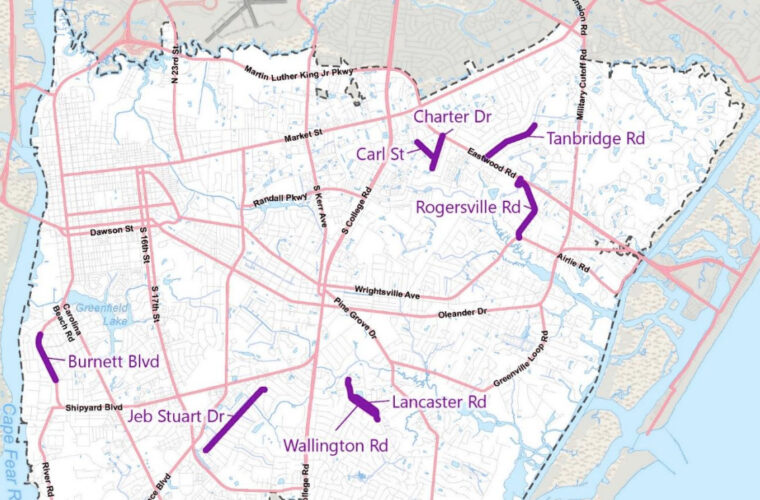
Despite the concern, staff presented an update on some traffic-calming techniques they have already put together and mapped onto for seven areas of the city. Speed humps would be installed on the following streets due to their long call history of accidents and lack of sidewalks:
- Rogersville Road
- Tanbridge Road between Eastwood Road and Wells Road
- Charter Drive
- Carl Street
- Jeb Stuart Drive
- Wallington Road/Lancaster Road
- Burnett Boulevard
“Even though some of them may look like through-streets, look like they get you from point A to point B a little quicker or shorter or easier, we still have to recognize that this a neighborhood,” traffic engineer Denys Vielkanowitz told council.
With the goal being a speed hump every 350 feet, Vielkanowitz said staff have identified 56 to 57 speed humps to be installed in-house at a cost estimation of $280,000 to $300,000. Instead of them being 3-foot bumps, the design is a 6-foot ramp with a 10-foot platform, then a 6-foot ramp down.
Rivenbark asked if the fire department had been consulted.
“They’re on board with this pilot program to reinstall speed humps,” Vielkanowitz said. “We have selected roads that are not on their priority routes.”
Vielkanowitz said the speed hump installations would be complementary with Vision Zero, should the council choose to move forward with that project. Both Vision Zero and staff’s speed hump plan are scheduled for a vote on Tuesday at council’s regular meeting beginning at 6:30 p.m.
Reach journalist Brenna Flanagan at [email protected].
Want to read more from PCD? Subscribe now and then sign up for our morning newsletter, Wilmington Wire, and get the headlines delivered to your inbox every morning.
