


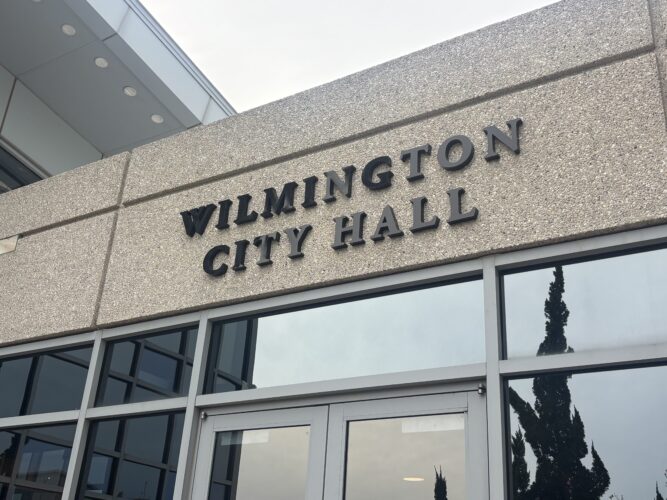
WILMINGTON — A recommended budget with a 14.3% increase is before the Wilmington City Council, though some members at the dais expressed concern Tuesday over the high jump.
In her first budget proposal since being hired, City Manager Becky Hawke’s recommendation includes a 5.75-cent tax rate increase. The council didn’t vote on the budget; it will have another budget session next week before a public hearing is set to occur on May 19.
The new rate of 34 cents would generate $43.73 million in additional revenue to implement a living wage for city employees, respond to inflationary pressures and public safety needs, and cover budgetary increases, including for Wave Transit.
Hawke explained the city has maintained a “conservative approach” to its tax rate over the last few years compared to the tax base’s ability to pay. Staff measured untapped revenue potential around $20 million until last year’s property revaluation, where it now is estimated at $75.9 million.
“There is a lot of capacity in the tax base to be able to afford the tax rate we are proposing,” Hawke said.
However, she noted staff was not “immune” to the impact on property owners.
A 5.75-cent increase would result in the following property bill increases for a home valued at:
- $250,000: $144 annually, $12 monthly
- $445,000: $256 annually, $21 monthly
- $800,000: $460 annually, $38 monthly
While Hawke described the increases as “relatively low,” Mayor Pro Tem Kevin Spears asked for the city to ensure the public knows the city tax is in addition to county property taxes; New Hanover County commissioners are not currently planning on a tax increase.
The largest budget increase will come with the living wage proposal — which would ensure all city employees make at least $45,531 annually, or 60% of Wilmington’s median income. It will have a total annual impact of $16.7 million, though only $14.2 million would come from the general fund.
However, many of the employees reaping the benefit of the living wage would be first responders. Coupled with $2.2 million in public safety investments, like mental health services and lighter turnout gear, public safety makes up 73% of the tax increase.
Hawke shared the Wilmington Police Department has around 40 vacancies currently, while the fire department has nine. While intended to increase recruitment and retention citywide, the living wage is aimed at especially doing so for first responders, who tend to see higher levels of burnout.
A higher wage, posited Hawke, would also attract more experienced officers to the city, allowing the department to see track records before hiring and relying less on fresh recruits, who take up to a year to certify.
Hawke said in her capacity as manager for the Town of Mathews, staff implemented a living wage and did not see a resignation for 18 months.
“It was transformative,” she said.
Also contributing to the budget increase is $642,000 in additional funding to Wave Transit, $400,000 of which will go toward ensuring full implementation of the Wave Reimagine Plan without having to reduce route frequency. Four routes in the new plan, which went into effect in January 2025, struggle to maintain on-time performance; the additional funding will allow Wave to add buses to the routes. New Hanover County is also planning to contribute $400,000 to the effort.
The recommended budget also accounts for $6.6-million in rises to health insurance, retirement contributions, utility costs and the like. About half a cent of the tax increase will be dedicated toward debt service on the city’s $31-million capital improvement plan.
The budget increases are on top of the city’s inability to rely on the same amount of property tax and sales tax revenue.
Hawke explained, due to recent international unrest and economic uncertainty, the city is budgeting a smaller growth in sales tax revenue: 2.5% for the next fiscal year compared to the 3.6% estimated for the current year.
The recommended budget also only includes a 0.79% increase in property tax revenue growth, compared to 1% or 2% in prior years. Hawke said this was due to the lack of available land to develop in the city, as well as a higher number of tax appeals the city is seeing.
Council didn’t give a lot of feedback on the recommended budget Monday. Port City Daily reached out to each council member asking for their thoughts; council members Cassidy Santaguida, David Joyner and Salette Andrews were the only ones to respond by press.
All three indicated the needs identified in the budget were legitimate, specifically the compensation plan for frontline employees.
“Since being elected to City Council in 2023, I have been frustrated at our difficulty fully staffing every department — in particular WPD,” Joyner said. “The push to bring every entry-level position up to a living wage not less than 60% of Area Median Income is one of the most important parts of our strategy to recruit and retain top talent. We are no longer going to follow the county or neighboring municipalities in the labor market.”
Santaguida pointed out the need to complete the capital improvement plan, which includes many long-ago approved projects yet to be finished. Joyner said it was his top priority.
While Joyner didn’t explicitly comment on the proposed tax rate increase, both Santaguida and Andrews said they weren’t completely comfortable with the 5.75-cent increase.
“The proposed tax rate increase is larger than what I see as ideal, so I’ll be spending the next ten days going through the budget with a fine tooth comb to make sure we pass a budget that makes the best possible use of tax-payer dollars while providing the services residents need and expect,” Santaguida said.
Andrews said this budget cycle has raised questions about how the city and the state as a whole frames budget discussions. Per state law, municipalities must publish a revenue neutral rate after each revaluation; last year, several locales sought to set the tax rate at revenue neutral, meaning the rate needed to bring in the same funding as the year prior, despite having increased needs.
“By moving from 42 cents to 28.25 cents last year, we may have created a fiscal cliff by not gradually capturing some of the natural growth in our tax base, only to come back one year later asking residents for one of the largest tax increases in recent memory,” Andrews wrote.
The council member questioned whether local governments making revenue neutral a “political goal” creates “unnecessary volatility” in the budget process.
Andrews shared several questions she wants to get answered before voting on the budget, including:
- What measurable outcomes will taxpayers see in exchange for this increase, and how will Council track those results over the next year?
- How much of the proposed capital funding is for new projects versus cost overruns on projects already approved?
- Were all options for smoothing this increase fully explored, including reserve strategies or phased implementation?
Council’s next budget session is scheduled for May 15.
[Ed. Note: A previous version of this article stated the budget’s property tax increase was 14.3%; this number actually refers to the overall increase in the budget. PCD regrets the error.]
At Port City Daily, we aim to keep locals informed on top-of-mind news facing the tri-county region. To support our work and help us reach more people in 2026, please, consider helping one of two ways: Subscribe here or make a one-time contribution here.
We appreciate your ongoing support.
